What Is Attribution Modeling A Guide for E-Commerce

Attribution modeling is simply the rulebook you create to give credit to the various marketing touchpoints a customer encounters before they decide to buy. It’s how you figure out which efforts—your ads, emails, or blog posts—are actually pulling their weight and driving sales.
The goal is to scale without dubious shortcuts and without hurting your credibility.
Think of it like a detective story. A sale is the final scene, but you need to retrace all the clues and interactions that led the customer there. It wasn't just one thing; it was a series of events.
Why Every Sale Has a Backstory
Let's walk through a typical customer journey. A shopper might first stumble upon your product in a TikTok ad, forget about it, then see it again in a Google Shopping search a week later. A few days after that, a retargeting ad on Instagram finally seals the deal.
So, who gets the credit? The TikTok ad that planted the seed? The Google ad that provided the info? Or the Instagram ad that was the final nudge? This is the core question attribution modeling helps you answer.
If you don't have a system in place, you'll almost certainly default to what's easiest: giving 100% of the credit to the very last click. That’s a huge mistake. It’s like crediting only the player who scored the final basket for a championship win, completely ignoring the assists, blocks, and defensive plays that made it possible.
Understanding the Customer Journey
Great marketing attribution recognizes that every customer's path is different and almost always involves multiple steps. If you want to spend your marketing dollars wisely, you need to understand the whole story, not just the last page. A solid grasp of What Is Attribution Modeling is non-negotiable for any e‑commerce brand serious about growth.
Getting this right pays off in several big ways:
- Smarter Budget Allocation: You can confidently shift your budget to channels that actually influence buyers, not just the ones that happen to be the last stop.
- Improved ROI: By seeing the full journey, you can fine-tune your marketing mix for maximum profitability and cut spending on channels that aren't contributing.
- Clearer Performance Insights: You get a much more accurate picture of how different campaigns and channels work together to create a customer.
Attribution modeling isn't just about assigning credit; it's about understanding the narrative of your customer's decision-making process. It reveals the conversations your brand is having with people before they ever add an item to their cart.
This concept has been around since the 1950s, but digital marketing’s data overload made simple last-click models the go-to solution for years. Early on, over 70% of digital marketers relied on this method. The problem? Later studies showed that this approach could undervalue top-of-funnel, awareness-driving channels by as much as 50%. This glaring gap is precisely why more sophisticated models became necessary.
Understanding the 6 Core Attribution Models
To really get a handle on attribution modeling, you need to understand the different "rulebooks" you can use to assign credit. Each of the six core models offers a unique perspective on the customer journey, highlighting different touchpoints as the most valuable. Think of them as different camera angles on the same play in a game—each one shows you something important, but none of them show you the entire field at once.
Let's make this tangible by following a single customer journey. Imagine a shopper named Alex buys a $100 pair of sneakers from your e-commerce store. Here’s the path Alex took:
- TikTok Ad (Discovery): Alex first sees your sneakers in a fun, engaging video ad while scrolling.
- Blog Post (Consideration): A week later, Alex is doing some research and stumbles upon your blog post, "The Top 5 Running Shoes of the Year."
- Google Search Ad (Intent): A few days after that, Alex searches for your sneaker brand by name and clicks on your paid search ad.
- Email Campaign (Conversion): Finally, Alex gets a "10% Off Your First Order" email, clicks the link, and makes the purchase.
So, how would each attribution model split the $100 in credit across these four touchpoints?
As you can see, the basic idea is simple: a series of interactions are analyzed by a model to assign value to a final action. Now let's see how each model does it differently.
H3: First-Click Attribution
The First-Click model is all about beginnings. It gives 100% of the credit to the very first touchpoint that introduced the customer to your brand. It’s a model focused entirely on awareness and sparking that initial interest.
- How it works: It answers the question, "What first brought this person to our world?"
- Alex's Journey: The TikTok Ad gets the full $100 in credit. The blog, Google ad, and email get $0.
This model is great for figuring out which channels are your best demand-generation engines. Its major weakness? It completely ignores every single thing that happened afterward, which is a massive blind spot for understanding what actually convinces people to buy.
H3: Last-Click Attribution
As the name implies, the Last-Click model is the polar opposite. It assigns 100% of the credit to the final touchpoint right before the customer converted. For years, this has been the default for many analytics platforms like Google Analytics because it’s simple and directly connects a click to a sale.
- How it works: It answers, "What was the final nudge that pushed them over the finish line?"
- Alex's Journey: The Email Campaign gets all $100 of the credit.
While simple, its biggest flaw is undervaluing all the hard work your awareness and consideration channels do. In fact, some research shows it can undercredit channels like organic search by 35-50%. Despite this, its simplicity keeps it relevant, but modern marketers need a more complete picture.
H3: Linear Attribution
The Linear model takes a more democratic approach. It splits the credit equally among every single touchpoint in the customer's journey. No one interaction is seen as more important than another; they all played an equal part.
- How it works: Every touchpoint gets an even slice of the pie.
- Alex's Journey: The $100 is split four ways. The TikTok Ad, Blog Post, Google Ad, and Email Campaign each get $25 in credit.
This model is a fantastic first step away from the extremes of single-touch attribution. It acknowledges that the messy middle of the journey matters, preventing you from mistakenly cutting the budget for a channel that’s quietly doing crucial work.
H3: Time-Decay Attribution
The Time-Decay model works on a simple, intuitive idea: touchpoints closer to the conversion are more influential. It still gives credit to all interactions, but the value assigned ramps up as the customer gets nearer to the purchase.
This model gives the most credit to the final touchpoints but doesn't completely ignore the initial ones. Think of it as a "crescendo" of credit leading up to the sale.
- How it works: The closer to the sale, the bigger the share of credit.
- Alex's Journey: The Email Campaign would get the most (e.g., $45), followed by the Google Ad (e.g., $30), then the Blog Post (e.g., $15), and finally the TikTok Ad (e.g., $10). The exact percentages can often be customized based on a "half-life" setting.
H3: Position-Based Attribution
Often called the "U-Shaped" model, this approach gives special importance to the two moments that arguably matter most: the first touch (discovery) and the last touch (conversion). The interactions in the middle still get credit, but a smaller share.
- How it works: A common setup gives 40% of the credit to the first touch, 40% to the last touch, and the remaining 20% is split evenly among all the middle touchpoints.
- Alex's Journey: The TikTok Ad (first touch) gets $40. The Email Campaign (last touch) also gets $40. The Blog Post and Google Ad split the remaining $20, getting $10 each.
H3: Data-Driven Attribution
Finally, we have Data-Driven Attribution (DDA), the most sophisticated model of the bunch. Instead of relying on a fixed set of rules, it uses your own historical data and machine learning to figure out how much each touchpoint actually contributed to the likelihood of conversion.
- How it works: It analyzes thousands of converting and non-converting customer paths to build a custom model unique to your business.
- Alex's Journey: The credit distribution is determined by the algorithm. It might look something like this: TikTok Ad $15, Blog Post $10, Google Ad $30, and Email Campaign $45, because the data showed that the combination of a search ad and a final email offer was a particularly powerful driver of sales.
To help you decide which model might fit your needs, let's break down the pros and cons of each in a more direct comparison.
Comparing Attribution Models Pros and Cons
Each of these six models provides a different lens through which to view your marketing performance. The table below summarizes the key strengths, weaknesses, and best-fit scenarios for an e-commerce business.
| Attribution Model | Key Advantage | Main Disadvantage | Ideal E-commerce Use Case |
|---|---|---|---|
| First-Click | Simple; excellent for measuring top-of-funnel awareness. | Ignores everything that happens after the first touch. | You're running a brand awareness campaign and want to know which channels bring in the most new prospects. |
| Last-Click | Easy to implement and measure; clearly ties a conversion to a final action. | Drastically undervalues awareness and consideration channels. | Your sales cycle is very short (e.g., impulse buys) and you primarily use bottom-funnel ads. |
| Linear | Fair and balanced; ensures all touchpoints receive some credit. | May undervalue truly pivotal moments by treating all touches equally. | You have a long sales cycle and want a holistic view of the entire customer journey to avoid cutting key mid-funnel channels. |
| Time-Decay | Intuitive; gives more weight to the actions that lead directly to a sale. | Can still under-credit top-of-funnel channels that start the journey. | Your business has a short-to-medium consideration phase, like seasonal promotions or flash sales. |
| Position-Based | Highlights both the channel that started the journey and the one that closed it. | The default 40/20/40 split is arbitrary and may not reflect your actual customer behavior. | You value both customer acquisition (first touch) and conversion-driving channels (last touch) and want a balanced view. |
| Data-Driven | The most accurate model; customized to your specific business data. | Requires a significant amount of conversion data to work effectively; can be a "black box." | You're a mature e-commerce store with high traffic and conversion volume, looking for the most precise optimization insights. |
Choosing the right model isn't about finding one perfect answer, but about finding the model that gives you the most actionable insights for your specific business goals. A brand focused on aggressive growth might lean on a First-Click or Position-Based model, while a business trying to optimize a complex journey might prefer a Linear or Data-Driven approach.
Choosing the Right Model for Your E-Commerce Business
Alright, let's move from theory to what actually works in the real world. This is where attribution modeling gets powerful.
Picking the right model isn't about finding some single "correct" answer. It’s about matching your measurement to your business goals and the unique way your customers shop. The model that works for a high-ticket furniture brand will probably sink a dropshipper who relies on flash sales.
There is no one-size-fits-all solution here. The best model for your e-commerce store depends entirely on what you’re trying to figure out. Are you hunting for brand new customers, or are you trying to understand what finally nudges them over the finish line? Your answer is the first step.
Match the Model to Your Sales Cycle
The length of your customer's journey is a huge piece of the puzzle. A short sales cycle means those final touchpoints are probably the most important. But a longer, more considered journey? Those early interactions play a massive role in the final decision.
Short Sales Cycles (Impulse Buys & Flash Sales): If your customers usually buy within a few hours or days, their path is pretty direct. This is super common for lower-priced items, trendy products, or dropshipping stores. In these cases, models that put a heavy emphasis on the end of the journey tend to be the most practical.
- Recommended Models: Stick with Last-Click or Time-Decay. These models give the lion's share of the credit to the final, conversion-driving actions, which is a pretty accurate reflection of a quick decision.
Long Sales Cycles (High-Ticket & Considered Purchases): Selling custom furniture, expensive electronics, or high-end fashion? Your customers are taking their time. They research, compare options, read reviews, and interact with your brand multiple times over weeks, maybe even months.
- Recommended Models: Position-Based or Linear models are your friends here. They make sure you value both the channels that helped people discover you and the ones that closed the deal, giving you a much more balanced view of that long consideration phase.
Platform-Specific Attribution Strategies
Where you sell matters. Customer behavior and tracking capabilities are totally different across platforms, so you need to tailor your approach to get insights you can actually use.
For Shopify & DTC Brands
If you're a direct-to-consumer brand, you have the most control over your data. You can see the whole journey, from that first TikTok ad a customer saw to the abandoned cart email that finally brought them back.
Your goal is to see the entire customer story. A Position-Based model is a fantastic starting point. It values how customers find you (first touch) and what makes them buy (last touch), giving you a solid picture for allocating your budget. Once you have enough data, graduating to a Data-Driven model in GA4 will give you the most precise insights possible.
For Amazon FBA Sellers
When you're on Amazon, your on-platform attribution is pretty locked down. But you can still measure what's driving traffic to your listings. The name of the game is figuring out how effective your external marketing is.
- Primary Tool: Use Amazon Attribution to track how your off-Amazon marketing—like Google Ads, Facebook Ads, or influencer posts—is performing.
- Recommended Model: A Last-Click approach is often the most practical choice. You’re really just trying to measure which external link led directly to a purchase. This helps you double down on the channels that are proven to send converting traffic straight to your product pages.
For TikTok Shop Sellers
TikTok is all about discovery. People often see a product, get curious, but don't buy right away. If you only look at the last click, you'll completely miss how valuable TikTok is for creating that initial spark.
- Key Challenge: The big challenge is capturing TikTok's influence on sales that happen later on, through other channels.
- Recommended Model: A First-Click or Position-Based model helps you see just how effective TikTok is at introducing your brand to new people. It properly credits the platform for starting the journey, even if the customer comes back a week later through a Google search. This stops you from killing the budget on what might just be your most powerful awareness engine.
Putting Your Attribution Model Into Practice
Alright, you get the theory behind the different models. But how do you actually use them? This is where the rubber meets the road—turning those concepts into real-world actions that can shape your marketing budget.
The good news? You don't need a team of data scientists to get started. The tools you’re likely already using, like Google Analytics 4 (GA4) and the big ad platforms, have powerful attribution features built right in. Let's dig into how you can put them to work.
Setting Up and Comparing Models in GA4
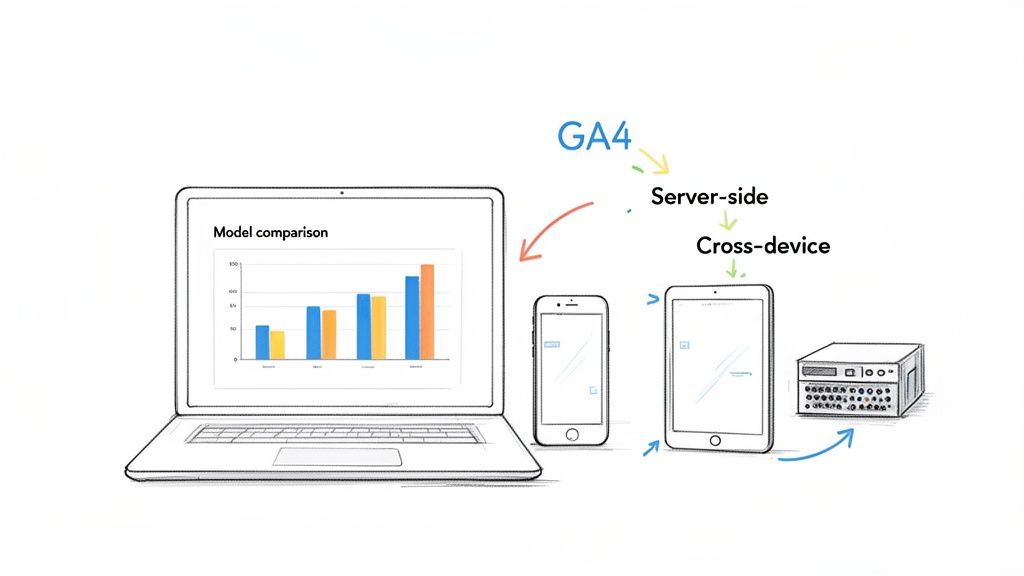
Think of GA4 as your mission control for understanding how all your marketing channels work together. Its most valuable tool for this is the Model comparison report, which lets you look at your conversion data through several different attribution lenses at the same time.
Here’s a quick guide to finding it:
- Head over to the Advertising section in your GA4 property.
- Under the "Attribution" dropdown, click on Model comparison.
- Now for the fun part: you can select up to three models to compare side-by-side (try pitting Last click, First click, and Data-driven against each other).
- GA4 will instantly show you how the credit for your conversions gets redistributed across your channels depending on which model you use.
By running this simple comparison, you can immediately spot which channels your current model is undervaluing. You might find that your organic social media, which gets almost zero credit with Last-click, is actually a powerhouse for discovery when viewed through a First-click lens.
This report is your first step toward making smarter budget decisions. If a channel consistently proves its worth in multi-touch models, you know it's a vital part of the customer journey, even if it isn't the one that seals the deal.
Checking Attribution in Your Ad Platforms
While GA4 provides the big-picture view, don't forget that your individual ad platforms have their own attribution settings. These settings directly influence how they report performance and, more importantly, how their algorithms optimize your campaigns. You need to know what they're set to.
- Meta Ads (Facebook & Instagram): Meta usually defaults to a 7-day click and 1-day view attribution window. This means it takes credit for a sale if someone clicks an ad and buys within seven days, or just sees an ad and buys within one day. You can (and should) check and adjust these windows in your ad set settings.
- Google Ads: For most conversion actions, Google Ads defaults to its own Data-driven attribution model. It also typically uses a 30-day lookback window. Knowing this helps you make sense of why the numbers in Google Ads might not perfectly match what you see in GA4.
Auditing these settings regularly is critical. It helps you understand why a platform reports what it does and stops you from killing a campaign that’s actually a key player from a more holistic point of view.
The Next Frontier: Server-Side Tracking and Cross-Device IDs
Let’s be honest: tracking users is getting harder. With privacy crackdowns and the slow death of third-party cookies, the old browser-based methods are becoming unreliable. To get accurate data for what is attribution modeling, you have to adapt.
Server-side tracking is a huge step forward. Instead of relying on a user's browser to send data, you send it directly from your server to platforms like GA4 or Meta. This method is far more resilient to ad blockers and browser restrictions, giving you a cleaner, more reliable data stream to feed your attribution models.
Just as important is cross-device identification. Your customers live on multiple devices. They might see your TikTok ad on their phone during their commute, browse your site on a tablet from the couch, and finally make the purchase on their work laptop. Without a way to connect those dots, your attribution is incomplete. Tools that stitch these sessions into a single journey—often using signals like email logins—are no longer a "nice-to-have." They are essential for future-proofing your entire attribution strategy.
Common Pitfalls and the Coming Cookieless World
Attribution modeling can bring incredible clarity to your marketing, but it’s no magic wand. If you're not careful, it can give you a false sense of confidence and lead to some really poor budget decisions. Knowing the common mistakes is the first step to building a measurement strategy that's both accurate and built to last.
One of the biggest blunders is treating a single model as the gospel truth. For instance, relying only on Last-Click attribution is like just watching the last two minutes of a basketball game. You'll see who made the winning shot, but you'll miss the entire strategy that set it up.
Working with incomplete or siloed data is another classic mistake that can wreck your efforts. If your tools can't connect a single customer's journey from their phone to their laptop, you're not seeing one cohesive path—you're seeing two broken ones. This inevitably leads to misreading customer behavior and undervaluing the channels that work together across devices.
The Cookieless Challenge Ahead
The elephant in the room for every marketer today is the big shift toward a privacy-first internet. The slow death of third-party cookies is completely rewriting the rules of online tracking. For years, these little data files were the backbone of advertising, letting brands follow users from one site to another.
Without them, connecting the dots of a customer journey becomes exponentially harder. A user who sees your ad on a blog and later searches for you directly will look like two different people, breaking the attribution chain. This shift is making many traditional multi-touch models less and less reliable because the very data they run on is vanishing.
The heart of the problem is simple: when you can no longer follow individuals across the web, you lose the ability to map out a complete, step-by-step customer journey. This is forcing a massive evolution in how we think about what attribution modeling even means.
Future-Proofing Your Measurement Strategy
Adapting to this new reality isn't about giving up on measurement. It's about pivoting to smarter, privacy-friendly solutions that don't depend on old-school tracking. To survive and grow, a few key strategies are becoming non-negotiable.
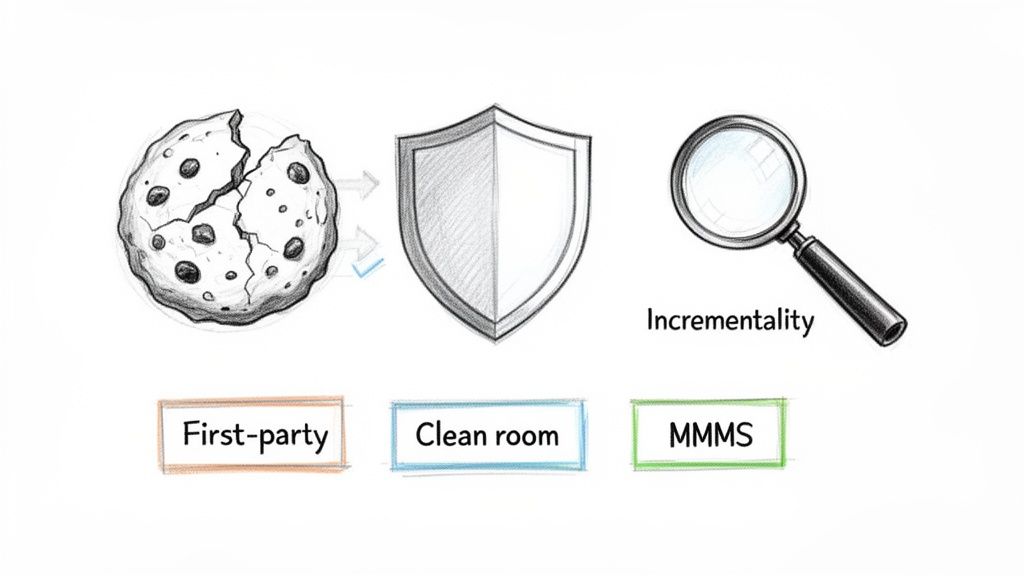
1. Go All-In on First-Party Data This is the information you collect directly from your audience—think email sign-ups, customer accounts, and purchase histories. In a cookieless world, this data is your most valuable asset. Encouraging users to create accounts or subscribe allows you to build a reliable, consent-based view of their interactions with your brand.
2. Look into Data Clean Rooms Picture a data clean room as a secure, neutral space where you can match your customer data with aggregated, anonymous data from platforms like Google or Meta. It lets you analyze campaign performance without either side having to share raw, personally identifiable information.
3. Embrace Aggregated Measurement Instead of trying to track every single click from every user, the industry is returning to top-down measurement techniques that analyze performance at a much broader level.
- Marketing Mix Models (MMMs): These are powerful statistical models that analyze how different marketing inputs (like ad spend on TikTok vs. Google) correlate with sales over time. They help you see the big-picture impact of each channel without needing to track individual users.
- Incrementality Testing: This is all about running controlled experiments—like showing an ad to one group but not another—to measure the true "lift" your ads are creating. It directly answers the million-dollar question: "How many of these sales would have happened anyway?"
By blending these modern approaches with the insights still available from tools like GA4, you can build a sturdy, future-proof measurement framework. This new setup respects user privacy while still giving you the clarity needed to grow your business effectively.
Your Game Plan for Smarter Attribution
So, you've got the theory down. But turning that knowledge into action is what actually drives growth. Think of it this way: effective attribution isn't about finding one magic bullet. It's about finally seeing the entire customer story, not just skipping to the last page.
It's time to move past gut feelings and use real data to see what's actually working for your e-commerce store.
When you take a more complete view, you can stop throwing money at channels that only look good on paper and double down on the ones that genuinely convince people to buy. This is how you start making smarter decisions that lead to real, sustainable growth. You get the clarity you need to fine-tune your marketing mix and prove your budget is working.
Your Quick-Start Checklist
Feeling overwhelmed? Don't be. You don't need to do everything at once. Just start with these three high-impact steps to get the ball rolling and see some immediate results.
Run a Health Check on Your Tracking: Before you touch a single report, make sure your data is solid. Check that your Google Analytics 4 tags, Meta Pixel, and TikTok Pixel are all firing correctly on your key pages. Pay extra attention to your checkout and thank-you pages. Bad data in, bad insights out.
Figure Out Your "Time to Buy": Pop into your analytics and find out how long it typically takes for someone to go from their first visit to a final purchase. Is it a couple of days? A few weeks? Knowing this immediately helps you eliminate models that just don't make sense for your business's sales cycle.
Play with the Model Comparison Tool: This is where the fun starts. Go straight to the "Model comparison" report in GA4. Put Last-Click, First-Click, and Position-Based models right next to each other. This simple exercise will instantly show you which channels your current reports are probably ignoring and give you a much more balanced view of what's performing.
Ultimately, the goal is to improve the bottom line. The better your attribution, the clearer your understanding of key metrics like ROI vs. ROAS becomes. Stop guessing and start measuring what truly matters.
Your Attribution Modeling Questions, Answered
Once you get the hang of attribution modeling in theory, the real questions pop up when you try to make it work for your own store. Let's tackle some of the most common things e-commerce owners and marketers run into.
Think of this as a quick-reference guide for those practical, "what-do-I-do-now?" moments. We'll cut through the noise and get straight to the answers.
What’s the Best Attribution Model for a Brand-New Shopify Store?
When you’re just starting out on Shopify, it’s perfectly fine to begin with the Last-Click model. It’s straightforward and shows you which channels are directly closing the deal. This gives you an immediate, though limited, view of what’s working right now.
But don't get too comfortable. As soon as you start branching out into social media, content marketing, or other channels, you need a more complete picture. Hop into Google Analytics 4 and start comparing models. A Position-Based or Linear model will give you a much more balanced view, preventing you from accidentally axing a channel that’s bringing new people to your brand for the first time.
How Should I Think About Attribution for My TikTok Ads?
Using a Last-Click model for TikTok is one of the biggest mistakes you can make. It almost guarantees you'll undervalue the platform. Think about it: people discover products on TikTok, then often search for them on Google or click a retargeting ad later to actually buy.
To really see TikTok's value, you need a multi-touch model like First-Click or the Data-Driven model in GA4. These models are designed to give credit where it’s due—in this case, to TikTok for kicking off the customer's journey. Also, dive into your TikTok Ads Manager settings to adjust your conversion windows; this will help you better connect the dots between a view and a later purchase.
Don't just measure the final click. Measure the first spark. For a platform like TikTok, understanding its role in brand discovery is the key to unlocking its full potential and justifying your ad spend.
Can I Use Attribution Modeling for My Amazon Store?
You can't really change the attribution model for sales that happen within Amazon's walls, but you absolutely can and should measure what drives shoppers to your product listings from the outside world. This is exactly what Amazon Attribution was built for.
It's a free tool from Amazon that lets you create special tracking links for your external marketing. Use it for your Google Ads, Facebook campaigns, or influencer posts. It shows you precisely which off-Amazon channels are sending traffic that actually converts, so you can stop guessing and start investing your ad budget where it counts.
How Is the End of Third-Party Cookies Going to Affect My Attribution?
The slow death of third-party cookies is a big deal for attribution. It makes it much more difficult to follow a single user's journey across different websites, which is what many older attribution models relied on.
The whole game is shifting. The new focus is on collecting and understanding your own first-party customer data (like email lists and site behavior). It also means smart marketers are moving to privacy-friendly methods like server-side tracking and looking at broader, aggregated approaches like Marketing Mix Modeling (MMM) to see the bigger picture of how all their channels work together.
Ready to stop guessing and start winning? EcomEfficiency bundles 50+ premium AI, SEO, and ad-spy tools to help you analyze competitors, find winning products, and optimize your marketing—all for one low price. Cut your software costs by up to 99% and get the insights you need to scale. Unlock your all-in-one e-commerce toolkit today!