Finding the Best Products to Sell Online A Practical Guide

Forget scrolling through endless lists of "hot" items. Finding the best products to sell online has nothing to do with chasing fads and everything to do with following a repeatable, data-backed system. This guide will walk you through that exact framework—a practical process for discovering, validating, and launching products that have real, sustainable market potential.
The goal is to scale without dubious shortcuts and without hurting your credibility.
Building a Framework for Finding Winning Products
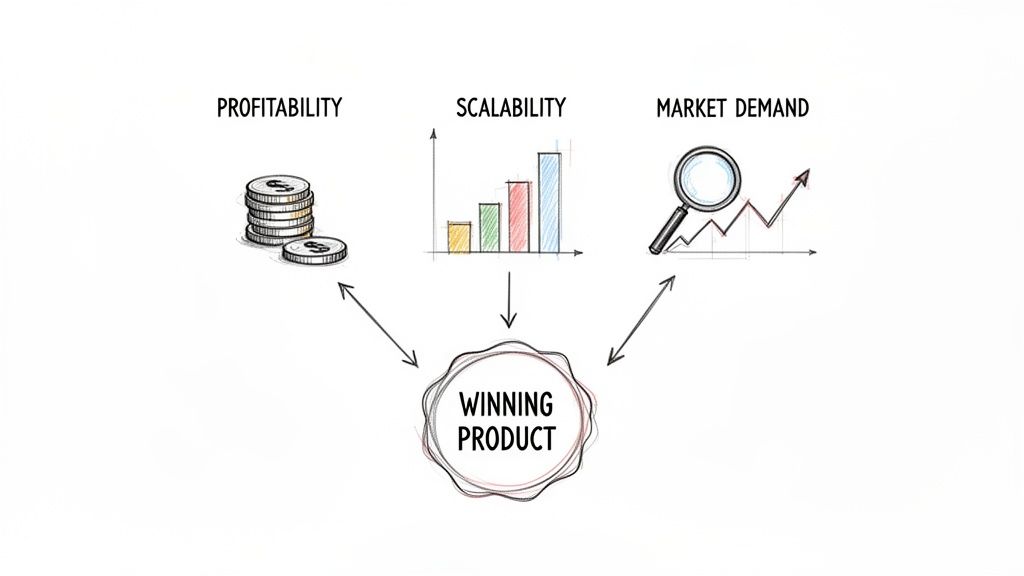
Most aspiring entrepreneurs get stuck trying to find that one "winning product." But what does a winner even look like? It's not just about what's popular today. A truly successful product is a strategic fit for your business, hitting the sweet spot between profitability, scalability, and genuine market demand.
The goal isn't to find a single trending gadget; it's to build a mental model you can use to evaluate any opportunity that comes your way. This is how you shift from chasing short-term trends to building a business with staying power. Learning How to Find Winning Products is the real foundation for your entire online venture.
Defining a Winning Product
Before you even start looking, you need to know what you're looking for. A winning product isn't a unicorn; it's just an item that checks the right boxes.
Here’s what I look for:
- Strong Profit Margins: Can it be sourced, shipped, and marketed while still leaving a healthy profit? A 3x markup from your total landed cost is a great benchmark to aim for.
- Consistent Demand: Are people actually looking for this? You can verify this with hard data from keyword and trend analysis tools. No guessing allowed.
- Scalability: Is the supply chain solid? If sales take off, you need to be able to ramp up order volume without hitting a wall.
- Low Market Saturation: The niche can't be completely dominated by a few giant brands. You need to find a corner of the market where a new player can actually compete and be heard.
The Tools of the Trade
Thinking like a seasoned e-commerce operator means swapping gut feelings for data. The good news is, the tools available today make this easier than ever. For instance, a platform like Exploding Topics is perfect for spotting trends before they hit the mainstream.
By looking at search interest, social media chatter, and what people are talking about online, you can get ahead of rising consumer needs. This proactive approach is what separates stores that thrive from those that are always playing catch-up.
Similarly, tools like Helium 10 or Dropship.io give you an incredible look behind the curtain with competitor sales estimates and keyword search volumes. This is how you validate an idea with cold, hard numbers and confirm that a real audience is out there, ready to buy. Throughout this guide, we’ll use these tools to build a reliable system for finding and launching your next bestseller.
Uncovering High-Potential Product Opportunities
Alright, this is where the real hunt begins. Forget brainstorming in a vacuum. The best product ideas aren't found on generic "top 10" lists; they're discovered in the wild, bubbling up from the very communities you want to serve.
The secret is to stop thinking like a seller and start listening like a customer. You need to immerse yourself in the digital spaces where people are already talking, complaining, and wishing for something better.
Tapping into Social Platforms for Ideas
Social media is so much more than a marketing channel—it's your direct line to raw, unfiltered consumer demand. If you know where to look, you can spot emerging needs long before they hit the mainstream.
- Dive into Reddit: Forget the front page. You want to go deep into niche subreddits like
r/BuyItForLife,r/gadgets, or hobby-specific communities. These places are goldmines. Someone’s detailed rant about their travel mug leaking is your signal. A thread wishing for a better-designed dog leash is your opportunity. - Decode TikTok Trends: The "TikTok Made Me Buy It" phenomenon is powerful, but don't just look at the hot product of the week. Read the comments. That's where the magic is. Are people asking for a vegan leather version? A bigger size? A different color? That feedback is your roadmap to a better product.
For example, you might see "skincare" is a huge category. That's useless. But a deep dive on TikTok might reveal that a specific ingredient, like bakuchiol (a natural retinol alternative), is what everyone’s actually excited about. Now you have a sub-niche you can completely dominate.
The goal is to get specific. You don't want to sell "pet supplies." You want to sell "an orthopedic, washable dog bed specifically for large, shedding breeds." That kind of focus is how a new brand cuts through the noise.
Using Data to Spot the Real Winners
Social listening gives you the initial spark, but data tells you if you can build a fire. This is the point where you have to switch from observer to analyst and use product research tools to validate your hunch.
This is where a platform like Dropship.io becomes your secret weapon. It lets you peek behind the curtain at what competitor Shopify stores are actually selling. You’re not guessing what was popular six months ago; you’re seeing real-time revenue data for products right now. This is how you separate a fleeting viral hit from a genuinely sustainable market.
Let's say you've noticed portable blenders are popping up everywhere. With a tool like Dropship.io, you could discover that out of ten stores selling them, only two are pulling in serious daily sales. What are they doing differently? By digging into their product pages, pricing, and ads, you can reverse-engineer their success and carve out your own unique angle.
Identifying Fads vs. Sustainable Trends
One of the quickest ways to lose money is to go all-in on a fad. Fidget spinners, anyone? The key is learning to tell the difference between a short-lived craze and a legitimate, long-term trend.
Here’s a simple way to think about it:
| Characteristic | Fad (e.g., Fidget Spinners) | Trend (e.g., Athleisure Wear) |
|---|---|---|
| Lifespan | Extremely short, gone in a few months. | Lasts for years, often becoming the new norm. |
| Audience | Narrow, usually a single demographic. | Appeals to a broad range of people. |
| Value | Purely novelty or entertainment. | Solves a real problem or offers practical use. |
A product might get a huge initial boost from a viral video, but a true trend will show stable or growing search interest on a tool like Google Trends over a 12-24 month period. It becomes part of someone's lifestyle, not just a throwaway purchase.
Think about the explosion of home fitness gear during the pandemic. It started as a necessity, but it evolved into a lasting trend because it tapped into a fundamental shift in how people view health and convenience. Focusing on these deeper shifts is how you build a business for the long haul, not just for a quick boom and bust.
So, you have an exciting product idea. That's a great start, but it's only that—a start. Now comes the hard part: proving people will actually pay real money for it. This is the validation phase, where we trade wishful thinking for hard data.
This isn't about killing your enthusiasm. It's about protecting your time, your money, and your sanity. By rigorously testing your idea against the realities of the market, you can move forward with confidence, knowing you're building a business on solid ground, not just a cool idea.
This whole process follows a logical path, starting broad and getting more and more focused as you gather data.
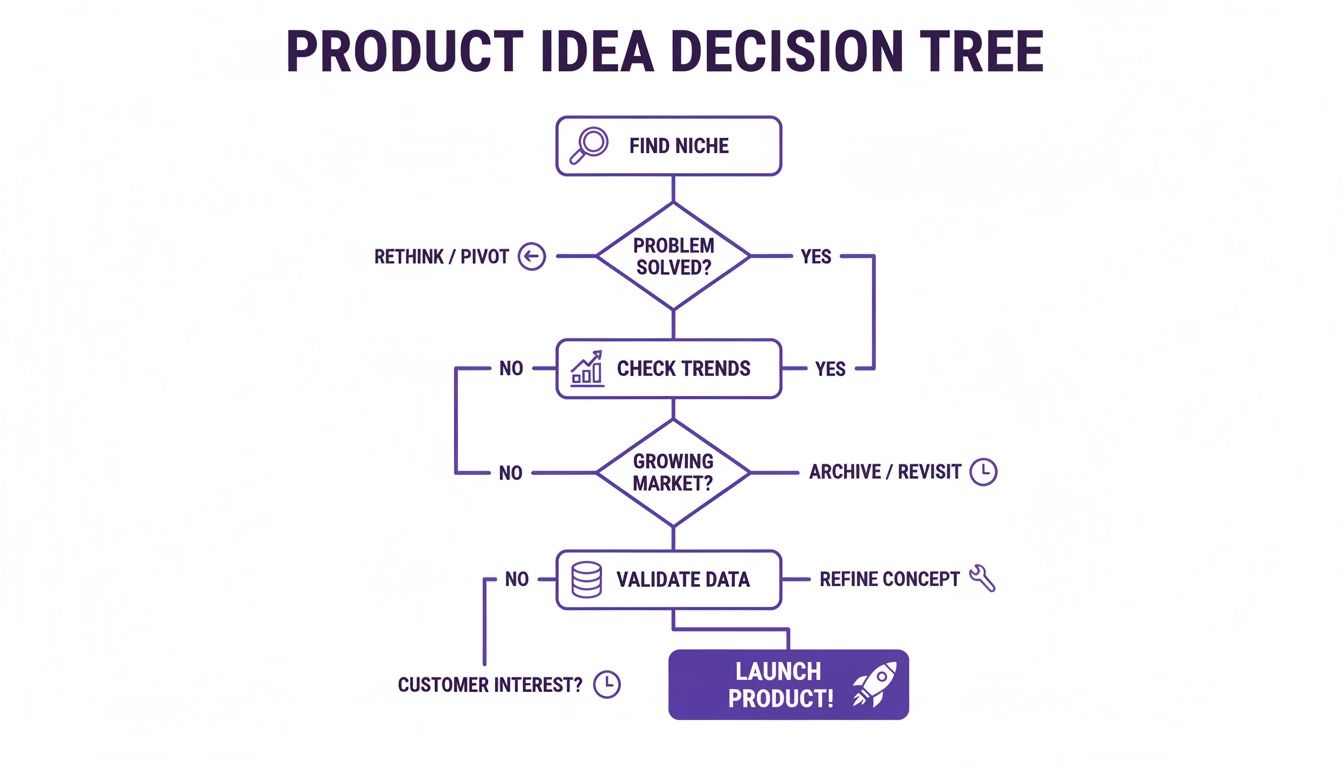
Let's break down how to actually do this.
Are People Already Looking For It? Gauging Demand with Keyword Research
First thing's first: are people actively searching for a solution like yours? If they are, you can bet they’re typing it into Google. This makes keyword research your secret weapon for early validation.
Using a tool like Semrush, you can see exactly what your potential customers are searching for and how often. You're hunting for keywords with commercial intent—phrases that scream "I'm ready to buy!"
Think about the difference between these two searches:
- Informational Intent: "how to organize kitchen"
- Commercial Intent: "best bamboo drawer organizers"
See the difference? That second search is pure gold. It comes from someone who has already identified their problem and is now actively shopping for a product to solve it. Your mission is to find keywords like this with real search volume—at least a few hundred searches per month—that directly map to your product idea.
Sizing Up the Competition
Okay, you've confirmed an audience exists. Great. Now, who's already selling to them? Don't be scared off by competition; a complete lack of it is often a red flag that there's no money to be made. What you need is an angle, a way to do it better.
A competitive intelligence tool like Similarweb can give you a peek behind the curtain at a competitor's traffic. You can see where their customers are coming from—Google, social media, email lists—which tells you a lot about their marketing strategy.
My Favorite Pro Tip: Look for competitors with passionate but underserved audiences. If you find a brand with a decent product but a clunky website, non-existent social media, or terrible customer service reviews, that's your opening. You can win by simply delivering a better experience.
Will It Actually Make Money? Calculating Your Potential Profit Margin
This is where so many aspiring entrepreneurs get it wrong. A product can look amazing on paper, but if the numbers don't work, it's a non-starter. Your profit margin is what's left after you've paid for everything involved in getting that product into your customer's hands.
Here’s a quick rundown of the costs you absolutely must account for:
- Cost of Goods Sold (COGS): What you pay your supplier for each unit.
- Shipping & Handling: The cost to get inventory from your supplier to you (or your fulfillment center) and then from there to the customer.
- Transaction Fees: Payment gateways like Stripe and PayPal take a slice of every sale, usually around 2.9% + $0.30.
- Customer Acquisition Cost (CAC): How much you spend on marketing (e.g., ads) to make a single sale. This is a huge variable and must be estimated.
Let's say you're looking at a specialty skincare item. The beauty and personal care market is a monster, projected to hit $169.6 billion by 2025. You can learn more from this deep dive into top-selling products. While the potential is massive, your profitability boils down to your specific unit economics.
Here’s a simple comparison showing why margins are everything:
| Metric | High-Margin Product | Low-Margin Product |
|---|---|---|
| Retail Price | $75.00 | $75.00 |
| Landed Cost (COGS + Shipping) | $20.00 | $50.00 |
| Transaction Fees | $2.48 | $2.48 |
| Estimated Marketing Cost (CAC) | $25.00 | $25.00 |
| Total Costs per Sale | $47.48 | $77.48 |
| Net Profit per Sale | $27.52 | -$2.48 (Loss) |
Notice how the same retail price leads to drastically different outcomes. A high sourcing cost completely wiped out the profit and actually created a loss on every sale.
As a general rule of thumb, I always aim for a 3x markup on my landed cost (the total cost to get one unit into my warehouse). If a product costs me $20 all-in, I need to be able to sell it for at least $60. This buffer is what covers your marketing, overhead, and—most importantly—your actual profit. Ignoring this math is the fastest way to build a business that loses money.
To help you stay objective, I've put together a simple scoring framework. Use this checklist to evaluate your product ideas against these core business criteria. Be honest with yourself as you score each one.
Product Validation Checklist
| Validation Criteria | Description | Scoring Guide (1-5) | Example Product Score |
|---|---|---|---|
| Market Size & Demand | Is there a large, identifiable, and growing audience for this product? | 1 = Niche/tiny audience; 5 = Large, growing mainstream market | 4 |
| Competition Level | Can you realistically compete and stand out in this market? | 1 = Saturated with dominant players; 5 = Little to no direct competition | 3 |
| Profit Margin Potential | Can you achieve a 3x (or better) markup on your landed cost? | 1 = Razor-thin margins (<1.5x); 5 = Excellent margins (>4x) | 4 |
| Sourcing & Logistics | Is the product easy to source, lightweight, and not fragile to ship? | 1 = Complex, heavy, fragile; 5 = Simple, light, durable | 5 |
| Marketing Channel Fit | Does this product lend itself well to visual platforms (social, video)? | 1 = Difficult to market visually; 5 = Highly "Instagrammable" | 4 |
| Trend & Longevity | Is this a sustainable product or a fleeting trend? | 1 = Flash-in-the-pan fad; 5 = Evergreen product with lasting appeal | 4 |
| Total Score | Sum of all scores | 24 / 30 |
This kind of objective scoring helps you compare different ideas side-by-side. An idea that scores below 20 might be a passion project, but it probably isn't a great business opportunity. The higher the score, the more confident you can be in your decision to move forward.
Sourcing Your Products and Managing Logistics
So you've landed on a promising product idea. That’s a huge step, but now the real work begins. The question shifts from what to sell to how you’re actually going to get it into your customers' hands. This is where your supply chain strategy comes in, and it's a make-or-break decision.
The path you choose for sourcing will dictate everything from your startup cash needs and profit margins to what your day-to-day operations look like. There’s no single “right” answer—it all boils down to your budget, how much risk you're comfortable with, and what you want your business to become.
Comparing Key Sourcing Models
Let's unpack the three main ways to source products: dropshipping, buying wholesale, and creating your own private label brand. Each one has its own set of pros and cons, especially when it comes to cash and control.
- Dropshipping: This is the leanest way to start. You essentially act as a middleman. A customer buys from your store, and you pass the order to your supplier, who then ships it directly to the customer. You never touch the inventory. The upfront cost is almost zero, but your profit margins will be thin, and you have very little control over product quality or shipping speed.
- Wholesale: Here, you buy existing branded products in bulk from a manufacturer or distributor. You get a discount for buying a larger quantity, which means better margins than dropshipping. This model requires more capital to buy inventory, but it gives you full control over your stock and the customer experience.
- Private Label Manufacturing: This is how you build a true brand. You work with a factory to produce a product to your exact specifications, with your own branding and packaging. This route offers the highest potential profit margins and total control, but it also demands the biggest initial investment to meet Minimum Order Quantities (MOQs) and fund product development.
A lot of successful sellers I've seen follow a natural progression. They'll often start with dropshipping to validate a product without risking a ton of money. Once they see consistent sales, they’ll use their profits to place a small wholesale order. This improves their margins and lets them offer faster shipping. The final step is scaling up to private label manufacturing to build a unique, defensible brand that nobody else can sell.
Vetting Suppliers and Finding a Partner
Whether you’re manufacturing a one-of-a-kind gadget or dropshipping phone cases, your supplier is arguably your most important business partner. A bad one can torpedo your business with shoddy products, missed deadlines, and poor communication. Finding a great one is non-negotiable.
When you're scrolling through options on a platform like Alibaba or AliExpress, don’t let a low price tag be the only thing that catches your eye. You need a systematic way to vet potential partners.
Supplier Vetting Checklist:
- Communication: How fast and how clearly do they reply? Is there a language barrier? A response within 24 hours is a decent benchmark. Slow replies now mean bigger problems later.
- Verified Status: On Alibaba, look for badges like "Verified Supplier" or "Trade Assurance". These aren’t foolproof, but they add a layer of security and show the supplier has undergone a third-party inspection.
- Experience: How long have they been in business? More importantly, how long have they been exporting to your target country? An experienced exporter will know the ropes when it comes to customs and documentation.
- Product Samples: Always, always order a sample. This is not optional. You have to see and feel the quality for yourself before you even think about placing a bulk order.
- MOQ Negotiation: If you’re manufacturing, find out their Minimum Order Quantity. If it’s more than you can afford, ask if they’d be willing to do a smaller test run for your first order. Many will if they believe in a long-term partnership.
Managing Logistics and Shipping
Okay, you’ve found a great supplier. Now for the next puzzle: getting your products to your customers without it costing a fortune or taking forever. Logistics can quietly eat away at your profits and kill customer loyalty if you don't get it right.
If you’re holding your own inventory, you'll need a solid shipping partner. The best carrier depends on what you're selling (size and weight) and where you're selling it. For anyone selling online, nailing logistics is crucial, and this best courier service Australia comparison guide for ecommerce success is a fantastic resource if you’re operating down under.
For dropshippers, this is an even bigger deal. Long shipping times are the number one killer of dropshipping stores. Look for suppliers who offer reliable and reasonably fast shipping options (like ePacket) or, even better, have warehouses in your customers' country.
The most important thing is to be transparent. Clearly state the estimated delivery times on your product pages. Managing expectations from the start will save you from a flood of angry emails and refund requests down the line.
Crafting Your Launch and Marketing Strategy
You've done the hard work. You've found a brilliant product, validated the demand, and sourced it perfectly. But even the best product in the world is just inventory gathering dust in a warehouse if nobody knows it exists.
This is where the rubber meets the road. Your launch and marketing strategy is what connects your solution to the people who desperately need it, and it's what builds unstoppable momentum from day one.
The good news? Your product already holds the clues to its own success. Is it visually stunning? Does it solve a problem people are actively Googling at 2 AM? Or is it something so innovative they don't even know they need it yet? The answer to that question tells you exactly where to put your time and money.
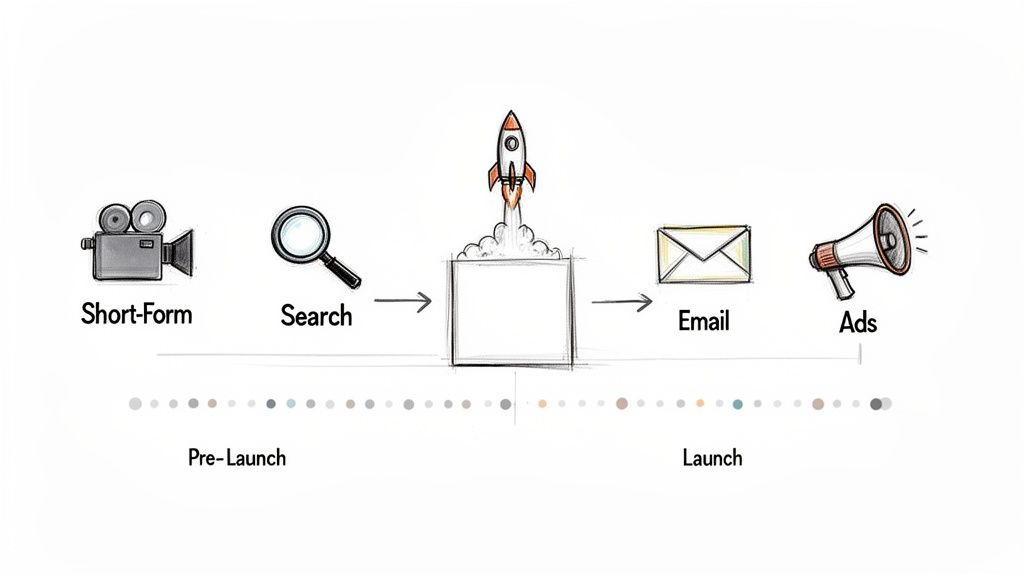
Match Your Product to the Right Marketing Channels
Every marketing channel has its own personality, and the key is finding the right fit. A beautiful, highly visual product belongs on an equally visual platform. A product that solves a specific, painful problem needs to be the first thing someone sees when they're searching for a solution.
Take fashion, for example. It's a monster category online, projected to hit $760 billion in global spending by 2025. Its power is its visual appeal, which makes it a natural fit for platforms like Instagram and TikTok. That’s where you see unisex t-shirts and custom hoodies fly off the virtual shelves. It's no surprise that 44% of users admit to occasionally buying clothes they see on social media. (You can dig into more stats about top-selling online products at gokickflip.com).
Here’s a simple way to think about it:
- Problem-Aware Products (High Search Intent): If you're selling something that solves a known problem, like an "ergonomic keyboard for wrist pain," then Google Ads and SEO are your new best friends. You're simply capturing demand that's already out there.
- Visually Driven Products (High Impulse-Buy Potential): Think custom jewelry, unique home decor, or trendy apparel. These thrive on discovery platforms like TikTok, Instagram, and Pinterest. Here, your job is to create demand with eye-catching visuals.
Don't try to force a square peg into a round hole. You'll burn a lot of money trying to make a boring, practical item go viral on TikTok. Instead, focus your energy on writing the most helpful, detailed blog post and crafting a killer Google Ads campaign that your customers will thank you for. Play to your product's strengths.
Choosing the right marketing channel is crucial for maximizing your ROI. This matrix breaks down which channels tend to work best for different product types, giving you a starting point for your own strategy.
Marketing Channel and Product Fit Matrix
| Product Category | Primary Marketing Channel | Secondary Channel | Key Success Tactic |
|---|---|---|---|
| Fashion & Apparel | Instagram, TikTok | Pinterest, Influencer Marketing | High-quality visual content, influencer collaborations, user-generated content (UGC) campaigns. |
| Electronics & Gadgets | YouTube, Google Ads | Tech Blogs, Affiliate Marketing | In-depth video reviews, comparison guides, targeting specific keywords like "best noise-canceling headphones." |
| Home & Kitchen | Pinterest, Facebook Ads | SEO (Blog Content), Instagram | Aspirational lifestyle imagery, problem-solution video ads (e.g., "organize your messy pantry"). |
| Beauty & Personal Care | TikTok, YouTube | Instagram, Email Marketing | Tutorial videos, before-and-after transformations, building a community with tutorials and tips. |
| Niche Hobbies | Facebook Groups, SEO | Reddit, Niche Forums | Hyper-targeted content, engaging directly with enthusiasts, becoming a trusted voice in the community. |
This isn't an exhaustive list, but it's a solid framework. The goal is to meet your customers where they already are, speaking their language and fitting naturally into their feed.
Get a Head Start by Analyzing Competitor Campaigns
Why reinvent the wheel when your competitors have already spent thousands of dollars figuring out what works? Ad-spy tools are your secret weapon for reverse-engineering successful campaigns.
Tools like Pipiads (for TikTok) or AdSpy (for Facebook) let you peek behind the curtain. You can see the exact ads your competitors are running, the creatives they’re using, the ad copy that’s resonating, and even the landing pages they’re driving traffic to. This isn't about copying—it's about learning from their data to make smarter decisions, faster.
Look for these patterns:
- Are their most successful ads using polished studio shots or scrappy, user-generated content (UGC)?
- What's the main hook in their video ads? Do they lead with a problem, or do they jump right into a product demo?
- What specific pain points or benefits do they hammer home in their ad copy?
By analyzing the top-performing ads in your niche, you can shortcut your learning curve and identify winning angles before you spend a single dollar.
Create Ad Creatives That Actually Convert
Now that you have insights from your competitor deep-dive, it's time to create your own ads. The great news is that you no longer need a massive budget or a full-time design team.
- Image Generation: Use tools like Midjourney or Flair.ai to generate incredible product lifestyle photos or background scenes. You can test dozens of variations in the time it takes to set up a single photoshoot.
- Video Creation: With apps like CapCut or platforms like Runway, anyone can edit compelling videos. Short, punchy, UGC-style videos are what's working right now on platforms like TikTok and Instagram Reels.
Your one and only goal is to stop the scroll. You have about three seconds to grab someone's attention. Lead with a hook that speaks directly to their biggest problem or desire, and then quickly introduce your product as the hero they've been looking for.
The Power of a Pre-Launch Strategy
The single biggest mistake I see new sellers make is launching to an audience of crickets. A truly successful launch begins weeks, sometimes even months, before your product is actually for sale. The goal is simple: build a tribe of people who are excited and ready to buy the second you go live.
Your pre-launch checklist needs to include:
- Building an Email List: This is your #1 asset. Set up a simple landing page that teases your product. Offer an exclusive "early bird" discount or a valuable freebie in exchange for an email address.
- Generating Social Media Buzz: Don't just show up on launch day. Post behind-the-scenes content of your product development. Run polls asking for feedback on colors or features. Use countdowns to build real anticipation.
- Engaging with Influencers: You don't need A-listers. Reach out to micro-influencers in your niche who have a real, engaged audience. Many will be thrilled to get a free product in exchange for an honest unboxing video or review they can post on launch day.
When you warm up your audience beforehand, you're not hoping for sales on launch day—you're expecting them. You'll have a core group of enthusiastic customers ready to provide those critical first sales, generating the social proof and momentum you need to scale.
A Few Common Product Traps to Sidestep
Learning from other people's mistakes is one of the fastest—and cheapest—ways to get ahead in this game. When you're on the hunt for that perfect product, steering clear of a few common traps can save you thousands of dollars and a world of headaches.
The biggest mistake I see? Picking a product based on a personal passion without a shred of market validation. It’s a classic. Just because you love making artisan sourdough doesn't mean there's a big enough online market to build a real business around it. You have to learn to separate your hobbies from viable business ideas that are actually backed by search data and sales trends.
Another major pitfall is diving headfirst into a hyper-competitive market with nothing unique to offer. Trying to sell yet another generic phone case is a brutal race to the bottom on price. You absolutely need a unique selling proposition (USP). What’s your angle? Maybe your cases are made from recycled ocean plastic, or they have a feature no one else does. That’s what lets you stand out and actually command a decent price.
Getting Blindsided by Hidden Costs
So many new sellers get starry-eyed looking at a product's retail price and completely forget to calculate its actual profitability. It’s easy to do. They don't factor in all the "hidden" costs that quietly chew away at your margins until there's nothing left.
Here are a few of the usual suspects that people tend to overlook:
- Supplier Shipping: That's the cost to get your inventory from the factory floor over to your warehouse or a 3PL. It can be shockingly high.
- Marketing Spend: Your customer acquisition cost (CAC) is a huge one. It doesn't matter if you have a 50% margin if it costs you 60% of the sale price to find the customer.
- Returns: Processing returns isn't free. You've got return shipping labels, inspection time, and sometimes products you can't even resell.
- Payment Gateway Fees: Services like Stripe or Shopify Payments take a slice of every single sale, typically around 2.9% + 30¢.
I've seen this happen a hundred times: someone gets excited about a product that's big, heavy, or fragile. The shipping costs for an oversized piece of furniture can wipe out your entire profit margin. And a single shattered ceramic vase leads to an unhappy customer, a bad review, and a costly replacement.
Finally, do your homework on trademarks and patents. Selling something that steps on someone else's intellectual property is a fast track to getting your store shut down and a nasty letter from a lawyer. A quick search on the USPTO database is non-negotiable before you sink a single dollar into inventory.
Dodging these blunders is just as critical as finding a winning product in the first place.
Common Questions About Finding Products to Sell Online
Jumping into ecommerce for the first time usually brings up the same set of questions for everyone. Let's walk through the most common ones so you can move forward with confidence.
What’s a Realistic Startup Budget?
Honestly, this completely depends on the path you choose. You could get a dropshipping business off the ground for less than $100. That would cover your basic online store subscription and a small budget to test a few ads.
On the other hand, if you're building a private label brand from scratch, you're looking at a much bigger initial investment. Expect to need anywhere from $2,000–$5,000 to handle your first inventory order, branding design, and a proper marketing launch.
Where’s the Real Money Made? What Categories Are Most Profitable?
You’ll always find reliable demand in evergreen markets like pet supplies, fitness gear, and home goods. But real, sustainable profit isn't about broad categories—it's about finding your specialized corner within them.
That said, consumer electronics is an absolute giant. Global spending is projected to hit a staggering $922.5 billion by 2025. This market is huge because people are comfortable buying tech online, where they can easily compare features and hunt for the best price. You can see more data on current ecommerce trends to get a better feel for the landscape.
The secret isn't picking a profitable category; it's finding a profitable niche. Don't just sell "pet supplies." Sell "biodegradable grooming wipes for sensitive dogs." That's how you stand out.
How Can I Tell if a Niche Is Too Crowded?
Market saturation is a legitimate worry, but there are some tell-tale signs. A great place to start is by checking the cost-per-click (CPC) on your main keywords with an SEO tool. If you see advertisers paying $5 or more for a single click, that's a red flag—it means big players are throwing serious money around.
Another simple test is to just Google your product idea. If the entire first page is filled with household names and massive retailers, you're looking at an expensive, uphill fight to gain any visibility.
Stop juggling dozens of tool subscriptions and bleeding cash. EcomEfficiency bundles over 50 premium e-commerce tools for product research, SEO, and ad intelligence into one simple, affordable plan. Get everything you need to find, validate, and market winning products at https://ecomefficiency.com.