Shopify Spy Tools Winning Product and Competitor Guide

Shopify spy tools are specialized pieces of software that give e-commerce store owners a look behind the curtain of their competitors. They pull back data on top-selling products, estimate sales figures, uncover active ad campaigns, and even reveal the specific apps a store is using to run its business.
The goal is to scale without dubious shortcuts and without hurting your credibility.
Essentially, these tools give you a strategic lens to view what’s actually working in the market right now, helping you make decisions based on real data instead of just gut feelings.
How Shopify Spy Tools Uncover Market Secrets
Let's get one thing straight: there's no magic "find a winning product" button. Think of these tools more like your personal intelligence briefing on the e-commerce battlefield. It's not about blindly copying what someone else is doing. It’s about decoding the patterns behind successful stores so you can build something even better.
This is how you learn from the best without burning through thousands of dollars on your own trial-and-error campaigns. You get to see which products are actually generating sales, what ad creatives are pulling in customers, and even the tech stack top stores use to scale their revenue.
Understanding the Core Functionality
At their core, these tools are just sophisticated data collectors. They scan publicly available information from thousands of Shopify stores and social media ad libraries, then organize it all into a clean, actionable dashboard. This lets you move past a competitor's polished homepage and see the engine running underneath.
- Product Analysis: Pinpoint a store’s hottest items, track new product launches, and dissect their pricing strategies.
- Sales Estimation: Get a directional idea of a store's daily or monthly revenue to gauge product demand and overall business health.
- Ad Intelligence: Uncover the exact video ads, images, and ad copy a competitor is running on platforms like Facebook and TikTok.
- Technology Stack: See the specific Shopify apps a store is using for everything from pop-ups and email marketing to loyalty programs and upsells.
This dashboard view gives you a quick snapshot of a competitor's vital signs, making it easier to spot trends and opportunities at a glance.
From a view like this, you can quickly tell which products are the real drivers of activity and see how recently the store has been making sales—both crucial clues about its current momentum.
Setting Realistic Expectations
It's really important to approach the data with the right mindset. The Shopify spy tool market has exploded alongside the global e-commerce sector, now valued at around $4.8 trillion. Many tools will claim their sales estimates have 70-80% accuracy, but independent analysis often puts the real numbers closer to 30-50%.
Even with those limitations, stores that use these insights strategically report an average conversion improvement of 15-30%. You can dig into these findings and the spy tool market over at Affinco.
The real value isn't in knowing a store made exactly $5,142 yesterday. It's in knowing that "Product A" consistently outsells "Product B" by a 3-to-1 margin, signaling stronger market demand.
Use these tools as a compass, not a GPS. They’ll point you in the right direction, but you still have to do your own thinking and validation. If you want to get a better handle on the tech that makes this all possible, checking out the best website data extraction tools can give you some great background on how this information is gathered in the first place.
Core Capabilities of Different Shopify Spy Tool Types
To help you choose the right tool for the job, it's useful to understand the different types available. Each has a slightly different focus, from finding hot products to analyzing a single competitor in depth. This table breaks down the main categories.
| Tool Type | Primary Function | Key Use Case | Example Tools |
|---|---|---|---|
| Product Research Tools | Find trending and potentially "winning" products | Discovering new product ideas based on sales data and social media trends | Koala Inspector, Dropship.io |
| Store Analysis Tools | Deep-dive into a specific competitor's store | Analyzing a direct competitor's best-sellers, apps, and sales velocity | Minea, Shophunter |
| Ad Spy Tools | Uncover competitor ad campaigns | Finding successful ad creatives, copy, and targeting angles on social media | PiPiAds, AdSpy |
| All-in-One Platforms | Combine product, store, and ad analysis | Comprehensive market research and competitor monitoring in one place | Dropship.io, Minea |
Understanding these distinctions will help you pick a tool that aligns with your immediate goals, whether that's finding a new product to sell or figuring out how your biggest rival is getting all their traffic.
Finding Winning Products By Analyzing Top Stores
This is where the real work—and the real money—is made. Forget chasing those "hot trending" product lists you see everywhere. By the time a product makes it onto one of those, the market is already flooded.
Our goal is different. We're going to use spy tools to see what successful stores are actually doing, right now, to make a profit. We're looking for products with real, sustainable demand, not just a one-hit-wonder that fizzled out last month.
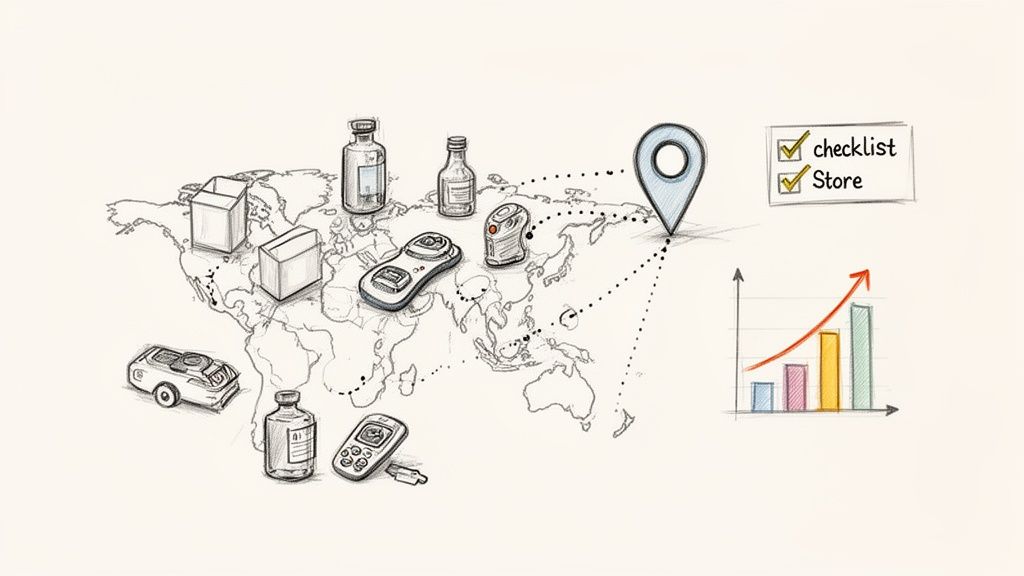
Identifying Stores with Genuine Momentum
Here's a tip that puts you ahead of 90% of other dropshippers: when you first log into a tool like ShopHunter or Dropship.io, don't search for products. Search for healthy stores. A winning product is usually just a symptom of a well-run business.
Instead of sorting by "All-Time Best Sellers," you need to find stores that are actively growing. Look for recent activity. A store that launched 15 new products in the last 60 days is way more interesting than one that hasn't touched its catalog in a year.
Pair that with evidence of consistent ad spend, and you've found a golden nugget. Think about it: a store owner only sinks more money into new products and ads when the business is already profitable and they're confident about scaling. That’s the signal you want to follow.
Analyzing Bestsellers with a Critical Eye
Once you've got a promising store on your radar, it's time to put on your detective hat and dig into their product catalog. The "Bestsellers" tab is a great starting point, but never take the estimated sales figures as absolute truth. They're just estimates.
The real story is in the details.
Check the launch date of their top sellers. A product that launched six months ago and is still at the top of their list screams long-term, stable demand. On the other hand, a product that shot up in the last week could just be a temporary fad you don't want to get stuck with.
Also, take a hard look at their pricing. Are they commanding a premium price or are they constantly running discounts? This tells you a lot about their brand perception and, more importantly, their potential profit margins.
Here’s a pro tip: One of the most telling things on a competitor's product page is the app they use for customer reviews. If you see them paying for a premium service like Loox or Yotpo, it’s a massive sign they’re serious. They wouldn't invest in high-end social proof unless the product was genuinely good enough to earn great reviews.
The Power of Product Clustering
This is a strategy most people completely miss. They find one "winner" and stop there. The smartest sellers look for "product clusters." A single winning product is good, but a collection of products that customers buy together is where you build a real brand.
Pay close attention to their "Frequently Bought Together" sections or any post-purchase upsells they offer. A store selling a popular skincare device, for example, might be making a huge chunk of its revenue from a specific cleansing gel and replacement heads. That's not an accident. It reveals a whole ecosystem of customer needs beyond the main product.
Finding these clusters gives you ideas for your hero product and a suite of complementary items you can offer from day one to instantly boost your average order value (AOV).
Your Final Product Vetting Checklist
Okay, you've found a product that looks like a winner. Before you dive in and commit, run it through this final sanity check. This isn't just about finding a good product; it's about finding a good business opportunity.
- Supplier Reliability: Can you find several high-quality suppliers on platforms like AliExpress or CJdropshipping? You never, ever want to rely on a single source.
- Private Label Potential: Is this a generic item you can put your own brand on? A product you can private label has far more long-term value than something with an existing, unremovable brand.
- Market Saturation: Do a quick check. How many other stores are running ads for this exact item right now? If the market is completely flooded, you’d better have a truly unique angle to stand out.
- Longevity vs. Trend: Head over to Google Trends. Is the search interest for this product category stable, growing, or falling off a cliff? You want to build on a solid foundation, not a fleeting fad.
By following this methodical process, you stop using spy tools as simple product finders and start using them as powerful market intelligence platforms. This is how you move from chasing temporary wins to building a sustainable e-commerce brand.
Uncovering Your Competitors' Ad Game Plan
So, you’ve found a potential winning product. That's a fantastic start, but it's really just the first leg of the race. The real challenge is getting that product in front of the right people, and that means you need a killer customer acquisition strategy.
This is where we pivot from looking at stores to reverse-engineering their entire marketing funnel. We'll use ad spy tools like Pipiads to see exactly how they're pulling in customers.
A competitor’s ad library is basically a goldmine of market research. It shows you the exact messaging that connects with your target audience, the visual styles that stop them from scrolling, and the offers that are too good to refuse. It's like getting a free peek at the results of their multi-thousand-dollar A/B testing budget.
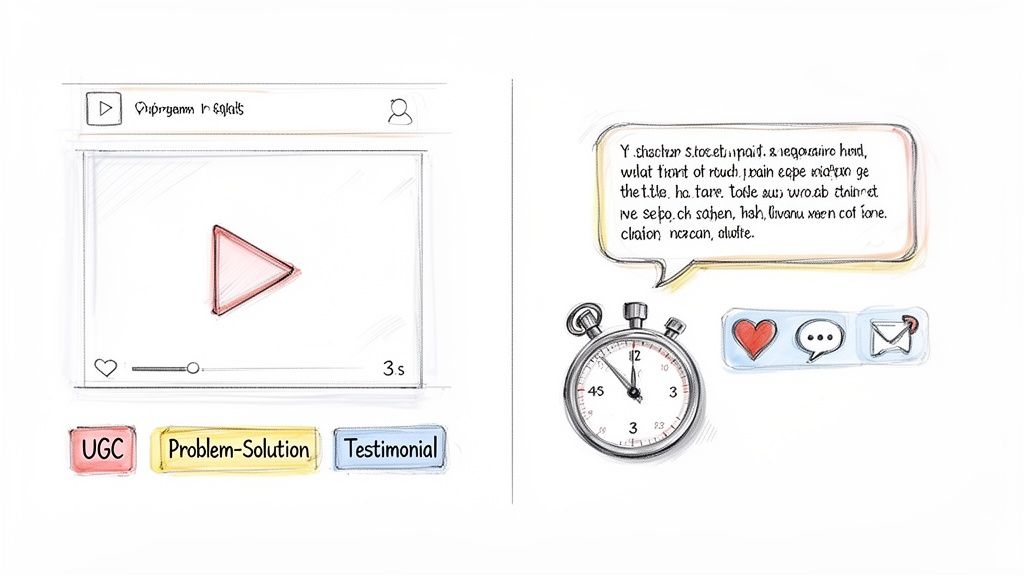
Separating the Winners from the Losers
When you first dive into an ad spy tool, you're going to see an avalanche of creatives. Your first job is to filter out the noise and zero in on ads that are clearly making money. An ad that just launched with a few dozen likes is probably just a test. But an ad that’s been running for 60 days straight with over 20,000 likes? That's a proven winner.
To find these gems, apply a few key filters right away:
- Look for Longevity: Set your filters to only show ads that have been active for at least 3-4 weeks. No one keeps throwing money at an ad that isn't bringing in a positive return on ad spend (ROAS). A long run time is your single best signal of a successful campaign.
- Hunt for High Engagement: Social proof matters. Filter for ads with a significant number of likes, comments, and shares. While engagement alone can be bought or faked, high numbers paired with a long run time are a dead giveaway that an ad is genuinely connecting with people.
- Spot the Variations: Pay close attention when you see a competitor running multiple, slightly different versions of the same core ad. This is a huge clue. It means they've found a winning concept and are now just fine-tuning it to squeeze out every last drop of performance.
Using these simple filtering strategies, you can immediately cut through the clutter and focus your energy on the campaigns that are actually driving sales for your competition.
Breaking Down a High-Converting Ad
Once you've got a handful of winning ads, it's time to put them under the microscope. Don't just watch the video—deconstruct it. The first three seconds of any ad are make-or-break. What are they doing to stop the scroll? Is it a shocking visual, a question, a bold claim?
So many people make the mistake of only watching the video. The ad copy, headline, and the call-to-action (CTA) are just as important. Analyze their language. Are they hitting a specific pain point? Highlighting a unique benefit? Creating urgency with a "limited time" offer?
Think about each ad as a complete package. Your mission is to understand how all the pieces—the hook, the main body, the copy, and the offer—work in harmony to convince someone to click.
The Shopify spy tool world has exploded, with platforms like BigSpy claiming to have databases of over 1 billion ads from 500,000 active advertisers. That's an almost endless library of examples to learn from. And for digging into the tech stack behind a store, tools like Wappalyzer have over 2,000,000 users. If you're looking for a comparison, check out this guide on the best Shopify spy tools.
When you're vetting these ads, it helps to have a checklist. A structured approach ensures you don't miss anything crucial.
Key Metrics for Vetting Competitor Ad Creatives
| Metric | What to Look For | Why It Matters |
|---|---|---|
| Run Time (Longevity) | Ads running for 3+ weeks | Indicates profitability; advertisers don't waste money on failing ads. |
| Social Proof | High number of likes, comments, shares (e.g., 10k+ likes) | Shows genuine audience resonance and engagement. |
| The "3-Second Hook" | A powerful opening visual, question, or statement | Crucial for stopping the scroll and capturing attention on crowded feeds. |
| Video/Image Quality | Clear, high-resolution visuals; may be polished or UGC-style | Reflects brand positioning and helps build trust. |
| Clarity of Offer | Is the deal or value proposition immediately obvious? | Confusion kills conversions. The user should instantly "get it." |
| Ad Copy Angle | Problem/solution, benefit-focused, scarcity, social proof | Reveals the core psychological trigger they are using to persuade. |
| Call-to-Action (CTA) | Clear, direct, and compelling (e.g., "Shop Now," "Get 50% Off") | Tells the user exactly what to do next, reducing friction. |
| Creative Variations | Are they testing multiple versions of the same ad concept? | A strong sign they've found a winning formula and are now optimizing. |
By systematically checking these boxes for each promising ad, you can build a reliable picture of what's working right now in your niche.
Turning Their Strategy Into Your Unique Angle
This is the most critical step: use your research as inspiration, not as a template. You should never, ever just rip off a competitor's ad. For one, it's unethical. But it's also just bad business. By the time an ad is popular enough for you to find it, it’s likely already starting to fatigue on the platform.
Instead, start categorizing the ads you've found by their core marketing angle. You'll start to see patterns.
- The Problem-Solver: Does the ad show a common frustration and then introduce the product as the ultimate solution? (Think of a dull knife mangling a tomato, followed by your product slicing it perfectly).
- The UGC Showcase: Is the ad a montage of real-looking customer videos and testimonials? This builds massive trust and authenticity.
- The Unique Feature: Does the ad focus on one special mechanism or technology that makes their product stand out from everything else on the market?
- The Dream Outcome: Does it focus less on product features and more on the amazing transformation or feeling the customer will get after using it?
Once you identify these proven angles, you can start brainstorming how to apply them to your product in a fresh, new way. For example, maybe you notice every competitor is using the same tired "Problem-Solution" format. This is your chance to break the pattern and stand out with a compelling, high-energy UGC-style ad instead.
This approach lets you build your creative strategy on a foundation of what’s already working, while still giving you the freedom to create a unique brand that people remember.
Validating Demand: Look Beyond the Spy Tool Hype
Spy tool data gives you a fantastic head start, but treating it as gospel is a rookie mistake I’ve seen cost people a lot of money. These tools show you what looks like it’s working for someone else, but they don’t tell the whole story.
Was that huge sales spike from a one-off influencer shoutout, or is there real, sustainable demand? This is the validation phase that separates the amateurs from the pros. It’s about taking the clues you've gathered and checking them against real-world data before you spend a dime on inventory or a big ad campaign.
Get the 30,000-Foot View with Google Trends
Your very first stop after finding a promising product should always be Google Trends. It's free and gives you an invaluable look at consumer interest over time. A spy tool might show a product crushing it this week, but Google Trends tells you if the overall demand is a rising tide, a stable sea, or a wave that's already crashing.
When you pull up a trend graph, you’re looking for a few key patterns:
- Steady Upward Growth: This is the dream scenario. It shows that public interest is growing consistently and organically.
- Seasonal Spikes: Does demand go through the roof every December and then fall off a cliff? Knowing this is critical for planning your inventory and marketing calendar.
- A Sudden, Sharp Peak: Be really careful with products that seem to appear from nowhere with a massive vertical spike. This usually screams "fad," and it'll likely crash just as fast as it rose.
This simple five-minute check can save you from betting big on a "winner" that's already yesterday's news.
Dig into Search Volume and Niche Communities
Okay, so Google Trends shows the direction of interest. Now you need to know the volume. Is "eco-friendly dog toy" getting 1,000 searches a month or 100,000? SEO tools like Semrush or Ahrefs will give you that answer, helping you understand the real size of your potential market. A high search volume is solid proof that people are actively looking for what you want to sell.
Next, it's time to find the people behind the numbers. Go hang out where they do—dive into niche subreddits, Facebook Groups, or specialized forums related to your product.
Search for your product’s name or the problem it solves. Are people passionately recommending it? Or are they complaining about its quality and all the spammy ads they see? This raw, unfiltered feedback is pure gold you will never find in a spy tool dashboard.
Getting inside your customers' heads is everything. Shopify's own data backs this up, showing that a massive 79% of all traffic comes from mobile devices. This forces you to think not just about what product people want, but how they're going to see it. The Pareto principle is also in full effect here; focusing on the top 20% of products that drive 80% of sales is a proven strategy, and spy tools help you pinpoint that 20%. You can dive deeper into these kinds of insights by exploring some data-driven analysis of Shopify sales patterns on WeTracked.
Run a Micro-Test Campaign to Get Real Answers
Ultimately, the only validation that truly matters is whether someone will pull out their wallet. Before you even think about sourcing your product, you can run a cheap "micro-test" to see if people will actually try to buy it.
Here’s a simple but incredibly effective way to do it:
- Throw Up a Simple Landing Page: Build a basic one-page Shopify site that makes the product look amazing. Use the best images and the most persuasive copy angles you found during your ad research.
- Make It a "Coming Soon" Offer: Instead of a "Buy Now" button, use something like "Get Notified at Launch." Hook this up to an email capture form and offer a small discount for signing up to sweeten the deal.
- Drive a Little Traffic: Run a small Facebook or TikTok ad campaign. We’re talking just $50-$100 here. Target the exact audience you think is your ideal customer.
- Check the Numbers: You're not trying to make sales; you're collecting data. Look at your click-through rate (CTR) and, most importantly, your email sign-up conversion rate. A high conversion rate at this stage is a huge green light.
This process takes your product idea from a hunch to a validated concept backed by actual user behavior. Now you can invest and scale with confidence.
Turning Competitive Intelligence Into Action
So, you've done the digging. You’ve pinpointed a hot product, dissected your competitor's ad playbook, and confirmed there’s real money to be made. What now? This is where the real work begins—turning all that raw data into a store that doesn't just compete, but dominates.
The goal isn't to be another "me too" shop. It's to launch with an unfair advantage. By understanding what’s already working for your rivals (and what isn't), you can build a better product listing, a sharper ad campaign, and a smoother customer experience from day one. You’re essentially skipping the expensive trial-and-error phase.
Crafting a Winning Product Description
That ad library you spent hours analyzing? It's more than just a source for creative ideas—it's a goldmine of sales copy that’s already been proven to work. Go back to those top-performing ads you saved. What specific words keep popping up? What frustrations are they constantly highlighting?
Those phrases are the emotional triggers that get people to click. Your job is to expertly weave them into your own product description.
- Steal Their Hooks: If their best ad starts with "Tired of dull knives mangling your tomatoes?" you’ve just discovered a major customer pain point. Use a similar hook in your own copy.
- Talk Like a Customer: Dive into the comments on their ads and the reviews on their product pages. How are real people describing the problem? Mirror their language to build instant trust.
- Echo Proven Benefits: Are they always talking about "saving time in the kitchen"? Make that a core benefit in your bullet points and headlines. They’ve already spent thousands of dollars testing which benefits hit home the hardest.
This isn’t about plagiarizing. It’s about leveraging their market research to build a more powerful story for your brand.
The real magic happens when you combine the persuasive angles from their best ads with the social proof from their customer reviews. This creates a product description that not only promises a solution but feels like it's already been co-signed by hundreds of happy buyers.
Reverse-Engineering the Perfect Tech Stack
A high-converting product page is more than just great copy. The right apps for reviews, upsells, and SMS marketing can be the difference between a 1% and a 4% conversion rate. One of the most overlooked hacks with Shopify spy tools is their ability to reveal a competitor's app stack.
Tools like the PPSPY Chrome extension or Wappalyzer act like an x-ray for any Shopify store, showing you exactly which apps they're running. This is pure gold.
For example, if you see a top competitor is using a premium review app like Loox, an SMS platform like Postscript, and an upsell tool like ReConvert, you've just been handed their conversion playbook. You now know that to compete, you’ll need a strategy for visual social proof, a way to reach customers via text, and a system for increasing average order value.
This process helps you validate every decision with data instead of just guessing what might work.
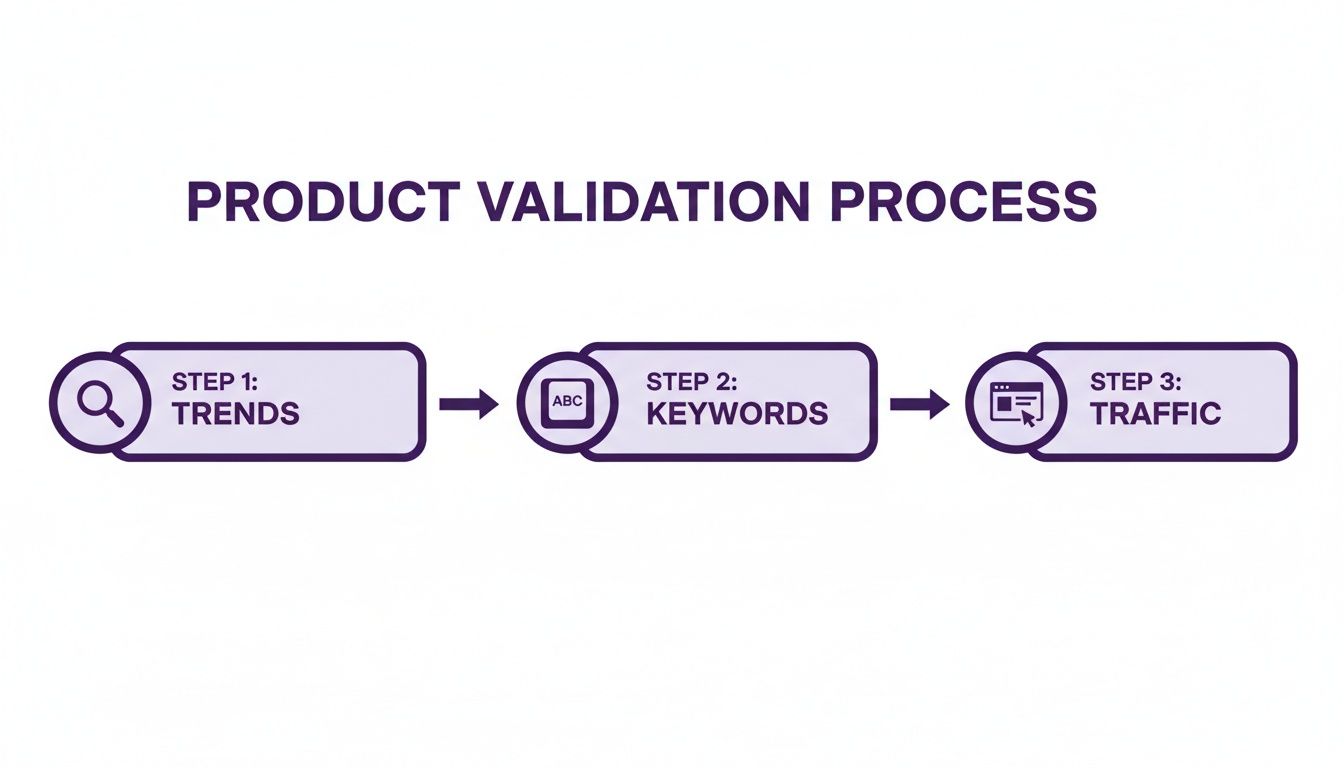
Following a logical flow like this ensures you’re not just throwing things at the wall and hoping they stick. Every choice is intentional.
Building an Offer They Can't Refuse
With all this intel, your final move is to craft an offer that’s simply better than what’s out there. And "better" doesn't always mean cheaper. You can often win by offering more value.
Think about building strategic advantages like these:
- Smarter Bundles: Did you notice customers are frequently buying two specific items together? Create a bundle with a small discount. You make the buying decision easier and immediately boost your average order value.
- A Bolder Guarantee: If they offer a standard 30-day return policy, crush it with a 60-day "love it or it's free" guarantee. This projects massive confidence in your product and removes all risk for the buyer.
- Faster Shipping: This is the Achilles' heel of many dropshippers. If you can find a supplier who can get the product to the customer in 5-7 days instead of 3-4 weeks, you have a game-changing advantage.
- Better Ad Creatives: You’ve seen their best stuff. Now one-up them. Invest in higher-quality user-generated content, write punchier ad copy, or test an entirely new angle they haven’t even considered.
Ultimately, spying on competitors is all about driving your own sales. For any brand, especially in crowded markets, knowing how to improve ecommerce conversion rates is how you turn this valuable insight into actual profit. By systematically analyzing the competition and then building a better product page, tech stack, and overall offer, you transform intelligence into a launchpad for your own success.
Got Questions About Shopify Spy Tools? We've Got Answers.
Jumping into the world of spy tools can feel a bit like getting a cheat code for e-commerce. It's powerful stuff, but it also brings up some fair questions. Let's clear the air on the most common ones so you can use these tools with confidence.
How Accurate Are the Sales and Revenue Numbers, Really?
This is probably the biggest question on everyone's mind. The short answer? Treat any sales or revenue figures you see as well-informed estimates, not gospel.
These tools aren't hacking into anyone's Shopify dashboard. They're using clever algorithms that look at publicly available clues—things like a product's rank on a bestseller list, visible inventory drops, and website traffic data—to piece together an estimate. While some are better than others, they're never going to be 100% accurate.
But that's not the point. The real value isn't in knowing if a store made exactly $10,250 or $15,500 yesterday. It's about seeing the trend—that Product A is consistently crushing Product B, or that a store's revenue has been on a steep upward climb for the last month.
Think of the data as a compass, not a GPS. It points you in the right direction, showing you what's hot and what's not. Use it to spot trends and compare the relative popularity of products.
Is This Whole "Spying" Thing Legal and Ethical?
Let's tackle this head-on. First, on the legal side: yes, using these tools is perfectly legal. They're simply aggregating public information in a smarter, more organized way. It’s sophisticated market research, not a black-hat operation. No private data is ever accessed.
The ethical question is where you come in. There's a huge difference between competitive intelligence and flat-out plagiarism. The goal is to understand strategy, not to steal someone's work.
- Good: See what ad angles are working and use them as inspiration for your own unique campaign.
- Bad: Rip their video ad and re-upload it with your logo slapped on.
- Good: Analyze their product description to see what customer pain points they're hitting.
- Bad: Copy and paste their entire description onto your own product page.
Learn from what’s proven to work in the market—the ad hooks, the product benefits, the sales funnels—and then use that knowledge to build something even better. It’s no different than a clothing brand checking out the competition's store layout and pricing. It's just smart business.
Can I Get By with Just One Spy Tool?
You can definitely get started and find some wins with a single, solid tool. But if you talk to seasoned e-commerce pros, you'll find they almost all use a "stack" of different tools. Why? Because no single tool is the best at everything.
One might have an incredible ad library, another might be killer at tracking Shopify sales data, and a third could be your go-to for sniffing out the specific apps a store is using to boost conversions.
A typical pro workflow often looks something like this:
- Discover: Use a tool like ShopHunter to spot stores that are gaining momentum and uncover their promising products.
- Analyze: Jump over to an ad spy tool like Pipiads to dissect the exact creatives and angles driving their sales.
- Deconstruct: Use a simple Chrome extension like PPSPY or Wappalyzer to see the apps and tech powering their best pages.
By layering the insights from several specialized tools, you get a much richer, more complete picture. It helps you confirm your hunches and avoid the blind spots that come from relying on just one source of information.
How Do I Find Products Before Everyone Else Does?
If you want to get ahead of the saturation curve, you have to look where others aren't. By default, most Shopify spy tools are set to show you the all-time greatest hits. Those products are great for learning, but the ship has likely sailed on them.
The trick is to tweak your filters to find the rising stars.
One of my favorite strategies is to search for newer stores—say, created in the last 6-12 months—that are suddenly ramping up their ad spend. This is a massive tell that a savvy marketer has found a new winner and is starting to scale.
Another tip is to look for ads that are clearly profitable but haven't gone viral yet. Hunt for creatives that have been running consistently for 3-4 weeks with moderate, but not massive, engagement (maybe under 10k likes). This is the sweet spot. It tells you the ad is working and making money, but it hasn't been blasted across the internet for every dropshipper to copy yet. You get to ride the wave just as it’s forming.
Shopify operators: the outils spy pour Shopify hub lists the spy stack included with Ecom Efficiency — without another ranking article.
Ready to stop paying for dozens of separate tools? EcomEfficiency bundles over 50+ premium AI, SEO, and spy tools—including Dropship.io, ShopHunter, Pipiads, and Semrush—into one simple, affordable subscription. Cut your software costs by up to 99% and get the intelligence you need to scale. Start using the entire e-commerce tool stack for just $19.99 at https://ecomefficiency.com.