Understanding Facebook Ads Cost Per Click to Maximize Your ROI

Right now, the average Facebook Ads cost per click (CPC) hovers around $1.14 across all industries. But take that number with a grain of salt. Your actual cost can swing dramatically, from as low as $0.44 to several dollars, all depending on who you're targeting, what you're selling, and your campaign's objective.
The goal is to scale without dubious shortcuts and without hurting your credibility.
Getting a handle on the metrics that drive this cost is the first real step to making your ad budget work for you, not against you.
Decoding Your Facebook Ads Cost Per Click
Think of it like paying for a billboard on a busy highway. You could pay a flat rate for every single car that passes, regardless of whether they even glance at your ad. Or, you could pay only when a driver is so intrigued they pull over to get a better look.
That second option is exactly how Cost Per Click works. In the world of Facebook ads, you're not just paying for eyeballs—you're paying for action. This is incredibly powerful for e-commerce brands on platforms like Shopify, Amazon, or TikTok Shop because it ties your ad spend directly to someone showing real interest.
But to really get smart with your budget, you need to speak Facebook's language.
Key Metrics You Must Know
While CPC gets most of the attention, it doesn't tell the whole story on its own. It's part of a trio of metrics that, together, give you a complete picture of your ad performance. Knowing the difference isn't just helpful; it's essential for staying profitable.
- Cost Per Click (CPC): This is the amount you pay anytime someone clicks anywhere on your ad. That could be a like, a click on your profile name, or a tap on the "read more" button. It’s a great measure of overall engagement.
- Cost Per Mille (CPM): "Mille" is Latin for thousand, so this is simply your cost per 1,000 ad impressions (or views). If your main goal is just getting your brand name out there, you'll be watching CPM closely.
- Cost Per Link Click (CPLC): Now we're getting specific. This is the cost you pay only when someone clicks the link that takes them off of Facebook and over to your website or product page. For any e-commerce business, this is often the most important click metric because it signals true intent to shop.
To really get to grips with your Facebook Ads Cost Per Click, you first need to understand the relationship between PPC vs CPC. People often use the terms interchangeably, but knowing the small differences helps you see how the whole ad auction system fits together.
Let's say you're running an ad for a new pair of sneakers. You might see a high CPC but a low CPLC. That's a huge clue! It tells you people are engaging with your ad (liking, commenting) but aren't clicking through to buy. The creative is good, but your call-to-action is weak. That's the kind of insight that saves you money.
To help you keep these straight, here's a quick cheat sheet.
Key Facebook Ad Metrics at a Glance
| Metric | What It Measures | Best Used For |
|---|---|---|
| CPC (Cost Per Click) | The cost for any click on your ad (like, share, comment, link). | Measuring overall ad engagement and creative appeal. |
| CPM (Cost Per Mille) | The cost to show your ad to 1,000 people. | Evaluating the cost of brand awareness and reach. |
| CPLC (Cost Per Link Click) | The cost for a click that leads to your website or landing page. | Assessing the efficiency of your traffic-driving campaigns. |
At the end of the day, the goal isn't just to get cheap clicks. It’s about getting profitable clicks. Understanding how CPC, CPM, and CPLC play together lets you diagnose problems quickly and turn your ad spend into a reliable engine for growth.
What Is a Good Facebook Ads CPC Anyway?
Trying to nail down a single, universal number for a "good" Facebook Ads CPC is a bit like asking for the price of a car. It all depends on what you're buying. Are we talking about a reliable daily driver or a luxury sports car? The same logic applies to your ad clicks.
A $0.50 click that never leads to a sale is actually very expensive. On the other hand, a $5.00 click that lands you a $200 purchase is an absolute steal. The real answer is that a good CPC is always relative to your store’s unique economics—specifically, your product profit margins and Average Order Value (AOV).
Instead of chasing some vague industry average, the smart move is to figure out your own target CPC. This simple shift turns your ad spend from a guessing game into a predictable financial model.
Understanding Historical CPC Trends
To set some realistic expectations, it’s helpful to look at how the cost of advertising on Facebook has evolved. The platform's ad costs have gone through some major shifts over the years, mostly driven by more and more advertisers jumping into the auction.
For example, the average cost per click shot up from $0.31 in 2018 to $0.45 just one year later. That’s a massive 45% jump as businesses flooded the platform. That trend hasn't stopped, and by 2025, the global average CPC had settled around $1.14. For e-commerce marketers, this history is critical because it shows that costs have roughly tripled in under a decade. This makes running efficient, well-managed ad campaigns more important than ever. You can dig deeper into the full research on Facebook ad cost trends to see how these dynamics have played out.
This infographic breaks down the key ad metrics that feed into your campaign costs, including the all-important CPC.
Each metric—CPC, CPM, and Cost Per Lead—tells a different part of your performance story. Understanding them helps you diagnose where your ad spend is truly going.
How Industry and Campaign Goals Affect CPC
While global averages give you a ballpark, your specific costs will be heavily influenced by your niche and what you’re trying to accomplish. Some industries are just flat-out more competitive, which naturally drives up auction prices.
Here’s a quick breakdown of how costs can differ:
- Highly Competitive Niches: Industries like finance, legal services, or high-ticket electronics often have much higher CPCs. That's because the potential lifetime value of a customer is enormous, so advertisers are willing to bid a lot more for that initial click.
- Less Competitive Niches: Sectors like arts, entertainment, or travel often have lower CPCs, sometimes as low as $0.42. The auction environment is simply less crowded.
Your campaign objective also plays a huge part. Facebook's algorithm optimizes ad delivery based on the goal you choose, and that directly impacts who sees your ad and how much you pay for it.
A Traffic campaign is designed to get the most clicks for the lowest cost, which is why its average CPC often hovers around $0.77. But be warned: these clicks might come from users who are just browsing, not buying. A Conversions campaign, on the other hand, targets users who are more likely to make a purchase, making its CPC inherently higher.
This is a perfect example of why a higher CPC isn't automatically a bad thing. Paying more for a click from a high-intent shopper is almost always a better investment than paying less for a click from someone who’s just passing by. The key is to always connect your Facebook Ads cost per click directly to your actual business outcomes.
The Six Key Factors That Drive Your CPC
Trying to understand your Facebook Ads cost per click isn't about finding some magic button for cheaper ads. It’s really about getting a grip on the six core levers that control the price you pay. Think of the ad auction less like a fixed-price store and more like a bustling stock market—prices are constantly shifting based on supply, demand, and quality.
Once you grasp how these six factors play together, you can shift from just accepting high costs to actively driving them down. Each one is a real opportunity to make your ad spend smarter and your campaigns more profitable.
Audience Targeting and Competition
First up, and arguably the biggest driver, is who you're trying to reach. Picture this: you and a dozen other brands are all trying to sell high-end running shoes to the exact same group of marathon runners.
Because that audience is so valuable and specific, the competition to get in front of them is fierce. This battle for attention drives up the bids in the ad auction, which in turn pushes up your CPC. On the flip side, targeting a much broader, less competitive audience will almost always get you a lower cost per click, but you might be sacrificing click quality in the process.
Key Takeaway: The more valuable and specific your target audience, the more you should expect to pay per click. The real trick is finding that sweet spot between audience quality and cost-effectiveness.
Ad Creative and Quality
Let's be clear: Meta’s number one job is to keep people scrolling happily on its platforms. Because of that, the algorithm is designed to reward advertisers who create ads that people actually want to see.
An ad with a thumb-stopping video, a gorgeous image, or copy that hits just right will naturally get more clicks, comments, and shares. All those positive signals tell Facebook your ad is delivering a good user experience, which directly improves its quality score.
Think of a high quality score as a discount in the ad auction. Facebook will often show a great ad over a competitor's, even if the competitor bid more. This means investing in top-notch creative is one of the most powerful things you can do to lower your Facebook Ads cost per click.
Your Bidding Strategy
How you tell Facebook to spend your budget has a massive impact on your final costs. You've got a few options, but for most e-commerce brands, it usually comes down to Lowest Cost and Cost Cap.
- Lowest Cost (or Highest Volume): This tells Facebook, "Get me the most clicks you can for my budget." It’s fantastic for driving sheer volume but can lead to CPCs that are all over the map.
- Cost Cap: Here, you set a ceiling on the average CPC you're willing to pay. This gives you way more control over your costs but might throttle your ad's reach if your cap is too low to compete in the auction.
Which one is right for you? It all comes down to your campaign goals. Are you just trying to get as many eyeballs as possible, or do you need to hit a very specific cost per acquisition?
Ad Placements
Not all ad placements are created equal. Where your ad shows up across Meta's ecosystem—whether it's the Facebook News Feed, an Instagram Story, or the Audience Network—can dramatically change your cost per click.
Some spots are just more valuable and competitive. For instance, Instagram ads tend to be the priciest, averaging around $0.60 per click. On the other end of the spectrum, the Audience Network is way cheaper at just $0.06 per click, but the traffic quality can sometimes be questionable. As you can see in these stats from a KlientBoost analysis of ad placement costs, it's critical to test different placements and see which ones deliver the best results for your budget.
Seasonality and Competition
The ad world has its own seasons, and costs can go through the roof during peak shopping times. The most obvious example is the "Black Friday effect," when the entire fourth quarter becomes a feeding frenzy of advertisers all fighting for holiday shoppers.
During these periods, the auction gets incredibly crowded. With so much demand for ad space, everyone ends up paying more for the same clicks. An ad that cost you $0.50 per click in August could easily cost $1.50 or more in late November. Experienced advertisers know this and either increase their budgets for these spikes or launch their campaigns early to lock in lower costs before the madness begins.
The Post-Click Experience
Finally, Facebook's job doesn't stop at the click. The algorithm also pays close attention to what happens after someone clicks your ad. It’s analyzing the quality of your landing page.
If users click your ad only to land on a page that’s slow, confusing, or looks terrible on a phone, they'll bounce immediately. Facebook sees this. These negative signals drag down your ad's overall quality score, and the algorithm can penalize you with higher CPCs over time.
A smooth, fast-loading, and relevant landing page that delivers exactly what your ad promised is non-negotiable. It doesn’t just boost your conversion rate; it also sends all the right signals back to Facebook, helping you keep your ad costs under control.
Actionable Strategies to Lower Your Facebook CPC
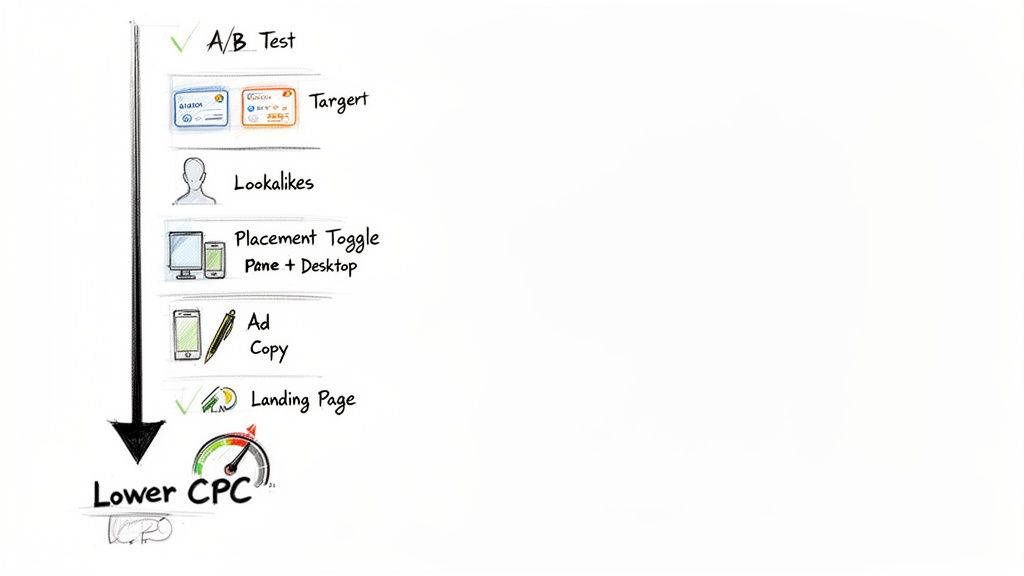
Knowing what drives your Facebook ads cost per click is half the battle. Actually getting in there and lowering it is what really matters. So, let's switch from theory to practice with a handful of proven optimizations you can start using today.
Each of these strategies hits one of the core CPC drivers we've talked about—audience, creative, and relevance. The goal here isn't just about getting cheaper clicks; it's about getting better clicks for less money.
Relentlessly Test Your Ad Creatives
Your ad creative is, without a doubt, the biggest lever you can pull to influence your CPC. Think about it: a boring, generic ad in a fast-scrolling feed is just going to get ignored. That signals a low click-through rate (CTR) to Meta, which their algorithm interprets as a lack of relevance, and your CPC shoots up.
To fight this, you need a mindset of constant testing. Don't just launch a single ad and cross your fingers. Instead, you should be running structured A/B tests on every single piece of your creative.
- Format: Pit a punchy video against a beautiful lifestyle photo. See how a carousel ad that shows off multiple products performs against a simple, single-image ad.
- Hooks: The first three seconds of a video or the headline on an image ad are everything. Test different opening lines, ask a provocative question, or share a surprising statistic to see what makes people stop scrolling.
- Angles: How are you framing your product’s benefits? Test whether your audience bites on an angle about "saving money," "saving time," or maybe achieving a certain lifestyle.
- Calls to Action (CTAs): It might seem small, but even switching "Shop Now" to "Learn More" can completely change user intent and have a massive impact on your click costs.
When you test creatives systematically, you’re feeding the algorithm valuable data. This helps it find the right audience for your ad much faster, which almost always brings your CPC down.
Sharpen Your Audience Targeting
Running a killer ad to the wrong audience is like putting up a brilliant billboard in the middle of the desert. It doesn't matter how great it is if the right people never see it. Nailing your targeting is a direct path to a lower Facebook ads cost per click because you stop wasting money on users who were never going to be interested anyway.
The first step is to move past broad, interest-based targeting. It can be expensive and often feels like you're just guessing. Instead, focus on building high-quality audiences that give Meta much clearer signals about who you're after.
Build High-Quality Lookalike Audiences
Lookalike audiences are one of Meta's most powerful tools. Instead of guessing who your customers are, you can literally upload a list of your best customers and let the algorithm find millions of users who share similar traits.
A pro tip is to create Lookalikes from your most valuable sources. Think lists of repeat buyers, customers with the highest lifetime value (LTV), or even just people who spent the most time on your website. A 1% Lookalike will give you a smaller audience, but it will be far more precise, which usually leads to a lower CPC right out of the gate.
Implement a Smart Retargeting Funnel
Not every website visitor is the same. Someone who added a product to their cart is way more valuable than someone who bounced off your homepage after five seconds. Segment your retargeting audiences based on where they are in your funnel, and then tailor your ad message to match. That boost in relevance almost always improves your CTR and lowers your CPC.
Optimize Your Ad Placements
By default, Facebook will happily take your money and run your ads everywhere using its "Advantage+ placements." While this can work, it often spreads your budget too thin, wasting cash on low-performing spots like the Audience Network, which is notorious for cheap but low-quality clicks.
The fix? Switch to manual placements once your campaign has a bit of data. Just go into your Ads Manager reports and use the "Breakdown" menu to view performance by placement. You'll probably find that just one or two placements—like Instagram Stories or the classic Facebook Feed—are driving almost all of your high-quality clicks.
By simply turning off the placements that aren't working, you force your budget into the spots that are. This makes you more competitive in the auctions that actually matter, which can improve both your CPC and your overall results. For more in-depth tactics, this guide on 10 Facebook Ad Strategies That Actually Work for e-commerce brands is a fantastic resource.
Enhance Your Post-Click Experience
Finally, never forget that Meta’s algorithm is watching what happens after someone clicks your ad. If users click through to your landing page and immediately bounce, it tells the system your ad might be misleading or the page experience is just plain bad. This creates a negative feedback loop that can drive up your Facebook ads cost per click.
Make sure your landing page feels like a natural continuation of your ad. The headline, the images, and the offer should all match up perfectly. And most importantly, your page absolutely must be mobile-friendly and load in a flash. A slow-loading page is a certified campaign killer, so run speed tests and compress your images to give users a smooth ride from click to conversion.
To help you put all this into action, here’s a quick checklist you can use to diagnose and fix high CPCs.
High-Impact CPC Optimization Checklist
This table breaks down the key areas to focus on and explains why each action helps lower your costs.
| Optimization Area | Action Item | Why It Works |
|---|---|---|
| Ad Creative | A/B test different video hooks, image styles, and ad copy. | Finds the combination that grabs the most attention, increasing CTR and relevance. |
| Audience | Build Lookalike Audiences from high-LTV customer lists (e.g., 1%). | Targets users who are statistically similar to your best customers, increasing click intent. |
| Audience | Segment retargeting by user action (e.g., cart abandoners vs. page viewers). | Delivers a more relevant message to "warmer" leads, making clicks more likely and cheaper. |
| Placements | Analyze placement data and disable low-performing ones (e.g., Audience Network). | Concentrates budget on high-performing placements where your ideal customers are. |
| Landing Page | Ensure your landing page message and visuals match your ad perfectly. | Reduces confusion and bounce rate, sending positive signals to Meta's algorithm. |
| Landing Page | Optimize page load speed, especially for mobile users. | Prevents users from leaving before the page loads, improving the post-click experience. |
By working through this checklist, you can systematically identify and fix the weak spots in your campaigns, leading to more efficient ad spend and a healthier return on your investment.
Calculating Your Break-Even CPC and Ad Spend
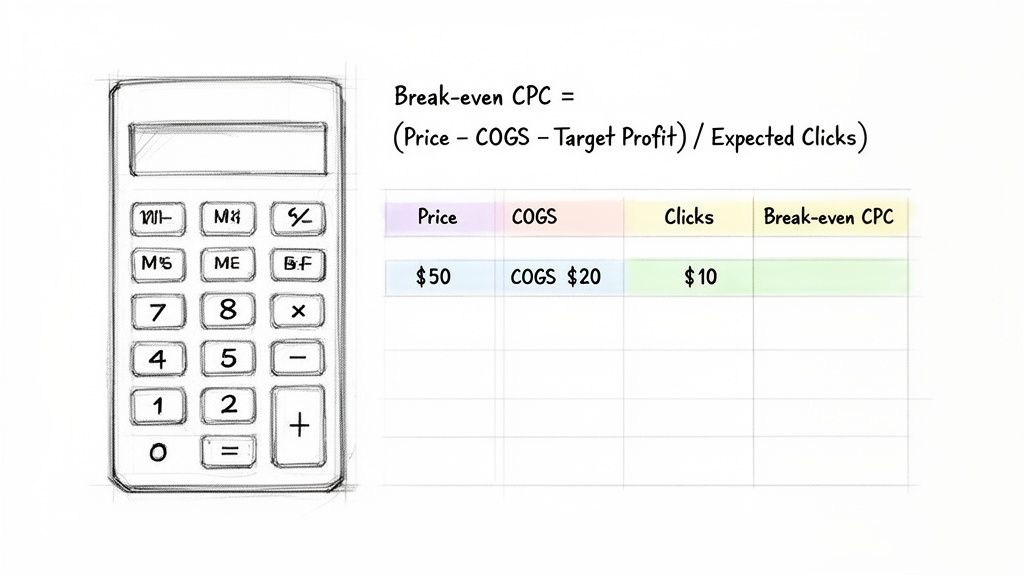
Knowing what drives your Facebook ads cost per click is one thing, but that knowledge alone doesn't pay the bills. If you want to run truly profitable campaigns, you have to get proactive. It’s time to move beyond just watching your metrics and start managing them based on the actual economics of your business.
This means knowing, down to the penny, the absolute highest CPC you can afford before a campaign starts burning cash. Don't worry, this isn't some complex financial modeling. It's a simple, powerful calculation that transforms CPC from a confusing number into a predictable lever for growth. Once you know your break-even point, you can set bid caps, adjust budgets, and make smart decisions that protect your profit margins with total confidence.
The Break-Even CPC Formula
At its core, your break-even CPC really comes down to two things: how much profit you make on a product and how well your website converts visitors into buyers. The formula simply connects the cost of a click to the profit you get from a sale, telling you exactly what you can afford to spend to get a customer in the door.
To get started, you'll need three key numbers:
- Average Order Value (AOV): How much does a customer typically spend in a single purchase?
- Cost of Goods Sold (COGS): What does it cost you to get that product into the customer's hands, including manufacturing and shipping?
- Website Conversion Rate (CVR): What percentage of people who land on your site actually buy something?
Once you have these figures, you can pinpoint your maximum affordable CPC.
A Practical Example for a Shopify Store
Let's walk through a real-world scenario. Imagine you run a Shopify store selling a popular skincare product for $50.
First, figure out your profit per sale. The product costs you $15 to produce and ship (your COGS). That means your profit on each sale is $50 (AOV) - $15 (COGS) = $35.
Next, factor in your conversion rate. Let's say your site has a solid 2% conversion rate. This means that for every 100 clicks you buy from Facebook, you make 2 sales.
Now, let's calculate your break-even CPC. If 100 clicks lead to 2 sales, and each sale brings in $35 in profit, then those 100 clicks generated $70 in total profit (2 sales x $35). To break even, the absolute most you can spend on those 100 clicks is $70. So, your break-even CPC is $70 / 100 clicks = $0.70.
This $0.70 is your magic number. Any CPC below this means you're making money on every conversion. Any CPC above it means you're losing money. Knowing this figure lets you set precise cost caps and judge campaign performance with absolute clarity.
This calculation is especially vital given how much costs can swing. The global average CPC recently hit $1.14, but costs can jump all over the place depending on your industry, the competition, and even the time of year. Knowing your break-even point gives you a stable financial anchor in a constantly changing ad market. It’s always a good idea to check out the latest Facebook ads cost benchmarks to see how current trends might impact your strategy.
Facebook CPC: Your Questions Answered
As you get into the weeds of managing your Facebook campaigns, you’ll inevitably run into questions about your cost per click. It's common to see costs bounce around for reasons that aren't immediately clear, which can be frustrating. This section is here to clear the air, tackling the most common questions advertisers ask so you can troubleshoot issues and manage your budget with more confidence.
Think of this as your field guide for figuring out the "why" behind your CPC. Nailing these concepts will help you react smartly when costs spike instead of panicking, leading to better decisions for your overall strategy.
Why Did My Facebook CPC Suddenly Skyrocket?
We've all been there. Your campaign is humming along nicely, and then, out of nowhere, your cost per click shoots through the roof. This kind of sudden jump is rarely a random fluke. It’s almost always a signal that something has changed in the ad auction.
Usually, one of two things is happening:
Ad Fatigue: This is a classic. Your audience has seen your ad so many times they’ve started to tune it out completely. When your click-through rate (CTR) drops, Facebook’s algorithm flags your ad as less relevant and starts charging you more to show it. The fix? Refresh your creative. New images, videos, or even just a tweak to your headline can breathe new life into a tired ad.
More Competition: You’re not bidding in a bubble. A new competitor might have just launched a massive campaign targeting the very same people you are. Or, it could be a seasonal rush like Black Friday when everyone is trying to get in front of buyers. This flood of new bidders drives up the auction price for everyone. Your move is to either raise your bids to stay in the game or pivot to a less crowded audience segment.
A sudden cost increase is a cue to investigate, not to hit the panic button. Start by checking your ad frequency, then take a look at the bigger picture to see if the competitive landscape has heated up.
Is a Super-Low CPC Always a Good Thing?
It’s tempting to chase the lowest possible CPC, but be careful—this can be a classic case of winning the battle but losing the war. A rock-bottom CPC isn't the real goal here. Profitable customer acquisition is. Sometimes, an extremely low cost per click is actually a red flag.
For instance, you might snag a $0.15 CPC by targeting a massive, low-competition audience in a country with lower purchasing power. But if none of that traffic ever converts because they can't afford or aren't interested in your product, you've just thrown money away, no matter how cheap the clicks were.
A higher CPC that targets a high-intent audience—like a Lookalike built from your best customers—is often a much better investment. A $2.50 click from a user who is highly likely to make a $100 purchase is infinitely more valuable than ten $0.25 clicks that lead to zero sales.
Always, always judge your Facebook ads cost per click in the context of your return on ad spend (ROAS). The quality of the person clicking is way more important than the cost of the click itself.
How Long Should I Let a Campaign Run Before I Start Tweaking It?
Patience is a superpower in Facebook advertising. You absolutely have to give the algorithm enough time and data to work its magic during the "learning phase." If you jump in and start making major changes too early, you can reset the whole process, and your campaign may never hit its stride.
So, how long is long enough?
A solid rule of thumb is to wait until an ad set has exited the learning phase, which usually happens after it gets about 50 optimization events (like purchases or leads) within a 7-day window. If you aren't hitting that volume, let the campaign run for at least 3 to 5 days before you make any big moves.
This initial period gives the algorithm the runway it needs to test the waters, explore different pockets of your audience, and figure out who is most likely to click and convert. Once you have that baseline data, you can start optimizing with confidence—turning off ads that are duds or shifting budget to the winners.
What’s the Difference Between CPC (All) and Link Clicks?
This is a common point of confusion when digging through Facebook Ads Manager reports, but the difference is huge for understanding what's actually working. These two metrics measure very different actions.
CPC (All): This number represents the cost for any click on your ad. That includes likes, comments, shares, clicks on your Page name, or even taps on the "see more..." text. It’s a broad measure of how engaging your creative is in general.
CPC (Link Click): For most e-commerce brands, this is the metric that really matters. It measures the cost only for clicks on the specific link that takes someone off Facebook and over to your website or product page. This is your best indicator of how efficiently you're driving actual traffic.
Your CPC (All) will almost always be lower than your CPC (Link Click). If you see a massive gap between the two, it might mean your ad is great at getting reactions but isn't doing its main job: getting people to visit your store. That's a great insight, telling you that you might need a stronger, clearer call-to-action.
Ready to slash your software costs and unlock the top e-commerce tools for growth? EcomEfficiency bundles over 50+ premium platforms for product research, SEO, and ad creation into one simple subscription. Stop paying thousands per month and start optimizing your entire operation for just $29.99. Join our community of 1,000+ ambitious sellers and get started at EcomEfficiency.