How to Analyze Competitor Website Traffic: A Practical Guide to Rivals' Insights

Before you even think about analyzing competitor traffic, you need to know who you're up against. Start by picking 3-5 of your closest competitors. Use a tool like Semrush or Similarweb to get a quick read on their traffic volume and where it’s coming from. This isn’t just about collecting data; it's about shifting your strategy from guesswork to surgical, data-backed decisions that can help you win your market.
The goal is to scale without dubious shortcuts and without hurting your credibility.
Why Competitor Traffic Analysis Is Your Secret Weapon
In e-commerce, looking at your competitors' traffic isn't just a "nice-to-have" task—it's your strategic intelligence mission. It's how you survive and grow. The whole point is to reverse-engineer what's already working for others, which saves you a ton of time and money you’d otherwise spend on trial and error. This isn't about blindly copying them. It's about finding proven opportunities they’ve already validated.
The insights you uncover will directly shape some of your most critical business decisions:
- Smarter Marketing Spend: See which channels (organic search, social, paid ads) are actually driving results for them, so you can stop wasting money and double down on what works.
- High-Intent Keyword Discovery: Unearth the exact keywords your rivals rank for that bring in customers with their wallets out, ready to buy.
- A Proven Content Strategy: Figure out which blog posts, guides, or videos are resonating with your shared audience, handing you a ready-made content roadmap.
- Product Development Insights: Identify which of their product pages get the most traffic, which is a massive signal of strong market demand you can tap into.
The E-commerce Battleground
The sheer scale of e-commerce makes this kind of analysis non-negotiable. Giants like Amazon pull in around 2.7 billion monthly visits, which accounts for over 20% of the total traffic share. Now, you’re probably not going toe-to-toe with Amazon, but their numbers show just how many potential customers are out there.
In a market expected to hit $7.9 trillion in sales, the brands that really get a handle on traffic acquisition are the ones converting two to three times better than everyone else. New channels are constantly popping up, too. For example, some AI chatbots are now referring traffic that converts at an incredible 11.4%, blowing the typical 5.3% from organic search out of the water. If you're curious, you can explore more global e-commerce statistics to see how the top players attract their audiences.
Key Takeaway: Competitor analysis isn't about vanity metrics. It’s a direct line to understanding customer behavior, market trends, and hidden growth levers that can sharpen your ad spend and drive more revenue.
From Data to Decisions
The real goal here is to turn raw numbers into a smarter game plan. For instance, just a quick glance inside a tool like Similarweb can give you a high-level dashboard of a competitor’s performance.
This initial snapshot tells you their traffic story at a glance—are they growing, shrinking, or just treading water? It gives you that crucial baseline before you start digging into the specific channels and pages that are driving their results.
To make sense of all this, it helps to have a clear idea of what you're looking for. Here’s a quick rundown of the core metrics you'll want to benchmark.
Key Traffic Metrics to Benchmark Against Competitors
| Metric | What It Tells You | Recommended Tool |
|---|---|---|
| Total Monthly Visits | The overall size of their audience and brand awareness. Are they a giant or a niche player? | Similarweb, Semrush |
| Traffic Sources | Where their visitors come from (e.g., Organic, Paid, Social). This reveals their marketing mix. | Similarweb, Ahrefs |
| Average Visit Duration | How long people stay on their site. Longer duration often signals engaging, relevant content. | Similarweb |
| Bounce Rate | The percentage of visitors who leave after viewing only one page. High bounce rates can indicate poor user experience or mismatched intent. | Similarweb |
| Top Pages | Which specific pages get the most traffic. This points to their most popular products, content, and offers. | Semrush, Ahrefs |
| Top Keywords | The search terms driving their organic traffic. This is a goldmine for your own SEO and content strategy. | Semrush, Ahrefs |
Tracking these metrics gives you a structured way to compare apples to apples. It’s the foundation for building a strategy that doesn't just compete, but gives you a real edge.
Building Your Competitor Intelligence Toolkit
The secret to great competitor analysis isn't just about having the right tools; it’s about having the right process. You need a repeatable workflow that turns a mountain of data into a handful of smart decisions. And the first step, the one most people get wrong, is figuring out who you’re really up against.
It’s easy to get fixated on the industry titans. But while it's good to keep an eye on them, your most dangerous competitors are often the scrappy, up-and-coming brands that are quietly stealing your clicks and customers right now. These are your true search rivals.
Identifying Your Real Competitors
Before you can peek at their traffic, you have to know whose door to knock on. You know your direct competitors—the ones with similar products and audiences. But your digital competitors can be a whole different ballgame.
- Organic Search Rivals: Who’s actually showing up on Google for the keywords you care about? Pop your domain into a tool like Semrush and see who else consistently ranks for your money terms. Don't be surprised if a popular industry blog is eating your lunch for high-intent keywords.
- Product Catalog Overlaps: If you're running an e-commerce store, tools like ShopHunter are gold. They can sniff out other stores (especially on Shopify) selling the exact same products. This is how you find the dropshippers and niche brands targeting your customers with a nearly identical offer.
By looking beyond the usual suspects, you get a much more accurate map of the competitive battlefield. This ensures your analysis focuses on the businesses that are actually impacting your bottom line. Integrating powerful SEO tools like Rank Math can also help round out your understanding of the organic landscape.
Creating Your Competitor Dashboard
Once you’ve narrowed down a list of 3-5 key competitors, it's time to get organized. Constantly jumping between different tools is a recipe for chaos. The pro move? Build a simple "Competitor Dashboard" in a Google Sheet or Notion page.
This isn’t about building something fancy. Think of it as your command center—a single place to monitor the vital signs of your competition. A little structure upfront makes the entire process sustainable and helps you connect the dots later.
A dedicated dashboard transforms random data points into a coherent story about your competitors' strategies, highlighting trends and opportunities you might otherwise miss.
All you need to start is a simple table. This organized view will become the foundation for everything, making it easy to spot patterns at a glance.
Here’s a basic structure I like to use:
| Competitor URL | Monthly Visits | Bounce Rate (%) | Top Organic Keyword | Traffic Mix (Org/Paid/Soc) | Notes/Observations |
|---|---|---|---|---|---|
| competitorA.com | 150,000 | 45% | "vegan leather handbag" | 60% / 10% / 20% | Big traffic spike in May. Looks like a new product launch. |
| competitorB.com | 85,000 | 62% | "eco friendly tote bag" | 80% / 5% / 10% | That bounce rate is high. Maybe their landing page isn't matching intent. |
| competitorC.com | 45,000 | 38% | "crossbody bag for travel" | 30% / 40% / 15% | Leaning hard on paid ads. I should check out their ad creative. |
This simple snapshot, updated monthly or quarterly, immediately brings critical questions to the surface. Why is Competitor C spending so much on ads? What’s Competitor A doing to keep visitors engaged? This is how you turn simple data collection into a real intelligence-gathering operation.
Uncovering Your Competitors' Traffic Strategies
Alright, with your dashboard ready to go, it’s time to put on your detective hat. Analyzing a competitor’s website traffic is so much more than just gawking at their visitor numbers. It's about taking apart their customer acquisition engine, piece by piece, to see what makes it tick.
You're trying to find the story behind the stats. This is how you stop wondering how many visitors they get and start understanding exactly how they get them. Let's peel back the layers on their marketing playbook, one channel at a time.
Deconstructing Their Traffic Acquisition Channels
Every competitor has a unique marketing mix. Some are SEO wizards, dominating organic search. Others are pouring cash into paid ads or have built a loyal following on social media that sends them a steady stream of customers. Your first job is to map this out to find their strengths—and your opportunities.
Using a tool like Similarweb, you can get a surprisingly clean breakdown of where their traffic is coming from:
- Organic Search: This shows you the exact keywords bringing them customers for free. Are they ranking for high-intent terms like "buy [product name]," or are they capturing attention with top-of-funnel content like "how to solve [problem]"?
- Paid Search: Here’s where you get a peek at their ad spend and messaging. What pain points are they hitting on in their copy? Which keywords are they willing to pay for? It’s a direct window into their paid strategy.
- Referrals: This channel is an absolute goldmine for finding partnership opportunities. A huge chunk of referral traffic often points to solid affiliate programs, guest posts on influential blogs, or features in popular newsletters you could also get into.
- Social: Forget vanity metrics. Which platforms are actually driving clicks? A competitor might have a massive Instagram following, but you could discover that a tiny, niche forum is sending them way more qualified traffic.
Here's a real-world example: I once worked with an e-commerce brand that was getting crushed on Instagram. After digging into their top rival's traffic, we found that a whopping 20% of their referral traffic came from a single, highly specific subreddit. We immediately pivoted, started genuinely participating in that community, and opened up a brand-new, high-converting channel we never would have found otherwise.
Finding Their Money-Making Pages
Once you know where their traffic is coming from, you need to see where it's going. I’m not talking about their homepage or "About Us" page. You want to uncover their Top Pages—the specific URLs that pull in the most eyeballs.
This gives you a direct look at what your shared audience truly cares about. Are their most popular pages...
- Best-Selling Product Pages? This is a huge signal of market demand. If a competitor's page for a specific product is getting thousands of organic visits, you know people are hungry for it.
- High-Traffic Blog Posts? This is basically a free, proven content roadmap. If their guide on "10 Ways to Use [Product]" is their most popular article, you know exactly what kind of educational content your audience is actively searching for.
- Viral Landing Pages? These are often tied to a specific campaign or promotion. Analyzing them can show you what kind of offers or marketing angles are successfully turning visitors into customers.
This whole process boils down to a simple workflow: identify, track, and analyze. It's the core loop for turning raw data into strategic gold.
Following this flow keeps you from getting lost in the numbers and helps you focus on finding actionable intelligence you can use.
Benchmarking Against the E-commerce Giants
While you’re zeroed in on your direct rivals, don't forget to zoom out and look at the big picture. The major players set the tone for the entire market, and understanding their scale provides some crucial context.
For instance, Amazon is on track to hit nearly 1.3 billion unique monthly web visitors in 2025. That completely overshadows even a fast-growing marketplace like Temu at 314.9 million. These numbers aren't just for show; they reveal deep insights into customer behavior. A site like eBay holds a user's attention for an average of 6.06 pages and has a low 44% bounce rate—that's the kind of engagement worth studying.
In a world with 2.71 billion online shoppers, every channel matters. Even new sources like AI-powered chat, which can convert at an impressive 11.4%, shouldn't be overlooked.
If you’re on Shopify and a competitor on Etsy (with its 438 million visits and 6.12 pages per visit) is leaving you in the dust, it’s a clear signal to investigate their ad sources with tools like Pipiads. This is especially true with social commerce projected to become a $2.9 trillion market by 2026.
For a deeper look at these industry-wide trends, I highly recommend you review the complete 2025 global e-commerce report.
Keeping an eye on these benchmarks helps you understand what "good" actually looks like. By combining a deep analysis of your direct competitors with a broader awareness of market trends, you can build a much more resilient and effective growth strategy.
Peeking Behind the Curtain: Platform-Specific Competitor Insights
Broad traffic metrics are great for a 10,000-foot view, but the real gold is found when you zoom in on the specific platforms where your competitors are actually making their sales. To get an edge, you have to dig deeper than general traffic sources and start hunting for signals on Shopify, TikTok Shop, and Amazon. This is where you uncover the product, ad, and keyword intelligence that you can act on immediately.
Think about it: a generic tool might tell you a competitor gets a lot of social traffic. So what? Platform-specific digging, on the other hand, can reveal the exact viral TikTok ad that’s driving a spike in sales. That’s the kind of intel that moves you from simply watching your competitors to outmaneuvering them.
Uncovering Shopify Sales and Product Data
When you're up against a Shopify store, one of the most valuable things you can learn is what's actually selling. This information is a goldmine for product research and market validation, but you won't find it in a standard traffic report. You need a specialized tool for that.
Platforms like ShopHunter are built specifically for this. They can analyze a Shopify store and give you surprisingly accurate estimates on:
- Best-Selling Products: Instantly see which items are their top performers, giving you a direct line into what your shared audience is buying right now.
- Recent Product Launches: Get notified when they drop new products, so you can see what they're testing and how the market reacts.
- Estimated Daily and Monthly Revenue: This helps you benchmark your own store and identify the fast-growing competitors you really need to watch.
This isn’t about just ripping off their product catalog. It’s about using their sales data as a real-world market signal to inform your own strategy, potentially saving you thousands on inventory that won't move.
Decoding TikTok Shop and Viral Ads
TikTok has completely changed the e-commerce game. Success here isn't about traditional SEO; it's about viral ad creative, trending sounds, and lightning-fast trends. Often, a single great video can make a product take off overnight. Your job is to find those videos.
This is where ad-spy tools like Pipiads are an absolute must-have. You can filter for ads running on TikTok Shop and quickly uncover:
- Top-Performing Ad Creatives: See the exact videos, hooks, and calls-to-action that are capturing attention and driving clicks.
- Trending Products: Spot products that are just starting to catch fire before the market gets completely flooded.
- Ad Spend Estimates: Get a feel for how much a competitor is pushing a specific product with paid ads.
Watching a competitor's winning TikTok ads is like getting a free masterclass in what makes your audience tick. You learn what messaging, video styles, and offers are working right now—without spending a dime of your own ad budget to find out.
Winning on Amazon with Reverse ASIN Lookups
If you're selling on Amazon, it's all about keywords. The fight for visibility is fierce, and the difference between landing on page one versus page three often comes down to a few crucial search terms. A reverse ASIN lookup is your best tool for uncovering the exact keywords that fuel a top competitor's sales.
Using a tool like Helium10, you can take a competitor's product ASIN (Amazon Standard Identification Number) and essentially reverse-engineer their keyword strategy. It will spit out a list of the organic and paid keywords they rank for.
This data lets you:
- Find High-Converting Keywords: Discover the long-tail phrases that actual buyers are typing into the search bar.
- Optimize Your Own Listings: Beef up your product titles, bullet points, and backend search terms with proven keywords.
- Identify Content Gaps: See what relevant keywords your competitors are ranking for that you've completely missed.
To make this easier, here's a quick reference guide for your platform-specific analysis.
Platform-Specific Analysis Cheatsheet
This table helps you quickly identify the right questions to ask and the best tools to use for uncovering unique insights on the top e-commerce platforms.
| Platform | Key Question to Answer | Recommended Tool | Actionable Insight |
|---|---|---|---|
| Shopify | What are their best-selling products and estimated revenue? | ShopHunter | Validate market demand for new products and benchmark your own sales performance. |
| TikTok Shop | What viral ad creatives are driving their sales? | Pipiads | Model your own video ads based on proven hooks, styles, and offers. |
| Amazon | Which keywords are driving traffic to their top product listings? | Helium10 | Find and target high-intent keywords to improve your product's organic rank and PPC campaigns. |
Use this cheatsheet as a starting point to guide your investigation and turn raw data into a real competitive advantage.
Don't Forget the Mobile Experience
Across every one of these platforms, there's one undeniable truth: mobile is king. It's a point that can't be overstated. Data shows that mobile devices are on track to generate 78% of all retail website traffic by 2026. With mobile sales projected to soar to $2.51 trillion in 2025, ignoring this segment is simply not an option. You can explore more of these key e-commerce statistics to see the full picture.
This means any serious competitor analysis has to include a mobile-first audit. Pull up your competitor’s site on your phone. Is it fast? Is the checkout process smooth or a total pain? A clunky, frustrating mobile experience is a massive weak point. Sometimes, the biggest competitive advantage isn't some secret product—it's simply a better mobile site that makes it easy for customers to give you their money.
Turning Your Analysis Into Actionable Growth
Let’s be honest: insights without action are just interesting trivia. You've just spent hours digging into your competitors' traffic data, and while that’s great, the real magic happens when you turn those numbers into a concrete growth plan. This is where the rubber meets the road.
All the effort you've put into learning how to analyze competitor website traffic leads to this moment. It's time to shift from intelligence gathering to strategic execution.
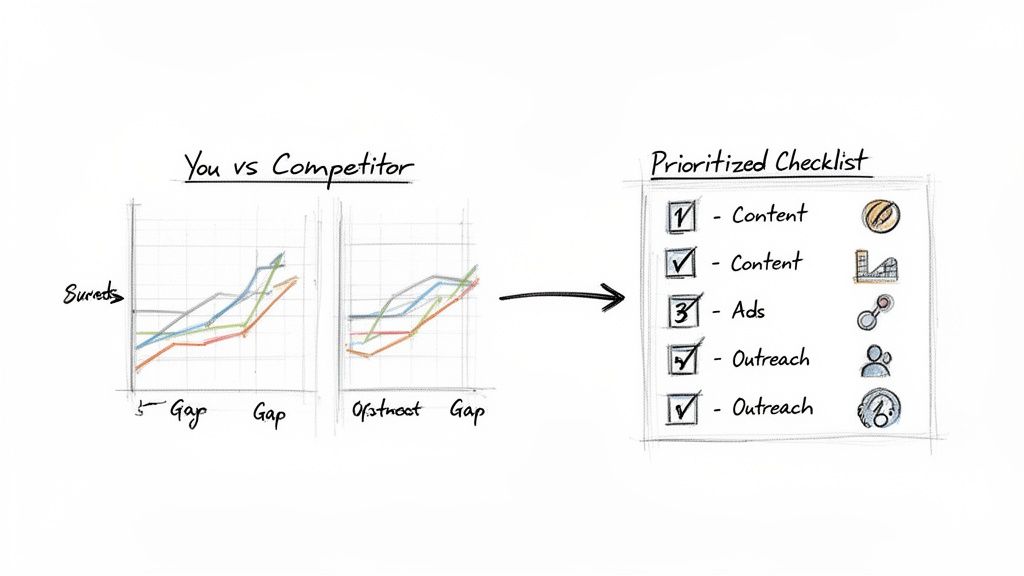
Building Your Gap Analysis Framework
The quickest way to get started is with a simple Gap Analysis. Don't overthink it—this isn't some complex financial model. It's just a straightforward comparison to make your biggest opportunities jump off the page.
Fire up a spreadsheet and create a few columns: "Metric," "Your Performance," "Competitor's Performance," "The Gap," and "Action Item." Now, start plugging in your most compelling findings. The goal here is to make the opportunities impossible to ignore.
For instance, a high-level gap analysis might look like this:
| Metric | Your Store | Competitor X | The Gap & Opportunity | Action Item |
|---|---|---|---|---|
| Top Referring Site | Coupon Site (low quality) | Major Industry Blog | They're getting high-authority traffic; we're not. | Pitch a guest post to that industry blog. |
| Top Organic Keyword | "Brand Name" | "How to solve X problem" | They own a crucial problem-solving keyword. | Create a new content series about solving problem X. |
| Top Social Channel | Instagram (1.5k visits/mo) | TikTok (15k visits/mo) | We're completely missing out on TikTok traffic. | Launch a three-ad test campaign on TikTok. |
See how that works? This simple chart forces you to translate every data point into a tangible next step. It’s the engine that turns your analysis into a prioritized to-do list.
Key Takeaway: An action plan isn't a vague goal like "improve SEO." It's a specific, measurable task like "Optimize three product pages for the keyword gaps we discovered."
Prioritizing Your Action Items
You’re probably looking at a long list of potential actions now. It's easy to get overwhelmed, but prioritization is simple. Just score each item against two factors: Impact and Effort.
I like to use a quick 1-to-5 scale for each. A high-impact, low-effort task is a no-brainer—a quick win you should tackle immediately. Something with low impact and high effort can probably wait.
- Quick Wins (High Impact, Low Effort): These are your top priorities. A great example is optimizing a few product page titles with competitor keywords you found. It’s a fast job with potentially huge returns.
- Major Projects (High Impact, High Effort): Think of these as game-changers that require real resources. Building out a comprehensive blog to challenge a competitor's content dominance falls squarely in this category. Block out time for these in the next quarter.
- Fill-In Tasks (Low Impact, Low Effort): These are small improvements you can knock out when you have a spare hour. Maybe you'll tweak some ad copy based on a competitor's messaging you admired.
- Re-evaluate Later (Low Impact, High Effort): These ideas are often not worth the investment right now. Stick them on the back burner and check back in six months to see if things have changed.
From Analysis to Tangible Next Steps
Let's make this real. Based on the kind of insights you've probably gathered, your immediate action plan could include concrete tasks like these:
- Launch a TikTok Ad Test: You noticed your competitor’s top social traffic source is TikTok, and it’s all driven by those scrappy, user-generated-style videos. Your next move? Create three short video ads that mimic that style and launch a small test campaign targeting a similar audience.
- Optimize Product Pages for Keyword Gaps: Your analysis with a tool like Semrush flagged three high-intent keywords that are sending a ton of traffic to a competitor's product page. Meanwhile, those keywords are nowhere to be found on your equivalent page. Your action is to rewrite your product descriptions and meta titles for those three pages to include these exact terms.
- Pitch a High-Value Guest Post: You discovered your rival's top referring domain is a major industry blog that you also read. Your action item for this week is to brainstorm three unique article ideas that would resonate with that blog's audience and send a personalized pitch to their editor.
This focused, step-by-step approach is the final, and most critical, piece of the puzzle. It guarantees that the time you invested digging through data translates directly into activities that will grow your traffic, improve your conversions, and—most importantly—increase your revenue.
Common Questions & Quick Answers
Even with a great set of tools, you're bound to have questions as you dig into a competitor's traffic. That's perfectly normal. Here are some of the most common ones I get, along with straightforward answers to keep you moving.
Just How Accurate Are These Traffic Analysis Tools?
This is always the first question, and it's a good one. Let's be clear: tools like Semrush and Similarweb provide sophisticated estimates, not a carbon copy of your competitor's Google Analytics. They can't be 100% precise.
But that's not where their real value lies. Their true power is in providing directional data and accurate proportions.
Think of it this way: instead of fixating on whether a competitor got 100,000 or 110,000 visitors last month, focus on the trends. Is their organic traffic climbing? What percentage of their audience comes from social media versus paid ads? That's the strategic gold. Use these tools for high-level comparisons, not exact headcounts.
Is It Legal and Ethical to Do This?
Yes, absolutely. Peeking at aggregated, anonymized traffic data using public tools is standard market research. It’s no different than walking into a competitor's store to see how they merchandise their products.
You aren't accessing any private data, server logs, or personal customer information. The ethical line is simple: use what you learn for inspiration, not imitation. See what's working for them and use it to brainstorm ways to improve your own marketing, content, and product strategy. Never just copy and paste their ad creative or blog posts.
My Take: Think of competitor analysis as fuel for your own creativity. The goal is to understand what resonates with your shared audience so you can build something even better that’s true to your own brand.
How Often Should I Be Checking Competitor Traffic?
This really depends on how fast your market moves. For most e-commerce brands, a comprehensive deep-dive once a quarter is the sweet spot. This is often enough to catch major strategic shifts and see the results of big campaigns without getting bogged down.
I also recommend a quick monthly check-in. This can be as short as 30 minutes just to monitor their overall traffic trends and spot any new pages that are suddenly taking off.
- Quarterly Deep-Dive: The full works—traffic sources, top pages, keyword gaps, referrers, and ad strategy.
- Monthly Check-In: A quick look at total visits, the channel mix, and any surprising new top-performing content.
- Weekly (Optional): If you're in a lightning-fast niche (like certain dropshipping categories) or rely heavily on social ads, a weekly glance at their ad creative on a tool like Pipiads can be worthwhile.
This rhythm keeps you informed without creating analysis paralysis.
What if My Competitor Is a Goliath?
Going up against a huge company can feel daunting, but it's actually a gift. They're essentially doing your market research for you on a massive scale. Forget trying to match their ad budget—you'll burn through your cash in a week.
Instead, let them spend the big money to validate ideas. Then, you can strategically adapt what’s proven to work for your own scale.
Here's where to focus:
- Content Themes: What customer problems are their top articles solving? This is a direct signal of what your audience is desperate to learn.
- On-Page SEO Structure: Look at their best-performing pages. How do they use keywords in titles and headers? Learn from their structure and apply it to your own long-tail keyword strategy.
- The Customer Journey: Trace their funnel. What kind of lead magnets do they offer? What emails do they send to new subscribers? This can spark incredible ideas for your own acquisition process.
You can't outspend them. But by being more agile and targeted, you can absolutely outsmart them.
Ready to stop guessing and start winning? EcomEfficiency bundles over 50 premium e-commerce tools like Semrush, Similarweb, Helium10, and Pipiads into one affordable subscription. Get the intel you need to analyze competitors, find winning products, and grow your store, all while saving up to 99% on software costs. Start your EcomEfficiency plan today and turn competitor insights into your unfair advantage.