How to Start a Dropshipping Business That Actually Succeeds
So, you want to start a dropshipping business. At its core, the process is pretty simple: you find a solid niche, build an online store that people trust, and then get the right customers to see your products. The real beauty of this model is that you sell things you never physically touch, which makes it one of the most accessible ways to jump into e-commerce.
The goal is to scale without dubious shortcuts and without hurting your credibility.
Your Blueprint for a Modern Dropshipping Business
Dropshipping is an e-commerce model where you, the store owner, don't actually stock any products. When a customer buys something from your site, you turn around and purchase that item from a third party—like a manufacturer or wholesaler—who then ships it directly to your customer. You're essentially the middleman, and you never have to deal with inventory.
This completely changes the startup game. Forget needing a massive loan to buy inventory that might not even sell. Your main job shifts from managing boxes in a warehouse to what really grows a business: great marketing, building a memorable brand, and creating an amazing customer experience.
And the timing couldn't be better. The dropshipping market was already valued at a staggering USD 365.7 billion in 2024 and is expected to explode to USD 1,253.79 billion by 2030. With about 27% of online retailers already using this model, getting in now means you're catching a massive wave. You can dig into more data on these market trends to see just how big the opportunity is.
The Core Dropshipping Workflow
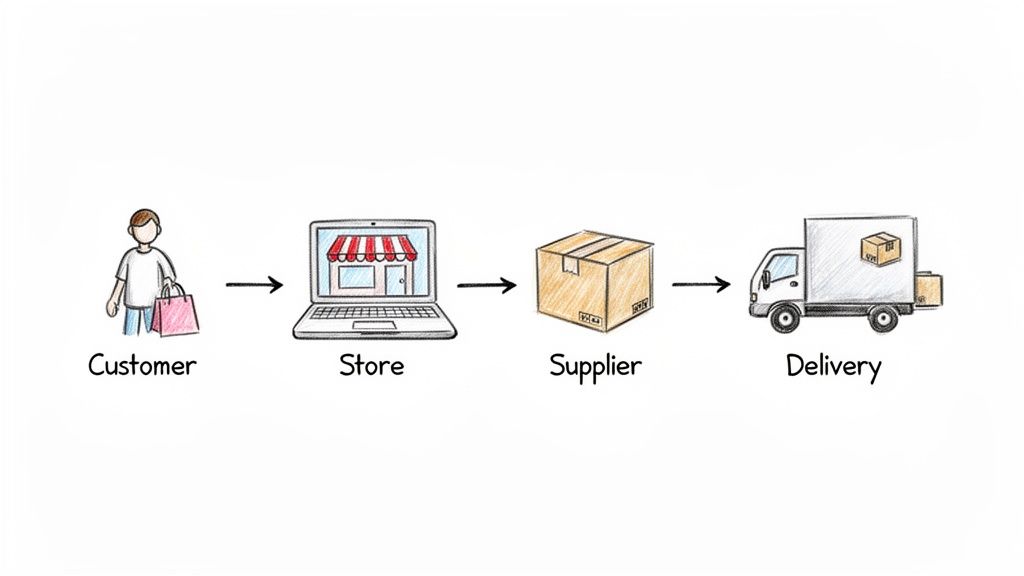
When you boil it down, the entire journey from idea to first sale can be broken into three key phases.
This diagram gives you a bird's-eye view of the entire process.
This shows that success isn't just about finding a cool product. It’s about building a complete system that brings in customers and convinces them to buy.
Think of it like a three-legged stool. If one leg is weak, the whole thing falls over. You could find the perfect niche, but if your store looks sketchy, no one will buy. A beautiful store with zero marketing is just a ghost town. Real success happens when these three elements are firing on all cylinders.
Key Takeaway: The days of finding a single "winning product" and getting rich overnight are mostly gone. Modern dropshipping is about building a real, sustainable brand. It demands a smart approach to choosing your niche, optimizing your store, and using data to guide your marketing decisions.
To give you a quick reference, here's a checklist that breaks down the entire launch process.
Quick Start Dropshipping Checklist
| Phase | Key Action | Essential Tool from EcomEfficiency |
|---|---|---|
| 1. Niche & Product Research | Identify a profitable market segment and source reliable products. | Niche Finder to analyze market trends and profitability. |
| 2. Supplier Vetting | Find and partner with trustworthy suppliers who ship quickly. | Supplier Database to connect with pre-vetted partners. |
| 3. Store Setup & Branding | Build a professional-looking and high-converting Shopify store. | Store Spy to analyze top competitor designs and layouts. |
| 4. Marketing & Acquisition | Launch targeted ad campaigns on platforms like Facebook & TikTok. | Ad Spy to uncover winning ad creatives in your niche. |
| 5. Optimization & Scaling | Analyze performance data to improve conversion rates and scale ads. | Performance Analytics to track key metrics in one dashboard. |
This roadmap highlights the crucial steps you'll need to master.
Fortunately, today's toolkits give newcomers a massive advantage. Platforms that bundle powerful research, spy, and marketing tools into a single subscription have leveled the playing field. Instead of shelling out thousands for a dozen different services, you can get everything you need in one spot. This frees up your cash for the one thing that matters most at the start: your ad budget.
Finding Your Profitable Niche and Winning Products
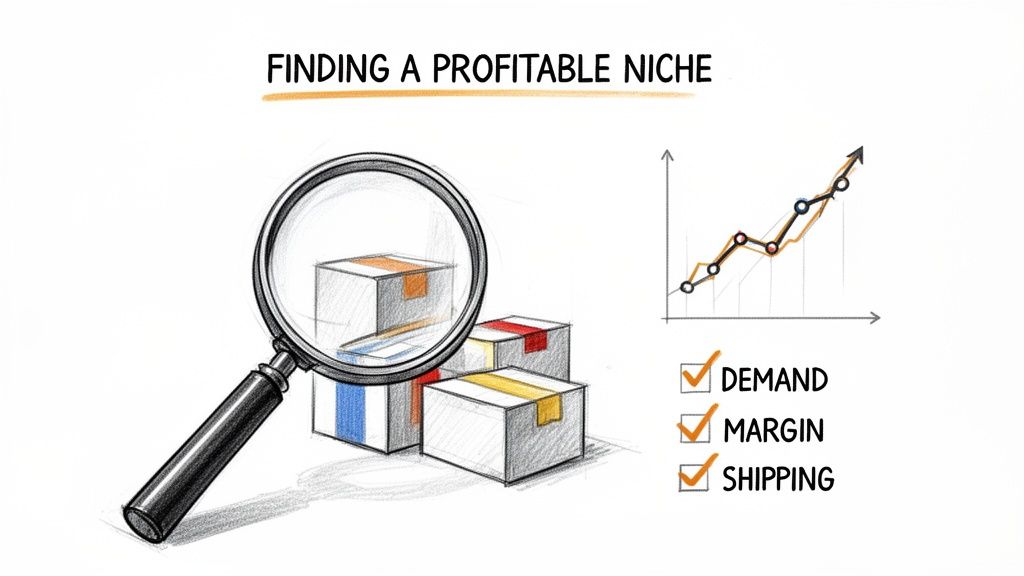
Let's be blunt: choosing your niche is the single most important decision you'll make. Get this right, and everything that follows—your marketing, your audience, your profitability—gets a whole lot easier. Picking a niche because you saw a "hot products" list on TikTok is a surefire way to burn through your budget and end up with nothing to show for it.
The sweet spot for a successful niche is where your personal interests, real customer demand, and market viability all overlap. You don't need to be the world's leading expert, but having a genuine interest in what you're selling will carry you through the inevitable tough days. That passion also shines through, making your marketing feel authentic and helping you connect with customers on a deeper level.
Brainstorming and Validating Niche Ideas
First things first, let's cast a wide net. Don't overthink it; just start listing ideas. What are your hobbies? What problems have you solved for yourself recently? Have you ever seen a product and thought, "I could definitely sell that"?
A great way to start is by looking at broad categories and then immediately niching down. For example, instead of just "pet supplies" (which is way too broad), you could dig into something like "customizable accessories for small dog breeds" or "eco-friendly cat toys." The real goal here is to find a dedicated, passionate audience that the big-box retailers tend to ignore.
Once you’ve got a list, it's time to put on your detective hat and validate these ideas with actual data. This is where we move from wishful thinking to real strategy. You need proof that people are actively searching for and, more importantly, buying these kinds of products.
Tools like Exploding Topics or Google Trends are fantastic for spotting interest that's on the rise before a market gets oversaturated. This can give you a huge first-mover advantage. From there, keyword research tools will tell you the monthly search volume for specific product terms, confirming that active demand actually exists.
Criteria for a Winning Niche
As you start analyzing your ideas, you'll want to run them through a mental filter. A profitable dropshipping niche almost always shares a few key traits.
- Passionate Hobbyist Audience: Think about hobbies like hiking, home brewing, or miniature painting. These folks are often willing to spend good money on quality gear and are incredibly active on social media, which makes them much easier to target with ads.
- Problem-Solving Products: Items that solve a specific, nagging problem have a built-in value proposition. Think of ergonomic office gear for people working from home or smart home gadgets that make daily routines a little less painful.
- High Perceived Value: The best products are the ones where what the customer thinks it's worth is much higher than what it costs you. This is how you build healthy profit margins. Unique jewelry, specialized kitchen tools, or custom art prints are perfect examples.
Pro Tip: Steer clear of niches completely dominated by a few massive brands. Trying to compete with the likes of Nike or Apple for customer loyalty is a losing battle you can't afford. Look for fragmented markets with lots of smaller players instead.
Finding Products People Actually Want to Buy
Alright, you've landed on a promising niche. Now comes the fun part: finding specific "winning" products to stock your digital shelves. This isn't about finding one miracle product that will make you rich overnight. It's about building a curated catalog that resonates with your ideal customer. A single winning product is a trend; a strong brand with a solid product lineup is a business.
A smart first move is to spy on your direct competitors. What are their bestsellers? What are they pushing hard in their social media ads? Using tools like ShopHunter or the ad-spy features in the EcomEfficiency suite can give you an incredible behind-the-scenes look at top-performing stores and their most popular items. This is a massive shortcut.
Use that intel to spot gaps in the market. Maybe your competitors are selling a popular product but their shipping times are terrible, or their product photos look like they were taken on a flip phone. That's your opening to swoop in and offer a much better customer experience.
| Product Selection Criteria | Why It Matters for Dropshipping | Example |
|---|---|---|
| Price Point ($50 - $200) | High enough for a healthy profit margin after ad spend, but low enough that customers don't need to think about it for weeks. | A high-quality portable blender. |
| Light & Easy to Ship | Keeps your shipping costs low and avoids the logistical headaches that can kill your profits and lead to angry customers. | Smart-home LED light strips. |
| Not Easily Found Locally | If they can just grab it at Walmart on their way home, why would they wait a week for you to ship it? You need some exclusivity. | A specialized Japanese kitchen knife. |
| Solves a Problem | Products that offer a clear solution are infinitely easier to sell. Your marketing practically writes itself. | A posture-correcting back brace. |
When you focus on these criteria, you stop being just another person selling random stuff online. You become a curator—a trusted brand that understands and serves a specific community. This is the foundation you need to build a truly profitable and sustainable dropshipping business.
Finding Your Partners: Sourcing Suppliers and Nailing Logistics
Let's be blunt: your supplier is the most important piece of your dropshipping puzzle. They aren't just a vendor; they're your warehouse, your shipping department, and your quality control team all rolled into one. A fantastic supplier leads to happy customers and a thriving business. A bad one? They can absolutely crater your brand before you even make your first sale.
Finding and properly vetting these partners isn't just a box to check—it's the foundation of a business built to last. Many newcomers start on massive platforms like AliExpress, which is a great place to get your feet wet. But you have to look past the tempting price tag. Your real mission is to find someone who acts like a true extension of your own brand.
How to Vet Potential Suppliers Like a Pro
Before you even think about listing a product, you need to do some serious homework on the supplier. Treat it like you're hiring a critical employee. A slick-looking storefront and a history of good reviews are just the starting point.
Here’s a quick-and-dirty checklist I run through every single time:
- The Communication Test: Fire off a message with a couple of specific questions about a product. How fast do they reply? Is their English clear and professional? If a supplier takes two days to answer a simple pre-sale question, imagine the headache you'll have when a customer's order goes missing.
- Order a Sample (Non-Negotiable!): This is the single most important thing you can do. You have to physically hold the product. Feel it. Use it. Does it live up to the pictures? Is this something you’d be genuinely proud to sell? This is also your chance to get a real-world feel for their packaging and actual shipping times.
- Deep-Dive the Reviews: Don't just glance at the star rating. Dig into the actual reviews, especially the one- and two-star ones. Look for patterns. Are people consistently complaining about slow shipping, items arriving broken, or getting the wrong product? These are giant, flashing red flags.
Finding reliable partners is crucial in any market, but it’s a make-or-break factor in specialized niches. For example, finding high-quality dropshippers for jewelry requires a whole different level of scrutiny to ensure you're not selling junk.
Crucial Insight: Your supplier’s performance is your performance. Your customer has no idea who your supplier is, nor do they care. If an order is late or the product is cheap, they blame you. Never, ever cut corners on supplier quality.
Getting a Handle on Global Logistics and Shipping
One of the trickiest parts of dropshipping is managing customer expectations around shipping. You have to be brutally honest about delivery times. If a product is going to take three weeks to arrive from overseas, you need to state that clearly on the product page, in the cart, and in your order confirmations.
The global supply chain plays a huge role here. The Asia-Pacific region currently dominates the market, holding 35.2% of the global share and growing at a staggering 24.5% CAGR. This means sourcing from places like China can give you an incredible cost advantage, but it comes with the trade-off of longer shipping times compared to North America’s 23.5% CAGR growth.
Building a Seamless Fulfillment Machine
Once you’ve locked in a few solid suppliers, it's time to build a system that runs on autopilot. You want orders to flow from your customer to your supplier without you having to lift a finger.
Here's how that simple workflow looks:
- Connect Your Store: Use an app like DSers or AutoDS to link your Shopify store directly with your supplier. This is what enables one-click (or even zero-click) fulfillment.
- Automate the Order: When a customer hits "buy," the app instantly pushes all the order details—product, quantity, shipping address—straight to your supplier.
- Sync Tracking Info: As soon as the supplier ships the package, the app grabs the tracking number and automatically sends a shipping confirmation email to your customer.
This kind of automation is what frees you up to work on your business instead of in it. You can focus your energy on marketing and customer experience, which is where the real growth happens. As you start to scale, you can even hire dedicated dropshipping agents to bundle orders and find faster shipping lines, turning your logistics from a liability into a competitive advantage.
Building a High-Converting Store and Brand
Your online store is so much more than a catalog of products. It’s your digital storefront, the face of your brand, and the engine that drives your sales. In a market this crowded, just having a website up and running won't cut it. You need to build a professional, trustworthy experience that nudges casual browsers into becoming paying customers.
Think of it this way: your products are the "what," but your brand and store are the "why." They’re the reason someone chooses you over a dozen other stores selling the exact same item. This is your chance to stop being just another dropshipper and start building a real, memorable brand.
Choosing Your E-commerce Platform
Before you can get into the fun stuff like design, you need to pick a home for your store. There are a few solid options out there, but let’s be real: for most people getting into dropshipping, Shopify is the undisputed champion. It’s built from the ground up for e-commerce, plays nicely with all the major dropshipping apps, and has a massive library of themes and tools.
But it’s not the only game in town. Platforms like WooCommerce (which runs on WordPress) give you a ton of flexibility if you're a bit more tech-savvy. On the other hand, BigCommerce comes loaded with powerful features right out of the box. Your choice really comes down to your technical skills and where you see your business going.
Let's break down the main contenders.
Platform Comparison for Your Dropshipping Store
Choosing the right foundation for your online store is a critical first step. This table compares the top e-commerce platforms to help you decide where to build your dropshipping business.
| Platform | Best For | Key Advantage | Consideration |
|---|---|---|---|
| Shopify | Beginners & most dropshippers | Incredibly user-friendly with a huge app ecosystem specifically for dropshipping. | Monthly subscription fees can add up as you grow. |
| WooCommerce | Those wanting full customization | It's an open-source plugin for WordPress, offering unlimited flexibility and control. | Steeper learning curve; requires you to manage your own hosting and security. |
| BigCommerce | Scaling businesses | Powerful built-in features with 0% transaction fees, which is great for high-volume stores. | The theme editor isn't as intuitive as Shopify's for total beginners. |
Ultimately, there's no single "best" platform—just the best one for you. That said, for 90% of new dropshippers, Shopify’s ease of use and dedicated support system make it the smartest and fastest way to get your store off the ground.
Key Insight: Don't get stuck in analysis paralysis. The best platform is the one you can launch quickly and manage efficiently. For the vast majority of newcomers, Shopify is the clear winner.
Crafting a Brand That Connects
Your brand is your store’s personality. It’s your logo, your color scheme, the way you write your product descriptions—it’s the entire vibe a customer gets when they land on your site. A strong brand builds trust and makes you stand out from the noise.
Start with the essentials:
- Pick a memorable name: It should be easy to say, spell, and ideally, hint at what you sell.
- Design a professional logo: You don't need a huge budget for this. Tools like Canva are perfect for creating a clean, simple logo in minutes.
- Define your color palette: Stick to two or three main colors that match your brand's personality. Think earthy tones for an eco-friendly brand or bright, playful colors for a store selling kids' toys.
This visual identity is the glue that holds everything together. Use it consistently across your website, social media, and customer emails to create a cohesive and professional look.
Designing a Store That Sells
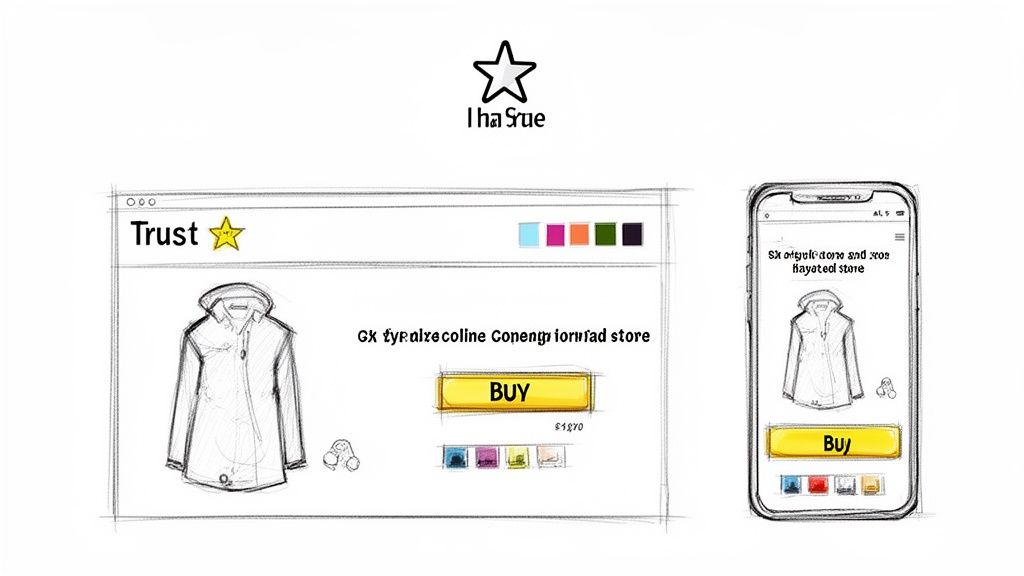
With your platform and branding sorted, it’s time to actually build the store. The goal here is a clean, intuitive experience that makes it dead simple for customers to find what they want and hit "buy."
First impressions are everything. A visitor decides if they trust your site in a matter of seconds. That’s why high-quality product photos are an absolute must. If your supplier's images are grainy or generic, order a sample and take your own. It's worth the effort.
Next, write product descriptions that actually sell. Don't just list specs and features. Tell a story. Explain how your product solves a real problem or makes the customer's life better. Use bullet points to highlight the main benefits so people can scan them easily.
Knowing how to improve ecommerce conversion rate is critical for turning that traffic into revenue. Small changes—like simplifying your checkout process, adding trust badges (like "Secure SSL Checkout"), and showcasing real customer reviews—can make a massive difference in your sales numbers. Your mission is to remove every single obstacle between a person landing on your site and completing their purchase.
The opportunity here is massive. With global e-commerce sales projected to hit $7.4 trillion in 2025, the dropshipping model is perfectly positioned to capture a piece of that pie. In fact, it already has a 27% adoption rate among online retailers. This trend is especially strong for sellers on Shopify and TikTok Shop who are targeting US and European shoppers hungry for fast, affordable products. This is why putting in the work to build a store that truly converts is one of the most important things you'll do.
Getting Your First Sales: Time to Market Your Store
Let's be brutally honest: a beautiful store with amazing products is completely useless if no one ever sees it. This is where the real work begins. Marketing is the engine that will drive people to your website and, more importantly, land those crucial first sales. The old "if you build it, they will come" mindset is a surefire way to fail. You have to go out and find your customers.
In the world of dropshipping, paid advertising is your launchpad. While long-term strategies like SEO are essential for sustainable growth, they're a slow burn. Right now, you need momentum. You need sales. That means getting comfortable with paid ads on the platforms where your target audience lives and breathes.
Your Go-To Channels: Paid Social Ads
For most new dropshippers, the game is won on TikTok and Facebook (which includes Instagram). These platforms have mind-blowingly powerful targeting algorithms that let you zero in on the exact type of person most likely to buy your product. The goal isn't just to get clicks; it's to find a profitable formula where every dollar you put into ads brings back more than a dollar in profit.
This is where you can get a massive head start by legally spying on your competition. Instead of throwing money at the wall to see what sticks, use ad-spy tools to see what’s already working for successful stores in your niche.
Tools like Pipiads (for TikTok) or the ad library features in platforms like EcomEfficiency are your secret weapon. They let you peek behind the curtain at your competitors' winning ad videos, their sales copy, and even their targeting strategies. This is a shortcut that can save you thousands of dollars in failed experiments.
Making Ads That Actually Work
The ad creative—the video or image—is everything. You have less than three seconds to stop someone from scrolling past. That generic, boring product photo your supplier gave you? It’s not going to work.
Your creative has to do one of two things, instantly:
- Show the Problem & Solution: If you’re selling a gadget that fixes a common annoyance, show it in action. A video of a posture corrector actually making someone sit up straight is infinitely more powerful than a static photo of the product.
- Sell the Feeling: If it's a lifestyle product, sell the emotion, not the item. An ad for a portable projector shouldn’t just show the device; it should show a group of friends laughing and having an amazing outdoor movie night.
Pro Tip: The best-performing ads often look like they were filmed on a phone by a regular person. This user-generated content (UGC) style feels authentic and builds trust way more effectively than a polished, corporate-looking ad.
Once you’ve grabbed their attention, your ad copy has to close the loop. Keep it short and focus on the benefits. Use a clear, urgent call to action (CTA) like "Shop Now & Get 50% Off" to push them to click.
To really get an edge, the pros are using influencer marketing and AI to stand out. Analyzing competitor traffic with a tool like Similarweb and generating unique ad visuals with AI like Midjourney (both accessible through EcomEfficiency) can dramatically improve your odds. You can find more on the tools and strategies transforming the dropshipping landscape here.
Don't Forget the Long Game: Organic Growth
Paid ads get you off the ground, but you can't rely on them forever. You need to build a foundation for free, organic traffic. This is what turns a quick-cash project into a sustainable, sellable business.
Focus your organic efforts on two key areas:
- Search Engine Optimization (SEO): This is all about getting your store to show up on Google when people search for products like yours. Start with the basics—write unique, keyword-focused titles and descriptions for every product. A great next step is to start a blog with helpful articles related to your niche, which will attract people who are still in the research phase.
- Content & Social Media: Build a genuine presence on one or two social platforms where your customers hang out. Don't try to be everywhere. Post content that’s actually useful or entertaining, not just constant sales pitches. Share customer photos, run polls, and create a community around your brand.
By pairing the immediate firepower of paid ads with the steady growth of an organic strategy, you create a powerful one-two punch. The ads will bring in your first sales and the cash flow you need to reinvest, while your organic efforts slowly build a loyal following and a brand that lasts.
Scaling Your Business for Long-Term Growth
Getting your store live and seeing those first few sales roll in is an incredible feeling. But that's just the starting line. The real work—and the biggest rewards—come from turning that early momentum into a business that lasts. This is the point where you stop thinking like a founder and start acting like a CEO, focusing on data, your customers, and smart expansion.
The path to scaling isn't easy. While dropshipping has a low barrier to entry, the reality is that only about 10% of entrepreneurs make it past their first year. This stat alone should tell you how critical it is to have strategies backed by solid data, not just guesswork.
The opportunity is massive, though. Over 27% of online retailers are already using a dropshipping model, and the entire market is projected to skyrocket to USD 2,268.19 billion by 2032. You can dive deeper into the explosive growth of the dropshipping market to see just how big this is, but the takeaway is clear: data-driven decisions are what separate the winners from the rest.
Let Your Store's Data Tell You What to Do
Think of your analytics dashboard as your business's command center. This is where you trade gut feelings for hard facts. To make the right calls, you need to get comfortable, even a little obsessed, with the numbers that reveal the true health of your store.
Here are the key performance indicators (KPIs) you should be checking constantly:
- Conversion Rate: This is simple: what percentage of your store visitors actually buy something? If it's low, something is broken. It could be your product pages, your pricing, or a clunky checkout process.
- Average Order Value (AOV): How much is the typical customer spending in a single order? You can directly influence this by offering product bundles or a small upsell discount. Think, "Want to add fries to that?"
- Customer Lifetime Value (CLV): What's the total profit you make from a single customer over time? A high CLV is the holy grail. It means you have happy, repeat buyers, which is always cheaper and more sustainable than constantly chasing new ones.
Key Takeaway: Stop guessing what works. Let your data be your guide. A small improvement in your conversion rate can have a much bigger impact on your bottom line than finding a new "winning" product.
Build a Brand People Trust with Great Service
As you grow, customer service will either become your secret weapon or your Achilles' heel. Every email, every comment, every return request is a chance to create a lifelong fan or a very loud critic.
Especially in dropshipping, where shipping times can sometimes be out of your control, fantastic service is how you stand out. It builds a brand people actually trust and want to tell their friends about.
Make sure you have a simple, clear returns policy and don't hide it. When a customer reaches out with an issue, get back to them fast and be human. A little empathy goes a long way. Even if processing a return costs you a few bucks today, the long-term value of keeping that customer happy is almost always worth it.
Smart Ways to Expand Your Operations
Scaling isn't just about cranking up your ad spend. Real, sustainable growth comes from building a more resilient and diversified business. Once you've got a system that's consistently profitable, it's time to look for new ways to grow.
Here are a few paths to consider:
- Broaden Your Product Catalog: Look at what's already selling. Your customers are telling you what they like. Now, find complementary products to add to your store. If you're crushing it with high-end coffee grinders, adding premium coffee beans is a no-brainer.
- Explore New Markets: Is all your traffic coming from one country? Do some research to see where else your products might be a hit. You can test the waters with a small, targeted ad campaign aimed at a new region.
- Diversify Your Marketing: If you've got TikTok ads dialed in, fantastic. Now it's time to build another pillar. Start working on your SEO, build an email list, or dip your toes into influencer marketing. Putting all your eggs in one traffic basket is a massive risk. A diversified marketing strategy makes your business stronger.
Got Questions About Starting a Dropshipping Business? We've Got Answers.
Even with a solid plan in hand, jumping into the world of dropshipping can feel like a big leap. It's only natural to have a few questions swirling around. Let's clear up some of the most common ones I hear from new entrepreneurs.
How Much Money Do I Actually Need to Start?
You've probably heard that dropshipping is cheap to start, and while that's true compared to traditional retail, it's definitely not free. Thinking you can start with zero cash is one of the quickest ways to fail. You need some skin in the game.
I tell new store owners to aim for a starting budget between $500 and $1,500. This isn't just a random number; it's a realistic runway. This cash covers the essentials: your Shopify plan, your custom domain name, and the most critical piece of the puzzle—your first ad budget. Having that marketing fund means you can test products and ads without panicking if your first few attempts don't hit it big.
Is Dropshipping Still a Profitable Business?
Yes, absolutely. But let's be real: the game has changed. The gold rush days of throwing a random gadget on a one-page store and making a fortune are long gone. The market is still growing like crazy, but today's profit comes from strategy, not just luck.
Success in modern dropshipping is all about building a legitimate brand. That means you have to get serious about:
- Your Brand Identity: What makes you different? Why should someone buy from you?
- Customer Service: This is non-negotiable. You have to treat your customers incredibly well to earn their trust and repeat business.
- Smart Marketing: Stop guessing. Use your data to figure out what’s working and double down on it.
Profitability is born from building a real business that serves a real need, not from being just another anonymous product reseller.
The takeaway? Profit isn't just a possibility—it's highly likely for those who treat this as a serious business. The goal is to build a brand people actually like and trust, not just to chase the latest viral product.
What are the Biggest Mistakes I Should Avoid?
I see new dropshippers fall into the same traps over and over again. Knowing what they are is half the battle.
One of the biggest blunders is picking a niche you couldn't care less about. When you're not passionate about what you sell, your motivation will fizzle out fast. Another classic mistake is partnering with a sketchy supplier—nothing kills a business faster than angry customers waiting weeks for a low-quality product.
But maybe the most common mistake is simply giving up too soon. Success rarely happens overnight, and too many people quit right before they’re about to figure things out. Underestimating your ad spend is another store-killer. You have to manage your money wisely and learn from your data right from the get-go.
Ready to slash your software costs and get the tools you need to succeed? The EcomEfficiency Pro plan bundles 50+ premium e-commerce tools for just $29.99/month, saving you thousands. Start discovering winning products and spying on competitors today.