Discover what is the difference between sem and seo and more

For e-commerce sellers trying to make sense of all the marketing jargon, let's cut right to the chase.
The goal is to scale without dubious shortcuts and without hurting your credibility.
SEM (Search Engine Marketing) is the big picture—it's everything you do to get your business seen on search engines. This includes both paid advertising and organic strategies. Think of SEM as your entire search toolkit.
SEO (Search Engine Optimization) is one of the most powerful tools in that kit. It’s the specific practice of improving your site to earn free, organic traffic from search results.
SEO vs. SEM: What E-Commerce Sellers Really Need to Know
In the real world, you'll almost always hear people use "SEM" to mean paid ads (like Google Ads) and "SEO" to mean organic search. Even though SEO is technically part of SEM, the industry uses these terms to separate the two core strategies: paying for traffic versus earning it.
Knowing this distinction is everything when you're deciding where to put your marketing dollars and what kind of results to expect for your store.
SEM gets you instant visibility. Those ads you see at the very top of Google labeled "Sponsored"? That’s SEM in action. You pay, you show up. It's fast and direct.
SEO is the long game. It’s about building trust with Google over time so your store naturally appears high in the organic search results—the listings below the ads. It’s an investment that pays dividends for years.
This visual breaks down the decision-making process perfectly.
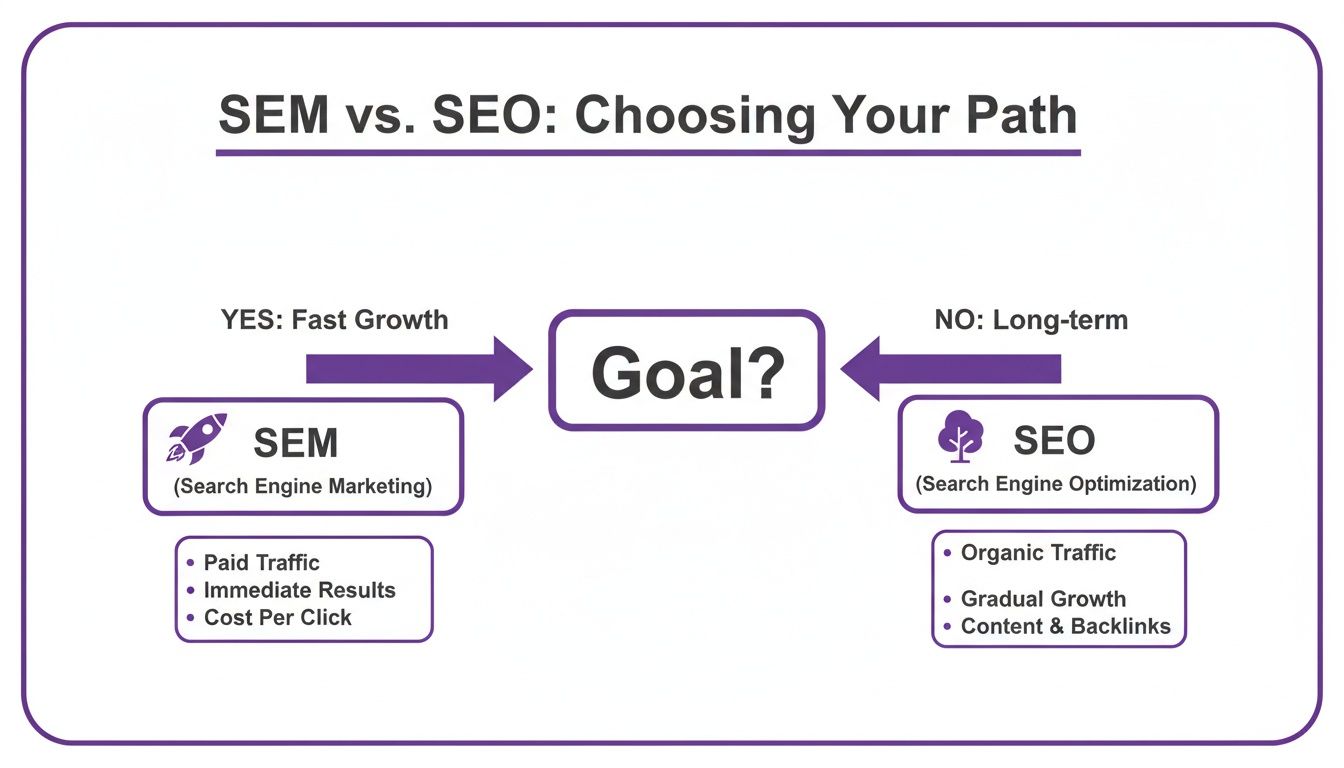
As you can see, the path you choose depends entirely on your goals. Need to drive traffic for a flash sale this weekend? SEM is your best bet. Want to build a brand that people find and trust for years to come? That’s where SEO shines. For more angles on this, ClicksGeek has a great guide on determining whether SEO or PPC is better.
Key Takeaway: This isn't just about paying versus not paying. It's a strategic choice between speed and sustainability. SEM buys you traffic right now. SEO earns you visibility that lasts.
To put it all together, here’s a quick comparison tailored specifically for e-commerce brands.
SEM vs SEO at a Glance
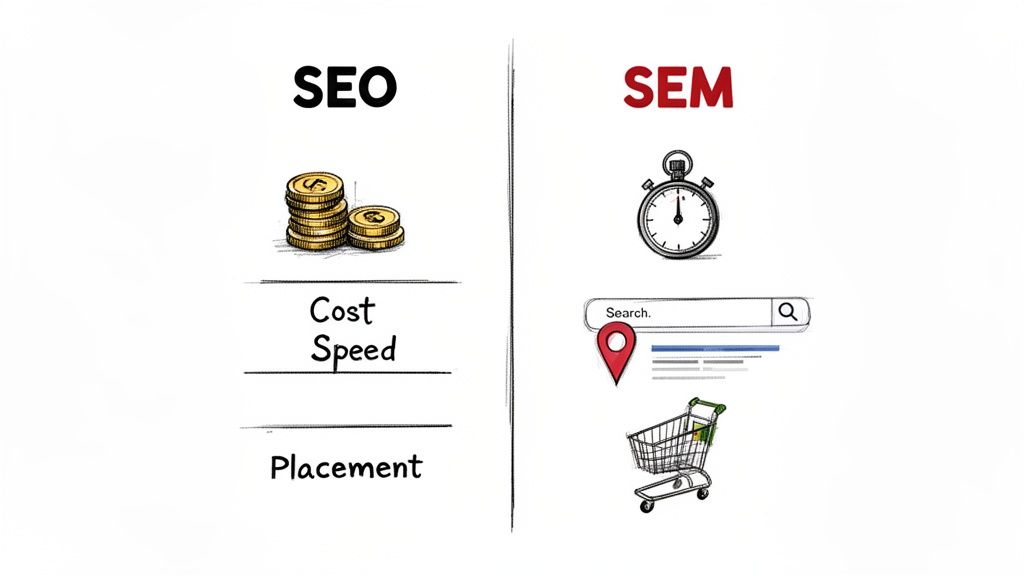
This table breaks down the core differences between the two channels, helping you see where each fits into your e-commerce strategy.
| Criterion | SEO (Search Engine Optimization) | SEM (Search Engine Marketing) |
|---|---|---|
| Cost | Investment in resources (content, technical work) | Direct ad spend (pay-per-click) plus management costs |
| Speed to Results | Slower (3-6+ months to see meaningful traction) | Immediate (traffic can start within hours of launch) |
| Placement on SERP | Organic results (below the paid ads) | Top of the page (Sponsored listings) |
| Sustainability | High; traffic continues long after the initial work is done | Low; traffic stops the moment you turn off your ads |
| Best For | Building brand credibility, long-term authority, and sustainable traffic | Flash sales, new product launches, and testing market demand |
Ultimately, you're not just choosing a tactic; you're choosing a growth model. SEM offers immediate, controllable results, while SEO builds a valuable, long-term asset for your brand. The smartest e-commerce sellers know they need a mix of both.
Understanding the Core Concepts of SEO and SEM
To really get what separates SEM from SEO, we need to pop the hood and see how each one actually works. They aren't just buzzwords; they're complete frameworks built on specific tactics designed to bring people to your online store. Let's break down the moving parts.
The Three Pillars of SEO
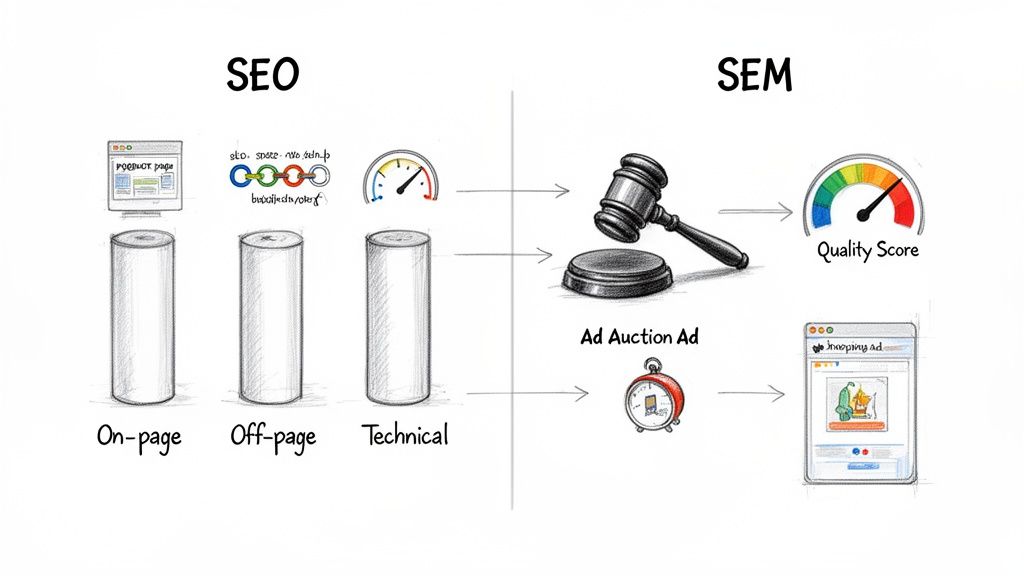
Search Engine Optimization is all about playing the long game. It's about earning trust from search engines like Google, and that trust is built on three core pillars that work in tandem to boost your organic rankings.
On-Page SEO: This covers everything you optimize on your actual website. For a Shopify store, that means weaving keywords naturally into your product descriptions, writing meta titles for your collection pages that people actually want to click, and creating genuinely helpful blog posts that solve a customer's problem.
Off-Page SEO: This is about the signals you build away from your website. The undisputed champion of off-page SEO is backlinks—links pointing to your site from other credible websites. Think of a backlink from a major industry blog reviewing your product as a powerful vote of confidence in Google's eyes.
Technical SEO: This is the nuts and bolts—the foundation your site is built on. It’s all about making sure search engines can find, crawl, and understand your pages without any trouble. Things like fast-loading pages, a mobile-friendly design, and a secure (HTTPS) connection are non-negotiable here; they directly affect both user experience and your rankings.
Deconstructing Paid Search in SEM
While SEM is the broad category, its paid side—often just called PPC or paid search—has its own set of rules. This is where DTC brands can get in front of customers almost instantly, but it’s not just about outspending your competitors. It's an auction, and the winner isn't always the one with the deepest pockets.
Key Insight: In the paid search auction, relevance can be just as valuable as your budget. Google wants to show the best ad for a user's query, not just the most expensive one.
This is where your Quality Score becomes critical. It's a rating Google gives your ads, keywords, and landing pages based on their relevance and quality. A high Quality Score can actually lower your ad costs and earn you better placements. You could literally pay less than a competitor but rank higher.
For e-commerce sellers, knowing which ad formats to use is half the battle. Google Shopping Ads, for instance, are a game-changer. They show your product image, title, and price right in the search results, making them far more compelling for someone ready to buy than a simple text ad. Understanding these mechanics is how you compete smart, driving high-intent traffic directly to your product pages.
Comparing Costs and ROI for Your E-Commerce Budget
Figuring out where to put your marketing dollars is a make-or-break decision for any e-commerce brand. SEO and SEM operate on completely different financial models. One is like buying a house; the other is like renting an apartment. Understanding this is key to seeing how they deliver value over time.
Think of SEO as a long-term capital investment in your digital property. You'll have upfront costs for high-quality content, technical site fixes, and earning quality backlinks. But once you start ranking, the organic traffic you get is essentially "free." This creates a powerful compounding effect that drives down your customer acquisition cost (CAC) for years to come.
SEM, on the other hand, is a straightforward pay-to-play model. Your costs are direct and ongoing—you're paying for ad clicks and potentially for someone to manage the campaigns. It's fantastic for getting immediate, predictable returns (ROAS) for a new product launch or a flash sale. The catch? The second you turn off the ad spend, the traffic vanishes.
Breaking Down the Financial Models
To really get a grip on this, you need to go beyond surface-level metrics and learn how to calculate marketing ROI that actually drives profit. This framework helps you evaluate both channels for what they truly contribute to your bottom line.
Let's look at where the money actually goes:
- SEO Investment: Your budget is spent on assets. This includes creating in-depth blog posts, optimizing product pages, building backlinks from respected sites, and resolving technical site errors. You're building digital equity.
- SEM Expenses: Your budget covers operational costs. This is your daily ad spend paid directly to platforms like Google, plus any agency or specialist fees for campaign management.
Key Financial Insight: SEO builds your brand's balance sheet by creating a traffic-generating asset. SEM is an income statement expense that drives immediate revenue but builds no lasting equity.
Real-World Costs and Returns
When you look at the data, the contrast is stark. SEO is a marathon with compounding returns, while SEM is a sprint that requires continuous fuel. Research shows SEO can drive 1,000% more traffic than organic social media. Over the long haul, SEO's average conversion rate of 2.4% often outperforms SEM's 1.3%.
For a Shopify store, this means an initial SEO investment of a few thousand dollars in cornerstone content could pay dividends in sustainable traffic for years. That same budget might only cover a single month of a competitive SEM campaign.
This isn't to say one is better than the other. The smartest approach is often a blend—using SEM for quick wins and initial data while your long-term SEO foundation gains traction.
Analyzing Timelines and Speed to Results
When you're deciding where to put your marketing dollars, one of the most practical questions you can ask is simple: “How fast will I see a return?” The answer really gets to the heart of the difference between SEO and SEM, and it will absolutely shape your marketing calendar and budget.
Think of it this way: SEM is a sprint, while SEO is a marathon.
If you need traffic now, SEM is your go-to. You can launch a paid search campaign and see targeted visitors hitting your product pages within a few hours. This kind of immediate visibility is a game-changer for time-sensitive promotions where you just can't afford to wait.
On the other hand, building a strong organic presence with SEO is a long-term play. It’s a marathon of consistent, high-quality effort. Generally, you’re looking at 3-6 months before you start to see real, meaningful traction as search engines begin to crawl, index, and trust your site enough to rank you for valuable keywords.
The Sprint: SEM for Immediate Impact
The sheer speed of SEM makes it the perfect tool for specific, high-stakes situations. It’s how you guarantee a surge in traffic right when you need it most, without waiting for the slow climb of organic rankings.
For a Shopify or DTC brand, this is invaluable. Consider these classic scenarios:
- Flash Sales: You've got a killer Black Friday deal. You need to drive urgency and traffic this weekend, not three months from now. Paid ads are the only way to deliver that instant visibility.
- New Product Launches: You're dropping a new product and need to generate immediate buzz and sales to build momentum from day one.
- Market Testing: Want to see if a new product line or message resonates with customers? Paid ads let you quickly test the waters before you commit to a full-blown SEO strategy.
The Marathon: SEO for Sustainable Growth
While SEM gives you that instant gratification, SEO is about building a lasting asset for your brand. The work you put into optimizing your site today continues to pay off for months, and even years, down the road. It creates a reliable, high-quality stream of traffic that becomes the foundation of your business.
Key Takeaway: SEO is an investment in your brand's digital real estate, building equity that appreciates over time. SEM is like renting a billboard—highly effective for a specific period, but the visibility stops the moment you stop paying.
The long-term value here isn't just theory; the data backs it up. Research tracking projects over two years found that the average time to hit first-page rankings with SEO is about 4.2 months. A positive ROI typically shows up around the 5.8-month mark.
But here's the kicker: for businesses that stick with their SEO strategy for over a year, the average return on investment can be an incredible 382%. As you can see in this deeper dive into SEO vs. SEM timelines, the financial returns over time tell two very different stories.
Control, Measurement, and Sustainability: Where Do You Place Your Bets?
Beyond just timelines and costs, the real strategic difference between SEO and SEM comes down to a trade-off: control versus sustainability. Each one gives you a totally different way to manage, measure, and grow your presence online.
Think of SEM as renting your spot at the top of the search results. You get immediate, granular control over almost everything. You set the exact budget, target precise customer segments, hand-pick your keywords, and A/B test ad copy on the fly. For media buyers who live and breathe performance data, it’s a dream come true.
The Precision of SEM
With SEM, the feedback loop is instant. You can track clicks, impressions, conversions, and Return on Ad Spend (ROAS) with near-perfect accuracy from the moment you launch. This makes it the go-to channel for performance marketing where every dollar has a job to do and needs to be optimized constantly.
SEM gives you an incredible amount of control, real-time metrics, and predictable traffic. It’s the fastest way to turn a marketing budget into hard data and sales. The catch? The moment you stop paying, the visibility disappears.
The Equity of SEO
On the flip side, SEO is all about building an asset—digital real estate that you own. You have less direct control, of course. You're always at the mercy of a surprise Google algorithm update. But the entire point is to create something sustainable.
When you earn a top organic ranking, you’re not just getting traffic; you’re building a powerful, consistent stream of high-intent visitors that keeps delivering value long after you’ve paid your agency or in-house team. This makes your business far more resilient and less reliant on the whims of rising ad costs.
The numbers back this up. The #1 organic result on Google gets a staggering 27.6% of all clicks. The top three spots? They gobble up 54.4% of user attention. This isn't just a trickle of traffic, either. SEO has been shown to drive 1,000% more visits than organic social media. You can find more details in these powerful search marketing statistics.
Ultimately, your choice really boils down to your goals. SEM offers quantifiable control for quick wins, which is perfect for testing a new offer or driving sales for a specific campaign. SEO, however, is the long game. It's about building a self-sustaining engine that drives down your customer acquisition costs over time and creates a more defensible brand.
How to Make SEO and SEM Work Together
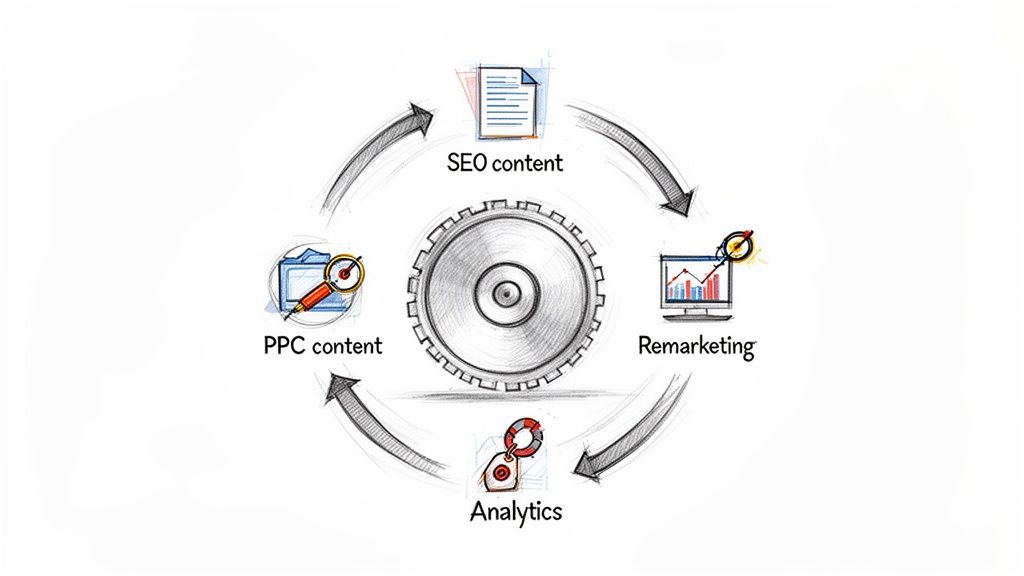
The savviest e-commerce brands have moved past the "SEO vs. SEM" debate. The real question isn't which one is better, but how to get them working in tandem. When you treat them as separate channels, you’re leaving money on the table. A unified strategy, on the other hand, creates a powerful flywheel where insights from one channel make the other stronger, ultimately lowering your acquisition costs and dominating search results.
Instead of picking a side, you integrate. This means building a system where paid and organic search actively feed each other, creating a marketing engine that’s far more resilient and effective than the sum of its parts.
Building a Cohesive Search Strategy
A truly integrated approach uses the strengths of one channel to patch the weaknesses of the other. SEM gives you immediate data and traffic, while SEO builds that crucial, long-term authority. When you combine them, you can own the search engine results page (SERP) from the very top to the bottom.
Here’s a practical framework for getting them to work together:
Use PPC Data to Inform Your SEO Content: Your Google Ads campaigns are a keyword goldmine. Find the paid keywords with the highest conversion rates and let them guide your SEO content strategy. This takes the guesswork out of the equation, ensuring you're building blog posts and landing pages around topics already proven to drive sales.
Remarket to Your Organic Visitors: Someone who finds you through a Google search is already interested, but they might not buy on their first visit. Use SEM remarketing campaigns to show targeted ads to these users after they leave your site. This keeps your brand top-of-mind and nudges them back to finish their purchase.
Test Landing Pages with Paid Ads First: Before you pour months of effort into ranking a page for a competitive keyword, test its conversion power with a small, targeted PPC campaign. You can quickly see how well the page converts clicks into customers, validating your approach before committing serious SEO resources.
The Flywheel Effect: Think of it this way: SEM is your R&D lab, giving you fast feedback and customer insights. SEO then takes those proven concepts and turns them into long-term, cost-effective assets that generate compounding returns over time.
This approach transforms your search marketing from a bunch of disconnected tactics into a cohesive growth engine. You use the speed of SEM to guide the slow-burn power of SEO, creating a system that’s built for sustainable growth.
Frequently Asked Questions
Even after breaking down the concepts, I find that e-commerce owners often have some very specific, practical questions about putting it all together. Let's tackle some of the most common ones I hear.
Which Is Better for a New Shopify Store?
If you're just launching a Shopify store, my advice is to use both, but in a specific sequence. You absolutely need to start with SEM right out of the gate. It's the only way to get immediate traffic, see if people are actually interested in your products, and start collecting real-world keyword data from day one.
At the same time, you need to be laying the groundwork for your SEO. This means building out your core product and category pages with solid, well-researched content. Think of it this way: SEM gets the first sales in the door, while SEO builds the foundation for long-term, free customer acquisition.
Can You Do SEO Without SEM?
Of course. Plenty of incredible brands have been built purely on strong SEO. It's a proven path to creating an authoritative presence that doesn't depend on a constant ad budget.
The catch? Patience. It's not a quick win. You have to be willing to invest in content creation and technical work for months before you see a real payoff in organic traffic. This timeline trade-off is one of the most important things to grasp when you're weighing what is the difference between SEM and SEO.
A pure SEO play is a long-term investment in your brand's digital real estate. It's incredibly powerful, but it demands a serious commitment without the instant gratification of paid ads.
How Do You Measure Success for Both?
When you’re running both SEO and SEM, you need to track their performance separately and together. It’s the only way to get a full picture of what’s working.
- For SEO: I’d keep a close eye on your organic traffic numbers, keyword ranking improvements, the number of new backlinks you’re earning, and—most importantly—your organic conversion rate.
- For SEM: This is all about the numbers. Track your click-through rate (CTR), cost per click (CPC), conversion rate, and your return on ad spend (ROAS).
To see how they’re working together, look at your blended customer acquisition cost (CAC). As your SEO gains traction, you should see your overall cost to acquire a customer go down. That's when you know the strategy is truly paying off.
Ready to gear up for both SEO and SEM? With EcomEfficiency, you can get access to over 50+ top-tier marketing tools like Semrush, Similarweb, and Pipiads for a tiny fraction of the usual cost. It’s a smart way for e-commerce brands to get the data they need to dominate search. You can learn more about the tools included.