What Is Return On Ad Spend A Guide To Profitable E-Commerce

Ever poured money into an ad campaign and wondered if it was just disappearing into a digital black hole? That's the question Return on Ad Spend (ROAS) is designed to answer.
The goal is to scale without dubious shortcuts and without hurting your credibility.
Simply put, ROAS measures the gross revenue you get back for every single dollar you spend on advertising. It's the most direct way to ask, "Are my ads actually making money?" A high ROAS tells you your campaigns are firing on all cylinders, while a low one is a clear signal that something in your strategy needs a serious tune-up.
What Is Return On Ad Spend In Simple Terms?
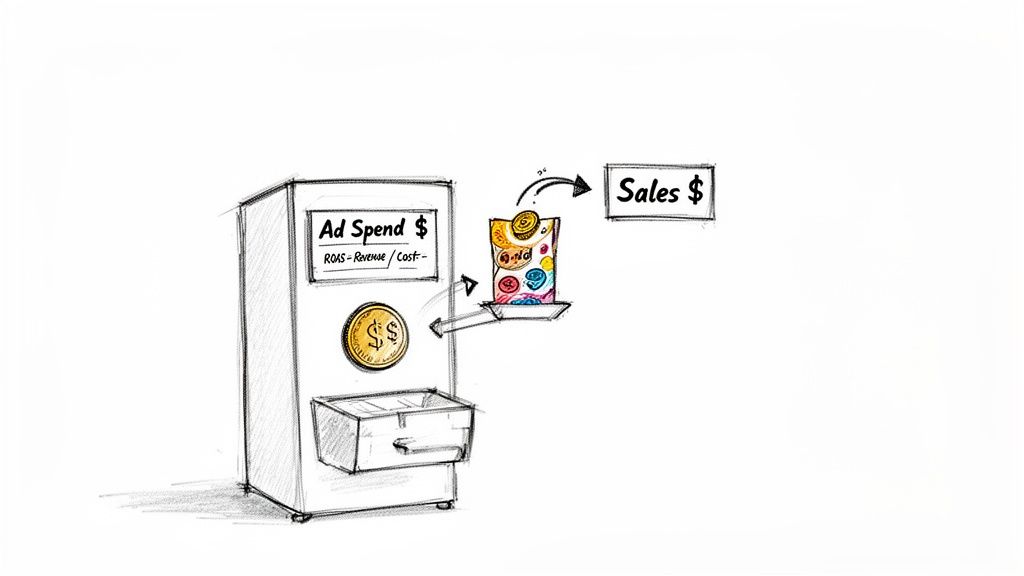
Let's strip away all the jargon. Think of your ad budget like a gumball machine. You put a quarter in (your ad spend), and you get a certain number of gumballs out (your sales). ROAS is just a way of measuring how many gumballs you're getting for each quarter you spend.
It's a beautifully simple metric. Its only job is to measure the direct financial kickback from your advertising. It doesn't get tangled up in other business costs like your cost of goods, shipping, or software subscriptions. It's all about one thing: how well your ads are turning clicks into cash.
The Basic ROAS Formula
At its heart, the calculation is incredibly straightforward. You just take the total revenue that came directly from an ad campaign and divide it by what you spent to run that campaign.
ROAS = Revenue from Ad Campaign / Cost of Ad Campaign
So, if you spend $1,000 on a Google Ads campaign and it brings in $5,000 in sales, your ROAS is 5:1. That means for every dollar you put in, you got five dollars back in revenue. It's this crystal-clear insight that makes ROAS an absolute must-track metric for any serious e-commerce marketer.
Pouring money into ads and watching it vanish without a trace is every e-commerce seller's nightmare. ROAS turns that fear into a superpower by measuring every dollar you invest against the revenue it generates. A ROAS of 4:1 means $4 in sales for every $1 spent. For Shopify store owners or TikTok Shop hustlers, hitting that mark can be the difference between just getting by and truly scaling your profits—especially when using a smart toolkit to find winning products and spy on competitor ads. The importance of this is underscored by the fact that global ad revenue continues to grow, making efficiency more critical than ever.
Understanding Your ROAS Ratio: What The Numbers Mean
Getting a number is one thing; knowing what it actually means for your bottom line is another. A 1:1 ROAS means you’re just getting your ad money back, while anything lower is a loss. The higher the ratio, the healthier your advertising engine.
This table gives you a quick snapshot of what different ROAS ratios are telling you about your business.
| ROAS Ratio | What It Means | Business Implication |
|---|---|---|
| 1:1 | For every $1 spent, you earned $1 back. | You've broken even on ad spend but are likely losing money once product costs and other fees are factored in. This is a red flag. |
| 2:1 | For every $1 spent, you earned $2 back. | This might be unprofitable for brands with low profit margins. You’re covering ad spend, but there's little left for anything else. |
| 4:1 | For every $1 spent, you earned $4 back. | Often seen as the "gold standard" benchmark. It suggests a healthy return that covers all your costs and leaves a solid profit. |
| 10:1+ | For every $1 spent, you earned $10 back. | An incredible return. This signals a highly effective campaign that you should be looking to scale aggressively. |
Ultimately, a "good" ROAS depends entirely on your profit margins, operating costs, and overall business health. But understanding these general tiers is the first step toward making smarter, more profitable advertising decisions.
Calculating Your ROAS: A Look at Real E-commerce Examples
Knowing the formula for Return on Ad Spend is one thing, but the real magic happens when you start applying it to your own campaigns. Let's walk through two common scenarios every e-commerce seller faces to see how this plays out in the wild. This will give you a clear, repeatable process for connecting your ad spend to the revenue it actually generates.
The biggest hurdle is often attribution—making sure the right ad gets the credit for a sale. Most ad platforms have built-in tracking, but you need to know what you're looking at to get an accurate picture.
Example 1: The Shopify Skincare Brand
Let's say you run a Shopify store specializing in organic skincare. You've just launched a new vitamin C serum and decide to run a Meta Ads campaign across Facebook and Instagram to get the word out.
You commit $2,000 for a one-month campaign. That’s your total Ad Spend.
Once the month is up, you dive into your Shopify analytics and Meta Ads Manager. The numbers show the campaign drove $8,600 in sales of the new serum. That's your Revenue from Ads.
Time to plug it into the formula:
- Formula: Revenue / Ad Spend = ROAS
- Calculation: $8,600 / $2,000 = 4.3
The result is a 4.3:1 ROAS. Plain and simple, this means for every $1 you put into Meta Ads, you got $4.30 back in revenue. That's a solid return, signaling that the campaign was a success and might be worth scaling up.
Looking at $8,600 in revenue is nice, but it's the 4.3:1 ratio that really tells the story. It’s the measure of your campaign's efficiency and a much better indicator of profitability.
Example 2: The TikTok Shop Gadget Seller
Now for a slightly different setup. Imagine you're selling a viral kitchen gadget on TikTok Shop. You decide to team up with a few micro-influencers, using Spark Ads to amplify their content to a much larger audience.
Here, your ad spend has a few more moving parts:
- Influencer Fees: You pay three creators $500 each, so that's $1,500.
- TikTok Spark Ads Budget: You put another $1,000 behind boosting their posts.
- Total Ad Spend: $1,500 + $1,000 = $2,500.
The campaign runs for two weeks. You've been using TikTok's attribution tools and unique discount codes to keep a close eye on sales. The data confirms these ads brought in $7,500 in direct revenue for your gadget.
Let’s run the numbers:
- Formula: Revenue / Ad Spend = ROAS
- Calculation: $7,500 / $2,500 = 3
Your ROAS for this influencer campaign is 3:1. For every dollar you invested—from creator fees to ad boosts—you made $3 back. If you want to dig deeper into the calculation process, this practical guide to calculating Return on Ad Spend is a great resource.
While a 3:1 ROAS is lower than our first example, it could still be very profitable depending on your gadget's profit margin. The big takeaway here is to include all advertising costs in your calculation, not just what you pay the ad platform. That's the only way to get a true read on performance and make smart decisions about where your money goes next.
Understanding ROAS vs. ROI and Other Critical Metrics
It's easy to get lost in the alphabet soup of e-commerce metrics. You’re constantly hearing about ROAS, ROI, CAC, and LTV. While they might sound similar, they each tell a very different—and very important—story about the health of your business.
Getting them straight isn't just an academic exercise; it's fundamental to making smart, profitable decisions for your brand.
ROAS vs. ROI: The Campaign vs. The Company
Think of Return on Ad Spend (ROAS) as a close-up shot of a single ad campaign. It’s a beautifully simple metric designed to answer one question: "For every dollar I put into this ad, how many dollars in revenue did I get back?" It’s all about the immediate effectiveness of your advertising creative and targeting.
Return on Investment (ROI), on the other hand, is the wide-angle lens. It zooms out to look at the profitability of your entire business operation. ROI doesn't just look at ad spend; it factors in all the costs of doing business—the cost of the products themselves (COGS), shipping, packaging, software subscriptions, and even team salaries. It answers the bigger question: "Are we actually making money?"
This is the core of the ROAS calculation—a direct line from ad spend to revenue, without all the other business costs cluttering the view.
The biggest mistake I see marketers make is treating ROAS and ROI as the same thing. They're not. A campaign can have a killer ROAS and still bleed your business dry if your profit margins are too thin.
Let’s say you spend $100 on a Facebook ad campaign and it brings in $400 in sales. That’s a 4:1 ROAS. Looks fantastic on your ads dashboard, right?
But hold on. Let's say the actual product you sold cost you $250 to produce and ship. Add your $100 ad spend, and your total expenses are $350. You only netted $50 in actual profit. Your ROAS was great, but your ROI tells a much more sober story.
ROAS measures revenue efficiency at the campaign level. ROI measures profit efficiency at the business level. You absolutely need to track both to get the complete financial picture.
Diving Deeper With CAC And LTV
To get an even sharper picture of your marketing's health, two other metrics are essential: CAC and LTV.
The Cost Per Acquisition (CPA), which in the e-commerce world we usually just call Customer Acquisition Cost (CAC), tells you exactly how much you have to spend, on average, to win a single new customer.
Then there's Customer Lifetime Value (LTV). This is a forward-looking metric that predicts the total amount of revenue a customer will likely generate for your brand over their entire relationship with you.
Here’s why they matter so much when put together:
- A High CAC Isn't Always a Red Flag: If your CAC is $50, that might seem high. But what if your average LTV is $500? You’re in an incredible position. You're effectively spending $50 to make $500. I'd take that deal all day.
- The Golden Ratio: A truly healthy, scalable e-commerce business makes sure its LTV is significantly higher than its CAC. This LTV-to-CAC ratio is one of the most powerful indicators of long-term business sustainability.
To make this crystal clear, here’s a quick cheat sheet for how these four essential metrics stack up.
ROAS vs. ROI vs. CAC vs. LTV: A Marketer's Cheat Sheet
This table breaks down the most critical e-commerce marketing metrics, helping you understand precisely what each one measures and, more importantly, when you should use it.
| Metric | What It Measures | Formula | Best For |
|---|---|---|---|
| ROAS | The gross revenue generated for every dollar spent on advertising. | Revenue from Ads / Cost of Ads | Assessing the immediate performance and efficiency of specific ad campaigns. |
| ROI | The total profit generated from an investment after all costs are deducted. | (Net Profit / Total Investment) x 100 | Evaluating the overall profitability of your entire business or marketing initiative. |
| CAC | The average cost to acquire a single new customer. | Total Marketing & Sales Spend / New Customers Acquired | Understanding the cost-effectiveness of your customer acquisition channels. |
| LTV | The total revenue a business can expect from a single customer over time. | Avg. Purchase Value x Avg. Purchase Frequency x Avg. Customer Lifespan | Predicting long-term business health and identifying your most valuable customers. |
In the end, mastering ROAS means knowing its role in this bigger ecosystem. ROAS gives you the tactical, real-time feedback you need to tweak your ads. But when you pair that insight with ROI, CAC, and LTV, you elevate your strategy from just running campaigns to building a truly profitable and enduring e-commerce brand.
What Is A Good ROAS In E-Commerce?
Every e-commerce marketer eventually asks the million-dollar question: "What's a good ROAS?" You'll often hear the number 4:1 thrown around—meaning $4 back for every $1 spent—as the gold standard. But the truth is, a "good" ROAS isn't a universal benchmark; it's a number that's deeply personal to your business.
Think of it like this. A 3:1 ROAS could be a massive win for a dropshipper with high-margin products and almost no overhead. For a different brand selling low-margin items with expensive shipping and production, that exact same 3:1 could spell financial disaster. Your target ROAS depends entirely on your unique financial model.
The Power Of Profit Margins
The single most critical factor in figuring out your target ROAS is your profit margin. It’s the engine that drives your business. A company with a healthy 80% profit margin can easily thrive with a lower ROAS and still rake in profits. Conversely, a business operating on a razor-thin 20% margin needs a much, much higher ROAS just to stay afloat.
Before you can even think about setting a ROAS goal, you have to know your break-even point.
Your break-even ROAS is the absolute minimum you need to make back to cover your ad spend plus the cost of goods and all other variable costs tied to that sale. Anything you make above this number is pure profit.
Figuring this out is surprisingly simple:
- Formula: 1 / Profit Margin % = Break-Even ROAS
- Example: Let's say your profit margin is 25% (or 0.25). Your break-even ROAS is 1 / 0.25 = 4. This means you need to hit a 4:1 ROAS just to cover your costs.
Setting Realistic ROAS Goals
Once you know your break-even number, you can start setting smart, tiered goals for your ad campaigns. A good ROAS isn't just about being profitable; it's about matching the campaign's specific purpose.
- Brand Awareness Campaigns: These ads are your brand’s first handshake with new audiences. The goal isn't immediate sales, so a lower ROAS that’s just a bit above your break-even point is often perfectly fine.
- Mid-Funnel Campaigns: When you're targeting people who've already shown some interest, you should be aiming for a much healthier ROAS that delivers a solid profit.
- Retargeting Campaigns: These ads go after your warmest leads, like people who abandoned their carts. Here, your expectations should be sky-high. These customers are on the verge of buying, so your ROAS should reflect that.
Benchmarks By Industry And Platform
While your own margins are what matter most, it can be helpful to see how you stack up against industry and platform averages. These benchmarks give you a sense of what's possible. For example, some campaigns using AI-powered tools like Microsoft's Performance Max have reported an 18% boost in ROAS, which shows how new tech can really move the needle.
Here are a few general starting points to keep in mind:
- Google Ads (Search): Tends to have a higher ROAS because you’re capturing people who are actively looking for what you sell.
- Meta Ads (Facebook & Instagram): Performance can be all over the map, depending heavily on your audience targeting and ad creative.
- TikTok Ads: Fantastic for driving impulse buys, but the ROAS can be a bit more unpredictable.
At the end of the day, stop chasing a magic number. Instead, do the math. Calculate your break-even point, understand your profit margins, and set strategic goals that align with your true business objectives. That’s how you find out what a "good" ROAS really means for you.
Actionable Strategies To Dramatically Improve Your ROAS
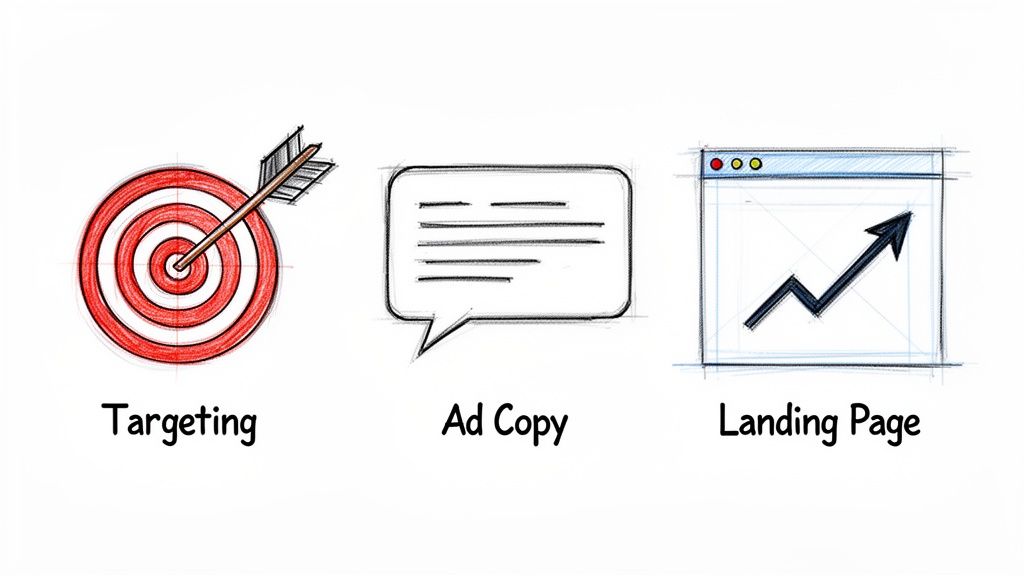
Knowing your ROAS is like looking at the fuel gauge in your car. It’s a critical piece of information—it tells you where you are right now—but it doesn't actually get you to your destination. To drive real growth, you need to actively improve your ROAS. This turns your ad campaigns from a line item on the expense sheet into a powerful engine for profitability.
The good news is that this isn't about finding some single magic bullet. It's about systematically optimizing every touchpoint in your customer's journey. The goal is to make every ad dollar work smarter, not just harder. Small, strategic tweaks from the audience you target to the page they land on can add up to massive gains in your overall return.
Let's break down the practical steps you can take today to get more out of your ad campaigns.
Refine Your Audience Targeting
The single fastest way to burn through an ad budget is to show your ads to people who will never buy. It sounds obvious, but it happens all the time. On the flip side, the quickest path to a better ROAS is getting your message in front of an audience that's already primed to convert. It's the difference between casting a wide, expensive net and using a laser-focused spear.
Here’s how to sharpen your aim:
- Build Lookalike Audiences: Take your list of best customers—I’m talking about the ones with the highest lifetime value—and upload it to platforms like Meta Ads. The platform’s algorithm will then hunt for new users who share similar characteristics, essentially creating a pre-qualified, warm audience for you to target.
- Lean Heavily on Retargeting: Someone who added a product to their cart and then left is the lowest-hanging fruit you can find. Set up specific campaigns to target these users with a gentle reminder or a small incentive. Their purchase intent is sky-high, making them one of the most profitable segments you can possibly advertise to.
- Dig Deep into Demographics and Interests: Go beyond basic age and location. Dive into your customer data and look for patterns in their interests, behaviors, and online habits. Do your best customers all follow a particular influencer or read a specific blog? Use those insights to build incredibly specific audience profiles.
The core idea is simple: stop paying to reach people who will never buy. Every dollar reallocated from a broad, low-performing audience to a hyper-targeted, high-intent segment is a direct investment in a higher ROAS.
Craft Compelling Ad Creative and Copy
Okay, so you've found the right people. Now what? You have to give them a compelling reason to stop scrolling and click. Your ad creative and copy are your digital storefront, and in a crowded feed, they need to be irresistible. Generic ads get generic results, and that almost always means a poor ROAS.
Your creative needs to stop the scroll, and your copy needs to seal the deal. This is where you connect what your product does with what your customer wants.
- Focus on Benefits, Not Just Features: Don't just say your skincare serum "contains hyaluronic acid." That’s a feature. Instead, say it "delivers deep hydration for a visibly plump, youthful glow." That's the benefit. You’re selling the outcome, not the ingredient list.
- A/B Test Everything: Never assume you know what will work. Continuously test different headlines, images, calls-to-action (CTAs), and ad formats. Let the data—not your gut—tell you what resonates with your audience, then double down on the winners.
- Use High-Quality Visuals: Grainy photos or poorly edited videos immediately signal unprofessionalism and erode trust. Invest in clean, eye-catching visuals that showcase your product in its best possible light.
For example, a Shopify store selling outdoor gear could test an ad showing a product in clean, static studio lighting against another showing it being used on a rugged mountain trail. Often, it's the context that drives the emotional connection—and the click.
Optimize Your Landing Page Experience
You can have the world's greatest ad, but if it sends users to a slow, confusing, or untrustworthy landing page, your ROAS will absolutely tank. The handoff from the ad to the landing page needs to be seamless. This is where the conversion actually happens, and any friction at this stage is a direct hit to your bottom line.
Think of your landing page as the final, most critical step in the sale.
- Ensure Message Match: The headline, visuals, and offer on your landing page must perfectly mirror what you promised in the ad. If a user clicks an ad for a 50% discount on running shoes and lands on your generic homepage, they're going to feel baited and leave immediately.
- Improve Page Load Speed: Every extra second it takes for your page to load dramatically increases your bounce rate. A potential customer who doesn't even wait for the page to render is a completely wasted ad click. Use tools to compress images and streamline your code to make sure your site is lightning-fast.
- Simplify the Checkout Process: Get out of the customer's way. Remove unnecessary steps and form fields. Offer guest checkout and multiple payment options like Shop Pay or PayPal. The easier you make it for someone to give you their money, the more likely they are to do it.
In a global advertising market that now exceeds $1 trillion, efficiency is everything. For performance marketers in direct-to-consumer or Amazon selling, ROAS is the ultimate yardstick for success. Search ads, now frequently supercharged with AI, grew 10.2% to $244.9 billion, offering the kind of pinpoint targeting needed to achieve 3x-5x returns even in the most competitive niches. You can learn more about how global ad spend forecasts are shaping e-commerce strategies on dentsu.com.
Answering Your Top ROAS Questions
Once you get the hang of the basics, the real-world questions about Return on Ad Spend start to pile up. It’s one thing to know the formula, but it’s a whole other ball game to actually use it to make smart decisions for your e-commerce store.
Let’s dig into the most common questions and sticking points marketers run into. Getting these answers straight will help you handle the tricky parts, solve problems, and use ROAS with the confidence needed to drive real growth.
Does ROAS Account For All My Business Costs?
In a word: no. This is probably the most critical distinction to get right. ROAS is a simple, powerful metric precisely because its focus is so narrow. It only cares about one thing: the gross revenue you generated from a specific ad spend.
It completely ignores all the other costs of doing business. Think about things like:
- Cost of Goods Sold (COGS): What you actually paid for the products you sold.
- Shipping and Fulfillment: All the costs to pick, pack, and ship an order.
- Software Subscriptions: Your Shopify plan, email marketing tool, and all the other apps that run your store.
- People Costs: Salaries for your team or fees for freelancers and agencies.
Since ROAS leaves all this out, it should never be the only metric you look at. It’s fantastic for judging how efficient an ad campaign is, but you need to look at it alongside metrics like Return on Investment (ROI) to understand if your business is actually making money.
Can A High ROAS Still Mean My Business Is Losing Money?
You bet it can. This is a dangerous trap that catches so many people. A high ROAS can give you a false sense of security, making a campaign look like a home run in your ad dashboard while it’s quietly draining your profits.
This happens when your profit margins are thin.
Imagine you hit a 3:1 ROAS. You spend $1 on ads and get $3 back in revenue. Sounds pretty good, right? But what if your product costs, payment processing fees, and shipping for that $3 sale add up to $2.50? You’re only left with $0.50 in profit, and that’s before you even think about your other overhead.
This isn’t some rare, academic scenario—it happens all the time. The way to avoid this is by calculating your break-even ROAS. This is the rock-bottom ROAS you need to cover all the variable costs of a sale. Once you know that number, ROAS transforms from a potential vanity metric into a genuine gauge of profitability.
How Long Should I Wait Before Measuring ROAS?
Patience is a virtue here. Jumping the gun and measuring a new campaign’s ROAS too early will almost always give you a skewed, and frankly, discouraging, view of its potential. You have to give the ad platform’s algorithm time to figure things out.
How long is long enough? It depends a bit on your typical sales cycle, but a solid rule of thumb is to wait 7 to 14 days. This gives the campaign enough runway for a few important things to happen:
- Algorithm Learning: Platforms like Meta and Google don't know who your best customers are on day one. They need time and data to learn and find the right pockets of people. The first few days are rarely a good indicator of what’s to come.
- Delayed Conversions: People don’t always buy right away. A customer might see your ad on Monday, browse your site, and not actually pull the trigger until Friday. Most platforms use an attribution window (like a 7-day click window) that connects that later purchase back to the initial ad. If you check your results on Tuesday, you’ve completely missed that sale.
It's fine to peek at your numbers daily to make sure nothing is broken, but don't make any big calls—like shutting down a campaign—until it’s had at least a week to show you what it can do.
Should My ROAS Target Be The Same For All Campaigns?
Definitely not. Setting one ROAS target for everything is a recipe for inefficient spending. The best marketers set different goals for different campaigns, all based on where the audience is in their journey.
It’s best to think of it in tiers:
- Top-of-Funnel (Prospecting): Here, you’re targeting cold audiences who may have never heard of you. The goal is to make an introduction, not necessarily to get an immediate sale. A lower ROAS target, even one that just breaks even (say, 2:1), is perfectly fine.
- Bottom-of-Funnel (Retargeting): These campaigns are for your warm audience—people who have visited your site or added products to their cart. They already know you and are close to buying. For these folks, you should aim for a much higher ROAS target (like 8:1 or 10:1) because you’re just giving them a nudge to finish what they started.
When you set strategic targets based on the sales funnel, you align your budget with how customers actually behave. This helps you build a far more effective and profitable marketing machine from top to bottom.
Ready to slash your software costs and unlock the tools you need to boost your ROAS? EcomEfficiency gives you bundled access to 50+ premium e-commerce tools like Semrush, Pipiads, and Helium10 for one low monthly price. Start saving and scaling today with a plan that fits your business.