What Is Organic Search Traffic A Complete Guide

When people talk about organic search traffic, they’re talking about the visitors who land on your website after clicking on one of the unpaid, natural results in a search engine like Google. Think of it as earning your spot. You didn't pay for an ad; you showed up because Google decided your page was the most relevant answer to what someone was looking for.
The goal is to scale without dubious shortcuts and without hurting your credibility.
1. The Bedrock of Sustainable Growth
This entire process is powered by a practice called What is Search Engine Optimization, or SEO. SEO is simply the art and science of making your website more appealing to search engines so they rank your pages higher for the keywords your customers are using.
Why does this matter so much? Because organic search is, by a huge margin, the biggest driver of website visits on the internet. It’s responsible for roughly 53% of all trackable website traffic worldwide. That’s a staggering number. It means that for every ten people who visit a site, at least five of them found it by clicking on a regular, non-ad search result.
2. How Organic Traffic Stands Apart
Your website analytics will show traffic coming from several different places, and knowing the difference is crucial for a smart marketing strategy. Organic traffic is unique because of the user’s mindset—they are actively looking for an answer, a product, or a solution.
Let’s break down how it stacks up against the other main traffic sources.
Website Traffic Sources at a Glance
Understanding where your visitors come from is the first step in creating a well-rounded strategy. This table quickly shows the main ways people find your online store.
| Traffic Source | How It Works | Example |
|---|---|---|
| Organic Search | A user finds you through an unpaid search engine result. | Someone searches "best running shoes for flat feet" and clicks your blog post. |
| Paid Search | You pay for ads (PPC) to appear at the top of search results. | A user searches "buy running shoes" and clicks the first result marked "Ad". |
| Direct | A visitor types your URL directly into their browser or uses a bookmark. | A loyal customer types yourbrand.com to check for new arrivals. |
| Referral | Someone clicks a link to your site from another website. | A popular running blog includes a link to your product page in their gear review. |
| Social | A user arrives by clicking a link on a social media platform. | Someone sees your new shoe collection on Instagram and clicks the link in your bio. |
Each of these channels plays a role, but the fundamental difference is what drives the visit.
Organic traffic is earned through relevance and trust. Paid traffic is bought. Direct traffic is driven by brand loyalty, while referral and social traffic come from your presence on other platforms.
While a mix of sources is healthy, organic search is often the engine that delivers a steady stream of high-intent visitors who are ready to engage and, ultimately, buy.
Why Organic Traffic Is a Business Goldmine
https://www.youtube.com/embed/IRZCffYn3ME
So we know what organic traffic is, but the real question is, why should you care? Why is it such a big deal for your business?
Think of it like this: paid ads are like renting a billboard on a busy highway. You pay to interrupt people as they speed by. Organic traffic, on the other hand, is like owning the most popular shop on Main Street. You’re not just shouting at passersby; you’re welcoming in people who are already looking for exactly what you have.
This difference is everything. Organic visitors show up with a specific purpose. They didn't just randomly click a link. They went to Google and typed something specific, like "ergonomic office chair for back pain" or "vegan leather crossbody bag." Google then pointed them your way, essentially saying, "Here's the best answer." That means these visitors are already halfway to making a purchase before they even land on your site.
The Compounding Value of SEO
The numbers just make sense. Paid advertising is a constant drain on your budget—as soon as you stop paying, the traffic disappears. SEO is different. It's an investment that grows over time. The work you do today—writing a great blog post, optimizing a product page—can keep bringing in customers for months, even years, without you spending another dime on it.
Let's break it down:
- Paid Ads: You pay for every single click. When the budget runs out, so does your traffic. It’s a classic pay-to-play system.
- Organic Traffic: You invest your time and resources upfront. This builds a valuable asset that generates what feels like "free" traffic long into the future.
This is what makes organic search such a powerful engine for sustainable growth. Every piece of content you create becomes another door for customers to find you, and those doors stay open 24/7.
Building Unshakeable Brand Credibility
Beyond the bottom line, showing up at the top of Google’s search results builds something priceless: trust. When Google puts your website at the top, it’s giving you a huge vote of confidence. It’s telling the world that you are a legitimate, authoritative voice in your field.
This trust has a direct impact on your sales. People are naturally more inclined to trust organic results than the ads at the top of the page. The data backs this up—organic results capture around 94% of all clicks on Google, while paid ads only get about 6%. If you want to dive deeper, you can find more telling SEO statistics.
This kind of credibility isn’t something you can just buy. It’s earned. When people keep seeing your brand pop up as the answer to their problems, you stop being just another store. You become the go-to expert, the trusted resource. That's how you build real brand loyalty that lasts far longer than a single purchase.
How To Measure and Analyze Your Organic Traffic
Knowing what organic search traffic is and actually measuring its impact are two different ball games. To turn all that data into smart business decisions, you need the right toolkit. Luckily, the two most powerful platforms for the job are completely free: Google Analytics 4 (GA4) and Google Search Console.
Think of them as two sides of the same coin. GA4 shows you what people do after they land on your store—which pages they browse, how long they stick around, and whether they end up buying something. On the other hand, Google Search Console reveals what happens before they even click—which search terms brought them to you and how your pages are stacking up in Google's results. Using both isn't just a good idea; it's essential for getting the full picture.
This simple workflow is the key: track, analyze, and improve. It’s a continuous loop.
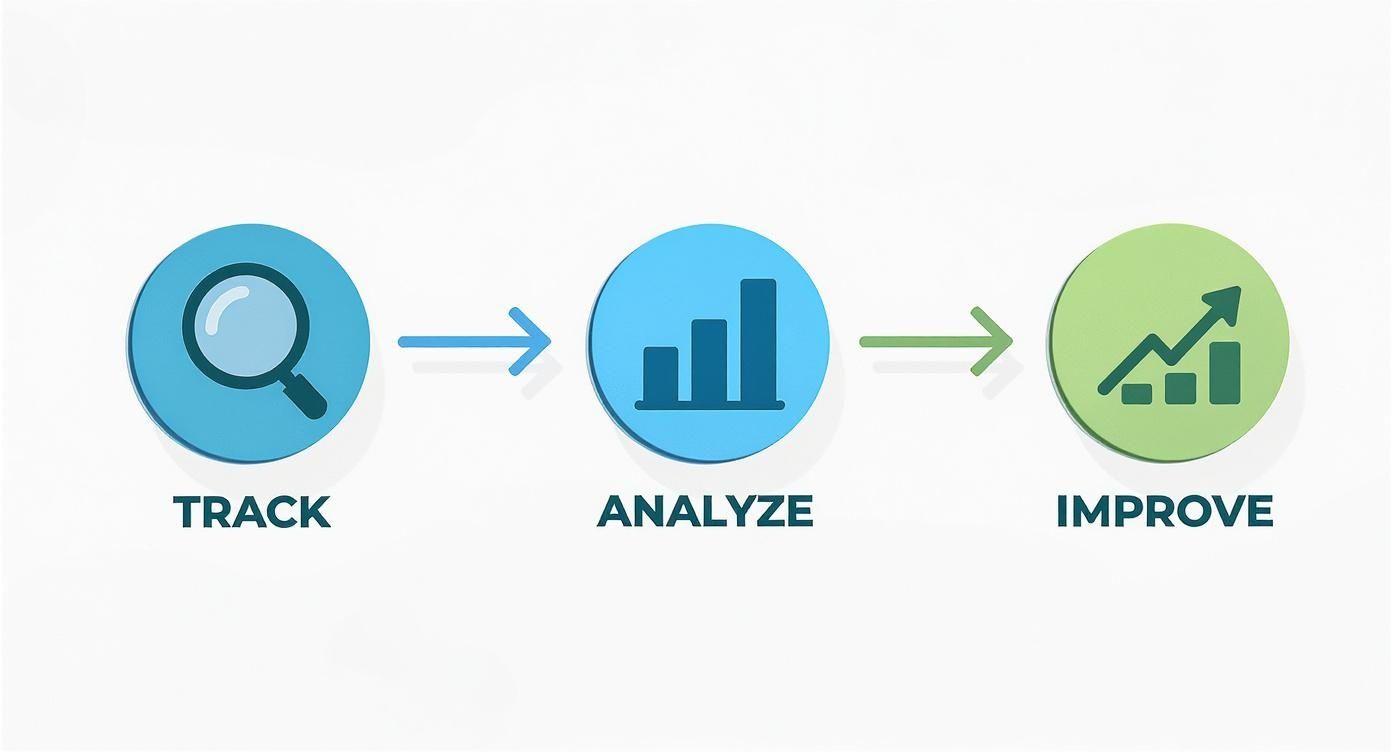
The data you get from these tools should directly feed back into your SEO strategy, creating a cycle of constant refinement.
Your Go-To Tool for On-Site Behavior: GA4
Google Analytics 4 is your mission control for understanding what happens on your website. It’s built to answer the questions that really matter, like "Are the people finding us on Google actually buying anything?" or "Which of our blog posts keeps readers hooked the longest?"
To see your organic traffic report, head to Reports, then click on Acquisition > Traffic acquisition. From there, you can filter by the "Session default channel group" and choose "Organic Search" to zero in on just those visitors.
This report is your treasure map. You'll see how many users came from search, how engaged they were, and—most importantly—how many conversions they completed and the total revenue they brought in.
Key Takeaway: It’s easy to get excited about big traffic numbers, but conversions are what pay the bills. Always tie your organic traffic data in GA4 back to real business results like sales, leads, or newsletter sign-ups.
This focus makes sure your SEO work is fueling real growth, not just feeding vanity metrics.
Uncovering Pre-Click Insights: Google Search Console
While GA4 is all about what happens on your site, Google Search Console (GSC) gives you a behind-the-scenes look at your performance on Google itself. It's less about user behavior and more about your raw visibility in search results.
The main area you'll live in is the Performance report. This dashboard tells you exactly what people typed into Google to find you. It's an unfiltered look at how your customers are thinking and searching.
The GSC report is packed with valuable metrics:
- Total Clicks: The raw number of times someone clicked on your site from a Google search result.
- Total Impressions: How many times a link to your site appeared in search results. Think of it as your brand's visibility.
- Average CTR (Click-Through Rate): The percentage of people who saw your link and actually clicked it (Clicks ÷ Impressions).
- Average Position: Your site's average rank in search results for different keywords over time.
This data is pure gold. It helps you spot "striking distance" keywords—those lingering on page two (positions 11-20) that, with a bit of a push, could vault onto page one. It also shows you which pages are getting the most impressions, giving you a clear roadmap for where to focus your next content and optimization efforts.
Key Organic Traffic Metrics To Track
To make sense of it all, here's a quick rundown of the most important metrics you’ll find in GA4 and GSC, and why they matter for your Shopify store.
| Metric | Tool | Why It Matters |
|---|---|---|
| Users | GA4 | Measures the unique number of individuals visiting your site from organic search. |
| Sessions | GA4 | Shows the total number of visits. One user can have multiple sessions. |
| Engagement Rate | GA4 | The percentage of sessions where users were actively engaged (e.g., stayed over 10 seconds). |
| Conversions | GA4 | The total number of desired actions (purchases, sign-ups) completed by organic visitors. |
| Total Revenue | GA4 | The direct dollar value generated from organic traffic. The ultimate ROI metric. |
| Total Clicks | GSC | The actual amount of traffic Google is sending to your site. A direct measure of SEO success. |
| Total Impressions | GSC | Represents your brand’s visibility and reach within Google search results. |
| Average CTR | GSC | A powerful indicator of how compelling your page titles and meta descriptions are. |
| Average Position | GSC | Tracks your ranking performance, helping you identify opportunities for improvement. |
Tracking these metrics gives you a 360-degree view, combining the "before the click" visibility data from GSC with the "after the click" conversion data from GA4.
Core SEO Strategies to Grow Organic Traffic
Knowing what organic search traffic is and actually growing it are two very different things. Spoiler alert: there's no single magic bullet for SEO success. It's all about building a solid, well-rounded foundation based on three core pillars. When they work together, they send all the right signals of quality and relevance to search engines.
Think of it like opening a new shop. First, you need a strong building with good plumbing and electricity (Technical SEO). Next, you need clear signs and organized aisles so people can find what they're looking for (On-Page SEO). Finally, you need amazing products and displays that actually draw people in (Content Marketing). If any one of these is weak, the whole structure suffers.
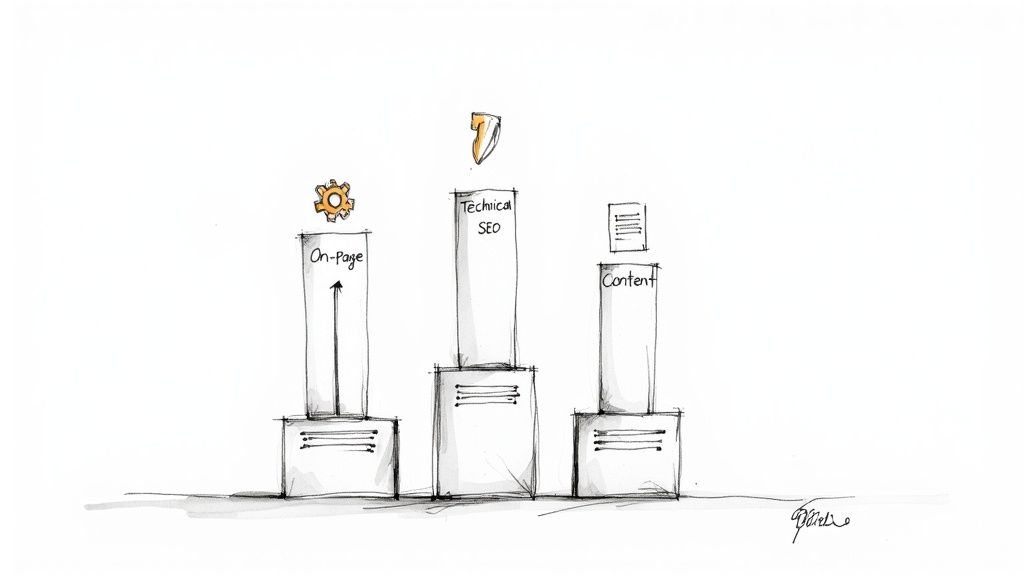
This synergy is what creates sustainable growth and helps you carve out a bigger piece of the search pie. And that pie is getting bigger every day. Google now handles a staggering 9.1 to 13.6 billion searches daily, highlighting the massive opportunity waiting for stores that get these fundamentals right.
Build a Flawless Technical Foundation
Technical SEO is all the crucial work that happens behind the scenes. It's about making sure search engines can easily find, crawl, and understand your website. If Google's "spiders" can't navigate your site, even the most brilliant content will remain invisible. It's like having a beautiful storefront with a permanently locked door.
A strong technical foundation comes down to a few key things:
- Mobile-Friendliness: The majority of searches now happen on mobile devices. It's not a "nice-to-have"; your site must work flawlessly and look great on any screen size.
- Site Speed: People are impatient. They expect pages to load in under three seconds. A slow site leads to high bounce rates, which is a big red flag to Google that users aren't having a good time.
- Crawlability and Indexability: This means having a clean site structure and a clear XML sitemap. Think of the sitemap as a roadmap you hand to search engines, guiding them to all your important pages.
Putting effective SEO-friendly web design tactics into practice is ground zero for visibility. A well-built site is simply easier for both people and search engines to use, which directly impacts your ability to rank.
Master Your On-Page SEO Signals
On-page SEO is where you optimize the individual elements on your pages to make them laser-focused on a specific keyword. This is your chance to tell Google exactly what a page is about. It's the art of aligning your page's content and its HTML code with what your customers are actually typing into the search bar.
Think of it as labeling the aisles and products in your shop. When the labels are clear, shoppers—and search engines—can find what they need in a snap.
Key Takeaway: Every important page on your site, whether it's a blog post or a product detail page, should have one primary focus. Trying to make a single page rank for a bunch of unrelated keywords just dilutes its power and confuses Google.
To really nail your on-page SEO, you'll want to focus on a few key areas:
- Keyword Integration: Naturally place your main keyword in crucial spots—the page title, the URL, at least one subheading (like an H2 or H3), and within the first 100 words of your content.
- Title Tags and Meta Descriptions: Your title tag is arguably the most important on-page signal. While the meta description doesn't directly affect rankings, it acts as your ad copy in the search results, compelling people to click on your link instead of a competitor's.
- Internal Linking: Linking from one page on your site to another is a powerful but often overlooked tactic. It helps spread authority (or "link equity") around your site and guides users to other relevant content, keeping them on your site longer.
Create Content That Attracts and Converts
Finally, we have content marketing—the engine that powers your entire SEO strategy. While technical and on-page SEO build the structure, high-quality content is what fills your shop with value. It’s what attracts visitors and earns their trust. This means creating genuinely helpful, informative, and engaging resources that solve your customers' problems.
For an e-commerce brand, this goes way beyond basic product descriptions. It means creating a library of resources that positions you as an expert in your niche. Think detailed buying guides, how-to tutorials, or blog posts that tackle the common frustrations your ideal customer faces.
When you create content that serves the user first, you naturally start attracting the kind of high-quality organic traffic that actually turns into sales.
Advanced Tactics for E-commerce Growth
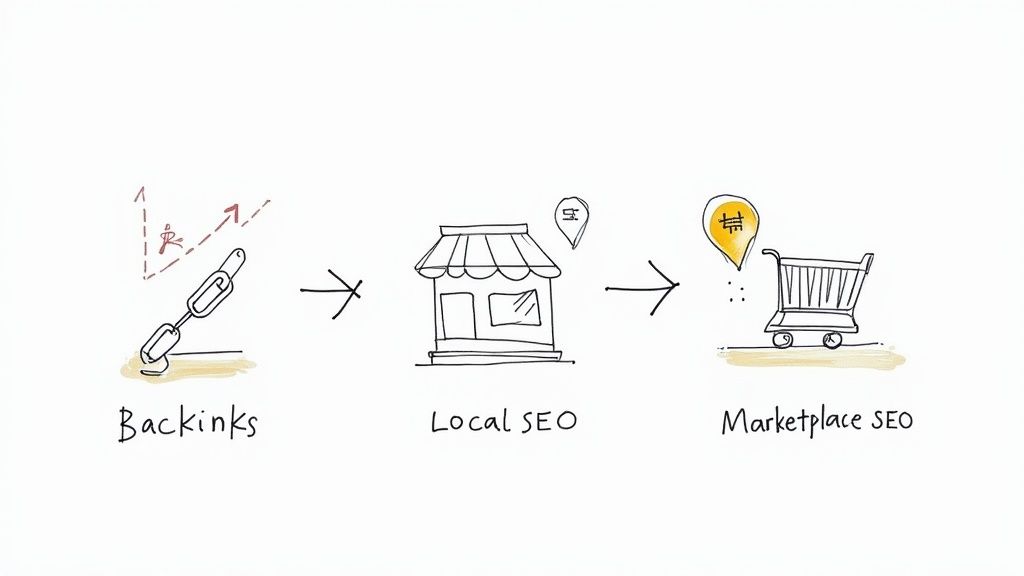
So, your technical SEO is tight, your pages are optimized, and your content is hitting the mark. What's next? It's time to graduate from the basics and start building serious authority that extends beyond your own website.
These advanced strategies are all about dominating search wherever your customers are looking. This is how you turn a nice, steady stream of organic traffic into a commanding presence in your market. It means focusing on off-site signals and specialized platforms, ensuring your brand isn’t just visible but seen as a genuine authority.
Earning Authority with Link Building
At its core, link building is simply getting other websites to link to yours. Think of every link as a vote of confidence. When a well-respected blog or industry site links to one of your product pages, it’s a powerful signal to Google that your content is trustworthy and valuable. That trust directly translates into better rankings.
But here’s the catch: not all links are created equal. You’re aiming for high-quality backlinks from sites that are relevant and authoritative in your niche. A fantastic starting point is to see what your competitors are up to.
A competitor backlink analysis is like getting a peek at your rival's playbook. It shows you exactly who is linking to the top-ranking sites in your space. Once you identify these link-building opportunities, you can build a strategy to earn them for yourself—whether that’s by creating even better content, doing smart outreach, or running a digital PR campaign.
This isn’t about tricking the algorithm; it's about building a link profile that proves your expertise and separates your store from the crowd.
Capturing Local and Marketplace Searches
For most e-commerce brands, growth isn't just about what happens on your Shopify store. Two often-overlooked areas of SEO can open up massive new streams of organic traffic.
Local SEO: Do you have a physical presence, like a flagship store, a pop-up, or even just stockists? Then local SEO is a goldmine. This means optimizing your Google Business Profile and making sure your store's info is consistent everywhere online. The goal is simple: show up for all those high-intent "near me" searches from local shoppers ready to buy right now.
Marketplace SEO: If you sell on platforms like Amazon, Etsy, or TikTok Shop, remember they are all search engines in their own right. Marketplace SEO is all about applying familiar SEO principles—keyword research, great titles, and detailed descriptions—directly to your product listings on those sites. A well-optimized listing won’t just rank high within the marketplace; it can also show up in Google's main search results, essentially giving you two shots at being discovered.
By mastering link building, local search, and marketplace optimization, you’re creating a powerful, multi-channel strategy. These tactics ensure you aren't just waiting for customers to find your site; you're actively capturing them across their entire buying journey.
Answering Your Top Questions About Organic Traffic
Even when you've got the basics down, a few questions always seem to pop up. Let's tackle some of the most common ones I hear from store owners. Getting these answers straight will help you set the right expectations and move forward with your SEO plan.
How Long Does It Take to Actually See SEO Results?
This is probably the number one question, and the honest-to-goodness answer is this: SEO is a marathon, not a sprint. It’s about building a foundation that pays off over the long haul.
While you might see some small wins early on, you're typically looking at 4 to 12 months before you see a real, meaningful lift in your organic traffic and, more importantly, your revenue.
Why such a wide range? A few things come into play:
- Your Starting Point: A brand-new store is starting from scratch, while an established site with some authority might see results faster.
- Your Competition: If you're selling t-shirts in a sea of a million other t-shirt shops, it’s going to take longer to stand out than if you’re in a niche market.
- Your Consistency: SEO isn't a one-and-done task. The more consistently you publish content, optimize your pages, and build good links, the quicker you'll gain momentum.
Look for the small wins along the way. Before you see a huge traffic spike, you'll notice other positive signs. Check Google Search Console for a steady climb in impressions, watch your keyword rankings improve, and see more of your pages getting indexed. These are the green shoots that prove your efforts are taking root.
Should I Do SEO Myself or Hire Someone?
Figuring out whether to go DIY or bring in an expert really comes down to your time, your budget, and your goals.
Doing SEO yourself is absolutely possible, especially if you have the time to learn and you aren't in an incredibly cutthroat market. Platforms like Shopify have made a lot of the basic on-page stuff much easier to handle than it used to be.
But, hiring an agency or a freelancer often makes a lot more sense if:
- You're up against big, established players in a competitive space.
- Your site has some tricky technical issues that are over your head.
- You simply don't have the hours to dedicate and want to grow faster.
There's no single right answer. It’s about finding the path that fits your business right now.
What’s the Difference Between Organic and Direct Traffic?
It's easy to get these two mixed up, but they tell you very different things about how people find your store.
As we've covered, organic traffic is from someone who typed a query into a search engine like Google and clicked on one of your non-paid listings. They were actively looking for something, and you were the answer.
On the other hand, direct traffic is when someone comes straight to you. They typed yourstore.com into their browser or clicked a bookmark they'd saved. There was no middleman. A healthy amount of direct traffic is a great sign of strong brand awareness—people know you by name and come back on purpose, which is often a long-term result of them discovering you through organic search in the first place.
Ready to get the tools the pros use without the hefty price tag? EcomEfficiency bundles 50+ premium SEO, AI, and ad-spy tools like Semrush, Similarweb, and Helium10 into one simple, affordable subscription. Stop paying for a dozen different tools and start focusing on growth. Explore our plans and get started.