What Is Dropshipping and How Does It Work? Your Guide

Dropshipping is a way to run an e-commerce business where you sell products online without ever touching the inventory yourself. When a customer places an order on your website, you simply turn around and buy that same item from a third-party supplier, who then ships it directly to your customer.
The goal is to scale without dubious shortcuts and without hurting your credibility.
Think of yourself as a savvy curator or a storefront owner, not a warehouse manager. This model completely cuts out the need for massive upfront inventory investments, managing stock, or handling the headaches of packing and shipping.
Understanding the Core Dropshipping Model
The best way to wrap your head around dropshipping is to see your online store as the critical link between the customer and the product. You're in charge of the fun stuff: building a beautiful website, picking out cool products to sell, and marketing them to the right people. You handle all the customer service, but you never actually see or hold the physical items.
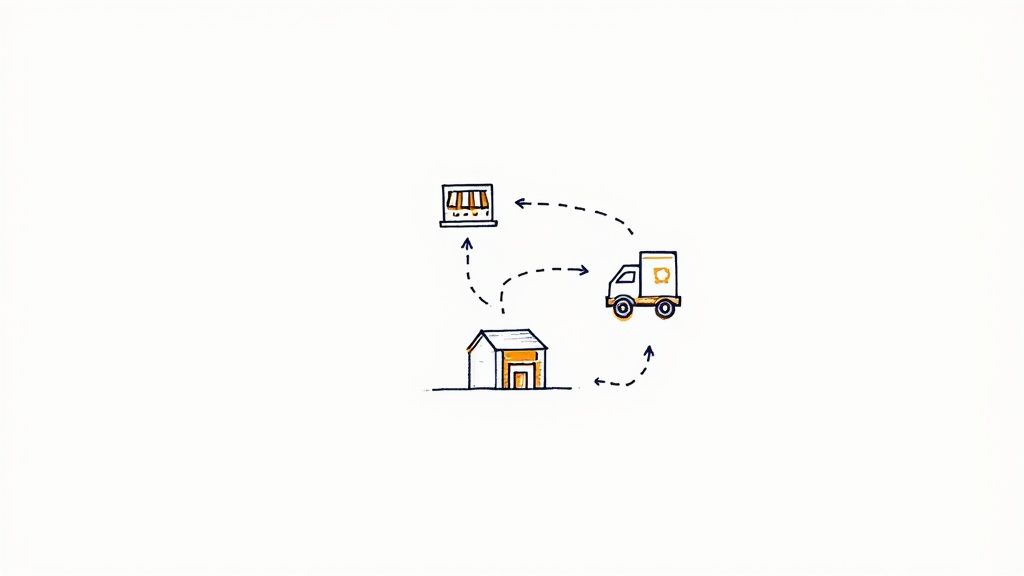
Instead, you build relationships with suppliers who do all the heavy lifting. They're the ones holding the inventory in their warehouses. This setup effectively splits a traditional retail business in two, letting you focus entirely on what you do best: marketing and selling.
The Three Key Players in Every Transaction
Every single dropshipping sale is like a well-choreographed dance between three distinct players. Getting a handle on who does what is the first step to really understanding how this whole thing works.
Let’s break down the cast of characters and their specific jobs.
| Player | Primary Role | Key Responsibilities |
|---|---|---|
| The Customer | The Buyer | Browses your store, finds a product they love, and completes the purchase. They only ever interact with your brand. |
| The Retailer (You) | The Marketer & Seller | Builds the website, curates products, sets prices, attracts customers, and provides all customer support. |
| The Supplier | The Fulfillment Partner | Sources or manufactures products, stores inventory, and handles all packing and shipping directly to the customer. |
Each role is crucial, but they all work together behind the scenes to create what feels like a standard online shopping experience for the end customer.
The magic of this model is that you, the retailer, act as the middleman. You connect a customer's demand with a supplier's product, and your profit is the difference between the retail price you charge and the wholesale price the supplier charges you.
It's no surprise this model has taken off. In fact, more than 27% of online retailers have already adopted dropshipping as their primary way of getting products to customers. The global market is booming, jumping from $351.81 billion to $434.98 billion in a single year. Experts even predict it could reach a staggering $2.57 trillion in the next decade. If you're curious, you can explore more data on the dropshipping market growth to see just how big the opportunity is.
The Dropshipping Process From Order to Delivery
To really get a feel for how dropshipping works, let’s follow an order from the second a customer hits “buy” to the moment the package lands on their porch. The whole setup relies on a smooth, often automated, flow of information between you, your customer, and your supplier. Think of yourself less as a warehouse manager and more like an air traffic controller for products.
Let's use a quick example. Say you run an online store selling cool home gadgets. A customer, let's call her Sarah, just bought a smart coffee mug from you for $50. What happens now?
Stage 1: The Customer Places an Order
Sarah discovers the mug on your website, is won over by your awesome product photos and description, and heads to checkout. She puts in her payment info and shipping address, just like any other online purchase. As far as she's concerned, she's buying it directly from your brand.
The moment her payment goes through, two things happen at once: you get $50 in your account (through a processor like Stripe or PayPal), and a new order pops up in your e-commerce dashboard, like on Shopify. This is the starting gun for the entire process.
This simple graphic breaks down the basic three-step flow of every single dropshipping sale.
As you can see, you're the central hub. You manage the customer relationship and tell the supplier where to send the product.
Stage 2: The Order Is Forwarded to the Supplier
This is where the real beauty of dropshipping automation kicks in. You’re not stuck manually emailing your supplier every time someone buys something. Instead, your store automatically sends Sarah’s order details—what she bought, her name, and her shipping address—straight to your supplier.
You then pay the supplier their wholesale price for the mug, which we'll say is $30. That $20 difference is your gross profit. Critically, this payment happens after Sarah has already paid you, so you never have to dip into your own pocket to buy inventory upfront.
Key Takeaway: You are the seller of record. Even though a third party is shipping the product, it's your brand name, logo, and contact info on the invoice and shipping label. The customer experience is 100% with your company.
Stage 3: The Supplier Ships the Product
With the order and payment in hand, the supplier’s team gets to work. They find the smart coffee mug in their warehouse, pack it up professionally, and get it ready to ship.
From there, the supplier ships the package directly to Sarah's address. They handle all the logistics—picking the shipping carrier, printing the label, and making sure it gets out the door on time. This is the hands-on part you completely outsource, saving you from ever needing a warehouse, packing tape, or stacks of boxes.
Stage 4: You Close the Loop with the Customer
Once the order is shipped, the supplier gives you a tracking number. Your final job is to get this vital piece of information to Sarah. Most e-commerce platforms can handle this for you, automatically sending out a shipping confirmation email with a tracking link.
Now, Sarah can follow her package's journey. If she has any questions about her order, where it is, or the product itself, she contacts you, not the supplier. You handle all the customer service, which reinforces her connection to your brand and helps build the trust that leads to future sales. This four-step workflow is the engine that keeps every dropshipping business running.
Weighing the Pros and Cons of Dropshipping
No business model is perfect, and that’s especially true for dropshipping. It’s an incredibly popular way to get into ecommerce, but the very things that make it so easy to start also create some unique challenges. Before you jump in, it's critical to get a clear-eyed view of both sides of the coin.
This balanced perspective will help you figure out if dropshipping really fits your goals and what to expect on your journey.
The Good: Key Advantages of the Dropshipping Model
The number one reason people flock to dropshipping is the extremely low startup cost. Think about it: traditional retail means sinking thousands of dollars into inventory before you’ve even made a sale. With dropshipping, that massive financial barrier is gone.
This directly translates into zero inventory risk. You’re not stuck with a garage full of fidget spinners after the trend dies down. You only pay for a product after a customer has already paid you, which frees up your cash and lets you test new product ideas without the financial hangover.
Beyond the money, dropshipping offers a level of flexibility that’s hard to beat.
- Work From Anywhere: As long as you have a laptop and an internet connection, you’re in business. This location independence is a huge draw for anyone dreaming of a more flexible lifestyle.
- Offer a Massive Catalog: You can sell a huge variety of products without ever worrying about warehouse space. If your supplier has it, you can list it in your store with a few clicks.
- Scale Without the Headaches: When orders start pouring in, you don't have to worry about hiring a team to pack and ship. Your supplier handles the heavy lifting, so you can focus on what really grows the business: marketing and customer service.
The Bad: The Real Challenges You Will Face
Okay, so the upsides are pretty great. But it’s crucial to understand the very real hurdles you'll face. The same low barrier to entry that makes dropshipping so appealing also means one thing: fierce competition.
This leads us to the biggest pill to swallow: lower profit margins. With dozens, or even hundreds, of other stores selling the exact same products, price wars are inevitable. It can quickly become a race to the bottom, which puts a serious squeeze on your profits. This is why having a strong brand and smart marketing isn't just nice to have—it's essential for survival.
Another major challenge is that you're putting a huge part of your business in someone else's hands. You have to deal with supplier and shipping complexities. You don't have direct control over product quality, how items are packaged, or how quickly they ship out. If your supplier messes up, your brand takes the hit.
Here's a classic dropshipping headache: a customer buys three items from your store, but each one comes from a different supplier. You end up eating multiple shipping costs, and your customer gets three separate packages on three different days. Not a great experience.
And finally, remember this: you are 100% responsible for customer service. When a product is defective or a shipment is late, the customer isn't going to call your supplier. They're coming to you. You become the public face for problems you didn't create, which demands a lot of patience and top-notch communication skills.
Dropshipping Model Pros vs Cons
To make it even clearer, let's break down the key points side-by-side. Seeing the good right next to the bad can really help put the entire business model into perspective.
| Advantages (Pros) | Disadvantages (Cons) |
|---|---|
| Low Startup Costs: No need to invest heavily in inventory. | Low Profit Margins: Intense competition drives prices down. |
| No Inventory Management: The supplier handles all storage and shipping. | Supplier Dependency: You have no control over quality or shipping times. |
| Location Independence: Run your business from anywhere in the world. | Shipping Complexities: Orders can be split into multiple packages. |
| Wide Product Selection: Easily offer a diverse range of items. | Full Customer Service Burden: You handle all customer complaints and issues. |
| Easy to Scale: Operations don't get much harder as you grow. | Branding is a Challenge: It's hard to stand out when selling the same products. |
Ultimately, dropshipping is a trade-off. You trade the financial risk of holding inventory for the operational challenge of managing a business you don't fully control.
It’s a tough game. In fact, only about 10% of dropshippers find significant success in their first year, mostly because of that intense competition. But for those who figure it out, the average profit margins can still land around a healthy 25%. To get a better feel for the numbers, you can discover more insights about dropshipping statistics and see what the data says.
Finding Products That Sell and Suppliers You Can Trust
Let's be blunt: your dropshipping business lives or dies based on two things: what you sell and who you get it from. Get these right, and you're building on solid ground. Get them wrong, and even the slickest marketing campaign on the planet won't save you.
This is where the rubber meets the road. We're moving past the theory and into the nitty-gritty of building a real store. First, you need a product that people are genuinely excited to buy. Then, you need a partner—a supplier—who you can count on to get that product into your customer's hands without a hitch.
How to Discover Winning Products
Finding a "winning" product isn't about stumbling upon a hidden gem by luck; it’s about smart, focused research. The real goal is to find items with strong demand but not-so-crazy competition. You want to find your own little corner of the market where you can make a name for yourself and, of course, turn a profit.
You're essentially hunting for products that do one of three things: solve a frustrating problem, tap into a deep passion, or ride a growing trend.
Here are a few proven ways to start digging:
- Become a Trend Spotter: Use tools like Google Trends or Exploding Topics to see what’s capturing people's attention. You're looking for a steady upward climb in interest, not just a flash-in-the-pan fad. This is how you validate an idea with real data before you go all-in.
- Go Where Your Customers Hang Out: Dive headfirst into niche communities on Reddit, TikTok, and specific Facebook Groups. What are people constantly complaining about? What gadgets or items are they raving about? These online hangouts are absolute goldmines for finding product ideas that already have a hungry audience.
- Use E-commerce Spy Tools: Why guess when you can know? Specialized platforms can give you a massive advantage. Tools like Dropship.io or ShopHunter let you peek behind the curtain and see which products are already crushing it for other Shopify stores. It's like getting a proven blueprint. If you're looking for a bundle of these tools, services like EcomEfficiency can make them more affordable.
Once you’ve got a shortlist of promising products, the next step is finding someone to supply them.
My Two Cents: The best products usually have a "wow" factor, fix a nagging annoyance, or cater to a hobbyist obsession. Stop thinking about generic stuff everyone sells and start thinking about products that make someone’s life easier, better, or just a lot more fun.
Finding and Vetting Suppliers Who Won't Let You Down
Think of your supplier as your silent business partner. Their performance is your performance. Their reliability directly shapes your brand's reputation, your customer reviews, and your sanity. A great supplier is a ghost—they ship quickly, the product is perfect, and you never hear a complaint. A bad one? They create angry customers, negative reviews, and a whole lot of headaches for you.
You can start your search on massive platforms like AliExpress, or use curated directories like SaleHoo and dropshipping-focused apps like DSers. But just finding a name on a list is barely step one. You have to vet them. Seriously.
A solid supplier is the absolute backbone of your operation. Taking the time to check them out properly isn't just a good idea; it's a non-negotiable part of the process.
Your Practical Supplier Vetting Checklist
Before you link your store to any supplier, put them through this simple but essential wringer. This little checklist will help you dodge the amateurs and partner with pros who will help you scale.
- Test Their Communication: Send them a few questions. How fast do they reply? Are the answers clear, or do they feel like a bad translation? If they're slow and unhelpful when you're a potential customer, just imagine the radio silence when an order goes missing.
- Get the Nitty-Gritty on Shipping: Ask for their average shipping times to the countries you're targeting. Crucially, do they provide tracking numbers on every single order? Nail down their policies for lost packages or delays. You need total transparency here.
- Read the Reviews (The Real Way): Don't just glance at their star rating. Actually read the feedback from other sellers. Are people complaining about product quality? Packaging? Shipping speeds? A few bad reviews happen, but if you see the same complaints over and over, that’s a giant red flag.
- Order Samples. Always. This is the most critical step, and too many people skip it. Order the product yourself. Get it shipped to your own house. Does it look and feel like the photos? Is the quality something you'd be proud to sell? How did it arrive—in a nice package or a crushed box? This simple test tells you exactly what your customer is going to experience.
When you meticulously choose your products and rigorously vet your suppliers, you're not just starting a store—you're building a real, sustainable business. This dual focus is what separates the stores that fizzle out in a few months from the ones that thrive for years.
Building and Marketing Your Dropshipping Brand
Let's be honest. In dropshipping, hundreds of other stores could be selling the exact same products you are. So, what makes a customer choose you? The answer is your brand.
Your brand is the only thing that's truly yours. It’s what turns a simple transaction into a memorable experience and convinces a first-time buyer to come back again and again. You can't just throw up a store and expect sales; you have to build something people actually want to buy from.
It all starts with the basics: a solid business name and a clean, professional logo. Don't mistake these for fluff—they're the handshake, the first impression you make on every single visitor.
Creating a Cohesive Brand Identity
Think of your brand identity as your store's personality. It’s the consistent vibe you put out there, from the colors on your website to the tone of your marketing emails. A strong, cohesive identity makes you instantly recognizable and builds a sense of trust.
How do you want people to feel when they land on your site? Fun and energetic? Sleek and sophisticated? Nailing this down will guide everything you do, from writing product descriptions to handling your customer service.
Key Insight: A brand is so much more than a logo. It's the promise you make to your customers—a promise of quality, a unique style, or an experience they simply can't get anywhere else.
Once you know who you are, it's time to tell the world. That’s where a smart marketing plan comes in, even if you’re working with a shoestring budget.
Your Beginner Marketing Roadmap
You don’t need a huge pile of cash to start getting traction. What you do need is a focused plan to reach the right people where they’re already hanging out online. The goal here is to build early momentum and get those first crucial sales rolling in.
Here are three core strategies to get you off the ground:
Search Engine Optimization (SEO): This is all about getting your products to show up when people search on Google. Start by figuring out the keywords your ideal customers are typing in and sprinkle them naturally into your product titles and descriptions. SEO is a long-term play, but it pays off with a steady stream of free, high-intent traffic.
Targeted Social Media Ads: Platforms like Facebook, Instagram, and TikTok are goldmines for finding customers. You can zero in on people based on their interests, age, location, and even their online shopping habits. Even $5-$10 a day can bring in real traffic and sales if your targeting is on point.
Email Marketing: Don't sleep on email. Seriously. Start collecting customer emails from day one. Use them to send order updates, shipping notifications, and—most importantly—promotions and new product announcements to drive repeat business. An email list is an asset you own, a direct line to your audience that no algorithm can take away.
These three pillars—SEO, social ads, and email—create a powerful marketing loop. They help you get discovered, make the sale, and turn one-time buyers into loyal fans of your brand.
Common Questions About Dropshipping
Even after you get the basic concept down, a few practical questions always seem to pop up. It's one thing to understand the model, and another thing entirely to picture yourself actually running the business day-to-day.
Let's clear the air and tackle some of the most common questions I hear from people just starting out.
Is Dropshipping Still Profitable?
Absolutely, but let's be real: it's not a "get rich quick" button. The gold rush days of slapping a product on a store and making a fortune are long gone. Today, profitability comes from being a smart business owner.
It all boils down to finding a solid niche, marketing your products effectively, and treating your customers well. Your profit margins on individual products will likely be thinner than traditional retail, but your big advantage is the lack of upfront inventory cost. You're not risking thousands of dollars on products that might not sell. Success is about managing your ad spend wisely and finding suppliers who give you enough room to make a profit.
How Much Money Do I Need to Start?
This is one of dropshipping's biggest draws. You can technically get a basic store up and running for under $100. That'll cover your first month of a platform like Shopify and a custom domain name.
But a more realistic starting budget needs to include marketing. I'd recommend setting aside at least $300 to $500 to start driving traffic and getting your first sales. You'll also want a little cash to order samples—never sell something you haven't seen and tested yourself.
How Do I Handle Returns and Refunds?
This is a big one. Your return process is almost entirely dependent on your supplier's policy, so it's something you need to figure out before you make your first sale. The first step is simple: create a clear, fair return policy and make it easy to find on your site.
When a customer requests a return, you're the middleman. You'll coordinate between them and the supplier. Some suppliers are great about returns, especially for damaged goods, while others might not accept them at all. For low-cost items, it’s often cheaper and better for customer satisfaction to just issue a refund and let them keep the product.
The dropshipping world is constantly shifting. Right now, North America is the biggest market, but the Asia Pacific region is catching up fast. As for what's selling, fashion is still king, but the food and personal care categories are growing like crazy. You can discover more insights about the dropshipping market to get a sense of where things are headed.
Ready to slash your software costs and find winning products faster? EcomEfficiency bundles over 50 premium e-commerce tools for product research, SEO, and marketing into one simple subscription, saving you up to 99% on monthly fees. Unlock the ultimate e-commerce toolkit today.