What Is Cost Per Acquisition A Complete Guide

Let’s cut to the chase: Cost Per Acquisition (CPA) is the total amount of money you spend to get one new paying customer. It’s that simple. Think of it as the final price tag for each sale you close, making it one of the most crucial metrics for understanding if your marketing is actually working.
The goal is to scale without dubious shortcuts and without hurting your credibility.
What Cost Per Acquisition Really Means
It's easy to get lost in jargon, but let's make it concrete. Imagine you run a food truck. You spend money on flyers, a new sign, and a few sponsored posts on Instagram to get people to come by. Your CPA is the total cost of all that marketing, divided by the number of new customers who actually bought a meal.
This metric is powerful because it ignores vanity metrics like clicks and impressions. Instead, it zeros in on the one thing that truly matters: turning a person browsing into a person buying. An "acquisition" isn't a lead or a sign-up; it's a cash-in-hand transaction that grows your business.
Understanding your CPA is the first real step toward building a predictable growth engine. If you don’t know this number, you're essentially flying blind—spending money without knowing if you’re making any back.
Why CPA Is A Bottom-Line Metric
Tracking your CPA gives you a direct line of sight into your company's financial health. It’s the bridge connecting your marketing budget to your revenue, answering the single most important question: "Am I getting a return on my ad spend?"
A healthy CPA means you aren't paying more to land a customer than they're worth to you. Finding that sweet spot is the key to sustainable, long-term success.
A solid rule of thumb is to aim for a Lifetime Value (LTV) to CPA ratio of at least 3:1. This means a customer should be worth at least three times what you paid to acquire them. Hitting this ratio is a strong signal that you have a scalable and profitable business model.
Quick Guide To Calculating Cost Per Acquisition
To get an accurate CPA, you have to be honest about all the costs involved. It’s more than just the money you give to Google or Facebook; it includes everything that helped close the deal.
Here’s a quick overview of the essential parts needed to figure out your CPA.
| Component | Description | Example |
|---|---|---|
| Total Marketing & Sales Cost | The full investment made to win new customers in a set period. This covers ad spend, creative costs, agency retainers, and marketing tools. | You spent $5,000 on a marketing campaign last month. |
| Total Acquisitions | The exact number of new, paying customers you gained directly from that marketing investment. | The campaign brought in 100 new customers. |
| CPA Calculation | Your total cost divided by the total number of new customers you acquired. | $5,000 / 100 customers = a CPA of $50. |
Once you’ve got these basics down, you can start making smarter, data-backed decisions that stretch your budget further and fuel real growth. For a deeper dive, check out a complete guide to Cost Per Acquisition and how to lower it. Think of this as your starting point for building marketing campaigns that don't just run, but actually deliver.
How to Calculate Your CPA with Confidence
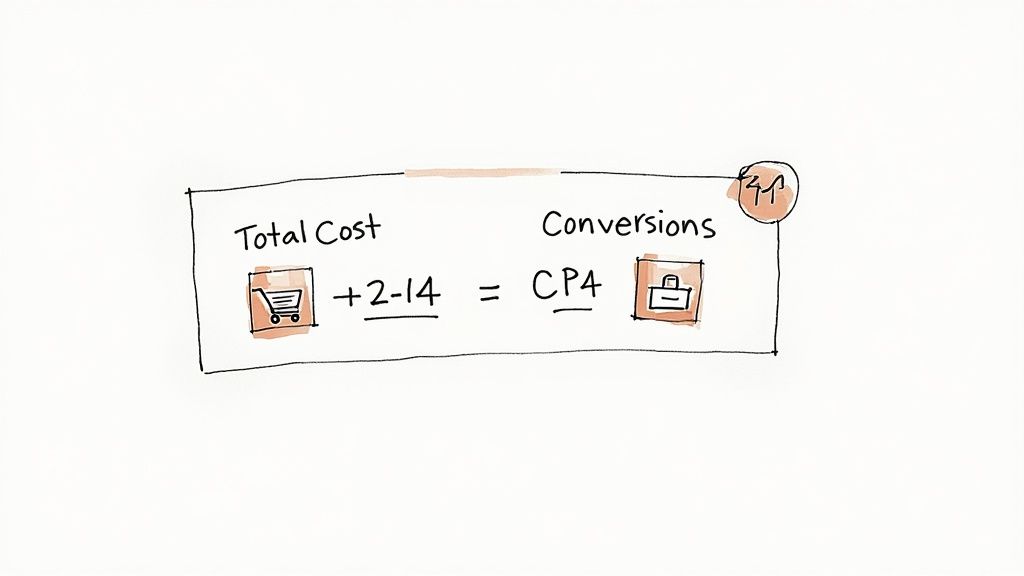
Figuring out your Cost Per Acquisition shouldn't feel like you're trying to solve a complex puzzle. At its core, the math is refreshingly simple. It all boils down to one powerful formula that shows you exactly what you’re spending to get a new customer in the door.
The basic CPA formula is: Total Campaign Cost ÷ Total Conversions = Cost Per Acquisition.
This simple equation gives you a clear, per-customer cost. But here's where people often trip up: getting a truly accurate CPA means you have to be honest about what you include in your "Total Campaign Cost." Just counting your ad spend gives you a dangerously optimistic number that doesn't reflect reality.
The CPA Formula in Action
To get this right, you have to look at the whole picture. The basic formula is your starting point, but the accuracy comes from tracking all the associated costs that went into winning that customer. We're talking about more than just the ad budget.
Think about costs like creative production, the tech you use, and any outside help you hired. For a deeper dive, check out these insights on customer acquisition costs at amraandelma.com.
Let’s break down all the costs you should be tracking:
- Direct Ad Spend: This is the easy one—it's the money you pay directly to platforms like Google, Meta, or TikTok for running your ads.
- Creative and Production Costs: Did you hire a designer for your ad creative? Pay for a video shoot? Those expenses are a direct part of the cost to acquire.
- Tool and Software Subscriptions: Don't forget the monthly fees for your analytics software, landing page builder, or any marketing automation tools that support the campaign.
- Agency or Freelancer Fees: If you’re working with a marketing agency or a freelance media buyer, their invoices absolutely count toward your total cost.
- Team Overhead (Optional but Recommended): For the most accurate view, many businesses will even factor in a portion of their in-house marketing team’s salaries.
When you include all these elements, you stop guessing and start getting a real, actionable understanding of what it costs to earn a new customer.
Example 1: The E-commerce Instagram Campaign
Let's say you run an online store that sells custom phone cases. You decide to run a targeted Instagram campaign for one month to boost sales.
Here's a look at your expenses:
- Instagram Ad Spend: $2,000
- Freelance Graphic Designer (for ad visuals): $300
- Subscription for a landing page tool: $50
Your Total Campaign Cost adds up to $2,350. Over that month, the campaign brought in 94 sales from brand-new customers.
Now, let's plug it into the formula:
$2,350 (Total Cost) / 94 (Conversions) = $25 (CPA)That means it cost you exactly $25 to acquire each new customer from this specific Instagram campaign.
Example 2: The B2B Blended CPA
Now for a more complex scenario. Imagine a B2B software company that uses a mix of channels to generate qualified leads, which are then handed off to the sales team to close. They want to calculate their "blended" CPA across all efforts for Q1.
Here’s a breakdown of their quarterly costs:
- Google Ads Spend: $15,000
- Content Marketing (writer fees & software): $5,000
- Sales Team Salaries (portion allocated to new business): $30,000
- Marketing Agency Retainer: $6,000
The Total Acquisition Cost for the quarter comes to $56,000. During that time, their hard work paid off, and they signed 70 new clients.
Applying the same formula:
$56,000 (Total Cost) / 70 (New Clients) = $800 (CPA)
This blended CPA of $800 gives the company a fantastic high-level benchmark for their overall efficiency. From here, they can dig deeper into each individual channel to see what’s working best and decide where to invest their budget next quarter.
Why Your Customer Acquisition Costs Are Rising
If you've been feeling like it’s costing more and more to bring in each new customer, you’re not wrong. Plenty of businesses are seeing their Cost Per Acquisition creep up, and it’s a trend that's forcing a major rethink of growth strategies. This isn't a sign that you're doing something wrong; it's a symptom of a digital marketplace that's more crowded and competitive than ever.
The old "set it and forget it" ad campaigns just don't pack the same punch anymore. The simple truth is that the digital watering holes where you find your customers are getting crowded. Grabbing someone's attention today takes more strategic thinking, better creative, and, frankly, a bigger budget.
The New Rules of a Saturated Market
Imagine the internet as a small town that exploded into a metropolis overnight. In the early days, opening a new shop was a big deal—you were one of just a few options around. Fast forward to today, and that same street is crammed with competitors, all vying for attention with flashy signs and special deals.
That’s exactly what has happened on platforms like Google, Meta, and TikTok. As more and more businesses pile in and invest in advertising, the cost of that digital real estate skyrockets. It's a massive bidding war, and the price to get your message in front of the right person goes up accordingly.
The data tells the same story. Over the past five years, many established companies have seen their customer acquisition costs soar by as much as 70% to 75%. Even newcomers in less crowded markets are feeling the pinch, with increases closer to 50%. You can dig deeper into these trends and discover more insights about CAC changes over time on paddle.com. The takeaway is clear: in mature markets, the battle for customer attention is getting incredibly expensive.
Rising Customer Expectations
It’s not just about market saturation. Today's customers are smarter and have higher expectations than ever before. They want personalized experiences, smooth interactions, and a real connection with the brands they buy from. Generic ads and cookie-cutter landing pages are a one-way ticket to getting ignored.
To meet these new standards, you have to invest more heavily in things like:
- High-Quality Creative: This means compelling videos, polished graphics, and sharp copy that actually connects with your audience.
- Personalization Technology: You need tools that can adapt ad messaging and on-site experiences for different types of visitors.
- Customer Experience: Your website has to be fast, work perfectly on mobile, and be backed by great support.
Every one of these improvements adds a little more to your total cost of acquiring that customer. It's not just about winning a click anymore; it's about delivering a complete, convincing experience from start to finish.
Let’s look at a fictional brand, "ActiveWear Co." Five years ago, they could run a simple photo ad on Facebook with a "20% Off" banner and bring in new customers for a CPA of $15. Today, that same ad would be dead on arrival.
To even have a chance, their new strategy has to be much more sophisticated. It includes:
- Influencer Marketing: They partner with fitness creators to get their gear seen by an engaged audience.
- Video Ads: They run professionally produced video campaigns on Instagram and TikTok.
- Retargeting Campaigns: They serve personalized ads to shoppers who left items in their cart.
This multi-channel approach works, but it's also pushed their average CPA up to $40. Their story is the new reality for thousands of brands. A rising Cost Per Acquisition isn't a failure; it’s a reflection of the higher bar for earning a customer's business in a world overflowing with options.
How Do You Know If Your CPA Is Any Good? Benchmarking Is Key
So, you've calculated your Cost Per Acquisition. That's a great first step. But what does that number actually mean?
A $50 CPA might be a massive win for a company selling premium home goods, but it could spell disaster for a mobile app that charges $1.99 a month. On its own, your CPA is just a number floating in space. It's only when you give it context that it becomes a powerful tool for making smart business decisions.
This is where benchmarking comes in. By comparing your CPA to the average for your industry, you get a much clearer picture of how you're really doing. It helps you answer that all-important question, "Is my CPA good?" and gives you the data you need to set realistic goals and justify your marketing spend.
Why CPA Varies So Wildly Across Industries
It would be nice if there was one "good" CPA number to aim for, but the reality is far more nuanced. A B2B software company will almost always have a much higher CPA than a direct-to-consumer T-shirt brand, and that’s completely normal.
These differences aren't random; they're tied directly to the fundamentals of each business model.
- Customer Lifetime Value (LTV): A business that sells enterprise software on a $50,000 annual contract can obviously afford to spend more to land one customer than a shop selling $30 t-shirts.
- Sales Cycle Length: Closing a B2B deal can take months of demos, meetings, and negotiations. An e-commerce purchase, on the other hand, can happen in a matter of minutes. More time and touchpoints mean higher costs.
- Market Competition: Industries like finance and legal are notoriously competitive. When dozens of companies are all bidding on the same keywords and targeting the same audiences, acquisition costs naturally skyrocket.
- Price Point: This one's pretty straightforward. The CPA for a luxury car brand is going to be in a completely different galaxy than the CPA for a fast-food chain.
Keeping these factors in mind is crucial for judging your own numbers fairly. To see how your CPA stacks up, it's essential to look at industry standards; you can learn more about the average cost of customer acquisition to get a broader perspective.
Average Cost Per Acquisition (CPA) by Industry
Having a solid benchmark transforms your CPA from a simple metric into a genuine key performance indicator (KPI). The data might surprise you. For instance, the eCommerce space sees an average CPA of $274. But that pales in comparison to the most expensive sectors—insurance companies shell out a staggering $1,280 per customer, while fintech companies hit $1,450.
Key Takeaway: A "high" CPA isn't necessarily a bad thing, especially if it's attached to an even higher LTV. The real goal isn't just to get the lowest CPA possible; it's to find the most profitable balance between what you spend to acquire a customer and what you earn from them over time.
To give you a clearer idea of where you stand, here’s a look at typical CPA values across several major industries.
| Industry Sector | Average CPA (USD) |
|---|---|
| Technology (SaaS) | $395 |
| Finance | $450+ |
| E-commerce (Retail) | $274 |
| Education | $430 |
| Healthcare | $315 |
| Legal | $675+ |
| Insurance | $1,280 |
| Fintech | $1,450 |
Think of these numbers as a starting point, not a strict rulebook. Your own CPA will always be unique to your brand, audience, and marketing mix. But this data gives you an invaluable reference point to start gauging your own efficiency and spotting opportunities to improve.
Proven Strategies To Lower Your CPA
Knowing your Cost Per Acquisition is one thing, but actively driving it down is where you start winning. A high CPA can bleed your marketing budget dry with little to show for it. On the flip side, a lean, efficient CPA is the engine for profitable growth. The goal isn't just to spend less—it's to spend smarter by cutting out the waste and making every dollar count.
This isn't about taking a sledgehammer to your budget. It's about surgical precision. It's about finding the leaks in your funnel and plugging them with smart, data-driven tactics. From zeroing in on your audience to perfecting the post-click experience, every small improvement helps lower that final price tag on each new customer.
This chart shows just how much CPA can vary from one industry to the next, from e-commerce all the way to high-stakes sectors like fintech.
It’s clear from the data that while an e-commerce brand might pay around $274 for a new customer, a company in the insurance or fintech space could be spending over $1,200. This really drives home why understanding your industry's context is crucial when you set your CPA goals.
Refine Your Audience Targeting
One of the quickest ways to slash your CPA is to stop showing ads to people who will never buy your product. It's like the difference between putting a billboard on a busy highway and running an ad in a niche hobbyist magazine. The billboard gets more eyeballs, sure, but the magazine ad gets the right eyeballs, which always leads to a better return.
Start by digging into your own customer data. What are the common threads among your best customers? Look at their demographics, their interests, and how they behave online. Use these insights to build lookalike audiences on platforms like Meta, which can find new people who are uncannily similar to your proven buyers. At the same time, beef up your negative keyword lists in search campaigns to filter out irrelevant searches. This makes sure your budget is spent only on people with real intent.
Enhance Your Landing Page Conversion Rate
Your ad has one job: to get the click. After that, it’s all on the landing page. A page that's slow, confusing, or just doesn't feel trustworthy can absolutely destroy your conversion rate and send your CPA into the stratosphere, no matter how brilliant your ad was. Fixing this experience is one of the highest-impact things you can do.
A killer landing page usually has a few key ingredients:
- A Clear Headline: It needs to echo the promise you made in your ad, instantly reassuring visitors they've landed in the right spot.
- Compelling Copy: Ditch the feature lists and focus on the benefits. How does your product actually solve a problem for the customer?
- Strong Call-to-Action (CTA): Use a clear, action-focused button that pops off the page. Think "Get Your Free Trial" instead of a generic "Submit."
- Social Proof: Nothing builds trust faster than seeing that other people have already bought in. Add customer testimonials, reviews, or logos of well-known clients.
Pro Tip: Page speed is a notorious conversion killer. Studies have shown that even a one-second delay in page load time can tank conversions by 7%. Use free tools like Google's PageSpeed Insights to find and fix what’s slowing you down.
Implement Strategic Retargeting Campaigns
Did you know that only about 2% of website traffic converts on the first visit? That means a staggering 98% of the people you paid to bring to your site just leave. Retargeting is your secret weapon to bring them back into the fold and close the deal.
By placing a small piece of code (a pixel) on your site, you can serve up tailored ads to people who've already shown they're interested. For example, you can run a specific campaign targeting users who added a product to their cart but bailed before checking out. These ads can feature the exact product they were looking at, maybe sweetened with a small discount or a reminder about free shipping.
This strategy is incredibly effective because you're no longer marketing to a cold audience; you're talking to people who already know your brand. It's why retargeting campaigns almost always boast a lower CPA and a much higher conversion rate than campaigns aimed at brand-new prospects.
A/B Test Your Ad Creative And Copy
Never, ever assume you know which ad will be a home run. The creative you think is a masterpiece might fall completely flat, while a simple, unexpected design could end up being your top performer. The only way to know for sure is to test everything.
A/B testing (or split testing) is as simple as running two or more versions of an ad to see which one gets better results. You can test virtually any element:
- Headlines: Try a direct, benefit-driven title against an intriguing question.
- Images and Videos: Pit a static image against a short video clip, or a lifestyle photo against a clean product shot.
- Ad Copy: Experiment with short, punchy text versus a longer, more detailed description.
- Call-to-Action: Does "Shop Now" outperform "Learn More" for your audience? Test it.
By constantly testing and iterating, you can systematically improve your ad performance, boost your click-through rates, and steadily drive down your Cost Per Acquisition over time.
How To Track And Measure CPA The Right Way
Trying to calculate your Cost Per Acquisition without a rock-solid tracking system is like flying blind. If your data isn't clean, you’re essentially just guessing which marketing efforts are bringing in customers. You can’t improve what you can’t measure.
A proper measurement framework is what separates the pros from the amateurs. It turns a jumble of raw data into clear, actionable insights that help you spend smarter and bring down your CPA.
Think of it like a detective following a trail of breadcrumbs. Your tracking setup lets you follow a customer from the very first ad they clicked all the way to the final purchase. This is how you connect every dollar you spend to a real outcome, giving you a crystal-clear picture of what's working and what's just wasting money.
The Building Blocks Of Accurate CPA Tracking
To really know what’s going on, you have to tag and track the traffic from your campaigns. This boils down to a couple of technical pieces that might sound complicated but have a very simple job: making sure credit goes where it's due.
- UTM Parameters: These are just little snippets of text added to the end of a URL. They act like little labels that tell your analytics tools exactly where a visitor came from—the source (like Google), the medium (like CPC), and the specific campaign name. It's how you can tell traffic from a Facebook ad apart from someone who clicked a link in your email newsletter.
- Conversion Pixels: This is a tiny piece of code you place on important pages, most often the "thank you" page someone sees after buying something. When a user who clicked your ad lands on that page, the pixel "fires," sending a signal back to the ad platform to report a successful conversion.
These two things work hand-in-hand to create a traceable path for every customer. They are the absolute foundation of any reliable CPA tracking system.
Choosing Your Attribution Model
Okay, so you’re tracking conversions. Great. The next big question is: who gets the credit?
A customer might see a Facebook ad on Monday, click a Google search result on Wednesday, and then open a promotional email on Friday before finally making a purchase. Which channel gets the credit? This is where your attribution model comes in.
Your choice of attribution model can completely change the CPA you see for different channels. There's no single "right" answer—the best model depends entirely on your business goals and how you think about the customer journey.
Let's break down the most common models:
- Last-Click Attribution: This is the default for many platforms and the simplest to understand. It gives 100% of the credit for a sale to the very last thing the customer clicked before buying. It's easy, but it often ignores all the hard work your other channels did to introduce the customer to your brand in the first place.
- First-Click Attribution: The exact opposite. This model gives all the credit to the very first channel that brought a visitor to your site. It’s fantastic for understanding which channels are best at generating brand new awareness and getting people in the door.
- Multi-Touch Attribution (e.g., Linear or Time-Decay): These are more sophisticated models that spread the credit across multiple touchpoints. A linear model gives equal credit to every single interaction. A time-decay model gives more weight to the touchpoints that happened closer to the final conversion.
Tools like Google Analytics let you switch between these models and compare the results. Getting this complete picture is how you start making truly smart, data-driven decisions that will consistently lower your CPA over time.
Answering Your Top CPA Questions
Even after you've got the basics down, a few common questions about Cost Per Acquisition always seem to pop up. Let's clear up some of the most frequent sticking points for marketers.
Is CPA The Same As Customer Acquisition Cost (CAC)?
This one trips up a lot of people, and it’s easy to see why. While they sound similar and are often used interchangeably, there’s a key distinction.
Think of CPA as a granular, campaign-level metric. It’s flexible. You can use it to measure the cost of almost any specific action you care about—a sale, sure, but also a newsletter sign-up, a lead form submission, a free trial, or an app download.
Customer Acquisition Cost (CAC), on the other hand, is the big-picture number. It measures the total cost to bring in a brand new paying customer. It's a much broader business metric. CPA is tactical; CAC is strategic.
How Often Should I Be Checking My CPA?
There's no single right answer here—it really depends on the marketing channel you're using and how long your sales cycle is.
- For fast-paced channels (think paid search or social media ads): You’ll want to keep a close eye on your CPA, checking it daily or at least weekly. This lets you react quickly, tweaking bids or creative before you burn through your budget on a campaign that isn’t working.
- For long-game channels (like content marketing or SEO): A monthly or quarterly check-in is much more practical. These efforts take time to build momentum, so looking at the numbers too often can give you a skewed picture and lead to premature decisions.
What’s A Good CPA When I'm Just Starting Out?
Trying to set a "good" CPA without any historical data can feel like throwing a dart in the dark. The smartest way to approach this is to work backward from a more stable metric: your Customer Lifetime Value (LTV).
As a rule of thumb, a healthy LTV to CAC ratio is widely considered to be 3:1. This simply means that the total revenue a customer brings you over their lifetime should be at least three times what you spent to get them in the door.
So, if you calculate that your average LTV is $300, aiming for a starting CPA of $100 or less is a fantastic, data-driven goal to set for yourself.
Ready to slash your software spending and get access to over 50+ premium marketing tools? EcomEfficiency bundles everything you need—from SEO and ad-spy tools to AI generators—into one simple subscription, helping you scale your e-commerce business for a fraction of the cost. Check out the full tool library and start your trial.