What Is Attribution in Digital Marketing Demystified

Attribution is how you figure out which of your marketing efforts are actually bringing in sales. Think of it less like a single winning shot and more like a full-court press in basketball—every player, or channel, contributes to the final score. For any e-commerce brand looking to scale without just burning cash, getting this right is non-negotiable.
The goal is to scale without dubious shortcuts and without hurting your credibility.
Understanding Attribution and Why It's Crucial for Growth
Let's walk through a typical customer journey for a pair of sneakers on your Shopify store. A potential buyer first stumbles upon a TikTok ad. A week later, they google your brand, click a shopping ad, look around your site, but don't buy. Then, an email with a 10% discount lands in their inbox, and they finally make the purchase.
So, who's the MVP here? Was it the TikTok ad that first planted the seed? The Google search that captured their interest? Or the email that pushed them over the finish line?
This is the central puzzle of attribution: assigning credit to each of these customer touchpoints. Without a system for this, you’re just guessing where to put your marketing dollars, and guessing is a terrible strategy for growth.
The Danger of Giving Credit to the Wrong Channel
The most common trap is giving 100% of the credit to the last thing a customer clicked before buying. This is a massively outdated approach that completely ignores all the hard work your other channels did to get the customer there.
It creates a distorted view of what's working. You end up pouring money into "closer" channels like branded search or retargeting ads while starving the very channels that are actually bringing new people to your brand. It's a surefire way to hit a growth plateau and waste a ton of money.
Here's a scary but common scenario: When you run ads on Google and Facebook, each platform takes full credit for the same sale if a customer clicked ads on both. This creates huge over-reporting and makes it impossible to see your true ROI.
Seeing the Bigger Picture
Good attribution lets you see the entire customer journey, from the first hello to the final thank you. It shows you how all your channels work together, helping you make smarter, more confident decisions.
By analyzing the full path to purchase, you can:
- Optimize Your Ad Spend: Stop wasting money on campaigns that don't move the needle and double down on what truly works at every stage of the funnel.
- Improve the Customer Journey: See the exact paths your best customers take and create more experiences like that for new visitors.
- Prove Your Worth: Clearly show the return on investment from each channel, making it easy to justify your marketing budget to anyone who asks.
In the end, attribution is about understanding the why behind the buy. It’s the key to unlocking real, sustainable growth by showing you what’s working, what isn’t, and where to invest your next dollar. For a closer look at putting this into practice, check out these proven ROI and attribution tips for measuring marketing campaign effectiveness.
The 6 Core Digital Marketing Attribution Models Explained
Picking an attribution model is a lot like deciding how to split the credit for a team's championship win. Does all the glory go to the player who scored the winning goal? What about the one who made the crucial first play? Or do you give a piece of the credit to everyone who touched the ball?
In digital marketing, each attribution model offers a different answer.
To make this tangible, let's walk through a real-world customer journey. Meet Alex, who just bought a new pair of sneakers from your Shopify store. His path wasn't a straight line; it involved a few key stops:
- Awareness: He first stumbled upon your brand through a TikTok ad.
- Consideration: A week later, he was reminded of your sneakers by a Facebook retargeting ad.
- Conversion: Finally, he clicked a link in a promotional email and made the purchase.
So, who gets the credit? Let's see how six common models would slice up the pie.
1. First Interaction Model
The First Interaction model (often called first-click) is simple and to the point. It gives 100% of the credit to the very first touchpoint that brought a customer into your world. It’s all about what kicked things off.
For Alex, the TikTok ad gets all the credit. This model is fantastic if your main goal is to figure out which channels are best at generating brand awareness and filling the top of your funnel. The obvious drawback? It completely ignores every single interaction that happened afterward to nurture that initial interest.
2. Last Interaction Model
Flipping the script entirely, the Last Interaction model (or last-click) gives 100% of the credit to the final touchpoint right before the sale. For decades, this has been the default for many platforms simply because it's so easy to track.
In Alex’s story, the promotional email is the hero. This model is great for identifying your "closers"—the channels that are most effective at pushing customers over the finish line. But it’s blind to all the hard work the other channels did to get them there in the first place.
This is where visualizing the entire journey becomes so important.
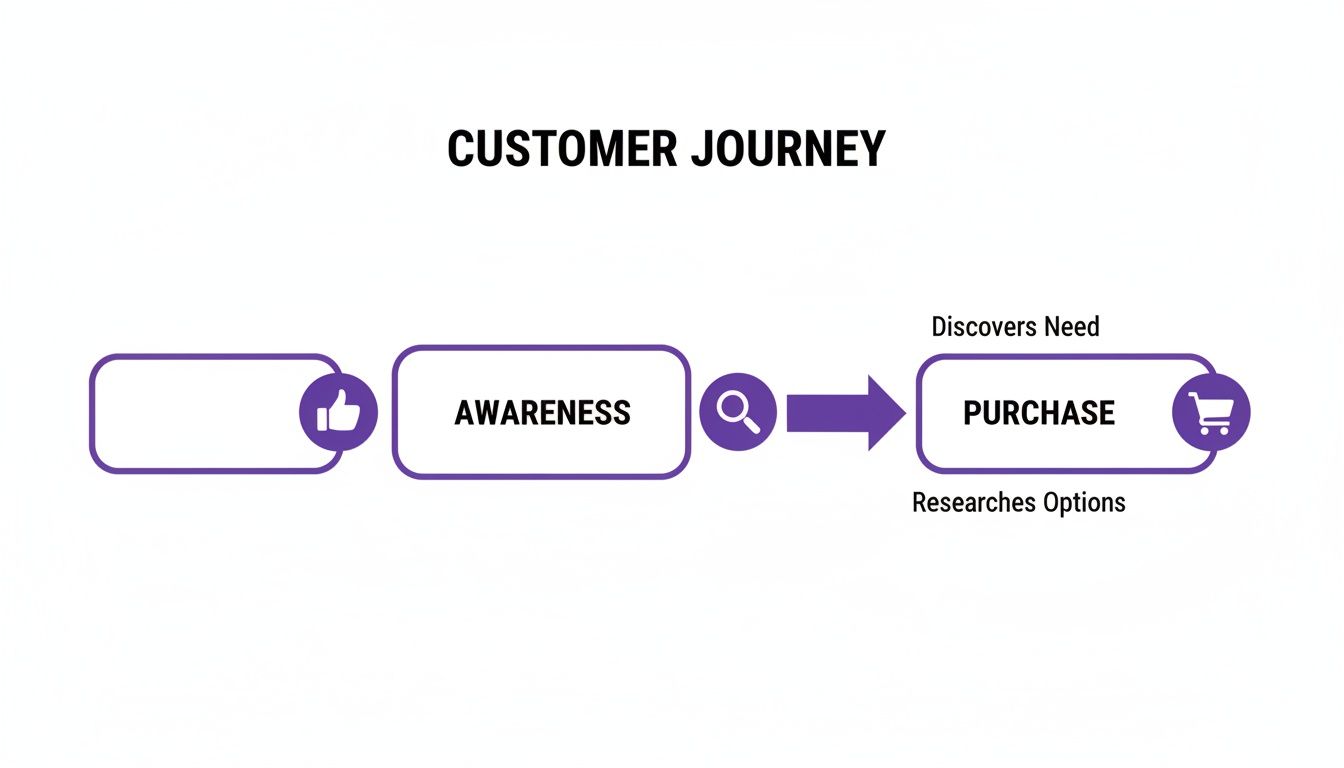
As you can see, every stage plays a part. Relying on a model that only sees the beginning or the end means you’re missing most of the story.
3. Linear Model
The Linear model is the diplomat of the group. It takes a democratic approach, splitting the credit equally among every single touchpoint along the customer’s path to purchase.
In our example, the TikTok ad, the Facebook ad, and the email would each get exactly 33.3% of the credit. This model’s strength is that it acknowledges every channel's contribution. Its weakness, however, is that it assumes every touchpoint is equally influential, which is almost never true in reality.
4. Time Decay Model
The Time Decay model operates on the idea that the closer an interaction is to the sale, the more important it was. It gives progressively more credit to the touchpoints that happened nearer to the moment of conversion.
Using a standard 7-day half-life, Alex’s final email click would get the biggest chunk of credit. The Facebook ad from a week ago would get about half of that, and the initial TikTok ad would receive even less. This is a solid model for businesses with longer consideration periods, but it risks undervaluing those crucial, early-stage campaigns that planted the seed.
5. Position-Based Model
Also known as the U-Shaped model, the Position-Based model is a hybrid that recognizes the unique importance of the first and last touches. It gives a hefty chunk of credit to the channel that started the journey and the one that closed it, then divides the rest among everything in between.
A common setup gives 40% of the credit to the first touch, 40% to the last, and the remaining 20% is split among the middle interactions.
For Alex, the TikTok ad gets 40%, the email gets 40%, and the Facebook ad gets the remaining 20%. It’s a balanced approach that values both the introduction and the final push.
6. Data-Driven Model
This is where things get really interesting. The Data-Driven model throws out the rulebook. Instead of relying on pre-set formulas, it uses machine learning to analyze all your conversion data. It compares the paths of customers who buy against those who don't to figure out the actual impact of each touchpoint.
The shift toward algorithmic models is one of the biggest moves in marketing right now. They assign credit based on true incremental lift, which is lightyears ahead of last-click models that can ignore 70-90% of the customer journey. A great example is Google Analytics 4's Data-Driven Attribution. The catch? It requires a massive amount of data to work effectively—a real challenge for many Shopify owners.
To help you weigh your options, here’s a quick breakdown of how these models stack up.
Comparison of Common Attribution Models
| Attribution Model | How It Works | Primary Pro | Primary Con | Best For |
|---|---|---|---|---|
| First Interaction | 100% credit to the first touchpoint. | Simple; highlights top-of-funnel channels. | Ignores all subsequent interactions. | Brands focused purely on driving initial awareness. |
| Last Interaction | 100% credit to the last touchpoint. | Easy to implement; shows what closes deals. | Overlooks awareness and nurturing channels. | E-commerce stores with short sales cycles. |
| Linear | Credit is split equally among all touchpoints. | Provides a balanced view and values every channel. | Falsely assumes all touchpoints are equal. | Teams wanting a simple, multi-touch baseline. |
| Time Decay | More credit goes to touchpoints closer to conversion. | Values interactions that directly influence a sale. | Can devalue important top-of-funnel channels. | Businesses with longer consideration phases. |
| Position-Based | 40% to first, 40% to last, 20% to middle. | Balances credit between "openers" and "closers". | The 40/20/40 split is arbitrary. | Marketers who value both first and last touch. |
| Data-Driven | Uses machine learning to assign credit based on data. | The most accurate and unbiased model. | Requires huge data volumes; a "black box". | Larger stores with high conversion volume. |
Ultimately, the goal is to find a model that gives you the clearest, most actionable picture of what’s really working.
Key Takeaway: There is no single "best" attribution model. The right choice depends entirely on your business goals, your sales cycle, and the complexity of your marketing. The real aim is to move beyond overly simplistic models to get a true understanding of your entire marketing ecosystem.
Navigating the Modern Challenges of Attribution
Attribution has never been a simple puzzle, but today's marketers face two massive hurdles that can shatter even the most sophisticated models. Customer journeys are now scattered across multiple devices, and new privacy rules are completely rewriting the book on user tracking.
Trying to ignore these shifts is a recipe for disaster. It leads directly to bad data and, even worse, wasted ad spend.
The models we've covered are only as good as the data they're fed. When the dots they're supposed to connect suddenly vanish, the whole picture falls apart. You're left guessing which channels are actually moving the needle. Getting a handle on these modern obstacles is the first step toward building an attribution strategy that can actually hold up.
The Cross-Device Conundrum
Just think about how you shop online. You might see a cool pair of shoes in a TikTok ad on your phone, look up reviews on your work laptop during lunch, and then finally pull the trigger and buy them on your home desktop later that night.
To old-school tracking systems, that looks like three separate people. Each device has its own ID, and there’s nothing to tie them together. The TikTok ad on your phone gets credit for a click, but the sale? That looks like it came from nowhere, attributed to a direct visit on your desktop.
This cross-device tracking problem is a huge source of data gaps. You might look at your reports and wrongly decide your TikTok campaigns are duds, cutting the budget on a channel that’s actually bringing you fantastic new customers. The journey is broken, and your attribution model is telling you an incomplete story.
The Cookieless Future Arrives
The other major headwind is the "death" of the third-party cookie. For years, these little bits of code have been the workhorses of digital advertising. They followed you around the web, enabling ad platforms to retarget you and build detailed profiles.
But that's all changing. Spurred by privacy concerns, browsers like Safari, Firefox, and soon Google Chrome are pulling the plug. This shift has profound implications for attribution. Without third-party cookies, many of the classic methods for connecting touchpoints across different websites simply stop working.
This isn't some far-off problem; it's here now. The decay of third-party data means we have to get serious about the data we own and control directly.
This change is forcing a much-needed evolution, pushing marketers toward more reliable and privacy-friendly solutions.
Forging a Path Forward with First-Party Data
So, how do we start connecting those dots again in this new reality? The answer is to shift your focus from data you "rent" to data you own. The best strategies for tackling these challenges are built on a solid foundation of first-party data.
Here’s how you can adapt:
- Prioritize Logged-In Experiences: Get customers to create accounts on your Shopify store. A logged-in user can be tracked by their user ID, not a flimsy browser cookie, giving you a clear view of their actions across their phone, tablet, and computer.
- Leverage Your Email and SMS Lists: These aren't just for sending promotions; they're incredibly valuable first-party data assets. When you can tie marketing touches to a specific email address or phone number, you start to stitch together a unified customer profile.
- Implement Server-Side Tracking: Instead of just relying on the customer's browser to send data (client-side), server-side tracking sends information directly from your web server to platforms like Google Analytics or Meta. This method is far more accurate, bypasses most ad blockers, and gives you complete control over what you share.
By building out a robust first-party data strategy, you're not just solving a tracking problem. You're creating a more durable and accurate system for understanding your customers while respecting their privacy—building the trust that's essential for any brand's long-term success.
How to Implement Attribution for Your E-commerce Store
Alright, let's move past the theory and get our hands dirty. Setting up a solid attribution system is less of a "nice-to-have" and more of the bedrock for every smart marketing decision you'll ever make. This isn't about flipping a switch; it's about building a reliable framework to capture clean data from day one.
The whole point is to create a single source of truth that shows you what’s actually driving sales—not just what each ad platform wants to take credit for. Let's walk through the essential steps to build this system from the ground up.
Laying the Foundation with Google Analytics 4
First things first: you need a central hub for all your marketing data. For most e-commerce brands, that's Google Analytics 4 (GA4). GA4 was built from the ground up around events and users, which makes it infinitely better at tracking the messy, multi-device journeys customers take today.
Getting the setup right is non-negotiable. That means installing your GA4 tag correctly on your Shopify store (or whatever platform you use) and making sure it’s tracking the most important customer actions.
Here are the must-have e-commerce events to track in GA4:
view_item: Someone looks at a product page.add_to_cart: They drop an item in their cart.begin_checkout: They start the checkout process.purchase: The big one—a completed sale.
When these events are firing properly, you get a clean, unbiased look at your entire sales funnel. This data becomes your baseline, the ground truth you'll use to measure everything else against.
Installing Pixels and Conversion APIs
While GA4 is your central hub, you still need to send data back to platforms like Meta (Facebook and Instagram) and TikTok. This is how their algorithms learn who your best customers are and find more people just like them. It's a two-part system.
- The Pixel (Client-Side Tracking): Think of this as a tiny scout on your website. It's a snippet of code that watches what users do in their browser and reports back to the ad platform. It's easy to set up, but it's also easily foiled by ad blockers and privacy settings.
- The Conversions API (Server-Side Tracking): This is the more reliable, heavy-duty connection. It sends data directly from your store's server to the ad platform's server, completely bypassing the user's browser. It’s far more accurate because it can’t be blocked.
Key Insight: You need both. Using the Pixel and the Conversions API is the modern standard. The Pixel catches what it can, and the API fills in the gaps, giving your ad platforms a much richer, more resilient stream of data to work with. Your campaigns will be smarter for it.
The Art of Consistent UTM Tagging
If pixels and APIs tell you what happened, UTM parameters tell you where it came from. These are simple tags you tack onto the end of your URLs to tell your analytics tools precisely which ad, email, or social post a visitor clicked. Without them, your reports just show a big, confusing blob of "direct" or "referral" traffic.
A well-organized UTM system is a game-changer for getting granular insights. Every single link you put out there—in an ad, an email, or an influencer post—needs to be tagged.
A standard UTM structure includes:
utm_source: The platform (e.g.,facebook,google,tiktok).utm_medium: The channel (e.g.,cpc,email,social).utm_campaign: Your specific campaign name (e.g.,spring-sale-2024).utm_content: Used to tell ads apart (e.g.,blue-sneaker-advs.red-sneaker-ad).
Consistency is everything. A messy UTM strategy leads to messy data, making it impossible to know which ad creative or email subject line actually drove a sale. Set up a clear naming convention for your team and be militant about sticking to it. This simple discipline pays for itself a hundred times over when it's time to decide where your next dollar should go.
Building Your E-commerce Attribution Tech Stack
Let's be honest, the right tools can make attribution feel less like a chore and more like your secret weapon. The term "tech stack" might sound complicated or expensive, but you don't need a dozen different subscriptions to get a clear picture of your marketing performance. It’s all about picking the right pieces and making them work together.
Think of it like building a car. You need an engine to power it, a dashboard to see what's happening, and a GPS to see where you're going and what the traffic looks like ahead. A modern e-commerce attribution stack is built on a similar idea, using three core pillars to give you one reliable view of what's really driving sales.
This setup ensures you have a central source of truth, the ability to dive deep into each channel's performance, and the competitive insights you need to outmaneuver everyone else.
The Core Components of Your Stack
A solid attribution setup really comes down to a few key types of tools. Each plays a very specific part, from tracking sales all the way to seeing what your competitors are up to right now.
- Central Analytics Platform: This is your command center, your single source of truth. It pulls in data from every channel so you can compare everything on a level playing field. Google Analytics 4 (GA4) is the non-negotiable foundation here; it’s the industry standard for a reason.
- Native Ad Platform Analytics: These are your in-the-weeds dashboards—think Meta Ads Manager, Google Ads, and TikTok Ads. Yes, they’re biased and will always over-report their own impact. But they give you incredibly granular data on audiences and creative that you simply can't get from GA4.
- Competitive & Creative Intelligence Tools: This is where you get your edge. Tools like Semrush, Similarweb, and Kalodata are like having a spy in your competitor's marketing department. You can find winning ad creatives, see what's trending, and spot opportunities before they become obvious.
The biggest hurdle for growing brands? The cost. Subscribing to all these premium tools one-by-one can easily run you over $3,900 per month. This is where bundled subscriptions are a total game-changer, giving you enterprise-level tools on a startup-friendly budget.
To get a clearer sense of how these tools fit together, here’s a breakdown of the essential categories you'll need.
Essential Attribution Tool Categories for E-commerce
| Tool Category | Purpose in Attribution | Example Tools (from EcomEfficiency) | Key Metric to Track |
|---|---|---|---|
| Central Analytics | Provides a single source of truth and cross-channel view. | Google Analytics 4 (GA4) | Cross-channel Conversion Paths |
| Native Ad Platforms | Offers granular, in-platform data on creative & audience. | Meta Ads, TikTok Ads, Google Ads | In-Platform ROAS, CPA |
| SEO & Keyword Research | Uncovers organic opportunities and paid search intent. | Semrush, Ahrefs | Keyword Rankings, Organic Traffic |
| Creative Intelligence | Reveals competitor ad strategies and top-performing creatives. | Kalodata, AdSpy, MagicBrief | Ad Engagement Rate, Ad Spend Est. |
| Market Intelligence | Analyzes competitor traffic sources and overall strategy. | Similarweb, BuiltWith | Traffic Share, Channel Mix % |
| Conversion Optimization | Tests and improves on-site user experience and funnels. | Hotjar, VWO | Funnel Conversion Rate |
Putting these pieces in place gives you a 360-degree view, moving beyond just last-click data to a truly strategic understanding of your market.
Bringing It All Together: A Real-World Workflow
So, how does this actually play out day-to-day? Let's walk through how a performance marketer at a growing Shopify brand might use this kind of integrated stack.
Step 1: Research & Discovery
The marketer starts by using competitive intelligence tools to see what’s working in their niche. They use Kalodata to analyze top-performing TikTok ads and fire up Semrush to find high-intent keywords their competitors are bidding on. This initial research uncovers a fresh ad angle and a promising new audience segment to target.
Step 2: Campaign Launch & Tracking
With a solid plan, they create the new ads and launch campaigns on Meta and TikTok. This is the crucial part: every single ad link is meticulously tagged with UTM parameters (e.g., utm_source=tiktok, utm_campaign=spring-promo, utm_content=video-ad-3). This simple step is what allows GA4 to trace every click back to its exact origin.
Step 3: Performance Analysis & Attribution
A week later, the data is flowing in. The marketer looks at the native platforms first. Meta Ads Manager proudly claims 50 purchases. TikTok Ads Manager shows 30 purchases. But over in GA4, their central source of truth, they see a total of 65 purchases from paid social. That gap of 15 conversions is because GA4 deduplicated the data, correctly identifying users who saw ads on both platforms before buying.
Step 4: Budget Reallocation
Using a position-based attribution model in GA4, the marketer gets the full story. While Meta is driving more of the final, last-click conversions, TikTok is doing an amazing job introducing new customers to the brand for the very first time. Armed with this insight, they confidently reallocate some of their budget to scale the best TikTok ads, knowing it’s effectively filling the top of their funnel.
This whole workflow, powered by an integrated and affordable toolset, transforms attribution from a messy data puzzle into a clear, repeatable process for profitable growth.
Got Questions About Digital Marketing Attribution? We've Got Answers.
Even when you feel like you've got a handle on the theory, putting attribution into practice always brings up new questions. It's totally normal. Getting these questions answered is what separates the marketers who get stuck in spreadsheets from those who make confident, data-backed decisions. Let’s dive into a few of the most common ones we hear from e-commerce brands.
I Just Launched My Shopify Store. Which Attribution Model Should I Use?
When you're just starting out, keep it simple. If you're only running one or two channels, like Meta ads, a Last Interaction model is your best friend. It’s easy to set up and even easier to understand. You’ll see exactly which ad creative or campaign was the very last thing someone clicked before buying. That gives you fast, actionable feedback.
But don't get too comfortable. As soon as you start layering in more channels—think Google Ads, email flows, or influencer partnerships—you'll outgrow that simple model. That's your cue to switch to something more nuanced, like a Position-Based or Linear model, to get a more complete view of how all your marketing efforts are working together. Start simple, but be ready to graduate.
How Do I Actually Track Sales from TikTok Shop and Influencers?
These channels can feel a bit like the wild west of tracking because the path to purchase isn't always a straight line. You need a few different tools in your belt to get it right.
- For Influencers: The classic approach still works best. Give each influencer a unique discount code or an affiliate link loaded with specific UTM parameters. This lets you see their exact traffic and sales in Google Analytics, so you can give credit where it's due without any guesswork.
- For TikTok Shop: This is all about the technical setup. You have to make sure your TikTok Pixel and Events API are firing correctly. Once that data is flowing, you can lean on a platform like Kalodata to dig into your TikTok performance and then compare those numbers to what you're seeing in Shopify and GA4 to understand its true impact.
Here's the bottom line: Analytics tells you what happened. Attribution explains why it happened and who gets the credit. Analytics might report 100 sales from Google, but attribution figures out how much of that credit Google truly deserves compared to the other touchpoints that helped out.
What’s the Real Difference Between Attribution and Analytics?
It's easy to use these terms interchangeably, but they have distinct jobs. Think of analytics as the raw story and attribution as the storyteller who gives credit to the characters.
Analytics platforms, like Google Analytics, are brilliant at collecting and reporting on mountains of data. They'll tell you which pages got views, how long people stayed, and where they came from. That’s the "what."
Attribution is the layer of intelligence on top of that data. It takes the raw numbers and assigns value to each channel. So, analytics might tell you that 100 sales came from a mix of Google Ads, Facebook, and your email list. Attribution is what helps you figure out that Google Ads earned 40% of the credit, Facebook drove 50%, and Email gets 10% because of the specific roles each played in getting those customers to convert.
Ready to stop guessing and start building a high-performance e-commerce tech stack? With EcomEfficiency, you get access to over 50 premium tools like Semrush, Kalodata, and Midjourney for one low monthly price. Cut your software costs by up to 99% and get the insights you need to scale profitably. Unlock your all-in-one tool bundle today!