What Is Amazon Listing Optimization A Guide to Higher Rankings

So, what exactly is Amazon listing optimization? Think of it as the art and science of fine-tuning your product page so it ranks higher in Amazon's search results and convinces more shoppers to click that "Add to Cart" button.
The goal is to scale without dubious shortcuts and without hurting your credibility.
This isn't just about stuffing keywords into a title. It's a holistic process where you improve every single element—from your product photos and bullet points to those hidden backend keywords—to appeal to two very different audiences at once: Amazon's A10 algorithm and actual human shoppers. Nailing this dual focus is the secret sauce for turning clicks into cash.
Your Digital Storefront on the World's Biggest Street
Imagine your Amazon listing as your primary storefront and your best salesperson, all rolled into one. On a platform with millions of products all screaming for attention, just having a fantastic product is never enough. It has to be found, and once found, it has to be convincing. That's where listing optimization makes all the difference.
It’s a deliberate strategy that boils down to two core objectives:
- Getting Seen (Visibility): This is the Search Engine Optimization (SEO) side of the coin. By strategically weaving in the right keywords and structuring your listing properly, you're essentially telling Amazon’s A10 algorithm, "Hey, this is what my product is, and this is who it's for." A well-optimized listing is far more likely to land on that coveted first page of search results.
- Closing the Deal (Conversions): This is all about salesmanship. Once a potential customer lands on your page, you have seconds to grab their attention and earn their trust. High-quality images, compelling bullet points that scream "benefits," and a clear, persuasive description are your tools to turn a browser into a buyer.
The Two Audiences You Need to Impress
To get this right, you have to become fluent in two different languages. You're simultaneously talking to a machine (the A10 algorithm) and a person (your customer).
The algorithm is a robot that cares about data: keywords, sales velocity, click-through rates, and relevance signals. The customer, on the other hand, is driven by emotion and logic: they want to see the benefits, trust the quality, and feel confident in their purchase. The perfect listing sits right in that sweet spot where both robot and human walk away happy.
At its core, Amazon listing optimization transforms a passive product page into an active sales asset. It's the difference between a product sitting on a dusty virtual shelf and one that's prominently displayed at the front of the store, actively drawing in customers.
Let's break down the essential pieces you'll be working with. Each component has a specific job to do, contributing to the overall success of your listing.
Core Components of Amazon Listing Optimization
This table provides a quick summary of the key elements involved in optimizing an Amazon product listing and the primary goal of each.
| Listing Component | Primary Goal | Key Action |
|---|---|---|
| Product Title | SEO & Click-Through Rate (CTR) | Integrate top keywords while making it readable and compelling. |
| Bullet Points | Conversion & SEO | Highlight key benefits and features using persuasive, keyword-rich copy. |
| Product Description/A+ | Conversion & Brand Building | Tell a deeper story, build trust, and overcome potential objections. |
| Images & Video | Conversion & Engagement | Showcase the product from all angles, in use, and explain its value visually. |
| Backend Search Terms | SEO | Add relevant "hidden" keywords that you couldn't fit into the main copy. |
| Pricing & Promotions | Conversion & Sales Velocity | Set a competitive price and use deals to attract buyers and boost rank. |
| Reviews & Ratings | Conversion & Social Proof | Encourage positive reviews to build trust and credibility. |
Mastering each of these areas is what separates the top sellers from everyone else.
Why You Can't Afford to Ignore Optimization
In such a fiercely competitive marketplace, failing to optimize is like setting up a shop in a back alley with no sign—you're basically invisible. The results of a proper optimization effort can be truly transformative.
Take one real-world example: a comprehensive listing overhaul resulted in a stunning 156% increase in conversion rate. This catapulted the product from the forgotten depths of page three to a prime spot on page one in just 60 days. You can dive into the full case study about this Amazon listing optimization example at eDesk.com.
This isn't about minor tweaks. It's a fundamental business strategy for thriving on Amazon. The great news is that modern tools and AI-powered platforms have made these advanced techniques more accessible than ever, allowing smaller sellers to compete effectively with industry giants. By systematically improving your listings, you gain direct control over your search ranking, click-through rate, and ultimately, your bottom line. To stay updated on the latest strategies and gain deeper understanding of why Amazon listing optimization matters, you can explore the blog for more insights.
Deconstructing the Perfect Amazon Listing
Think of a top-selling Amazon listing like a finely tuned engine. It's not just one thing that makes it go; it's a whole collection of parts working in perfect harmony to drive sales. To really understand what separates a best-seller from a dud, we need to pop the hood and look at each component. Every piece, from the title all the way to the backend keywords, has a very specific job to do for both Amazon's search algorithm and the real, live person you're trying to sell to.
When you break it all down, you see two main forces at play: visibility and conversion. Visibility is all about getting found in a sea of millions of other products. Conversion is what convinces a shopper to actually click that "Add to Cart" button once they've landed on your page.
This diagram shows how these two goals shape every single part of your listing.
As you can see, a killer listing is built on a foundation where SEO (for visibility) and persuasive copy (for conversion) work together, not against each other.
Let’s dig into each of these puzzle pieces one by one.
Product Title: The SEO Magnet
Your product title is, without a doubt, the most important piece of SEO real estate you have. It's your first and best shot at telling Amazon’s A10 algorithm exactly what your product is. A well-written title acts like a powerful magnet, pulling in relevant customer searches.
But it’s not just for the robots. The title is also the very first thing a shopper reads. It has to be clear, descriptive, and punchy enough to make them click your product instead of the dozen others on the search results page.
The best way to structure it is logically. A proven formula often includes:
- Brand Name: Helps build recognition and trust.
- Main Keyword: Your #1 search term. Get it as close to the front as you can.
- Key Features or Benefits: Think material, size, quantity, or a major selling point.
- Primary Use Case: Who is this for? What problem does it solve?
Treat your title like a newspaper headline—it needs to grab attention and deliver the most critical info in a split second.
Bullet Points: The Benefit-Driven Sales Pitch
If the title gets the click, the bullet points (what Amazon calls "Key Product Features") are what seal the deal. This is your chance to turn boring product features into irresistible customer benefits. Shoppers scan this section to quickly figure out if your product is right for them, so you have to be clear and persuasive.
Don't just say, "Made with 100% organic cotton." Instead, frame it as a benefit: "Sleep better with ultra-soft, breathable organic cotton that's gentle on your skin." The first is a feature; the second is a solution.
A common mistake I see is sellers treating bullet points like a technical spec sheet. You have to use them to answer your customer’s unspoken questions: "What’s in it for me?" and "How will this make my life better?"
Structure each bullet point like a mini-headline followed by a short explanation. This makes it easy for busy shoppers to scan and absorb the information, building their confidence with every line they read.
Product Description and A+ Content: The Brand Story
Down in the product description, you finally have room to tell a richer brand story. For sellers who aren't brand registered, this is just a plain text field. But for those with Brand Registry, this space unlocks A+ Content—a game-changing tool for visual storytelling.
A+ Content lets you use high-quality images, comparison charts, and custom branded layouts to tackle customer doubts head-on and show off your product's value in a much more engaging way. This is where you can build an emotional connection and make your brand stand out from the generic competition.
It's also a huge signal to Amazon's algorithm. The A10 algorithm is smarter than ever, paying close attention to conversion rates and customer satisfaction. The best sellers consistently hit 20%+ conversion rates by obsessing over their listings, blowing past the 10-15% marketplace average. A+ Content is a direct lever you can pull to boost conversions, which tells the algorithm your listing is a winner and helps you rank higher. For a deeper dive, check out how Amazon’s algorithm connects listing quality to sales at amazonsellerslawyer.com.
Images and Videos: The Visual Persuasion Engine
On Amazon, your customers can't touch, hold, or try on your product. That means your images and videos have to do all the heavy lifting. A robust stack of high-quality images isn't a "nice-to-have"; it's a non-negotiable. It’s your visual persuasion engine, answering questions and building trust before a shopper even reads a single word of your text.
Your image strategy needs to cover all the bases:
- The Hero Image: A crystal-clear shot of your product on a pure white background. No exceptions.
- Infographics: Images with text overlays that highlight key features and benefits.
- Lifestyle Images: Photos showing your product being used by real people, helping customers imagine it in their own lives.
- Comparison Charts: Show why your product is the better choice compared to the competition.
- Instructional Images: Graphics that clearly explain how to use or assemble the product.
Videos take it to the next level. A well-made video can skyrocket your conversion rate by demonstrating your product in action, showing it from every angle, and making its value instantly obvious.
Backend Keywords: The Invisible Ranking Advantage
Finally, let's talk about the backend keywords. These are the "hidden" search terms you plug into Seller Central that customers will never see. This section is your secret weapon for ranking for more keywords without stuffing your title and bullets and making them sound unnatural.
Use this space for all the relevant search terms you couldn't fit into your customer-facing copy. This includes things like:
- Synonyms and common misspellings.
- Long-tail keyword phrases.
- Terms in other languages that are common in your marketplace (like Spanish in the US).
Quick tip: Never repeat keywords that are already in your title or bullet points. Amazon's algorithm only needs to see a keyword once to index you for it. Filling this section out properly ensures you’re casting the widest possible net, giving you an invisible edge over competitors who neglect it.
Finding the Sweet Spot: How SEO and CRO Work Together
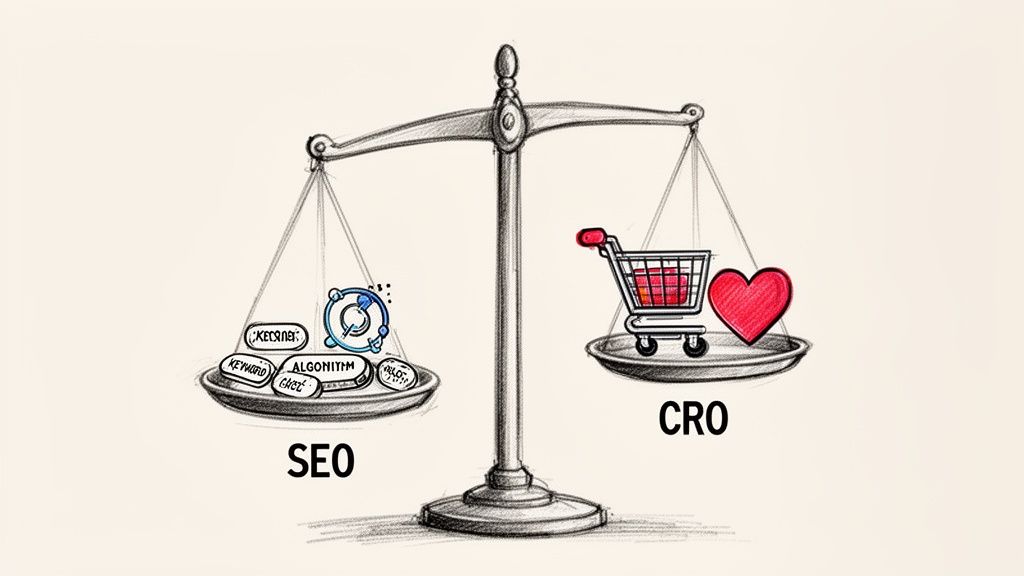
When you're optimizing an Amazon listing, you're really juggling two critical forces: Search Engine Optimization (SEO) and Conversion Rate Optimization (CRO). Getting this balance right is everything. Think of it like a performance car—SEO is the powerful engine that gets you into the race, but CRO is the expert driver who knows how to cross the finish line first.
SEO is all about getting found. It’s the technical side of things, where you speak directly to Amazon's A10 algorithm. You use specific keywords so that when a shopper searches for "waterproof hiking backpack," your product actually shows up.
But getting seen is only half the battle. Once they click, CRO takes over. This is the art of persuasion—convincing that shopper your backpack is the one. It's about your compelling images, your benefit-focused copy, and the trust you build.
SEO: Your Engine for Visibility
Amazon SEO boils down to two things: relevance and performance. The A10 algorithm has one primary mission: show customers the products they are most likely to buy. It figures this out by scanning the keywords in your title, bullet points, and even your backend search terms.
A huge part of mastering Amazon is simply understanding the fundamentals of optimizing content for SEO. Your job is to get inside your customer's head and use the exact words and phrases they're typing into that search bar.
SEO gets the customer to your door. CRO invites them inside and convinces them to stay. If you ignore one, you're leaving sales on the table. One drives traffic; the other turns that traffic into revenue.
But great SEO isn't just about plugging in keywords. The algorithm also watches what shoppers do. It tracks your sales velocity and click-through rate. If lots of people click on your product and actually buy it, Amazon takes that as a strong signal that you're a good result, bumping you higher in the rankings.
CRO: Your Engine for Persuasion
Once a shopper lands on your page, the conversation shifts. You're no longer trying to impress an algorithm; you're talking to a real person. This is where you have to connect with their needs and solve their problems.
Conversion Rate Optimization is about building trust and showing value, fast. Every single part of your listing should work together to answer a shopper’s questions, calm their fears, and get them excited about your product. It’s a masterclass in online sales psychology.
Here’s how the different pieces of your listing drive conversions:
- High-Quality Images and Video: People buy with their eyes. Your visuals need to instantly show off the product's quality, key features, and how it will improve their life.
- Benefit-Oriented Bullet Points: Shoppers scan. They don't read. Your bullets must quickly answer the question, "What's in it for me?" by turning dry features into exciting benefits.
- A+ Content: This is your chance to tell a deeper brand story. Use it to compare your product to competitors, showcase your brand's values, and create a premium experience that justifies the price.
- Customer Reviews and Ratings: Nothing sells a product better than social proof. A high star rating and a wall of positive reviews can be the final push a customer needs to click "Add to Cart."
Striking the Perfect Balance
The real magic happens when you find that perfect harmony between talking to the algorithm and talking to a human.
It’s a common mistake to "keyword-stuff" a title until it’s an unreadable mess. Sure, the algorithm might notice you for a minute, but if shoppers are confused or put off, they won't buy. That low conversion rate tells Amazon your listing isn't relevant, and your rank will tank.
On the flip side, you could have the most beautifully written, persuasive listing with award-worthy photos, but it's all for nothing if nobody can find it. If you haven't done your keyword research, you're invisible.
The two must work hand-in-hand. Every decision you make—from the first word in your title to the last photo in your gallery—has to serve both visibility and conversion. That's the secret to winning on Amazon.
Your Step-By-Step Optimization Checklist
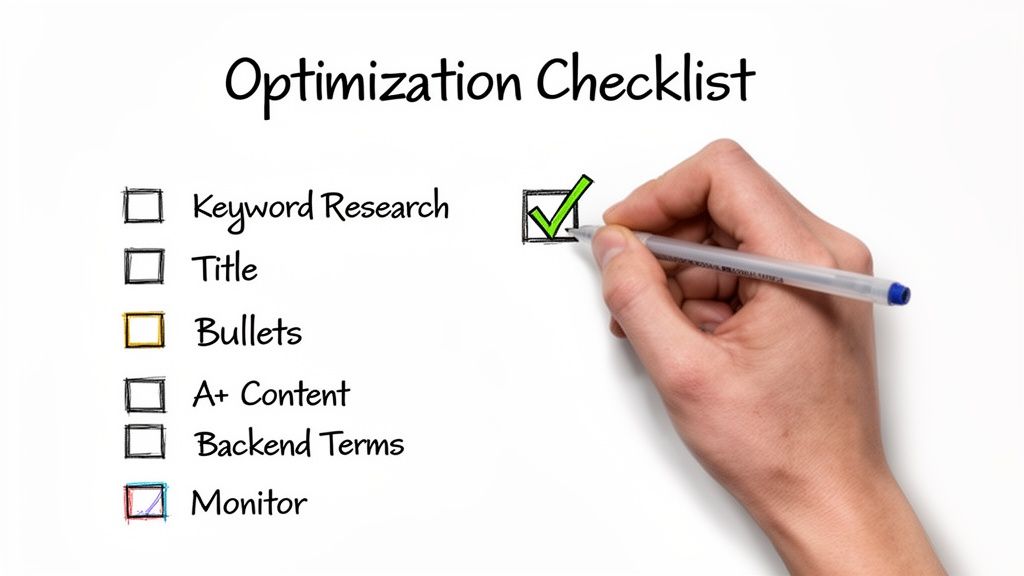
Knowing what makes a great listing is one thing, but actually building one is another beast entirely. This checklist turns all that theory into a practical, step-by-step game plan. Follow it, and you'll systematically rebuild your product page, making sure every single element is pulling its weight to get you seen and sold.
This isn't about throwing things at the wall to see what sticks. It's a proven process for building a listing that speaks to both Amazon's A9 algorithm and your ideal customer.
Step 1: Deep Keyword and Competitor Research
Before you even think about writing a headline, you need to get inside your customer's head. What words are they using? What are your competitors doing right (and wrong)? This first step is the foundation for everything that follows.
Your main goal is to build a master list of all the search terms a shopper might use to find a product like yours. You'll want to use a mix of specialized tools and good old-fashioned manual digging.
- Seed Keywords: Start with the basics. What are the most obvious, one or two-word terms for your product? Think "yoga mat" or "water bottle."
- Long-Tail Keywords: Now get specific. These longer, more detailed phrases like "extra thick non slip yoga mat for hot yoga" show a customer knows exactly what they want and is ready to buy.
- Competitor Spying: Use a tool to peek under the hood of your top competitors' listings. See which keywords are sending them the most traffic. This is an absolute goldmine of proven search terms.
- Customer Language: Read the reviews on competing products. Seriously, spend an hour on this. Note the exact words people use to describe what they love, hate, or wish the product did differently.
This research phase hands you the raw materials—the keywords and customer pain points—that will become the backbone of your entire listing.
Step 2: Crafting a High-Impact Title
Your title is the single most valuable piece of real estate on your entire product page. It has to be loaded with your most important keywords while still being clear and convincing enough to make someone click.
A good title has to pull double duty: it needs to please the algorithm and persuade a human. A solid formula that works time and again looks something like this:
Brand Name - Top Keyword Phrase - Key Benefit - Main Use Case - Size/Color/Quantity
So, a weak title like "Yoga Mat" becomes a powerhouse: "ZenGrip - Pro Non-Slip Yoga Mat for Hot Yoga - Eco-Friendly TPE with Carrying Strap - 6mm Thick." See the difference? It's packed with keywords and tells a shopper everything they need to know at a glance.
Step 3: Writing Benefit-Focused Bullet Points
Okay, they clicked! Now your bullet points have to seal the deal. This is your chance to turn dry features into compelling benefits, answering the only question that matters to a customer: "What's in it for me?"
Think of each bullet as a mini sales pitch. A great trick is to start with an all-caps, attention-grabbing hook and then explain the benefit. Weave in your secondary keywords here, but keep it feeling natural.
Don't just list a feature. Connect it directly to a customer's problem or desire. Instead of saying, "Durable Material," try: "BUILT TO LAST: Stop replacing your mat every year. Our tear-resistant TPE is designed for daily practice without cracking, fading, or falling apart."
This approach makes your key points pop, helping a scanning shopper quickly understand why your product is the best choice.
Step 4: Designing a Complete Image Stack
On Amazon, your images are your product. Shoppers can't touch it, feel it, or test it out, so your photos have to do all the heavy lifting. A complete "image stack" uses every available slot to show off your product, answer questions visually, and build trust.
A winning image lineup should always include:
- The Hero Image: A flawless, high-resolution shot of your product on a pure white background. This is a non-negotiable Amazon rule.
- Infographics: Clean graphics that use text callouts to highlight key features, dimensions, or materials.
- Lifestyle Shots: Photos of your product being used in a real-world setting. Help customers picture it in their own lives.
- Comparison Chart: A simple graphic showing why your product is a better choice than the competition.
- How-To Graphics: Images that show how to use, assemble, or care for the product.
Step 5: Building Compelling A+ Content
If you're brand registered, A+ Content is your chance to truly shine. Use its rich modules—high-quality banners, detailed comparison charts, and branded text—to tell a deeper story about your product and brand.
This is your space to handle any lingering doubts a customer might have, showcase what your brand stands for, and create a premium feel that justifies your price tag. Done right, A+ Content can give your conversion rate a massive boost, which in turn helps your organic ranking.
Step 6: Populating Backend Search Terms
Think of the backend search term fields as your secret weapon. This is where you can stuff all the relevant keywords that you couldn't quite fit into your title and bullets.
This is the perfect spot for synonyms (e.g., "pouch" vs. "bag"), common misspellings, and related Spanish terms. Just remember one crucial rule: never repeat keywords that are already in your visible title or bullets. It's a waste of space and provides zero extra SEO benefit. Maxing out these fields helps you cast the widest net possible.
Step 7: Monitoring Performance and Iterating
Optimization is never truly "done." Once your revamped listing goes live, you have to watch it like a hawk. Keep a close eye on your sessions, conversion rate, and where you're ranking for your top keywords.
Use Amazon's own "Manage Your Experiments" tool to A/B test different titles or main images to see what really moves the needle. Constant, data-driven tweaking is what separates the top sellers from everyone else.
Using Technology for Smarter Optimization
Getting your hands dirty and manually optimizing a listing is a great starting point. But let’s be realistic—trying to manage a catalog of dozens, let alone hundreds, of products that way is a recipe for burnout. The market moves too fast, competitors are always shifting their tactics, and the sheer volume of data is staggering.
This is where technology stops being a "nice-to-have" and becomes your most valuable team member.
Working smarter, not harder, isn't just a cliché; it's the only way to scale your Amazon business. Modern software and AI-powered tools are no longer reserved for massive brands. They’re essential for any seller who wants to stay competitive. These tools take the most tedious parts of optimization off your plate, freeing up your time while delivering far more precise results.
Instead of guessing which keywords to target, a tool can crunch millions of data points to find high-value search terms you’d never think of on your own. Instead of just hoping your images are good enough, AI can analyze what’s working for the top sellers in your niche and give you ideas proven to convert.
The Power of Automation and AI
Think of today's listing optimization software as a force multiplier. These platforms give you access to the kind of data and automation that was once only available at the enterprise level, helping you spot hidden opportunities and fix weaknesses across your entire product line.
Imagine trying to manually check keyword rankings for 50 different products every single day. It would be a full-time job in itself. A good software tool does this for you automatically, sending you an alert the moment a competitor bumps you down for a crucial search term.
This lets you make smart, data-driven decisions on the fly instead of reacting weeks later when you notice your sales have tanked. These platforms are built to do the heavy lifting, so you can focus on strategy.
Technology transforms listing optimization from a tedious, reactive chore into a strategic, proactive growth driver. It eliminates the guesswork, replacing it with actionable data that directly impacts your bottom line.
Unlocking Your Catalog's Hidden Potential
The true value of technology really shines when you're dealing with a large catalog. For example, we've seen brands with 20,000 products pull in $28 million a year. But dig into the numbers, and you often find that $20 million of that comes from just the top 500 SKUs.
That means there’s over $7 million in potential revenue just sitting there, locked away in the rest of the catalog. You can learn more about how AI is unlocking hidden revenue for large Amazon sellers at incrementumdigital.com.
Manual tweaks are just too slow and expensive to fix these underperforming products, which often leaves 95% of a seller's inventory completely neglected. Technology is the only practical way to systematically find and fix these issues at scale, turning those forgotten listings into reliable revenue streams.
Key Functions of Optimization Tools
While every tool is a bit different, the best ones share a core set of features that are non-negotiable for serious sellers:
- Advanced Keyword Research: Digging deep to find high-volume and long-tail keywords, often by reverse-engineering what’s working for your top competitors.
- Listing Quality Audits: Automatically grading your listings against Amazon's best practices and pinpointing exactly what needs fixing, from title length to image count.
- Rank Tracking: Keeping a close eye on your product's search position for your most important keywords so you can see what’s working and what isn’t.
- AI-Powered Copywriting: Generating benefit-driven bullet points and descriptions based on your keywords and product features, saving you from the headache of writer’s block.
When you weave these tools into your workflow, you shift from guessing to knowing. You ensure every listing is given the best possible chance to rank high and convert shoppers. That’s the modern answer to what is amazon listing optimization: a powerful blend of human strategy and smart technology.
Common Questions About Amazon Listing Optimization
Even after you've got the basics down, questions always pop up when you start putting theory into practice. Let's tackle some of the most common things sellers ask, giving you clear, straightforward answers to help you fine-tune your strategy.
Think of this as your quick-reference guide for all those "what if" and "how often" moments you'll run into.
How Often Should I Update My Amazon Listing?
There's no single magic number for this. A good rule of thumb is to check in on your most important listings every quarter or any time you see a big change in the market. You want to resist the urge to make constant, tiny tweaks. That can actually confuse Amazon's algorithm while it's trying to figure out how your listing performs.
Instead, let the data tell you when it's time to act. If your conversion rate suddenly tanks, it's time to take a hard look at your images and copy. If your keyword rankings start sliding, you need to do some fresh keyword research.
A significant refresh every 6-12 months is a solid baseline to stay competitive. And for any major changes, like a new title or main image, use Amazon's "Manage Your Experiments" tool. This lets you A/B test your ideas to make sure your updates are actually improvements backed by real numbers.
What Are the Most Common Listing Mistakes?
It's funny how many sellers stumble over the same hurdles. Just by avoiding these common slip-ups, you'll immediately pull ahead of a huge chunk of your competition.
Here are the biggest mistakes I see all the time:
- Keyword Stuffing: The classic mistake of cramming so many keywords into a title or bullet point that it becomes an unreadable mess. It absolutely kills your conversion rate and can even get you penalized by Amazon.
- Poor Quality Images: Blurry, unprofessional, or just plain boring photos are the fastest way to lose a customer's trust and their business. Your images have to do the heavy lifting of showing off your product's value.
- Ignoring the Mobile View: Forgetting that most people are shopping on a tiny screen is a massive oversight. The first 80 characters of your title and that main image are pretty much all they'll see at first glance. They have to be perfect.
- Listing Features, Not Selling Benefits: Just rattling off technical specs ("100% waterproof polyester") is boring and unpersuasive. You have to translate that into a real-world benefit ("Keeps your gear bone-dry in a downpour, guaranteed").
- Neglecting Backend Keywords: Leaving these fields blank is like saying "no thanks" to free traffic. It's a huge missed opportunity to rank for all the synonyms, long-tail terms, and common misspellings that don't fit in your main copy.
Can I Use the Same Keywords Everywhere?
You can, but you have to be smart about it. Your absolute most important keyword phrase has to be in your title, and the closer to the beginning, the better. Then, you should weave your other important, secondary keywords naturally into your bullet points and product description.
The backend search term fields are for everything else—all the keywords you couldn't gracefully fit into the customer-facing parts of your listing.
Amazon's algorithm only needs to see a keyword once somewhere in your listing to index it. Repeating the same exact phrase over and over gives you zero extra SEO juice and just makes your listing sound robotic. The goal is broad keyword coverage, not cramming one phrase in as many times as possible.
How Does A+ Content Affect My Listing Rank?
This is a fantastic and very common question. Officially, Amazon says the text and images in A+ Content are not directly indexed for search keywords. But—and this is a big but—it has a massive indirect impact on your ranking.
Think about it: high-quality A+ Content makes the shopping experience way better. It builds your brand's credibility, answers customer questions visually with things like comparison charts and lifestyle photos, and helps shoppers get over any hesitations they might have.
All of that adds up to a higher conversion rate. And since conversion rate is one of the most powerful ranking factors in Amazon's A10 algorithm, a listing with great A+ Content will almost always sell better. Over time, this sends a powerful signal to Amazon that customers love your product, which helps push it higher in the search results.
Ready to stop guessing and start optimizing with data? EcomEfficiency bundles over 50+ premium AI, SEO, and e-commerce tools into one simple subscription. Get access to Helium10, Semrush, Midjourney, and dozens more to supercharge your product research, keyword strategy, and content creation—all for one low monthly price. Cut your software costs by up to 99% and gain the competitive edge you need to dominate on Amazon. Explore the full tool suite and start your trial at EcomEfficiency.