What Is a Good Conversion Rate for Ecommerce and How to Improve Yours

So, what's a good conversion rate for an ecommerce store? If you're looking for a quick, straightforward answer, the global average hovers somewhere between 2.5% and 3.0%.
The goal is to scale without dubious shortcuts and without hurting your credibility.
That means for every 1,000 people who visit an online store, about 25 to 30 of them will actually buy something. But that's just the tip of the iceberg.
Understanding Your Store's Performance Baseline
While having a single number like 2.5% is a decent starting point, it's just the beginning of a much bigger story. Think of it like a global average temperature—it's a useful fact, but it doesn’t tell you whether to wear a coat or shorts in your specific city today. Your store's ideal conversion rate is shaped by dozens of unique factors.
Before we get into what makes a rate "good," it's crucial to grasp what conversion rate truly means for your business. It's the ultimate report card on how well your store persuades casual browsers to become paying customers.
Context Is Everything
A "good" conversion rate is simply one that's getting better over time and stacks up well against your direct competitors. A few key things will always influence where your numbers land:
- Your Industry: Someone selling high-end furniture will naturally have a different conversion cycle than a store selling coffee beans. The consideration phase is completely different, and so are the conversion rates.
- Traffic Source: A visitor who clicks through from a targeted email campaign is already warmed up and far more likely to buy than someone who stumbled upon a social media ad.
- Device Type: It's common for people to browse on their phones but switch to a desktop to complete a bigger purchase. This creates totally different conversion behaviors across devices.
- Brand Maturity: Are you a brand-new store or an established name with years of customer trust? That history and loyalty play a huge role in how readily people buy from you.
Interpreting the Global Average
Let's look at that 2.5% to 3.0% figure again. It's the most widely cited benchmark, and it’s a solid, if general, reference point. But averages can be deceiving.
Some data, for example, shows lower averages—around 1.4% on platforms like Shopify—often because the dataset includes a massive number of brand-new, unoptimized stores. This just goes to show why chasing a single global number can send you down the wrong path.
Your goal isn't just to hit some generic average. The real objective is to figure out your own baseline and then find smart, systematic ways to improve it.
Knowing "what is a good conversion rate for ecommerce" is less about a magic number and more about using the right benchmarks as a compass. This guide will help you look beyond the simple average and build a real strategy for growth based on your store's unique performance.
Quick Guide to Conversion Rate Benchmarks
To give you a rough idea of where you might stand, here’s a quick breakdown of what different conversion rate levels typically mean for an online store.
| Performance Level | Typical Conversion Rate | What This Means for Your Store |
|---|---|---|
| Needs Work | Below 1.0% | There may be major issues with your user experience, product-market fit, or traffic quality. |
| Average | 1.0% - 2.5% | Your store is functional, but there are significant opportunities for optimization and growth. |
| Good | 2.5% - 5.0% | You're outperforming many competitors. The focus should be on fine-tuning and scaling what works. |
| Excellent | Above 5.0% | You're likely a leader in your niche with a highly optimized site and strong brand loyalty. |
Remember, this table is a general guide. The most important thing is to establish your own baseline and focus on consistent, incremental improvements from there.
Why You Should Ignore the Global Average
Let's get one thing straight: comparing your store to some single, global "average conversion rate" is a fool's errand. It's like asking if a speedboat is as good as a cruise ship. They're both boats, sure, but they’re built for completely different things.
For a high-end furniture store, a 2% conversion rate could be cause for celebration. But for a shop slinging coffee beans? That same 2% might be a sign that something's seriously wrong. This is why looking at benchmarks for your specific industry is the only way to get a real answer to the question, "Is my conversion rate any good?"
Every niche has its own customer behaviors, buying cycles, and how often people come back to buy. These things create wildly different standards for performance. You just wouldn't expect someone to buy a custom-built sofa with the same snap decision-making they use to re-order their favorite coffee.
It All Comes Down to Purchase Psychology
The real reason for the huge difference in conversion rates is the customer's mindset. The more thought, research, and hand-wringing that goes into a purchase, the lower the conversion rate is going to be on any single visit.
Think about a store selling everyday items—snacks, skincare, things people use up and buy again. These are fast-moving consumer goods that benefit from low-effort, high-frequency purchases. The customer already knows what they want, the price is low, and there’s virtually no risk. That’s a recipe for quick decisions and, you guessed it, higher conversion rates.
Now, flip that around. A store selling something expensive and complex faces a much longer, more winding path to a sale. A customer might visit a website dozens of times over weeks or months while researching a luxury watch, comparing different sofas, or digging into reviews for a new gadget. Each of those visits is just one step in their journey. Only the very last one ends in a sale, which naturally drags the overall conversion rate down.
The bottom line is this: A "good" conversion rate isn't a fixed number. It’s a moving target defined by your product's price tag, its complexity, and how much trust you need to earn before someone will click "buy." Chasing a generic average will only drive you crazy.
Recent data shows just how massive this gap is. In 2024-2025, categories like food & beverage, personal care, and beauty are consistently hitting conversion rates between 3% and 7%. Meanwhile, luxury goods, jewelry, and high-ticket home furnishings are often struggling to get above 2%. That 2% rate would be phenomenal in the furniture world, but it might signal a major issue for a popular snack brand. You can dig deeper into these industry-specific conversion rates to see how your own sector stacks up.
Setting Goals That Actually Make Sense
When you understand your industry's benchmarks, you can finally set goals that are both ambitious and achievable. It stops you from popping the champagne over a mediocre performance or, worse, panicking over numbers that are completely normal for your niche.
Here’s a simple way to frame it:
- Low-Cost, High-Frequency Stuff (e.g., cosmetics, coffee, pet supplies): These products are all about impulse buys and repeat business. A "good" rate here probably starts around 3.5% and can go much, much higher for top brands. People just don't need a lot of convincing.
- Mid-Range Products (e.g., apparel, electronics, home goods): This is where comparison shopping really kicks in. Customers are going to check out a few different sites before they make a move. A solid conversion rate usually lands somewhere in the 2% to 3.5% range.
- High-Cost, Low-Frequency Products (e.g., luxury items, furniture, custom goods): These are big, considered purchases. They require a ton of research and a deep well of trust. It’s completely normal to see conversion rates below 1.5%, and it's not a reason to panic. The game here is about nurturing leads over the long haul.
By grounding your goals in the reality of your market, you can put your energy where it will have the biggest impact. Instead of just blindly trying to "increase conversions," you can start improving the specific parts of the customer journey that matter to your customers—whether that’s building rock-solid trust for a huge purchase or making the checkout process frictionless for a spur-of-the-moment buy.
How Traffic and Devices Influence Conversions
Not all visitors are created equal. Where a customer comes from and what device they’re using are two of the biggest factors that determine whether they’ll actually buy something. Lumping all your traffic together into one "average" conversion rate completely misses this—it masks the real stories your data is trying to tell you.
Think about it like this: two people walk into a brick-and-mortar shop. One was personally invited to an exclusive sale (that’s your email list), and the other just wandered in off the street after glancing at a sign (that’s a social media ad). Who do you think is more likely to open their wallet? The same exact logic applies to your online store. A visitor's intent is everything.
Traffic Source: The Story of Intent
The path a shopper takes to get to your site says a lot about their mindset. Some channels naturally attract people who are ready to buy, while others are more for discovery and casual window shopping. Getting a handle on this difference is the first step toward setting realistic goals for your store.
Here’s a quick breakdown of how different traffic sources usually stack up:
- Email & Referral Traffic: These are almost always your top performers, often seeing conversion rates of 3% to 5% or even higher. Visitors coming from these sources already have a relationship with your brand; they trust you, which makes them much warmer leads.
- Organic & Paid Search: When someone finds you through a search engine, they’re actively looking for what you sell. This active intent leads to solid conversion rates, typically falling right in line with the industry average of 2% to 4%.
- Social Media Traffic: Visitors scrolling through Instagram or TikTok are usually in discovery mode, not necessarily "buy now" mode. As a result, conversion rates from social channels tend to be much lower, often dipping below 1%.
This infographic shows just how much conversion rates can swing based on what you’re selling.
As you can see, what counts as "good" is all over the map. Everyday essentials like food convert at a much higher clip than considered purchases like luxury goods.
The Great Desktop vs. Mobile Divide
The device a customer is using creates another massive split in conversion behavior. For years, we've seen a stubborn gap between how desktop and mobile perform, and it’s a critical piece of the puzzle. People love to browse and discover on their phones, but a lot of them still feel more comfortable pulling out their credit card on a bigger screen.
This leads to a super common scenario: a customer adds a product to their cart on their phone during a lunch break but waits until they get home to their laptop to actually complete the purchase.
A low mobile conversion rate isn't always a sign of a broken mobile site. It often reflects modern, cross-device shopping habits. The goal is to make the experience seamless on both platforms.
To really nail down what a good conversion rate looks like for your store, you have to look at these segments. The table below gives you a clearer picture of what to expect.
Average Conversion Rates by Traffic Source and Device
| Segment | Typical Conversion Rate Range | Key Consideration |
|---|---|---|
| Desktop (All Sources) | 3.0% - 4.5% | Users are often more focused and ready to complete a purchase. |
| Mobile (All Sources) | 1.5% - 2.5% | Prone to distraction; often used for browsing and initial research. |
| Email/Referral (Desktop) | 4.0% - 6.0%+ | Your most motivated audience on their preferred purchasing device. |
| Search (Mobile) | 2.0% - 3.5% | High-intent shoppers, but the smaller screen can still be a barrier. |
| Social (Mobile) | 0.5% - 1.5% | Low-intent, discovery-focused traffic. Clicks don't always equal sales. |
As the data shows, a visitor from an email campaign using a desktop could convert at 5% or more, while a mobile visitor from a social media ad might convert at less than 1%. This is why a blended average is so misleading.
The data consistently backs this up. In fact, desktop conversions commonly exceed mobile by roughly twofold in many 2025 datasets. It’s not unusual to see a healthy desktop conversion rate hovering around 3.5% to 4.0%, while a mobile rate of 1.8% to 2.0% is considered perfectly normal. You can dig deeper into how these different factors impact conversion benchmarks on Mobiloud.com.
Making Smarter Marketing Decisions
So, what does this all mean for you? It means you have to stop looking at your overall conversion rate as a single number. You need to dive into your analytics and segment your data to see how each channel and device is really performing on its own.
By breaking it down this way, you can start making much smarter decisions about where to spend your marketing dollars. You might find that your email campaigns are delivering an incredible return and deserve more of your budget, while a certain social media ad is getting tons of clicks but almost no sales—a clear signal to rethink your strategy.
This layered analysis helps you move from a vague question like "what is a good conversion rate for ecommerce?" to a powerful, actionable one like, "how can we get more of our Instagram traffic to actually buy?"
Getting a Handle on Your Conversion Rate Numbers
Alright, let's move from the "what" to the "how." It's time to roll up our sleeves and get into the numbers that actually drive your business. Figuring out your ecommerce conversion rate is surprisingly simple on the surface, but the real magic is in tracking it correctly.
It all boils down to one straightforward formula:
(Total Number of Sales / Total Number of Sessions) x 100 = Conversion Rate
So, if you made 500 sales last month from 20,000 sessions, you'd have a 2.5% conversion rate. Think of this number as your store's pulse—it tells you how good you are at turning casual browsers into paying customers.
Where to Find the Right Data
The good news is you don't have to pull out a calculator. These numbers are waiting for you in your analytics and ecommerce platforms. Most people pull this data from one of two places.
- Your Ecommerce Platform (Shopify, BigCommerce, etc.): Your dashboard is the fastest way to get a bird's-eye view of your sales and traffic. It’s perfect for a quick check-in on how things are trending over a specific period.
- Google Analytics 4 (GA4): For a much deeper analysis, GA4 is the gold standard. This is where you can slice and dice your data by traffic source, device, or user behavior to get the full story behind that single conversion rate number.
Setting Up Your Tracking the Right Way
One of the most common pitfalls is tracking the wrong thing. To get a truly accurate picture, you need to understand the difference between users and sessions. One person (user) can visit your site multiple times, and each visit is a session. The industry standard is to base your conversion rate on sessions because each visit represents a new opportunity to convert.
Here’s what a typical Google Analytics dashboard looks like, giving you the raw numbers you need to get started.
This gives you a quick summary of the metrics that form the foundation of your conversion rate calculation.
Another crucial step? Clean up your data by filtering out noise. Your own team, your developers, and even you are probably visiting the site all the time. These aren't real customers, and they can skew your numbers, making your conversion rate look worse than it is. Make sure you set up IP filters in your analytics to exclude all this internal traffic.
Look Beyond the Sale: Tracking Micro-Conversions
The final sale is what we're all after—that's the macro-conversion. But focusing only on that one metric means you're missing a huge part of the story. A visitor who doesn't buy today might still be showing huge signs of interest.
This is where micro-conversions come in. These are the smaller, yet critical, steps a user takes on their way to making a purchase. They give you a much clearer picture of the entire customer journey.
Be sure to keep an eye on these actions:
- Adding a product to the cart
- Signing up for your email newsletter
- Creating a user account
- Adding an item to a wishlist
- Watching a product video
These are all signals of real engagement. For example, if you see a ton of "add to cart" events but a low final conversion rate, you know you have a problem somewhere in your checkout flow. By tracking both macro and micro-conversions, you can diagnose your store's health with precision and know exactly where to focus your energy.
Proven Strategies to Improve Your Conversion Rate
Knowing what a "good" ecommerce conversion rate is is one thing. Actually improving it is where the real work—and the real money—is made. The goal is to consistently nudge those numbers upward, turning curious browsers into happy, paying customers. It's all about making smart, targeted changes that add up over time.
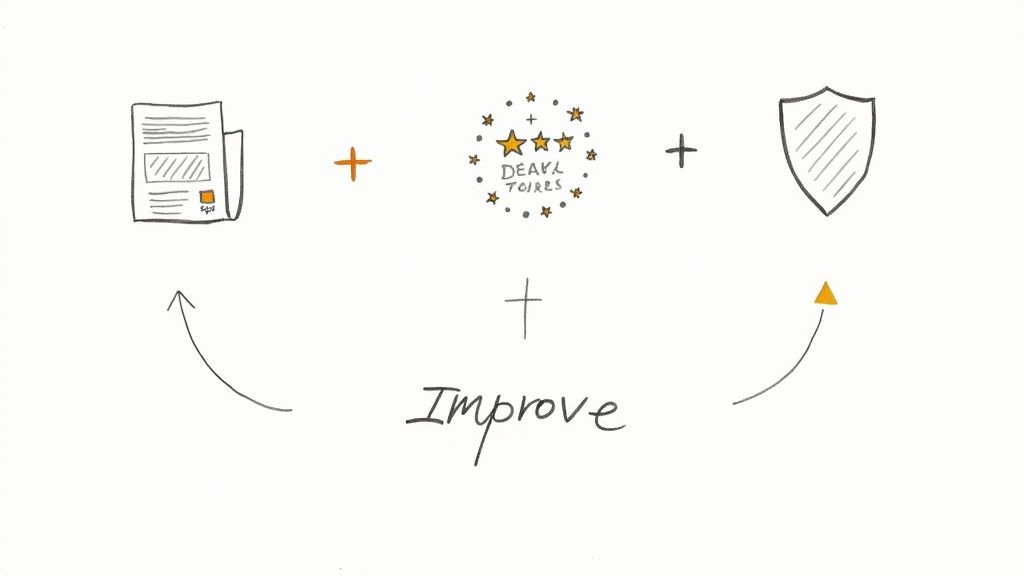
We can group the most effective tactics into three core areas of your store: fine-tuning your product pages, smoothing out the checkout flow, and building rock-solid trust with your audience.
Optimize Your Product Pages
Your product page is the moment of truth. This is your digital sales floor, where a shopper decides "yes" or "no." Every single element needs to work in harmony to convince them that your product is exactly what they've been looking for.
Here are a few high-impact ways to make your product pages sell harder:
- Use High-Quality Visuals: Don't just settle for static images. Show your product from every angle with high-resolution photos, add a 360-degree view, and—most importantly—include product videos. Seeing a product in action can instantly erase a customer's doubts.
- Write Benefit-Driven Descriptions: Shift your copy from what your product is to what it does for the customer. Instead of saying "water-resistant material," paint a picture: "keeps your gear bone-dry on any adventure." You're not selling features; you're selling a better life.
- Showcase Social Proof: Get those customer ratings, reviews, and testimonials front and center. The data is clear: the vast majority of shoppers trust online reviews just as much as a recommendation from a friend.
Streamline Your Checkout Process
A clunky or confusing checkout is the silent killer of online sales. Think about it: nearly 70% of shoppers abandon their carts, and a frustrating checkout experience is a primary suspect. The goal here is simple: make giving you money as easy as possible.
The customer has already made the decision to buy. Don't give them a reason to second-guess it now.
A seamless checkout experience respects the customer's time and trust. Every field you remove and every click you save is a step toward a higher conversion rate.
Here are a few essential fixes for your checkout:
- Offer Guest Checkout: Forcing someone to create an account is like putting a brick wall in front of the cash register. Always give new customers a guest option to get them through the process quickly.
- Simplify Your Forms: Be ruthless. Only ask for the information you absolutely need to fulfill the order. Use tools like address auto-fill to cut down on typing and errors. Fewer fields almost always means more completed orders.
- Provide Multiple Payment Options: People want to pay how they want to pay. By offering digital wallets like Apple Pay, Google Pay, and PayPal, you cater to modern buying habits and can see a huge lift in mobile conversions.
Build Unshakable Trust
At the end of the day, people buy from brands they trust. Every part of your site—from the homepage to the final confirmation screen—needs to build confidence and reassure shoppers they're making a safe choice. This is doubly true for first-time visitors who don't know you yet.
Trust signals are the little cues that tell a customer you're a legitimate, professional, and reliable business. For a deeper dive into data-driven strategies and tactics, explore this comprehensive guide to improving ecommerce conversion rates.
Start by implementing these trust-building elements:
- Crystal-Clear Policies: Your shipping and return policies should be dead simple to find and understand. Ambushing a customer with surprise shipping fees is one of the top reasons for cart abandonment.
- Display Trust Badges: Show off security seals (like SSL certificates) and the logos of payment methods you accept. These little graphics instantly tell shoppers that their personal and financial data is safe with you.
- Provide Accessible Support: Make it easy for customers to get help. Whether it's a live chat widget, a clear phone number, or a detailed FAQ page, knowing that help is just a click away can calm a nervous shopper and get them across the finish line.
Using A/B Testing to Systematically Boost Sales
Landing on a great conversion rate isn't a one-time fix or a happy accident. It’s the result of a steady, data-backed process called Conversion Rate Optimization (CRO). This is exactly how the most successful stores climb from average to excellent—by systematically testing, learning, and refining everything they do.
At the very core of CRO is a technique you've probably heard of: A/B testing, sometimes called split testing. The idea behind it is beautifully simple. Let's say you're torn between two headlines for your product page. Instead of just guessing which one will perform better, you show Headline A to half your visitors and Headline B to the other half.
After letting the test run for a bit, you just look at the numbers. Which headline actually led to more sales? That's all there is to it. A/B testing pulls you out of the guessing game and grounds your decisions in cold, hard data, making sure the changes you implement actually work.
Adopting a Scientific Approach
Good CRO really just follows the scientific method you learned back in school. It’s a disciplined loop of observing a problem, forming a hypothesis, running a test, and analyzing what happened. This framework keeps you from making random changes based on a gut feeling and instead channels your energy into things that will genuinely move the needle.
Here’s what that process looks like for your store:
- Form a Hypothesis: Start with an educated guess rooted in your analytics or customer feedback. For example: "I believe that changing our 'Add to Cart' button from our standard blue to a more vibrant green will grab more attention and lead to more clicks."
- Run a Controlled Test: Use an A/B testing tool to show the original blue button (this is your 'control') to 50% of your traffic and the new green button (your 'variation') to the other 50%.
- Analyze the Results: Once enough people have seen both versions, the tool will report back on which one drove a statistically significant lift in conversions.
- Implement the Winner: If the green button was the clear winner, you roll it out permanently for everyone. If it wasn't, or if the results were inconclusive, you stick with what you had and move on to your next testing idea.
What Should You Test First?
You can test nearly anything on your site, but let's be realistic—some changes have way more potential than others. To get the most bang for your buck early on, focus on the elements that most directly influence a shopper's decision to buy.
A/B testing is all about making small, incremental improvements that compound over time. It’s a marathon, not a sprint, where consistent, data-backed decisions build a high-performing ecommerce machine.
Zero in on these high-impact areas for your first few tests:
- Headlines and Value Propositions: This is your first and best chance to hook a visitor. Is your main message clear and compelling?
- Call-to-Action (CTA) Buttons: Play with the color, size, placement, and even the text. Does "Buy Now" work better than "Add to Bag"?
- Product Images and Videos: See what happens when you swap out standard product photos for professional lifestyle shots or add a short product demo video.
- Social Proof: Try different ways of displaying customer reviews and testimonials. Should they be higher up the page? Should you feature star ratings more prominently?
When you fully embrace this testing mindset, you stop asking a fuzzy question like "what is a good conversion rate for ecommerce?" and start answering a much more powerful one: "How can I make my conversion rate better tomorrow than it was today?"
Got Questions? We've Got Answers
Even after you've got the basics down, a few specific questions about ecommerce conversion rates always seem to pop up. Let's tackle some of the most common ones I hear from store owners.
What’s the Real Average Conversion Rate for a Shopify Store?
You’ll often see the average conversion rate for a Shopify store quoted at around 1.4%. That number can feel a bit discouraging when you compare it to the overall ecommerce average, which hovers somewhere between 2.5% and 3.0%.
So, what gives? The key is to remember that Shopify is home to millions of stores, including a huge number of startups and small businesses just getting off the ground. These newer stores, still working out the kinks, naturally pull the platform's overall average down. A mature, well-run Shopify store can and should blow that 1.4% benchmark out of the water.
Should I Really Bother Tracking My "Add to Cart" Rate?
Yes, one hundred percent. Your Add to Cart (ATC) rate is a critical leading indicator. Think of it as a measure of how well you're selling the idea of your product. A high ATC rate means your product pages are compelling and your offers are resonating.
If you see a lot of people adding items to their cart but very few actually completing the purchase, you've got a classic checkout problem. That disconnect is a massive red flag pointing to friction somewhere between the cart and the final "thank you" page—things like surprise shipping costs, a clunky form, or not enough payment options.
Your "add to cart" rate tells you how desirable your products are. Your final conversion rate tells you how easy you make it for people to actually buy them.
How Long Until I Actually See Results from CRO?
This is the classic "it depends" answer, and it almost always comes down to one thing: traffic.
If you're running a high-traffic store, you might get statistically significant results from an A/B test in just a few days. For a smaller shop with less daily traffic, you might need to let that same test run for several weeks to collect enough data to be confident in the outcome.
The most important thing here is patience. The goal isn't just to get fast results; it's to get reliable results that lead to real, sustainable growth.
Unlock the tools the top 1% of sellers use to analyze competitors, find winning products, and optimize their stores. EcomEfficiency bundles over 50+ premium apps for SEO, ads, and product research into one simple subscription, cutting your software costs by up to 99%. Start scaling smarter today for just $29.99/mo.