Upselling and Cross Selling Techniques to Boost Ecommerce Revenue

The real magic of upselling and cross-selling lies in showing customers relevant, valuable offers at just the right time.
The goal is to scale without dubious shortcuts and without hurting your credibility.
It’s a simple but powerful idea. Upselling is all about convincing a customer to buy a better, more premium version of the product they're already looking at. Cross-selling, on the other hand, is about suggesting related items that make their main purchase even better. Both are geared toward one thing: boosting your Average Order Value (AOV) and building long-term customer relationships.
The Difference Between Upselling And Cross-Selling
Let's break it down. Upselling encourages a better purchase, while cross-selling encourages a broader purchase.
Imagine a customer is buying a standard laptop. If you show them a model with more RAM and a faster processor, that's a classic upsell. But if you suggest they also add a wireless mouse and a laptop bag to their cart, that's a cross-sell.
One strategy increases the value of the item they're already set on buying. The other introduces related products that complete the package or improve the overall experience.
To help you instantly tell these two core strategies apart, here’s a quick comparison.
Upselling vs Cross Selling At a Glance
| Attribute | Upselling | Cross-Selling |
|---|---|---|
| Goal | Sell a better, more expensive version of an item. | Sell additional, complementary products. |
| Example | Upgrade from a 128GB phone to a 256GB model. | Add a phone case and screen protector to the cart. |
| Timing | Often on the product page or just before checkout. | Can happen in the cart, post-purchase, or in emails. |
| Focus | Increases the value of the primary purchase. | Increases the number of items purchased. |
| Customer Benefit | Gets a higher-quality or more feature-rich product. | Gets a complete solution or enhanced experience. |
Hopefully, that table clears things up. Both are incredibly effective, but you need to know which one to use and when. For a deeper dive, check out our guide on the cross-sell vs. upsell relationship.
Why These Strategies Matter More Than Ever
Here’s a hard truth: it’s always more expensive to find a new customer than it is to sell more to an existing one. Upselling and cross-selling are your most powerful tools for getting more value from the traffic you already have.
When done right, this isn't about being pushy. It’s a form of customer service. You're anticipating what your customer might need and offering helpful solutions right when they need them.
The goal is to make the customer feel understood. A well-placed offer shows you know what they need to succeed with their purchase, building trust and loyalty that pays dividends far beyond a single transaction.
This isn't just theory—the numbers back it up. By 2020, a huge 80% of U.S. e-commerce businesses were already using cross-selling to grow their sales. Some brands even reported revenue increases of up to 30% from these tactics alone. These aren't just vanity metrics; they represent a fundamental shift in how successful brands operate.
Real-World Ecommerce Scenarios
So, how does this look in practice? Let's take a subscription service like EcomEfficiency as an example.
Upselling in Action: A new user signs up for the
$19.99/mo Starterplan. As they go through the onboarding process, a pop-up shows them they can unlock premium tools like Midjourney and Helium10 by upgrading to the$29.99/mo Proplan. That’s a direct upsell—a better version of the same service.Cross-Selling in Action: A member on the Pro plan is actively using Semrush for their keyword research. The platform could then offer a special bundle that includes Pipiads for ad-spy insights at a small additional cost. This is a perfect cross-sell—adding a complementary tool to their current subscription.
Finding Your Key Offer Moments
Timing is everything. I can't stress this enough. A perfectly good offer at the wrong moment feels pushy and can actually kill the entire sale. The real secret is to walk in your customer’s shoes, map out their journey, and place your offers where they feel like a helpful suggestion, not a sales pitch.
Think about it this way: you wouldn't try to upgrade someone to first class after their flight has already landed. It's just... weird. In the same way, blasting a first-time visitor with a dozen bundle deals the second they hit your homepage is a surefire way to get them to click 'back'. Good upselling and cross selling techniques should make the shopping experience better, not interrupt it.
So, let's break down the best places to make your move.
The Product Page Sweet Spot
The product detail page (PDP) is your first, and frankly, your best shot at a high-impact upsell. Someone on this page is already interested; they're actively weighing their options. This is the perfect time to show them a better, more robust version of what they're looking at.
For example, if a customer is checking out a standard drone, you could have a simple side-by-side comparison with a premium model that has a longer flight time, a 4K camera, and better obstacle avoidance. You have to clearly show why the upgrade is worth it.
- Showcase Premium Versions: Display a "Pro" or "Plus" version right there on the page.
- Highlight Key Differences: Use bullet points or a clean table to compare features. Don't make them work for it.
- Frame it as a Better Solution: Your messaging should be all about how the upgrade solves their problem more completely.
In-Cart and Checkout Opportunities
Once an item is in the cart, you've got them. The main decision has been made. This is a golden opportunity for low-friction cross-sells. The goal here isn't to make them second-guess their purchase, but to add small, complementary items that make it even better.
Think small, convenient, and highly relevant. If they've just added a pair of running shoes, suggesting performance socks or specialized insoles is a no-brainer. These are impulse buys that don't require a lot of thought.
Don't sleep on this moment. A smart offer at checkout can feel like a helpful reminder—"Oh yeah, I needed those!"—and can bump up your Average Order Value with a single click.
Here’s a visual breakdown of how these strategies play out at different points in the customer's journey.
As you can see, upselling is all about enhancing that initial purchase, while cross-selling is about adding related items to round out the cart.
The Post-Purchase Power Play
The "thank you" page is probably the most underused piece of real estate in all of e-commerce. Think about it: the customer has just put their trust in you, their payment info is in, and the buying friction has completely disappeared. This is the perfect time for a one-click upsell or a time-sensitive deal on a related product.
Let's say a customer just bought a new coffee machine. On the confirmation page, you could hit them with a one-time offer for a subscription to your best-selling coffee beans at 20% off—but they have to accept it right now. This creates a bit of urgency and provides real value without messing with their original checkout flow.
The data backs this up. Research shows that upselling can drive over 4% of total sales, which completely eclipses the 0.2% you might get from basic cross-selling pop-ups. But don't ignore the checkout; those offers can still pull in an impressive 3% of sales. It's not an either/or situation; you need a multi-stage approach. You can dig deeper into how upselling boosts conversion rates if you're a data nerd like me.
Beyond the Sale with Email and Retargeting
The conversation doesn't end when the customer clicks away. The post-purchase phase is where you can get really smart with cross-selling through automated emails and retargeting ads.
Imagine someone buys a skincare product for acne. You can build an email flow that kicks in a couple of weeks later.
- Email 1 (Week 2): "Hey, how's it going?" Check in on their results and suggest a complementary moisturizer that pairs perfectly with what they bought.
- Email 2 (Week 4): Introduce a related face mask for a weekly deep-cleanse. You're helping them build a routine.
- Retargeting Ad (Ongoing): Show them ads for the rest of your skincare line on their social feeds.
This turns a single transaction into a long-term relationship. You're not just selling; you're showing them you understand their needs and are there to help them on their journey.
How to Craft Offers That Actually Convert
A great offer should never feel like a hard sell. Instead, it should come across as a genuinely helpful recommendation, like a tip from a friend who gets what you're trying to do. The real art here isn't just about pushing more products; it’s about framing your offer so perfectly that the customer feels they'd be silly to pass it up.
Getting this right is a careful mix of psychology, smart personalization, and strategic pricing. You need the right product, at the right price, with the right message, all at once. When those three things click, your offers don’t just get noticed—they get accepted.
Nail Your Pricing and Value Proposition
Believe it or not, pricing is more about psychology than math. Price an offer too high, and it looks like a cash grab. Price it too low, and you can accidentally devalue both the original item and the add-on. The magic happens in that sweet spot where the customer feels the value they're getting is way more than the extra cost.
A solid rule of thumb I've seen work time and again is the 'Rule of 25.' This guideline suggests an upsell shouldn't bump the total order value by more than 25%. So, if someone has a $100 jacket in their cart, don't try to upsell them on something that costs more than $25. This keeps the decision in that "impulse buy" zone and minimizes second-guessing.
For cross-sells, the approach is even more conservative. These complementary items should be a lot cheaper than the main product. In fact, research from Invesp suggests cross-sell products should be at least 60% cheaper than the item in the cart. This makes it a quick, no-brainer "yes."
Create Compelling Bundles and Tiers
Bundling is one of my favorite upselling and cross selling techniques because it does the hard work for the customer. Instead of them having to piece together a solution from a dozen different add-ons, you hand them a perfectly curated package.
- Problem-Solution Bundles: Think about the end goal. A "New Vlogger Kit" that bundles a camera, mic, and tripod sells a solution, not just products.
- Tiered Packages: Give them good, better, and best options. For a service like EcomEfficiency, this could be Starter, Pro, and Agency plans, with each tier adding more powerful features.
- Mixed Bundling: This is a powerful one. Let customers buy items separately or grab the bundle for a small discount. It gives them a choice while making the bundle the clear value winner. Be careful with "pure" bundles—forcing them can actually hurt sales by up to 20%.
By packaging items together, you shift the customer's mindset from "Do I really need this one thing?" to "Which of these packages is the best deal for me?" That subtle reframing can do wonders for your average order value.
Master Your Messaging and Scarcity
The words you use are just as critical as the deal itself. Your message has to be sharp, to the point, and all about what's in it for the customer. Vague offers get ignored.
Here are a few angles that consistently get results:
- Value-Driven Language: Focus on the outcome. Instead of "Upgrade to the Pro Plan," try "Unlock the full suite for complete market analysis."
- Urgency and FOMO: A little scarcity nudges people to act now. "Limited stock on this bundle!" or "Offer ends at midnight" are classics for a reason—they create a sense of now-or-never.
- Social Proof: People trust what other people are doing. "Join 1,000+ other sellers using our Pro tools" builds instant credibility and makes the upgrade feel like the smart move.
Ultimately, every offer has one job: to convert. If you want to go deeper, there are some great strategies for increasing your sales conversion rate that can really amplify your upselling efforts.
Segment Your Offers for Maximum Relevance
The single biggest mistake I see brands make is blasting the same offer to everyone. That's a huge waste. A first-time visitor needs something different than a loyal customer who's bought from you five times. Personalization is everything.
You need to slice up your customer base and deliver offers that feel like they were made just for them.
| Customer Segment | Potential Offer | Why It Works |
|---|---|---|
| First-Time Buyer | A small, low-cost cross-sell in the cart (like batteries for an electronic toy). | It’s a low-risk way to build trust and introduce them to more of your catalog without being pushy. |
| Repeat Customer | An email offer to upgrade to a "Pro" version of a product they already own. | They already like your stuff. This shows them how to get even more out of their purchase based on what you know they like. |
| High-AOV Customer | An exclusive bundle of new arrivals or premium items sent directly to them. | These shoppers have proven they're willing to spend. Reward them with early access and high-value packages. |
When you tailor your approach like this, you're not just a store—you're a helpful guide. It not only boosts the immediate sale but also builds the kind of loyalty that turns new buyers into lifelong fans. This is what truly effective upselling and cross selling techniques are all about.
Choosing the Right Automation Tools
Let’s be honest: trying to manually juggle dozens of upsell and cross-sell offers across your site is a recipe for disaster. You’ll miss opportunities, show the wrong products, and leave a ton of money on the table. If you're serious about scaling, you absolutely need to automate.
The right tools do more than just save you time. They dig into your data to make smarter, more profitable suggestions than a human ever could. They are the engine behind modern upselling and cross selling techniques, turning your strategy from a tedious chore into an automated revenue machine that works for you 24/7.
Building Your Shopify Tech Stack
For anyone running a store on Shopify, the app ecosystem is your best friend. With just a few key apps, you can build out a sophisticated, multi-stage offer funnel that works seamlessly. The goal is to present compelling offers at the perfect moments without ever getting in the way of the primary purchase.
Here’s how I think about structuring a Shopify stack:
- On the Product Page: This is your first shot. Apps like Candy Rack let you add pre-purchase upsells and cross-sells right on the product detail page. It's the perfect spot to offer a premium version, an extended warranty, or a "complete the look" bundle before an item even hits the cart.
- In the Cart: Once an item is in the cart, you want to make low-friction, highly relevant offers. The best tools will trigger a pop-up or a slide-out cart suggesting complementary items—think batteries for a new toy or a protective case for a phone.
- Post-Purchase Funnels: This is where the real magic happens. After a customer has already committed and paid, their trust is at its peak. Apps like ReConvert are brilliant at building one-click post-purchase offer funnels that appear on the thank you page. Since their payment info is already in, accepting another offer is completely frictionless, making this one of the highest-converting placements you have.
Essential Tools for Upselling and Cross-Selling Automation
Choosing the right apps and platforms can feel overwhelming, but you don't need a dozen tools to get started. The key is to select a few powerful options that integrate well with your primary sales channel and cover the most critical customer touchpoints.
Here’s a breakdown of my go-to tools depending on where you're selling. This isn't an exhaustive list, but it's a solid foundation for building a powerful automation stack that can handle offers from the product page all the way through to post-purchase emails.
| Platform | Recommended Tools | Primary Use Case |
|---|---|---|
| Shopify | Candy Rack, ReConvert, AfterSell | Pre-purchase, in-cart, and one-click post-purchase offers. |
| Amazon | Helium10, SellerApp | Keyword research for bundles, influencing "Frequently Bought Together." |
| TikTok Shop | Pipiads, FastMoss | Ad-spy for competitor offers, identifying trending bundled products. |
| Email/SMS | Klaviyo, Postscript | Post-purchase cross-sell flows, segmented campaigns for related products. |
Focus on mastering one or two of these to start. Once you have a handle on how they work and you're seeing results, you can begin layering in more sophisticated tools to expand your reach and fine-tune your targeting.
Don't Overlook Built-in Platform Features
You don't always need to shell out for a third-party app, especially when you're just getting started. Major platforms like Amazon and TikTok Shop have powerful, native features that you should be taking full advantage of.
Take Amazon's "Frequently Bought Together" section. This isn't just a random list; it's a recommendation engine powered by an algorithm analyzing millions of purchases. You can actually influence this. By creating your own "virtual bundles" and running targeted ads that encourage customers to buy specific products together, you're effectively training the algorithm to favor your pairings.
TikTok Shop is also moving fast, constantly rolling out new promotional tools. Keep a close eye on any features that let you bundle products or offer add-on discounts during your live streams or from your shop tab. In my experience, platforms always give preferential treatment to their native tools in the algorithm.
The combination of upselling and cross-selling is multiplicative magic for e-commerce margins, especially when powered by data and AI. Research highlights that these techniques can supercharge sales by 20% and profits by 30%. Amazon's model, where recommendations drive 35% of revenue, showcases the power of predictive AI. You can find more great insights on how these strategies drive revenue on business-explained.com.
Reverse-Engineer What Already Works
Why spend months guessing what might work? Your most successful competitors have already done the hard work for you. With the right intelligence tools, you can reverse-engineer their entire sales funnel to get inspiration and spot gaps in your own strategy.
For e-commerce sellers, I often recommend a subscription like EcomEfficiency, which bundles access to several powerful tools for exactly this purpose.
- Start with Semrush or Similarweb to see where a competitor's traffic is coming from and which landing pages get the most attention. This tells you which products they're pushing the hardest.
- Next, use ad-spy tools like Pipiads to see their best-performing TikTok ads. Look closely at the offers. Are they upselling to a bigger size or cross-selling a specific accessory? The ads don't lie.
- If you're on Amazon, a tool like Helium10 is non-negotiable. It can show you which keywords are driving sales for certain product bundles, giving you a clear roadmap for your own listings.
By studying what's already proven to work in the market, you can implement effective upselling and cross selling techniques without the expensive trial-and-error. This data-first approach lets you build a smarter automation strategy from day one and puts you on a much faster path to revenue growth.
How to Track Success and Sidestep Common Mistakes
So, you've launched your upsell and cross-sell campaigns. Great. But running them without tracking the right numbers is like flying blind. You feel motion, but you have no clue if you're actually headed toward your destination. If you can't measure it, you can't improve it—and that’s a non-negotiable truth in e-commerce.
A truly effective upsell strategy is built on a solid foundation of data. By keeping an eye on a few key performance indicators (KPIs), you’ll quickly see what’s working, what's a dud, and where your biggest growth opportunities are hiding. This isn't about getting lost in spreadsheets; it's about making smart, data-backed decisions that fatten your bottom line.
The Key Metrics You Need to Be Watching
To get a real sense of your performance, you have to look beyond just top-line revenue. A well-executed offer strategy touches multiple parts of your business, from the size of that first purchase all the way to long-term customer relationships.
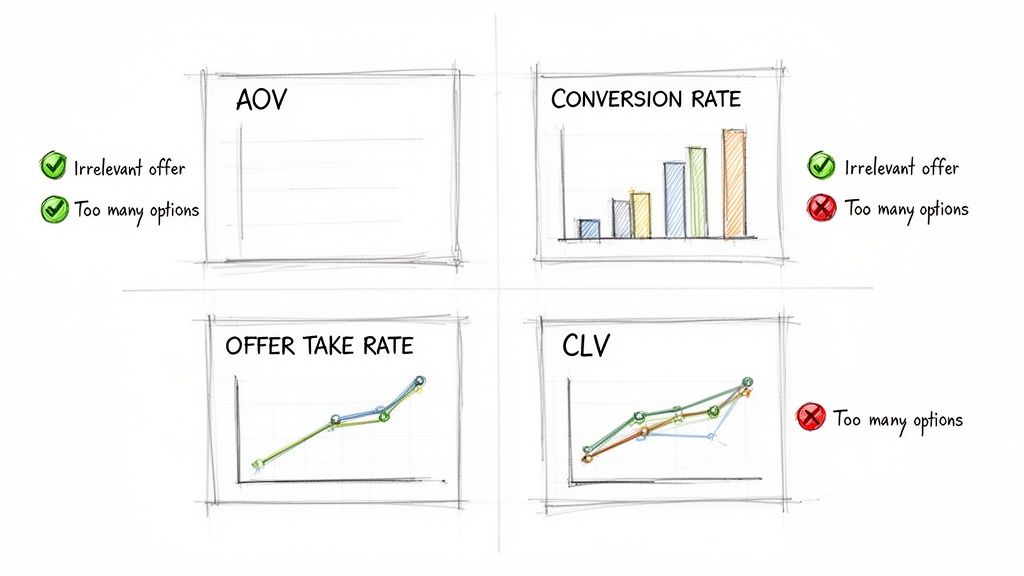
Here are the essential KPIs I always keep on my dashboard:
- Average Order Value (AOV): This is the most direct measure of success. Is it going up? If so, you're on the right track. This is the whole point, after all.
- Offer Take Rate: This tells you exactly what percentage of customers who see an offer actually accept it. A low take rate is a blaring alarm bell—it means your offer is either irrelevant, badly timed, or priced all wrong.
- Conversion Rate: You absolutely must watch your overall site conversion rate. A clunky, poorly implemented offer can add just enough friction to make someone abandon their cart, which means you're not just losing the upsell, you're losing the primary sale too.
- Customer Lifetime Value (CLV): This is the long game. The best upsells and cross-sells don't just beef up one sale; they introduce customers to more of your products, build loyalty, and encourage repeat purchases, ultimately boosting CLV.
You can find most of these numbers right inside your Shopify or Amazon Seller Central dashboard. For a more detailed look, I recommend setting up custom events in Google Analytics to track how customers are interacting with specific offers.
Sidestepping the Most Common Pitfalls
Knowing what not to do is just as important as knowing what to do. I’ve seen countless promising strategies fall flat, not because the idea was bad, but because the execution was flawed. Even tiny mistakes can torpedo your results and, worse, tick off your customers.
Let's walk through the traps I see brands fall into most often.
The Irrelevant Offer Mistake
This is, hands down, the number one killer of upsell campaigns. Suggesting a completely random product just because it has a high margin is a fast pass to annoying a customer and shredding any trust you've built. Offering hiking boots to someone buying an evening gown? It just screams, "I don't know you at all."
How to Fix It: Every single offer must be contextually relevant. Dig into your customer data and purchase history to make logical suggestions. If someone buys a camera, offer a memory card, a better lens, or a tripod—not a coffee maker.
The Aggressive Salesperson Problem
Blasting customers with pop-ups, banners, and in-your-face offers creates a genuinely awful, high-pressure experience. Your goal is to be a helpful shopping assistant, not a pushy used-car salesman. Too much aggression leads directly to cart abandonment and can seriously tarnish your brand's reputation.
How to Fix It: Less is more. Seriously. Stick to one or two thoughtfully placed offers during the entire customer journey. A single, helpful suggestion in the cart or a one-click offer on the post-purchase page is infinitely more effective than three disruptive pop-ups.
Overly aggressive tactics create a negative perception and undermine the entire user experience. The best offers feel like helpful suggestions that add value, not intrusive sales pitches that create friction.
The Analysis Paralysis Trap
Presenting a customer with too many choices is a well-documented conversion killer. You've probably heard about the jam study: a display with 24 jam options attracted more browsers, but a display with only 6 options resulted in 10 times more sales. The exact same principle applies to your offers.
How to Fix It: Keep it simple. Offer one, maybe two, highly relevant choices.
- For Upsells: Present a single, clearly superior alternative ("Get the Pro version for just $20 more").
- For Cross-Sells: Suggest a maximum of three complementary items ("Others also bought these").
By narrowing the field, you make the decision effortless and dramatically increase the odds of them saying "yes."
Ultimately, the only way to really dial this in is to test everything. A/B test your offer placement, your copy, and your product combos to see what actually connects with your audience. What works for a skincare brand might fail for a pet supply store. The data from your KPIs and your tests will give you a clear roadmap to building a strategy that's both profitable and customer-friendly.
Frequently Asked Questions
Even with a solid game plan, a few questions always pop up before diving into new upselling and cross-selling tactics. Let's tackle some of the most common ones we hear from fellow store owners to clear up any lingering doubts.
How Can I Upsell Without Being Pushy?
This is the number one fear I hear, and it's a completely valid one. Nobody wants their store to feel like a high-pressure used car lot.
The trick is to reframe your thinking from "selling more" to "helping more." A good offer should feel like you're doing the customer a favor—a genuinely useful recommendation that makes their original purchase even better, not a last-ditch attempt to grab more cash.
To nail this, you have to be obsessed with value and relevance. Every offer needs to solve a potential problem or create a clear benefit. For instance, instead of just showing a more expensive laptop, you could say, "For smoother video editing, this model's extra RAM will save you hours of frustration." It's no longer a sales pitch; it's a solution.
How Many Offers Should I Show at Once?
Less is more. Seriously. The fastest way to lose a sale is to overwhelm someone with choices. It's a real thing called analysis paralysis, and it happens when you present a dozen different add-ons and turn a simple purchase into a homework assignment.
My rule of thumb is to keep it incredibly simple. For an upsell, show one, clear, superior option. For a cross-sell, offer no more than three highly relevant, complementary items. That's it.
This keeps the path to checkout clean and frictionless. It respects your customer's time and mental energy, making it easy for them to say "yes" without having to second-guess everything in their cart.
Do Upselling and Cross-Selling Work for Low-Priced Items?
They absolutely do, but you have to adjust your strategy. Upselling a $10 product to a $12 premium version might not sound like much, but that 20% bump can have a massive impact on your profit margins when you scale it across thousands of orders.
That said, the real magic with cheaper products is often in the cross-sell.
The goal here is to offer small, convenient, low-cost add-ons right in the cart or at checkout. Think of them as impulse buys that require zero mental gymnastics.
- Buying a bottle of craft glue? A set of precision tips for $1.99 is a no-brainer.
- Grabbing a new dog toy? A small bag of their favorite treats for $3.00 is an easy add.
These tiny additions stack up and can significantly boost your Average Order Value over time. The key is making sure the cross-sell item is priced much lower than the main product, so it feels like a small, effortless toss-in.
What Is the Difference Between Bundling and Cross-Selling?
Great question. They're related, but they serve different functions.
Cross-selling is about suggesting separate, complementary products. You're showing the customer a phone case and a screen protector as individual items they can add to their cart.
Bundling is when you package multiple products together and sell them as a single item with one price. So instead of suggesting the case and protector separately, you’d offer a "Phone Protection Kit" that includes both for one price, usually with a small discount.
Think of bundling as a done-for-you cross-sell. You've already curated the perfect solution for the customer, which increases the perceived value and makes the buying decision even easier.
Ready to stop juggling dozens of expensive tool subscriptions? At EcomEfficiency, we bundle 50+ premium SEO, AI, and ad-spy tools into one simple, affordable plan. Unlock the entire suite your business needs to grow for just a fraction of the cost. Learn more about EcomEfficiency.