Your Guide to Semrush Group Buy Services

So, what exactly is a Semrush group buy? Think of it as a shared subscription. One person or a service buys a high-level, expensive Semrush plan and then sells access to that single account to a bunch of other people. This drastically cuts the cost for everyone involved, putting these powerful SEO tools within reach for freelancers and small businesses who just don't have a big-agency budget.
The goal is to scale without dubious shortcuts and without hurting your credibility.
The Core Concept of a Semrush Group Buy
At its core, a Semrush group buy is all about leveraging collective buying power. Instead of one person trying to swallow the full cost of a premium SEO toolkit, a group of individuals pools their money together. A central provider manages the official subscription and then hands out access to the paying members, turning what would be a steep monthly fee into a much more manageable expense.
It's a lot like splitting the cost of a big beach house with a bunch of friends for a vacation. Everyone gets to enjoy the entire place—the pool, the kitchen, the great view—but you're each only paying a fraction of what it would cost to rent it alone. In the same way, group buy members get to use the exact same powerful features that massive agencies rely on for keyword research, competitor analysis, and site audits.
How Does It Actually Work?
The mechanics are usually pretty simple. A provider, who you might find on a specialized website or in a private online community, buys a legitimate, high-tier Semrush account. From there, you pay a small monthly fee directly to that provider, and they give you login details or access through a shared portal. It completely bypasses the need to sign up for your own expensive subscription directly with Semrush.
The main driver here is simple economics. Let's look at the numbers for a moment.
Here's a quick comparison to put the savings into perspective:
Official Semrush Plan vs. Group Buy Cost Comparison
| Feature | Official Semrush Subscription (Guru Plan) | Typical Semrush Group Buy |
|---|---|---|
| Monthly Cost | $249.95/month (or $208.33/month if billed annually) | $5 - $15 per month |
| Included Features | Full access to all Guru plan features, historical data, Looker Studio integration. | Often includes Guru or Business level features, but can vary by provider. |
| Dedicated Support | Direct access to Semrush official customer support. | Support is provided by the group buy admin, not Semrush. |
| Terms of Service | Fully compliant with Semrush terms. | Typically violates Semrush's terms of service. |
As you can see, the price difference is massive. A Semrush Guru plan can set you back over $200 a month, even when you pay for a year upfront. But a semrush group buy can give you access for just a few dollars a month, often through communities on platforms like Discord or Telegram. The cost disparity is the entire reason this model exists and thrives.
Key Takeaway: The whole system is built on a simple idea: share the subscription cost among many people to make premium tools affordable. It’s a workaround designed to give marketers with smaller budgets a fighting chance.
Now, it's important to know that this cost-saving method operates in a bit of a gray area. Sharing accounts like this almost always goes against the software provider's official terms of service, which is a big trade-off we'll dig into later. Still, the main appeal is that dramatic price drop, which opens the door for so many marketers who would otherwise be locked out. This makes the semrush group buy an incredibly popular choice for those just starting out or trying to scale their marketing on a shoestring budget.
How to Find a Reputable Group Buy Provider
Jumping into a Semrush group buy can feel a bit like the Wild West. The internet is flooded with providers, and frankly, a lot of them are sketchy. Finding a reliable service isn't just a good idea—it's the only way to make sure you get consistent access to the tool without throwing your money away or compromising your data. It all comes down to knowing where to look and what to look for.
A great starting point is the communities where people are already talking about these services. I'm talking about SEO-centric forums like BlackHatWorld or niche subreddits where digital marketers hang out. You'll find threads packed with reviews, recommendations, and horror stories. This is where you get the real, unfiltered feedback from people actually using these group buys every day.
The whole process, from picking a provider to getting your login, should be straightforward and secure. This visual breaks it down nicely.
As you can see, it boils down to three core pillars: a provider you can trust, a payment process that’s secure, and access that actually works when you need it.
Vetting Potential Providers
Once you've got a shortlist, it's time to do a little detective work. A legitimate semrush group buy service will have a professional setup. Look for clear and accessible support channels—think a dedicated support email, a live chat on their site, or an active Discord server. If their only point of contact is a shady-looking social media account, that's a huge red flag.
Payment security is another deal-breaker.
- Secure Payment Gateways: Stick with providers who use established payment processors like PayPal or Stripe. These gateways offer buyer protection, which is your safety net if the service doesn't deliver.
- Avoid Direct Transfers: Be very wary of anyone asking for payment via cryptocurrency or direct bank transfer. These methods are typically irreversible, meaning if you get scammed, your money is gone for good.
A provider's track record is everything. Google their brand name. Check them out on Trustpilot. Go back to those forums and search for their name specifically. You're looking for a consistent history of positive feedback over months, not just a few generic "great service!" comments from last week. Also, pay attention to how they respond to negative reviews. A professional provider will engage and try to fix the problem.
Pro Tip: Before you pull out your wallet, test their support. Shoot them a pre-sale question like, "What's your uptime guarantee?" or "What's your refund policy if Semrush blocks the account?" How quickly they respond and how clearly they answer will tell you volumes about their customer service.
Red Flags to Watch Out For
Knowing what to avoid is just as critical as knowing what to look for. Run—don't walk—from any provider making promises that are obviously too good to be true. "Lifetime access" for a small, one-time fee? That's almost certainly a scam.
Another massive warning sign is the absence of a clear refund policy. Any decent provider knows that accounts can be unstable. They'll have a transparent policy that explains exactly what happens if you lose access. If you can't find that policy or it's buried in confusing language, it's a good sign they have no intention of helping you when things go wrong.
If you're patient and methodical, you can absolutely find a great semrush group buy that delivers incredible value without the headache.
The Hidden Risks of Sharing SEO Tool Accounts
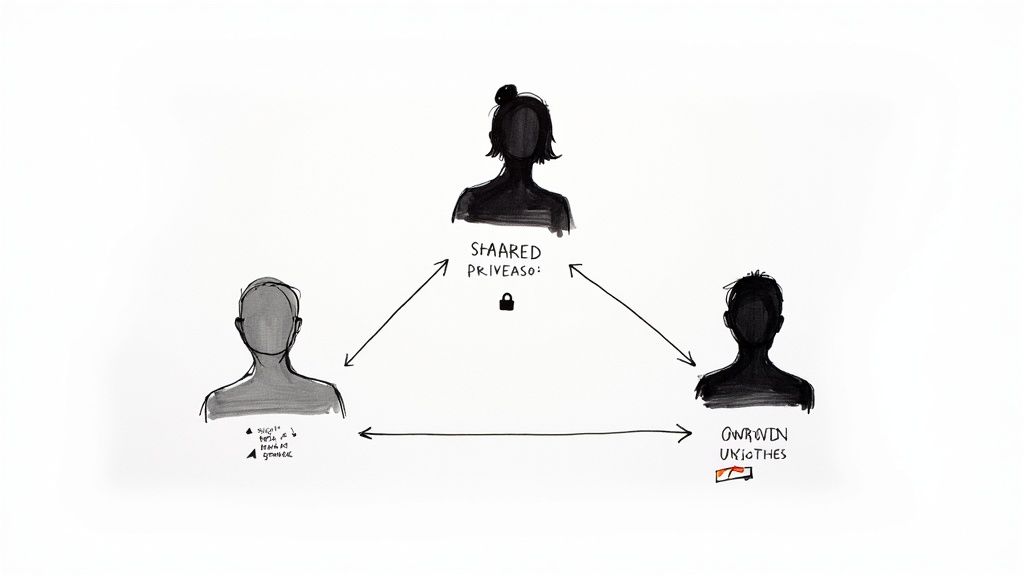
The incredible savings from a Semrush group buy look great on paper, but you really have to understand the trade-offs. That low price tag comes with some serious risks that sellers rarely mention, and going in blind can cause some major headaches. I'm not trying to scare you off, but you need a clear-eyed view of what can go wrong.
One of the biggest issues I see is data privacy. When you use a shared account, you’re basically working in a public space. Every keyword you track, every competitor you analyze, and every client site you plug in could be seen by dozens of other anonymous users on that same account.
For any freelancer or agency, that's a huge liability. Just imagine a competitor discovering your entire keyword strategy for a big client launch just by peeking at the account's search history. For anyone handling sensitive business info, this lack of confidentiality is an absolute deal-breaker.
The Problem of Account Instability
Beyond privacy, the sheer instability of these shared accounts can be a constant source of frustration. Group buys directly violate Semrush's official Terms of Service, so the master account is always at risk of getting flagged for suspicious activity and shut down. When it happens, it’s sudden and comes without any warning.
You could be in the middle of pulling a critical report for a client deadline, only to find your login has been kicked out. The provider might just disappear, or it could take them days to set up a new account, leaving you completely stuck.
This unpredictability makes it almost impossible to rely on the tool for any time-sensitive work. The money you saved doesn't mean much when you can't access the tool you need to actually do your job.
So, what does a real-world shutdown look like?
- Sudden Lockout: Your access is just gone, instantly.
- Provider Response: You're stuck waiting on the provider's support, which is often slow or completely non-existent.
- Data Loss: Any unsaved projects or search history are lost for good.
- Financial Loss: A shady provider might not offer a refund, meaning your money vanishes along with the account.
A common trigger for a ban, for example, is having too many people logging in from different IP addresses all over the world within a short time. Semrush's systems are built to catch this. Once that account is terminated, there’s no appeal—it's gone forever. You have to weigh the low cost against the very real possibility of sudden disruption and data exposure before committing to any semrush group buy service.
Using Your Shared Semrush Account Safely
Alright, so you’ve decided to go the Semrush group buy route. Now comes the important part: learning how to navigate this shared environment without putting your work at risk. Using a shared account is a whole different ballgame than having your own private subscription. The name of the game is protecting your data and avoiding headaches from other users.
Think of it like working at a shared desk in a co-working space instead of your own private office. You wouldn't leave sensitive client documents lying around for everyone to see, right? The same logic applies here. Your goal should be to get in, grab the data you need, and get out. Adopting that mindset from the start is your best defense.
Establish Your Safe Usage Protocol
This is the most critical piece of advice I can give you: never, ever use the 'Projects' feature for your websites or your clients' domains. I can't stress this enough. That entire section is a public bulletin board for everyone sharing the account. Using it means you're basically handing over your keyword strategy, site audit findings, and backlink targets to a bunch of strangers. It’s a massive privacy breach and competitive risk you just don't need to take.
Instead, you need to get into a "grab and go" rhythm.
- Export Everything: The moment you run a report—whether it's for keyword research, a domain overview, or competitor analysis—export it. Get that data out of Semrush and onto your local computer as a CSV or PDF.
- Use a Burner Password: Don't even think about using the same password you use for your email or banking. Create a strong, unique password just for this group buy service. That way, if anything ever goes wrong, the damage is contained.
- No API Connections: Do not connect the shared Semrush account to any of your other tools, like reporting dashboards or rank trackers. Handing out API keys from a shared account is just asking for security trouble.
This simple workflow ensures your valuable research stays yours and yours alone. You get all the power of the tool without leaving your strategic footprint behind for others to stumble upon.
Treat the shared Semrush account like a computer at a public library. You can get incredible value from its resources, but you wouldn’t save your personal financial plan on it. This small shift in how you work adds a massive layer of protection.
Prepare for Potential Issues
Let's be real—even with a great provider, shared accounts can be a bit shaky sometimes. Access might go down, or the account could get locked. Knowing how to handle these hiccups is key to not losing your mind.
Before you ever have a problem, figure out how to get help. Does the provider have a support ticket system? A Discord channel? An email address? Send them a simple, non-urgent question just to see how quickly they respond. It’s a good way to test the waters.
Also, be a good neighbor. Firing off a massive number of reports or running scripts can get the account flagged and potentially banned for everyone. Use the tool like a normal human, and you'll help keep things stable. By being a responsible user and knowing what to do when things go sideways, your semrush group buy experience will be a whole lot smoother.
Why Professionals Still Pay Full Price for Semrush
While a Semrush group buy looks like a fantastic deal on the surface, there's a good reason why established agencies and serious in-house marketing teams keep paying the full premium. For them, it's not just about getting access to a tool; it's an investment in a reliable, secure, and fully supported business asset.
When you're handling sensitive client data and high-stakes campaigns, the potential downsides of a shared account just aren't worth the savings. Professionals need things a group buy can never truly guarantee: total data confidentiality, rock-solid account stability, and a direct line to dedicated customer support. These aren't just nice-to-haves; they're essential for running a successful marketing operation.
Picture this: you're hours away from a major client presentation and you spot a weird data discrepancy. With an official subscription, you can get Semrush support on the line immediately. In a group buy, you have to go through a third-party admin who might be asleep, busy, or just gone, leaving you high and dry when it matters most.
The Value of Unrestricted Access and Data Integrity
Beyond just getting help, professionals need to use every feature they pay for without hitting walls. This means full API access for building custom dashboards and, crucially, access to deep historical data for analyzing long-term trends. Official Semrush plans offer a treasure trove of historical SEO data, with some datasets stretching all the way back to January 2012. You can learn more about these powerful historical data capabilities on Semrush's knowledge base.
That kind of decade-plus insight is often limited or unreliable in a shared environment. Heavy usage from other members can throttle performance or even lock you out of certain features when you need them. For an agency that needs to show a client their progress year-over-year, this kind of data is absolutely non-negotiable.
And then there's the big one: client confidentiality. An official account means all your projects, keyword lists, and competitive research are kept in your own private, secure space. There is zero risk of another user on the account accidentally—or intentionally—snooping on sensitive client information.
The bottom line for professionals: Paying full price for Semrush is a strategic business decision. It's an investment in reliability, security, and the peace of mind that comes from knowing your most critical marketing tool will work flawlessly whenever you need it.
Ultimately, it all comes down to your specific needs and how much risk you're willing to take. A Semrush group buy can be a great starting point for a freelancer getting their feet wet or for a small project on a shoestring budget. But for any organization where SEO is a core part of the business, the stability and security of an official subscription are a smart investment in their own success and reputation.
Your Questions Answered
When you're thinking about jumping into a Semrush group buy, a few key questions always come up. Let's tackle them head-on, so you know exactly what you're getting into.
Is a Semrush Group Buy Actually Legal?
This is the big one, and the answer is a bit of a gray area. You're not going to get a knock on the door from law enforcement for joining a group buy; it's not a criminal offense.
However, you are directly breaking Semrush's official Terms of Service. They are very clear that account sharing is not allowed. If they catch on, they can—and often do—shut down the account instantly, with no warning and no refund. The real risk here isn't legal trouble, but losing your money and access overnight.
Can I Use the 'Projects' Feature?
I can't stress this enough: do not use the 'Projects' feature on a shared account. Ever. It's a massive privacy and security risk.
Think about it—every bit of data you save in a Project, from your client's website to your keyword strategy, becomes an open book for every other person using that same login. It's just not worth it. The smart way to use a group buy is for quick, on-the-fly research. Run your analysis, export the data to a CSV, and get out.
What Happens if the Account Gets Banned?
Account bans are not an "if" but a "when" in the group buy world. They happen all the time. Your experience after a ban completely depends on the provider you signed up with.
- Good Providers: A trustworthy service has a plan for this. They'll typically have a replacement account ready for you within a few hours or offer a pro-rated refund for the days you lost.
- Shady Providers: The less reputable sellers often just vanish. The account gets banned, and so does their support chat. You're left with nothing—no access, no refund, no answers.
This is exactly why spending time vetting your provider is so critical. You're not just buying a password; you're buying their promise to keep the service running.
The true test of a group buy provider isn’t how they sell you access, but how they handle things when that access inevitably breaks. Their response to a ban tells you everything you need to know.
Are There Safer Alternatives to a Group Buy?
Of course. If the risk and instability of a group buy don't sit right with you, you have plenty of other solid options. It really just comes down to your budget and what features you absolutely need.
For starters, you can always take the official Semrush free trial for a spin. You could also check out other all-in-one SEO tools that are much more budget-friendly, like Mangools or Ubersuggest. They pack a lot of power for a fraction of the price. The market is full of great tools. Interestingly, while Semrush has around 1,166,000 active users, only about 117,000 are paying customers. This shows that a lot of people are finding other ways to meet their SEO needs. You can dig into more stats about Semrush's user base and market penetration if you're curious.
Looking for the power of premium SEO tools without the classic group buy headache? EcomEfficiency offers a more stable solution, bundling Semrush with over 50 other tools for one flat monthly fee. Unlock your all-in-one tool suite today at https://ecomefficiency.com.