How to Write Product Descriptions That Sell

Before you even think about writing, the real work starts. It’s easy to fall back on generic ‘buyer personas,’ but to truly connect, you have to dig deeper and uncover the real-world motivations of your ideal customer. The whole point is to find their exact language, so you can frame your product as the only logical solution to their problems.
The goal is to scale without dubious shortcuts and without hurting your credibility.
Understanding Your Customer Before You Write
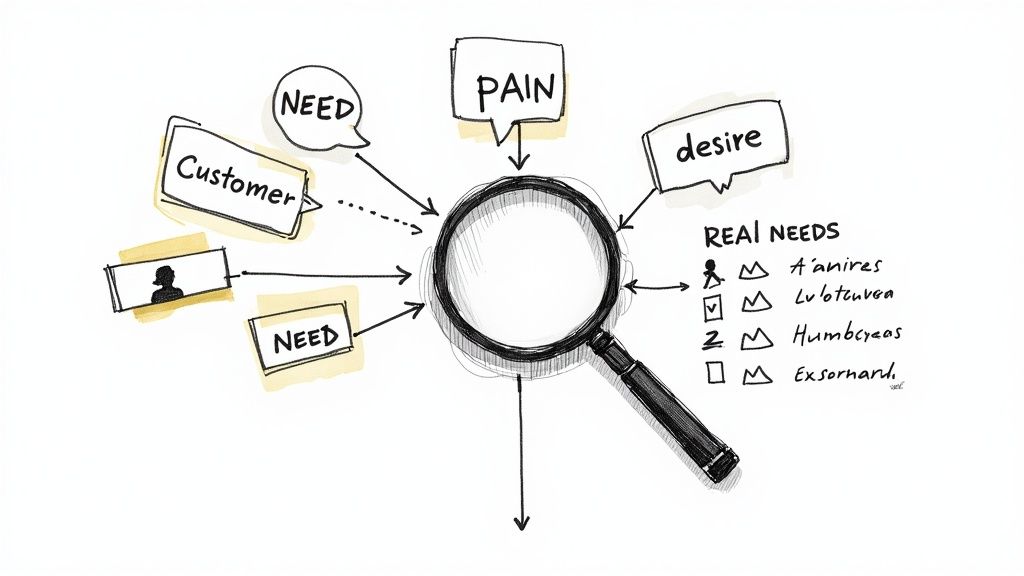
The line between a product description that bombs and one that sells often boils down to a single thing: empathy. Great copy isn't about rattling off a list of features. It’s about showing you genuinely understand your customer’s world—their frustrations, their hopes, and the specific words they use to talk about them.
This initial research isn't optional; it's the bedrock of good copy. We know that nearly 90% of consumers say product content is extremely important when they're deciding to buy. And with 87% of shoppers doing online research before pulling out their wallets, your descriptions are often your most important digital salesperson.
Mining for Customer Language
Here’s a secret: the best copy doesn't come from a brainstorming session. It comes directly from your customers' mouths (or keyboards). Your job is to act like a detective, gathering the exact phrases, pain points, and desires that resonate with your audience. This is where you find the raw material for descriptions that feel authentic and hit home.
Instead of guessing what they care about, go find the proof. Here’s where I always start:
- Competitor Product Reviews: Dive into the 1-star and 5-star reviews for similar products. The bad reviews are pure gold for identifying common frustrations, while the glowing ones show you what people actually value.
- Social Media and Forums: Places like Reddit, Facebook groups, or niche industry forums are treasure troves of unfiltered customer chatter. Look for the questions people ask over and over and the problems they’re desperately trying to solve.
- Your Own Support Tickets: Your customer support inbox is a direct pipeline into your customers' biggest headaches and questions. A simple survey asking, "What was the main problem you hoped our product would solve?" can also uncover incredible insights.
As you gather this "voice of customer" data, you're building a swipe file of words, phrases, and emotional triggers. This is how you ensure every description speaks directly to their needs and preemptively answers their questions. For a more detailed breakdown of this process, this guide on how to write product descriptions that sell is a fantastic resource.
From Data to a Clear Customer Picture
Once you have all this raw data, the next job is to pull it all together into a clear, usable snapshot of your ideal buyer. This is so much more than a stuffy persona document with an age range and a location. You're creating a practical tool that will guide every word you write.
Key Takeaway: You're not creating a fictional character. You're building a composite sketch of a real person based on data, focusing on their motivations, hesitations, and the specific outcomes they're chasing.
This is what allows you to frame your product as the hero of their story. When you truly understand their "before" state (the problem) and their desired "after" state (the goal), your product naturally becomes the bridge that gets them there. This deep understanding is what turns a bland list of specs into a powerful conversion machine.
To make this crystal clear, here’s a quick-reference table summarizing the essential elements every great product description needs.
Core Components of a High-Converting Product Description
| Component | Purpose | Example Snippet |
|---|---|---|
| Hooking Headline | Grab attention and summarize the core benefit immediately. | "The Last Travel Mug You'll Ever Need." |
| Benefit-Driven Intro | Connect a key feature to a desired outcome or solution. | "Keeps your coffee piping hot for 12 hours, so you can conquer your morning commute without a single lukewarm sip." |
| Scannable Bullets | Highlight key features and benefits for quick reading. | "• Leak-Proof Lid: Toss it in your bag with zero worries." |
| Social Proof | Build trust with quotes, ratings, or testimonials. | "Over 10,000 5-star reviews can't be wrong!" |
| Mini-Story | Paint a picture of the customer's life improved by the product. | "Imagine finally enjoying your hike without constantly stopping to adjust a bulky, uncomfortable pack." |
| Clear Call-to-Action | Tell the customer exactly what to do next. | "Add to Cart and start your adventure." |
Keep these components in mind as you start writing, and you'll have a solid foundation for crafting descriptions that don't just inform, but actually persuade.
Finding Your Brand Voice and Telling a Story
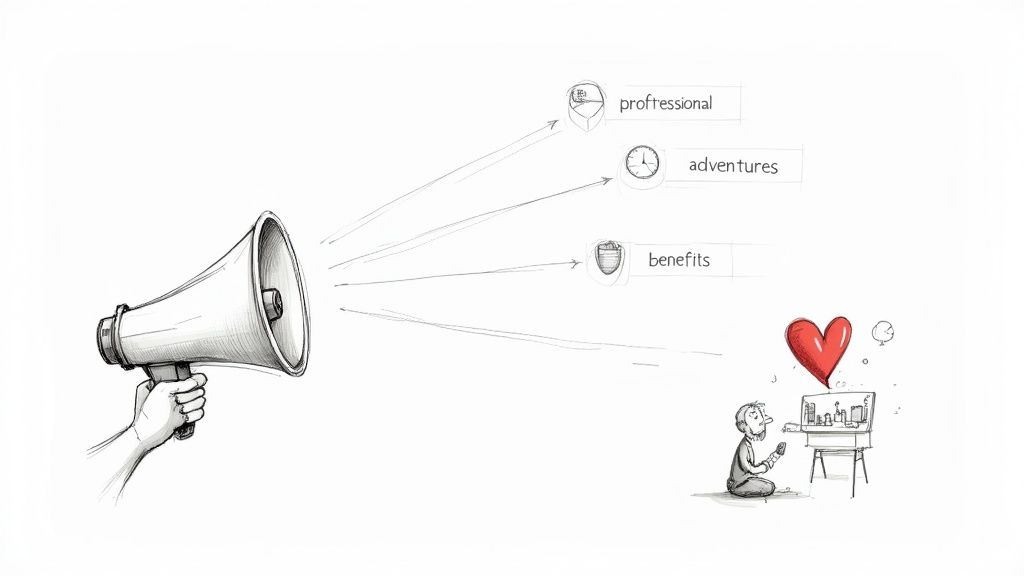
Alright, you know who you’re talking to. Now comes the fun part: figuring out how to talk to them. A great product description is so much more than a spec sheet; it's a conversation. It has a distinct personality and wraps your product in a story that sticks. This is the difference between a one-time sale and a loyal customer.
Your brand voice is essentially your company’s personality. It’s the consistent tone and style that makes you sound like you and not just another faceless online store. When that voice is consistent, customers start to recognize it, which builds familiarity and trust—the two pillars of brand loyalty.
Think about it. A company selling rugged outdoor gear for serious mountaineers shouldn't sound like a brand selling minimalist, high-end skincare. The words you choose, the rhythm of your sentences, it all has to feel right for both the product and the audience. It's not about being clever; it's about being authentic.
Choosing Your Brand Voice Archetype
So, where do you start? A good first step is to pick a broad archetype. This gives you a foundation to build on and keeps everyone on your team, from copywriters to social media managers, singing from the same hymn sheet.
See if your brand fits into one of these common archetypes:
- The Professional Expert: You're confident, authoritative, and educational. Your language is precise and clear. This is perfect if you're selling complex tech, B2B services, or high-end electronics where trust and expertise are paramount.
- The Witty Friend: You're relatable, maybe a bit cheeky, and you don't take yourself too seriously. You lean into conversational language and pop culture. This voice is a natural fit for lifestyle brands or anything aimed at a younger crowd.
- The Minimalist Sage: Calm, clean, and intentional. Every word has a purpose; there's no fluff. This works beautifully for wellness products, design-focused brands, or companies built on sustainability.
- The Adventurous Guide: You're bold, inspiring, and full of energy. You use active, motivational words that paint a picture of what's possible. It’s the go-to voice for travel, fitness, or outdoor gear brands.
Once you have a general direction, dig deeper. Is your "Witty Friend" more sarcastic or genuinely encouraging? Is the "Professional Expert" a formal professor or a helpful senior colleague? Jot down these details—they'll become your guide.
From Features to Feelings with Storytelling
With your voice locked in, you can start weaving stories. Storytelling is your best tool for forging a real emotional connection. It helps shoppers see themselves not just owning your product, but having their life improved by it. You’re not just selling a thing; you’re selling a better version of their future.
The trick is to learn how to translate a boring feature into a benefit-driven mini-story. This simple shift puts the customer at the center of the action and makes the value of your product feel real and immediate.
Pro Tip: Your goal is to spark the customer’s imagination. When they can clearly picture a positive outcome, the urge to buy becomes an emotional impulse, not just a logical checklist.
Here’s a simple three-step process to get you started:
- Isolate a Feature: Pull out a single technical spec from your product.
- Example: "IP68 water-resistant coating."
- Ask "So What?": What does that actually mean for your customer? What problem does it solve?
- Example: "It means the phone won’t get ruined by rain or an accidental spill."
- Paint the Scene: Now, turn that benefit into a relatable moment.
- Example: "Caught in an unexpected downpour on your commute? While everyone else is frantically protecting their tech, you can relax. Your phone is perfectly safe, ready for that next important call."
This little exercise is a game-changer. Let's try it again, this time with a "Minimalist Sage" voice for a candle company.
| Feature | The Benefit | The Mini-Story |
|---|---|---|
| Recycled Glass Container | It's sustainable and eco-friendly. | "Enjoy the warm glow, knowing its beautiful container can find new life in your home. Less waste, more beauty." |
| All-Natural Soy Wax | It burns cleanly without toxins. | "Breathe easy. We use only all-natural soy wax, filling your home with pure fragrance, not harmful chemicals." |
By consistently applying your voice and telling these small stories, you build an experience that resonates. You stop being just another store and start becoming a brand with a personality people actually want to connect with. And that's how you write descriptions that don't just inform—they sell.
Structuring Descriptions for Scannability and SEO
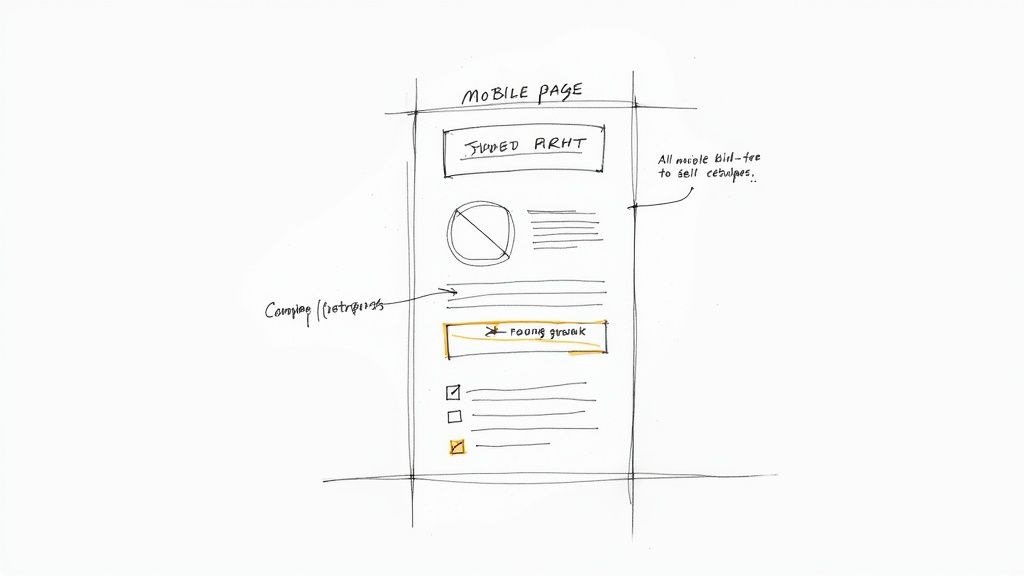
This diagram really drives home how many moving parts are involved in SEO. It's a great reminder that every single element on your product page, from the main headline down to the image text, plays a role.
Let’s be honest: even the most beautifully written, persuasive copy is worthless if nobody reads it. Today’s shoppers, especially those scrolling on their phones, don’t read every word. They scan.
Your job is to make your product description incredibly easy to scan, guiding their eyes to the most important info without them even realizing it. This means using short paragraphs, clear headings, and benefit-focused bullet points to create a smooth, digestible experience. A scannable description respects your customer's time, which makes them far more likely to stick around and absorb your message instead of hitting the back button.
And here’s the best part: this structure is also exactly what search engines love. A well-organized page helps Google understand what you're selling and rank you higher.
Crafting a Headline That Hooks and Ranks
Think of your product headline as the welcome sign for your page. It’s the very first thing a potential customer reads, and it’s a powerhouse for SEO. It has to pull double duty: grab a person’s attention with a clear benefit while also including the main keyword that brought them there in the first place.
A great headline is basically a bite-sized summary of your product's biggest promise. It needs to be compelling enough to stop someone mid-scroll and make them think, "This could be exactly what I need."
For example, a generic headline like "Durable Backpack" is forgettable. But something like "Waterproof Commuter Backpack for Laptops & Gear" is so much better. It immediately tells you the key benefits (it’s waterproof, great for commuting) and naturally weaves in keywords people are actually searching for.
The Power of Benefit-Driven Bullet Points
After the headline, a shopper's eyes will almost always jump straight to the bullet points. This is your chance for a quick win. The secret is to avoid a boring list of specs and instead translate every feature into a real-world benefit.
Go back to that "So what?" test we talked about earlier. For every feature you list, answer that question from your customer’s perspective. This simple shift in thinking makes your bullet points far more persuasive because they help the reader instantly picture how the product will make their life better.
Here’s a quick before-and-after to show you what I mean:
Feature-Focused (Weak):
- 1-inch CMOS sensor
- Weighs 249 grams
- 4K/60fps video
Benefit-Driven (Strong):
- Capture Breathtaking Detail: The large 1-inch sensor pulls in more light, giving you stunningly clear, professional-quality photos, even at sunset.
- Fly Almost Anywhere: Weighing less than 249g, this drone is regulation-friendly, so you can skip the registration hassle in many regions.
- Silky-Smooth Cinematic Shots: Record epic moments in crisp 4K at 60 frames per second for unbelievably smooth, high-resolution video.
See the difference? We went from technical jargon to tangible value, which makes a huge impact on someone who's just scanning the page.
Optimizing for Search Engines
Beyond just making your page easy to read, this structure is the foundation of solid on-page SEO. To really get this right, you need to blend persuasive writing with search engine visibility, which is the core of . A well-optimized page doesn't just convert the visitors you have; it actively brings new ones to your store.
Key SEO Takeaway: Weave your primary and secondary keywords naturally into your copy. They should appear in your headline, a subheading, and within the description itself. Just remember, keyword stuffing is a thing of the past—it reads terribly and can get your page penalized by Google.
Here are a few more on-page SEO tactics you can put to work right away to boost your search visibility:
Image Alt Text: This is so often overlooked. Alt text is what search engines read to understand what your images are about. Instead of a generic filename like
image123.jpg, use descriptive alt text like "woman hiking with the waterproof commuter backpack in the rain." This simple step is huge for ranking in image searches.Meta Descriptions: This is the short snippet of text that shows up under your page title in Google's search results. While it's not a direct ranking factor, a great meta description can dramatically increase the number of people who click on your link. Summarize the product's main benefit and add a call to action, like "Shop now and get free shipping."
By focusing on a clean, scannable structure, you're doing two things at once: creating a better experience for your customers and sending all the right signals to search engines.
Using AI as Your Creative Co-Pilot
Let's get one thing straight: artificial intelligence isn't a magic button that spits out perfect, high-converting copy. If you think of AI as a replacement for a skilled copywriter, you're setting yourself up for bland, robotic descriptions that don’t connect with anyone.
The real magic happens when you reframe AI’s role. Think of it as your creative co-pilot or an incredibly fast research assistant.
Use it to blast through writer's block, generate a dozen different angles in seconds, and handle the initial heavy lifting. But never forget that the final product needs your human touch—your unique brand voice, your deep customer insights, and your knack for storytelling. The authenticity that actually sells comes from you, not the machine.
Brainstorming Angles and First Drafts
The blank page is intimidating for everyone. Luckily, AI is brilliant at filling it with possibilities. Instead of getting stuck staring at that blinking cursor, you can prompt a tool like ChatGPT or Jasper to brainstorm benefit angles you might have overlooked. This is how you leap from a dry feature list to compelling, customer-centric ideas.
For example, a lazy prompt like "Write a product description for a coffee mug" will get you a predictably lazy answer. To get a great starting point, you have to give it great input.
Prompt Example: "Act as an expert e-commerce copywriter. Brainstorm five different benefit-driven angles for a product description of a self-heating travel mug. The target audience is a busy professional who commutes an hour to work. Focus on themes of convenience, luxury, and control over their morning routine."
See the difference? This prompt gives the AI the context it needs—the who, what, and why—to generate truly relevant and creative ideas. You can then cherry-pick the best angles to build your first draft, saving yourself hours of work.
The Critical Human-in-the-Loop Process
An AI-generated draft is a fantastic starting point, but it's rarely a finished product. It simply doesn't have the nuanced understanding of your audience or the distinct personality of your brand. This is where the human-in-the-loop process is absolutely essential.
Your job is to take that AI output and breathe some life into it. This means editing for tone, injecting your brand’s specific vocabulary, and weaving in the little stories and emotional triggers you found during your customer research.
Here's a simple workflow I use to refine AI copy:
- Generate a Draft: Use a specific, context-rich prompt to get a solid first version.
- Inject Your Voice: Rewrite clunky sentences to match your brand's personality. Are you witty? Professional? Minimalist? Make the copy sound like you.
- Add Customer Language: Go back to your customer reviews and social media comments. Weave in the exact words and phrases people use. This makes the description feel instantly authentic and relatable.
- Fact-Check Everything: AI can sometimes "hallucinate" and just make things up. Double-check every feature, spec, and claim to ensure 100% accuracy.
This back-and-forth lets you use AI for speed while you maintain full creative control. It’s a powerful combo that helps you produce better copy, faster. The trend is clear: recent data shows that over 9% of Claude AI use cases are dedicated to content creation, with another 4% focused on digital marketing and SEO. You can discover more insights about AI's role in content writing on research.aimultiple.com.
Creating A/B Test Variations in Minutes
Here's where AI becomes a serious game-changer: A/B testing. Manually writing multiple versions of a headline, an introduction, or a set of bullet points is tedious work. With AI, you can generate these variations in a fraction of the time.
For your next test, try asking an AI assistant to:
- Rewrite a headline with a different emotional hook (e.g., focus on scarcity vs. social proof).
- Create three different versions of your bullet points, each one leading with a different core benefit.
- Generate a much shorter version of your description to use in a social media ad.
This lets you constantly test and refine your copy based on real data, helping you optimize your product pages for maximum conversion without getting bogged down in manual rewrites. Your role shifts from just being a writer to being a strategist who guides the AI and analyzes the results.
The Final Polish for a Global Audience
Getting that first draft down is just the beginning. The real magic happens in the editing phase, where you sharpen good copy into something truly great. This final polish is what makes your message clear, persuasive, and ready for customers, no matter where they're shopping from.
Don't mistake this for a simple spell-check. A sloppy, rushed description can kill a customer's trust in seconds. A polished one, on the other hand, signals that you’re a professional who cares about the details.
The Power of Reading Aloud
Here’s one of the simplest yet most powerful editing tricks I know: read your description out loud. Seriously, try it. Your ears will catch what your eyes skimmed right over.
When you say the words, you’re forced to slow down. Awkward phrases, clunky sentences, and unnatural word choices that looked fine on the screen will suddenly sound jarring. If it doesn't sound like something a real person would say, it needs a rewrite.
This one simple act is the key to making sure your copy is conversational and smooth. You're not writing an academic paper; you're having a one-on-one conversation with your customer.
Creating Your Pre-Publish Checklist
Before you ever hit that "publish" button, run your copy through a final quality-control checklist. This is how you maintain consistency and brand integrity across every single product page. A systematic review is a huge part of learning how to write product descriptions that consistently convert.
Your checklist should cover a few key bases:
- Clarity: Is the main benefit obvious in the first three seconds?
- Brand Voice: Does this sound like us?
- Scannability: Are the paragraphs short? Are the bullet points easy to scan?
- Accuracy: Are all specs, dimensions, and prices 100% correct?
A consistent editing process transforms your product pages from a collection of individual listings into a cohesive, trustworthy brand experience that encourages customers to explore and buy more.
This final check is your last line of defense against errors that can cost you sales.
Writing for a Global Market
In the world of e-commerce, your next customer could be anywhere. Writing for a global audience means being incredibly mindful of language that might not translate well. What's clever in one culture can be confusing—or even offensive—in another.
My advice? Ditch the culturally specific idioms, slang, or pop culture references. A phrase like "it's a home run" might land perfectly in the United States but means absolutely nothing to a shopper in Japan. Stick to clear, universal language that focuses on the benefits.
This is more important than ever as international markets expand. The Asia Pacific region, for example, is becoming a powerhouse in the demand for content, driven by the e-commerce boom in countries like China, India, and Japan. You can see the full research on the growth of content services on research.aimultiple.com.
To make your content truly global-friendly, keep these points in mind:
- Use Simple Sentences: Avoid overly complex sentences that are tough for non-native speakers to follow.
- Be Careful with Humor: Sarcasm and wit are highly cultural. They often get lost in translation.
- Provide Clear Measurements: If you sell internationally, include both imperial (inches, pounds) and metric (centimeters, kilograms) units. It's a small detail that makes a huge difference.
Taking these extra steps creates a more inclusive and welcoming experience for shoppers around the world, turning your product descriptions into a powerful tool for global growth.
Your Top Product Description Questions, Answered
Once you get down to the business of writing, the practical questions start to surface. Theory is one thing, but sitting in front of a blank screen trying to sell a product is where the real challenges pop up.
I get asked these questions all the time, so let's tackle them head-on. This is your go-to guide for those "but how do I..." moments, designed to help you move from knowing to doing.
How Long Should a Product Description Be?
Honestly, there's no magic word count. Anyone who gives you a hard number like "350 words" isn't telling you the whole story. The right length depends entirely on your product and your customer.
For something simple and visual, like a cool graphic tee, you might only need 100 words and a few snappy bullet points. The customer gets it instantly—your job is to sell the vibe. But for a complex piece of tech, like a professional camera drone, you could easily need 400+ words to cover the specs, use cases, battery life, and other key details a serious buyer needs to know.
My rule of thumb: Be as long as you need to be to build trust, but as short as you can be to keep their attention. Always prioritize clarity over an arbitrary word count.
No matter the length, scannability is king. Use short paragraphs, benefit-focused bullet points, and clear headings. Whether it’s 100 words or 500, your customer should be able to find the information they want without having to hunt for it.
What Are the Biggest Mistakes to Avoid?
Most e-commerce stores stumble over the same few hurdles. The good news? If you just sidestep these common pitfalls, your descriptions will already be a cut above the rest. And this isn't just about sounding good—a staggering 40% of consumers have sent an item back simply because of bad product content. Getting this right directly impacts your return rate and your revenue.
Here are the five blunders I see most often:
- Listing Features, Not Benefits: This is the cardinal sin of product copy. Don't just say it has a "1-inch CMOS sensor." Tell them what that does: "Capture stunning, crystal-clear photos even in low light."
- Using Empty Clichés: Words like "high-quality," "innovative," or "best on the market" mean nothing without proof. Don't tell me it's high-quality; show me by describing the premium Italian leather or the meticulous hand-stitching.
- Writing a Wall of Text: Giant paragraphs are an instant turn-off, especially on a phone. Keep paragraphs to 1-3 sentences and embrace white space. It makes everything easier to read.
- Forgetting About SEO: You might write the most beautiful prose in the world, but it won't matter if no one can find it. You have to weave in the keywords your customers are actually searching for.
- Sounding Like a Robot: A generic, formal tone creates zero connection. Let your brand's personality shine through. Be engaging, be human, be memorable.
Should I Use a Product Description Template?
Yes, templates can be a fantastic starting point. They're especially helpful when you're just getting started or when you need to maintain a consistent feel across hundreds of products. Think of a template as a checklist to make sure you don't miss any critical ingredients.
A solid template might provide a structure like this:
- Benefit-Driven Headline: A hook that grabs attention.
- Relatable Opener: A short paragraph that sets a scene or hits on a pain point.
- Scannable Bullet Points: 3-5 key benefits that translate features into real-world value.
- The Deeper Dive: More detail for the customers who need it.
- Social Proof: A glowing customer quote or a powerful statistic.
- A Clear Nudge: A final push toward that "Add to Cart" button.
But here’s the crucial part: a template is a guide, not a crutch. Don't just fill in the blanks. The structure is the skeleton, but the magic comes from fleshing it out with your unique brand voice, customer insights, and a bit of storytelling.
How Often Should I Update My Product Descriptions?
Your product descriptions are not static. They’re living marketing assets that need a tune-up now and then to keep performing their best.
As a general guideline, I recommend reviewing your top-selling products every quarter and giving your entire catalog a full audit at least once a year.
You should definitely make an update right away if:
- You get new customer reviews. Shoppers often describe why they love a product better than you can. Borrow their language! It feels more authentic.
- The product’s features or materials change. Accuracy is everything. One wrong detail can destroy trust in an instant.
- You spot new SEO opportunities. Search trends are always shifting. Keep your descriptions aligned with what people are looking for.
- A product's conversion rate starts to dip. If a page isn't performing, the copy is one of the first places to look for an easy win.
By regularly refreshing your descriptions, you ensure they stay relevant, persuasive, and perfectly aligned with what your customers need to see.
Ready to slash your software spending and streamline your e-commerce operations? EcomEfficiency bundles over 50 premium AI, SEO, and ad-spy tools into one affordable subscription. Stop juggling dozens of expensive tools and unlock everything you need to find winning products, analyze competitors, and create high-converting marketing campaigns. Join over 1,000 ambitious e-commerce operators and get started for just $19.99/mo.