How to Spy on Competitors Ads an Ethical Guide

Learning how to spy on competitor ads is like getting a backstage pass to their marketing strategy. You get to see their exact messaging, who they're targeting, and what offers they're pushing. It’s all about using public data and the right tools to see what's working for them, so you can sidestep their mistakes and borrow their best ideas to boost your own campaigns.
The goal is to scale without dubious shortcuts and without hurting your credibility.
Why Analyzing Competitor Ads Is a Game Changer
Before we jump into the "how-to," let’s talk about the "why." This isn't just about copying your rivals; it's a core piece of any solid marketing plan today. Watching what your competitors do gives you a crystal-clear look at their entire promotional funnel, from the ad creative all the way to the landing page.
This gives you an incredible edge by showing you their strategic hand. You can see the exact pain points they're hitting in their ad copy or the unique selling points they're hammering home. This isn’t just some abstract theory—it directly affects your budget and your results.
By analyzing competitor ads, you can skip their costly A/B testing failures and go straight to what works. This can save you thousands in wasted ad spend and months of painful trial and error.
Uncover Market Gaps and Opportunities
Peeking into your competitors' playbooks lets you see what they aren't doing. Maybe their ads are all aimed at one demographic, leaving another valuable segment wide open. Or maybe their messaging feels a bit stale, focusing on features when they should be talking about benefits. These are your openings.
Here’s a quick rundown of what you can dig up:
- Audience Targeting: Find out which customer segments they’re chasing on platforms like Facebook or Google.
- Messaging Angles: See what emotional triggers and key benefits they’re using to drive clicks and conversions.
- Promotional Calendars: Get a feel for their seasonal sales and product launches by watching their ad activity over time.
- Creative Performance: Learn which ad formats—video, carousel, static image—are getting the most love from your shared audience.
In the end, all this intel gives you a benchmark for your own performance. It helps you build campaigns that aren't just creative, but are strategically wired to beat the competition right out of the gate.
Finding Competitor Ads On Social Media Platforms
Social channels have become more than places for likes—they’re where brands battle for attention. Luckily, many networks now offer free windows into your rivals’ campaigns. Think of these resources as your backstage pass to their ad playbook.
The Meta Ad Library is an open database covering Facebook, Instagram and Messenger ads. No login required—you simply enter a competitor’s name and instantly see their live ads. From headlines to images to calls-to-action, every detail is at your fingertips.
Tapping Into Meta’s Ad Library
To move beyond a surface-level view, drill into the Library’s filters. That’s where you’ll uncover real strategic insights.
• Country – Pinpoint regional efforts, like a push in Australia versus Germany.
• Platform – Compare ads running in Stories against those in the main feed.
• Media Type – Spot whether video is taking priority over static images.
Filtering this way often reveals a pattern. You might find a rival doubling down on video ads in Canada—clear evidence they’ve identified that market as a growth opportunity.
The Ad Library reads like a competitor’s marketing journal, exposing their current offers, key messages and visual tactics.
Expanding Beyond Facebook And Instagram
Don’t stop at Meta. Other platforms pull back the curtain, too:
• On TikTok Creative Center, explore top-performing ads by industry and region to see what hooks viewers.
• Visit a company’s LinkedIn page and click the “Ads” tab to review every sponsored post from the last six months—perfect for dissecting B2B messaging.
Advertisers poured roughly $1.1 trillion into campaigns worldwide in 2024, with 72%—over $790 billion—going to digital channels. That level of spend forces networks to be transparent, making competitive ad research both possible and crucial.
Free Ad Library Comparison
Below is a quick comparison of the features available in the most popular free social media ad libraries.
| Platform | Ad Search Capability | Filtering Options | Data Provided |
|---|---|---|---|
| Meta Ad Library | Search by brand or page | Country, Platform, Media Type | Active ads, creatives, copy, CTAs |
| TikTok Creative Center | Browse top ads by industry | Region, Industry, Ad Type | Engagement metrics, creative examples |
| LinkedIn Ads Tab | View sponsored content per company | Date Range | Sponsored posts, formats, engagement insights |
Use this comparison to choose the right tool for your competitive ad analysis—and start uncovering the strategies driving your rivals.
Peeking Behind the Curtain of Your Competitors' Search and Display Ads
While social media gets a lot of attention, the real heavy hitters in ad spending are often slugging it out on Google's Search and Display networks. This is where you'll find some of the biggest budgets and most refined strategies. To really understand what your competitors are doing here, you have to look past the public-facing ad libraries and grab a few specialized tools.
This is how you figure out exactly how they’re capturing customers who are ready to buy. We're talking about a massive battlefield—the global digital ad market is valued at a staggering $734 billion in 2024, and it's only getting bigger. With 84% of businesses reporting a positive ROI from their PPC efforts, you can bet your competitors are all in. Keeping tabs on their keyword game isn't just a nice-to-have; it's fundamental to staying in the game. You can dig into more stats on digital advertising market trends if you're curious.
Your First Clue Is Hiding in Your Google Ads Account
Before you spend a dime on fancy tools, your first stop should be right inside your own Google Ads account. Go find the Auction Insights report. It's a goldmine of free, direct information that tells you exactly who you’re up against for the keywords that matter most to your business.
Think of it as a snapshot of your immediate search neighborhood. It lays out a few crucial metrics:
- Impression Share: How often did your ad show up versus theirs?
- Overlap Rate: How frequently are you and a specific competitor showing up on the same search results page?
- Top of Page Rate: Who’s consistently snagging those premium, highly-visible ad spots at the top?
No, it won't show you their ad copy or how much they're spending. What it does do is instantly tell you who your main rivals are in the search auction. This helps you narrow your focus before you start a deeper investigation.
Time for a Deeper Dive with Ad Intelligence Tools
To really see the full playbook, you'll need to bring in a third-party ad intelligence tool. Think of platforms like Semrush or Ahrefs as search engines for advertising. Just plug in a competitor's domain, and you'll get a firehose of data back.
These tools let you see their entire PPC strategy—from the keywords they bid on most aggressively to their estimated monthly ad spend and even the ad copy they've used over time. It's like having a time machine to see every message and offer they've tested.
My favorite part? You can see the exact landing pages they're sending traffic to from their ads. This is where the magic happens, connecting their ad creative directly to their conversion strategy. It shows you precisely how they're turning a simple click into a paying customer.
Here’s a look at a typical Semrush dashboard, which is your starting point for this kind of analysis.
This dashboard gives you that crucial 30,000-foot view of a competitor's entire online presence, letting you dive straight into their paid campaigns.
By picking apart this data, you can essentially reverse-engineer what's working for them. Keep an eye out for ads they've been running for months on end. That's a huge tell—it almost certainly means those campaigns are profitable. Use that insight as your blueprint to build a smarter bidding strategy and write ad creative that truly stands out.
Choosing the Right Ad Intelligence Tools
While manually digging through ad libraries is a great starting point, it only tells you part of the story. If you're serious about competitive analysis, you need a dedicated ad intelligence tool. These platforms are game-changers, pulling in data from countless sources to give you a complete, high-level view of your competitor’s strategy—from their ad spend to which creatives are actually working.
The market is flooded with options, from massive all-in-one platforms to niche tools that focus on just one channel. The "right" tool really comes down to what you need and what you can spend. Are you a small e-commerce store running ads on Facebook and Instagram? A specialized social ad tool will probably give you the best bang for your buck. But if you’re a larger enterprise fighting for every last keyword on Google, a comprehensive suite is a much smarter investment.
All-In-One Suites Versus Specialized Tools
Think of an all-in-one suite like Semrush or Ahrefs as your wide-angle lens. It lets you see a competitor's entire digital marketing world—search ads, display banners, social campaigns—all from a single dashboard. This is incredibly useful for seeing how all the pieces of their strategy fit together.
Specialized tools, on the other hand, are your microscope. A dedicated TikTok ad spy tool, for example, can give you incredibly granular details on things like viral sounds, influencer partnerships, and specific ad formats that a broader platform might gloss over.
The real secret sauce of these tools is their ability to show you what’s been working over time. If you see a competitor has been running the same ad for six months, that’s a massive clue that it's a winner. You simply can't get that kind of historical insight from a basic library search.
One of the most powerful ways to spy on competitors is by tracking their ad spend and placement trends over time. The U.S. digital advertising market hit a staggering $317 billion in 2025, and that massive volume of data is exactly what fuels these tools. They can reveal a competitor’s programmatic spending habits and much more. You can dive deeper into the latest U.S. advertising market trends on byyd.me.
To help you get started, this decision tree lays out a simple path for where to begin your analysis, depending on your competitor's main ad channels.
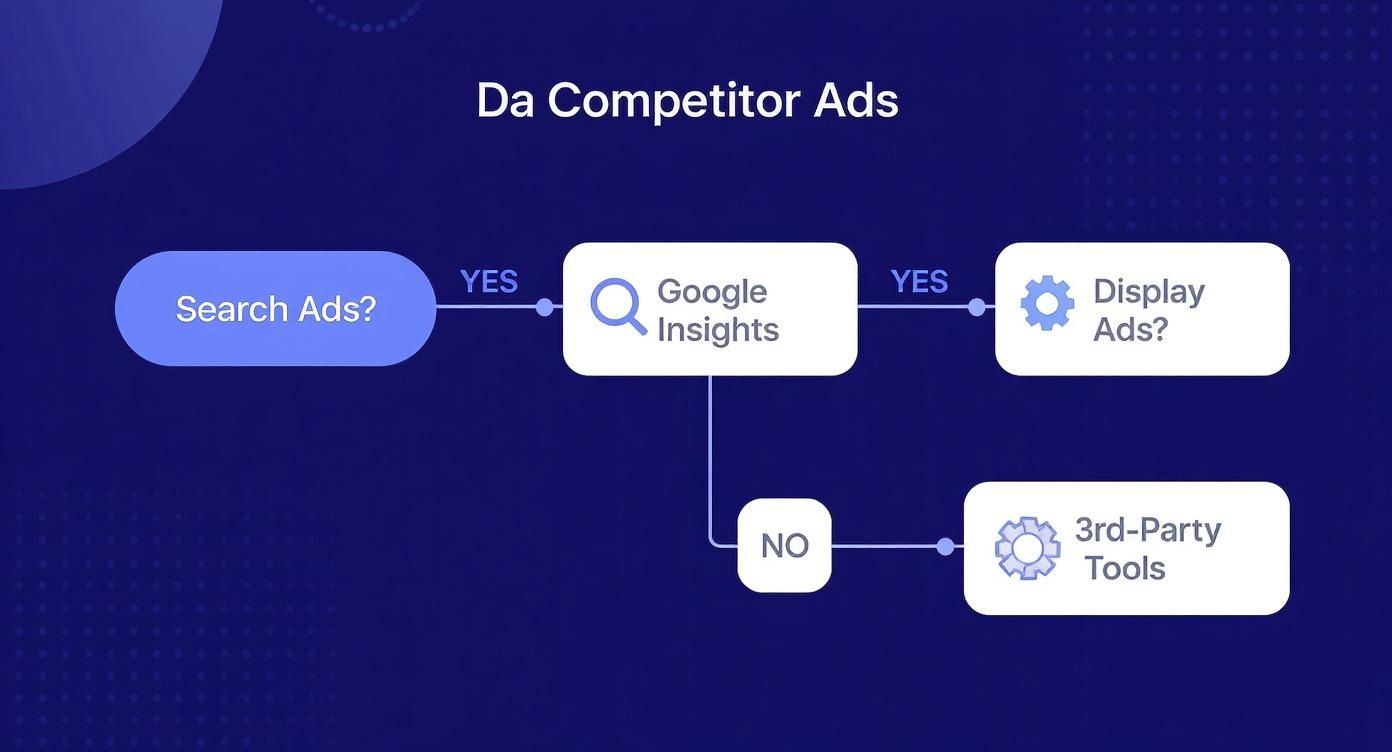
As you can see, your starting point—whether it's search ads or social ads—will guide you toward either free, native tools or a more powerful third-party software for a much deeper analysis.
Top Ad Intelligence Tool Features
To make your decision a bit easier, here’s a quick breakdown of some of the leading ad intelligence tools and what they’re best for. This table compares their main features so you can quickly see which one aligns with your needs.
| Tool Name | Best For | Key Features | Price Point |
|---|---|---|---|
| Semrush | All-around digital marketing & search ad analysis | PPC keyword research, ad copy analysis, display advertising, competitor GTM | Mid to High |
| AdSpy | Deep social media ad discovery (Facebook/Instagram) | Massive searchable ad database, advanced filtering, affiliate insights | Mid-range |
| BigSpy | Multi-platform social & native ad intelligence | Covers 9+ platforms including TikTok & Pinterest, creative downloads, trending ads | Low to Mid |
| Ahrefs | SEO-focused competitor analysis with PPC data | Strong backlink data, paid keyword insights, top landing pages, content gaps | Mid to High |
Ultimately, the best tool is the one that gives you the specific insights you need to make smarter decisions. Whether you choose a comprehensive suite or a specialized platform, the goal is the same: to turn competitor data into your own strategic advantage.
Turning Your Competitor Research Into a Winning Strategy

Let's be honest—gathering intel on your rivals is only the first step. The real magic happens when you transform all that data into a smarter, more effective marketing plan that actually gets results.
Knowing what your competitors are up to is interesting. Using that knowledge to outmaneuver them? That's powerful.
The key is to give your findings some structure. My go-to method for this has always been a classic SWOT analysis (Strengths, Weaknesses, Opportunities, Threats). It’s a simple but incredibly effective way to turn a pile of screenshots and notes into a clear strategic roadmap.
Think of it like this: every ad you've analyzed is a piece of evidence. It reveals a strength you need to counter, a weakness you can exploit, or a gap in the market just waiting for you to fill.
Build Your Competitive SWOT
Start by sorting what you’ve learned into the four SWOT categories. This exercise forces you to see the bigger picture beyond individual ads and spot the patterns in your competitors' playbooks.
Strengths: What are they absolutely nailing? Maybe their video ads on Instagram are consistently brilliant, or their ad copy speaks directly to customer pain points in a way that just works. Note it down.
Weaknesses: Where are the chinks in their armor? I often see things like outdated ad creative, confusing calls-to-action, or landing pages that feel completely disconnected from the ad's promise. These are gold mines for you.
Opportunities: What gaps are they leaving wide open? Perhaps they're completely ignoring a key demographic on TikTok, or they’re so focused on product features they've forgotten to sell the emotional benefits. That's your opening.
Threats: What moves are they making that could directly impact your market share? A competitor launching a massive, long-term campaign targeting your most profitable keywords is a direct threat you can't afford to ignore.
Prioritize and Plan Your Next Move
With your SWOT complete, you can start planning your attack. The trick is to prioritize based on a simple "impact vs. effort" calculation. For instance, a competitor's weak landing page is a huge opportunity—you can create a much better user experience and potentially poach their conversions with relatively little effort.
Now, bake these insights directly into your campaign planning. If you noticed a rival’s ads are all static images, maybe it's time to double down on producing eye-catching video content. This is how you shift from simply reacting to the market to proactively shaping it with a data-driven strategy.
Answering Your Top Questions About Competitor Ad Spying
People often have a few key questions before they dive into analyzing their competitors' ads. Let's clear those up right now.
Is This Actually Legal?
This is usually the first thing people ask, and it's a great question. The short answer is yes, it's completely legal.
You're not hacking into anyone's private accounts. All the information you'll be gathering from ad libraries and spy tools comes from publicly available sources. Think of it as market research, not espionage. It's an ethical and standard practice for staying competitive.
How Accurate is the Data?
This is where you need to be a savvy analyst. Most of the tools out there provide spend estimates and other metrics like demographics or engagement. These numbers are based on data sampling and proprietary algorithms, not a direct feed from your competitor's ad account.
My advice? Don't take any single tool's data as gospel. It's best to use the numbers as a directional guide. If you really want to get a clearer picture, cross-reference the data between two or three different tools. You'll start to see patterns and get a more reliable sense of what's actually happening.
How Often Should I Check My Competitors' Ads?
The right frequency really depends on your industry's pace.
- For fast-moving niches like e-commerce or mobile apps, I recommend a weekly check-in. Things change in the blink of an eye.
- For most other industries, a monthly analysis is usually enough to keep you informed without getting bogged down.
A good habit is to set up alerts or a quick 15-minute calendar reminder. When you spot a brand-new creative from a major competitor, especially one that's getting a lot of traction, take a look within 24 hours. This is how you spot emerging trends before they become common knowledge.
Also, be sure to save or screenshot the standout ads you find. Add a few notes on why you think they're working. This little library becomes an invaluable resource for your own team's brainstorming sessions.
The bottom line: Researching public ads is not only safe and legal, but it’s a strategic necessity for anyone running paid campaigns.
With these questions answered, you can move forward confidently and start planning smarter, more effective campaigns based on what's already working in your market.
When you are ready to run this method with the stack already in one login, start from the outils ad spy hub.
Try EcomEfficiency now for instant access to over 50 ad-spy tools at https://ecomefficiency.com today