How to Scale Facebook Ads Without Wasting Money

Scaling your Facebook ads is all about pouring gas on a fire that’s already burning bright. It’s a methodical process—you find what works, prove it’s not a fluke, and then strategically ramp up your ad spend to get those results in front of more people, all while keeping your Return on Ad Spend (ROAS) in the green.
The goal is to scale without dubious shortcuts and without hurting your credibility.
This isn't about just cranking up your budget and hoping for the best. It’s a calculated strategy that involves validating your offer, meticulously expanding your audiences, and optimizing every creative based on cold, hard data.
Build a Solid Foundation Before You Scale
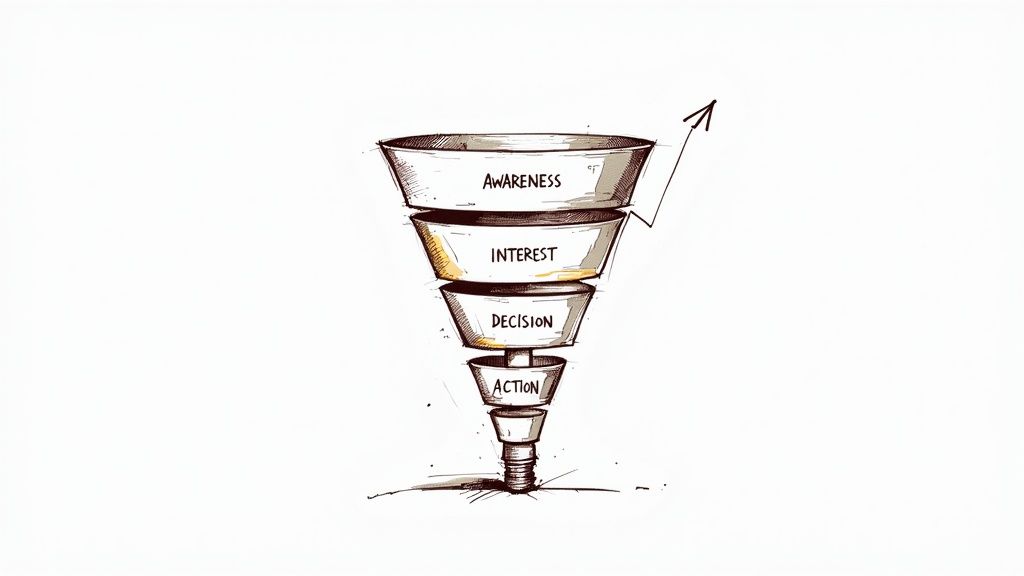
I’ve seen it a hundred times: advertisers get excited by a few good days and immediately try to scale an unstable campaign. This is, without a doubt, the single fastest way to torch your ad budget. Before you even think about increasing your spend by a single dollar, you need to be absolutely certain your campaign is built on solid, repeatable success.
We're moving beyond the thrill of a single "winning" ad. A truly scalable campaign isn't about a lucky creative; it's a well-oiled machine where several key components work together to convert customers predictably.
Confirm Product-Market Fit and a Validated Funnel
Your ads are only as good as the offer and the experience you provide after the click. Before you hit the accelerator, you need undeniable proof that people actually want what you're selling. This isn’t about a handful of sales—it's about consistent demand from a well-defined audience.
Just as important is a sales funnel that converts reliably. Your user's journey from ad to landing page to checkout needs to be seamless. If you’ve got a high cart abandonment rate or your landing page isn’t converting, those are major red flags. You have leaks in your bucket, and pouring more water in won't help. Fix them before you scale. It’s non-negotiable.
So, how do you know if you're truly ready? It's time for a quick gut check. Run through this list to see if you've got the green light to start scaling.
Scaling Readiness Checklist
Use this checklist to quickly assess if your Facebook Ads campaign is ready to scale.
| Metric/Element | What to Look For | Why It Matters |
|---|---|---|
| Consistent Profitability | A stable and positive ROAS over at least 7-14 days. | A few good days can be a fluke. A week or two of consistent profit shows a stable trend you can build on. |
| Predictable CPA | You know your target Cost Per Acquisition (CPA) and are consistently hitting it. | If your CPA is all over the place, increasing the budget will only amplify that instability and kill your profitability. |
| A Proven Offer | Clear data shows a specific audience wants what you're selling at its current price. | Scaling won't fix a bad offer. You need proof that the market has validated your product before you try to reach more of it. |
| Optimized Landing Page | Your ad's destination has a strong conversion rate and reinforces the ad's message. | Sending more traffic to a page that doesn't convert is like flushing money down the drain. |
If you can confidently check off these boxes, you’re in a great position.
Understand the Modern Ad Environment
Why is a paid scaling strategy so crucial now? Because the days of getting significant free reach on social media are over. Organic post reach on Facebook now averages a dismal 1% to 2% of a page’s followers. That means for every sixty fans you have, only one is likely to see your unpaid content. You can explore more Facebook advertising statistics to really understand this shift. This reality makes a robust, data-driven approach to scaling your ads an essential part of any real growth strategy.
Scaling isn't just about spending more; it's about amplifying what already works. If you don't have a clear winner, you have nothing to amplify.
Ultimately, this entire foundational stage is about mitigating risk. By proving your campaign is stable and profitable at a lower spend, you gain the confidence to invest more. You're no longer gambling—you're making a calculated investment in your business’s future.
Master Smart Budget Scaling Techniques
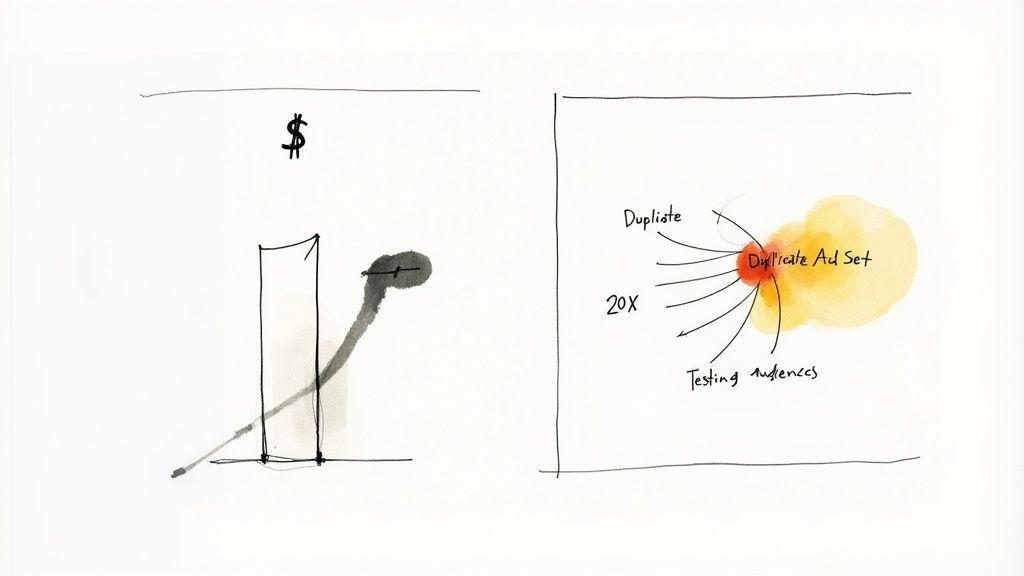
So you've got a profitable campaign humming along. The numbers look good, the ads are stable, and the temptation to crank the budget sky-high is real. I get it. But before you double or triple your spend, take a breath.
Making huge, sudden budget changes is probably the fastest way to kill a winning ad set. It's like a shock to the system for Facebook's algorithm, often forcing it back into the dreaded "learning phase" and completely tanking the performance you were trying to multiply.
Effective scaling is a game of patience and precision. In my experience, there are two tried-and-true methods for sustainably increasing your ad spend without wrecking your results: vertical scaling and horizontal scaling. Knowing which one to use, and when, is what separates the pros from the amateurs.
Vertical Scaling: The 20 Percent Rule
Vertical scaling is the most direct route. You're simply increasing the daily budget on your best ad sets—the ones that are already clear winners. The goal is to pour more fuel on the fire that's already burning bright, like an ad set with a killer Return on Ad Spend (ROAS).
The keyword here is gradually. You can't just jump from a $50/day budget to $250/day overnight. That kind of move spooks the algorithm. It scrambles to find customers at a frantic pace, which almost always spikes your Cost Per Acquisition (CPA) and tanks your profitability.
The secret? Stick to the 20% rule.
- The Guideline: Increase your ad set budget by no more than 20% every 24-48 hours. This small, incremental bump is gentle enough that it won't reset the algorithm's learning.
- The Process: Let's say you have an ad set spending $100 a day with a great ROAS. You'd raise it to $120. Let that run for a full day, watch the metrics, and if the performance holds steady, you can bump it again by another 20%.
Pro Tip: Never, ever touch the budget more than once every 24 hours. The algorithm needs time to adjust and optimize for the new spend level. Constant tinkering is a recipe for chaos and unpredictable results.
Keep your eyes glued to your ROAS during this process. A small dip is normal as you push the budget up, but if it drops below your break-even point, you’ve hit the ceiling for that ad set. At that point, you can either hold the budget there or scale it back down to its last profitable level.
Horizontal Scaling: Finding New Pockets of Customers
While vertical scaling is about spending more on what works, horizontal scaling is about finding more things that work. This is my favorite way to expand. You duplicate a proven ad set and then change one key variable to test a totally new audience segment.
Think of it this way: instead of putting more money into one basket, you're creating more baskets. You're taking the DNA of your winning ad set—the creative, the copy, the offer—and introducing it to a fresh crowd to see if you get the same magic.
Here’s the step-by-step playbook:
- Find Your Champion: Identify an ad set that's been consistently profitable for at least a week. Don't rush this.
- Duplicate It: Head into Ads Manager, select the ad set, and hit "Duplicate." You now have an exact clone.
- Change Just One Thing: In the new ad set, change only one variable. This is non-negotiable for a clean test. You could target a new lookalike audience (e.g., clone a 1% lookalike and target a 1-3% group), a different interest, or a new country.
- Match the Budget: Launch the new ad set with the exact same budget as the original. This gives you a true apples-to-apples comparison.
By isolating a single variable, you’ll know for sure if the new audience is a winner. If the duplicate performs well, you've just unlocked a whole new pocket of customers. You can then start scaling that new ad set vertically. If it bombs? No sweat. Just turn it off. Your original winner remains untouched and keeps making you money.
Expand Your Audience Without Diluting Results
So, your core audiences are humming along, and you've started bumping up the budget. Great. But now you've run into the real test of scaling Facebook ads: how do you find more of your best customers without your performance tanking?
This is where smart audience expansion comes in. It’s a delicate balance. Get it right, and you unlock exponential growth. Get it wrong, and you're just burning cash while your Cost Per Acquisition (CPA) skyrockets.
Let's walk through how to expand your reach the right way.
Master Lookalike Audience Expansion
For my money, Lookalike Audiences are the single most powerful tool you have for scaling. Facebook's algorithm builds these for you by finding users who share characteristics with your most valuable customers. But here's the thing: not all Lookalikes are created equal. You have to be methodical.
It all starts with your source data. Garbage in, garbage out. You need to feed the machine your highest-quality customer lists—think past purchasers, people with a high lifetime value, or even users who spend the most time on your site. The cleaner the source, the better the Lookalike.
From that source, you'll create tiered audiences based on a percentage of the population in your target country. I always approach it like this:
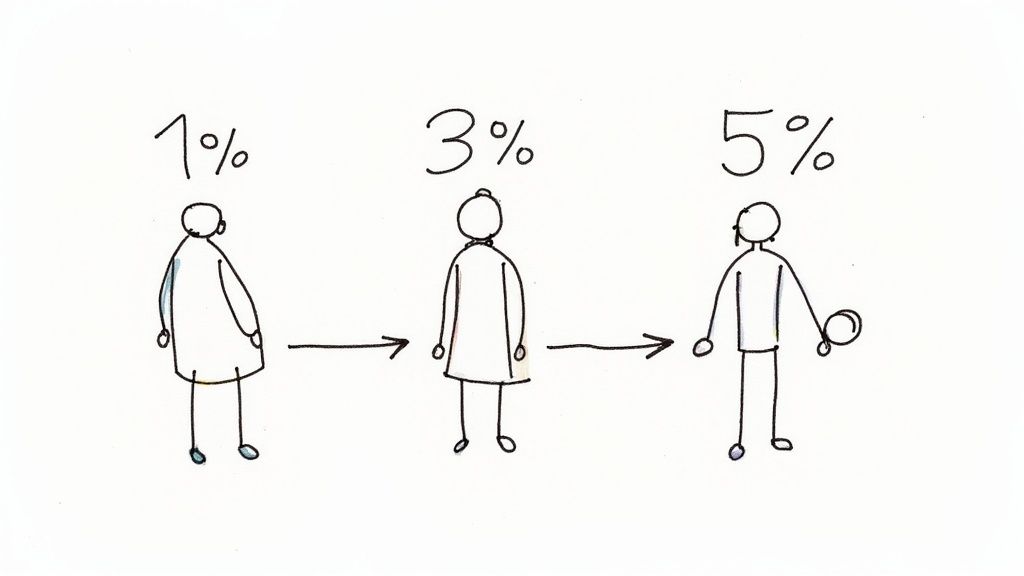
- 1% Lookalike: This is your ground zero. It’s the smallest, most potent audience that mirrors your source. Expect your best performance here.
- 1-3% Lookalike: Once your 1% is proven and profitable, you can move out to the next ring. This tier excludes that initial 1% and targets the next closest group.
- 3-5% and 5-10% Lookalikes: Now you're getting broad. Your CPA will almost certainly climb as you expand into these tiers, but the sheer volume you can tap into is massive.
Here's a pro tip that’s non-negotiable: test each tier separately. Never, ever lump a 1% and a 5% Lookalike into the same ad set. Prove out each tier, scale it vertically, and only then should you move to the next, broader audience.
Go Broad and Trust the Algorithm
This next one feels wrong, I know. But one of the most effective scaling strategies I've used is to just go broad. I'm talking about targeting a massive audience with very few interest-based restrictions and letting Facebook’s algorithm find your customers for you. It has more data than we ever will, so why not let it do the heavy lifting?
For example, if you sell fitness apparel, instead of meticulously layering five niche interests, try targeting just "Activewear." Or even something as general as "Online shopping" with a wide-open age and gender demographic. You're giving the algorithm a giant sandbox to play in, and you'll be surprised by the pockets of customers it uncovers—people you would have never found on your own.
This strategy pairs beautifully with Campaign Budget Optimization (CBO). Facebook will automatically shift your spend toward the best-performing creatives and audience segments within that huge, broad pool.
The Art of Interest Stacking
While going broad is incredibly effective, sometimes you need a little more direction. That’s where interest stacking comes in. Instead of just one broad interest, you "stack" several related but distinct interests into a single ad set.
The goal is to build a "super-audience" that’s both large enough to scale and highly relevant. Here’s how you do it:
- Pick a Core Interest: Start with a primary, obvious interest, like "Yoga."
- Add Shoulder Interests: Layer in related interests. Think "Lululemon," "Mindfulness," or "Organic food."
- Keep an Eye on Size: You want the final audience to be several million strong. This gives the algorithm enough room to breathe and find winners.
This whole expansion game is a numbers game. With over 3 billion monthly active users, Facebook offers advertisers a potential audience of about 2.28 billion people. That colossal scale is what makes these tactics work. When the platform-wide average conversion rate is around 9.2%, you know the potential is there if you can just find the right people. You can dig into more of these Facebook ads statistics to see how you stack up.
Ultimately, moving from a tight 1% Lookalike to a broad 10% audience drastically increases your reach. But it also dilutes the similarity to your best customers, which will impact performance. That's why methodical, tiered testing is the key to scaling your Facebook ads without breaking the bank.
Keep Your Ad Creatives Fresh to Beat Fatigue
So, you’ve started to push your budget higher and your audiences are getting bigger. Great! But now you’ve run head-on into a new problem: ad fatigue. That one rockstar ad that crushed it with your initial niche audience is going to get old. Fast.
When people see the same ad over and over, they start to tune it out. It's not a possibility; it's an absolute certainty. Your click-through rates (CTR) will nosedive, your cost per acquisition (CPA) will creep up, and all that hard work you did to scale will start to unravel. The only way to win this fight is to get proactive with your creative testing.
This infographic says it all. It shows the direct link between an ad's frequency and its performance, and how fresh creative is the only real solution.
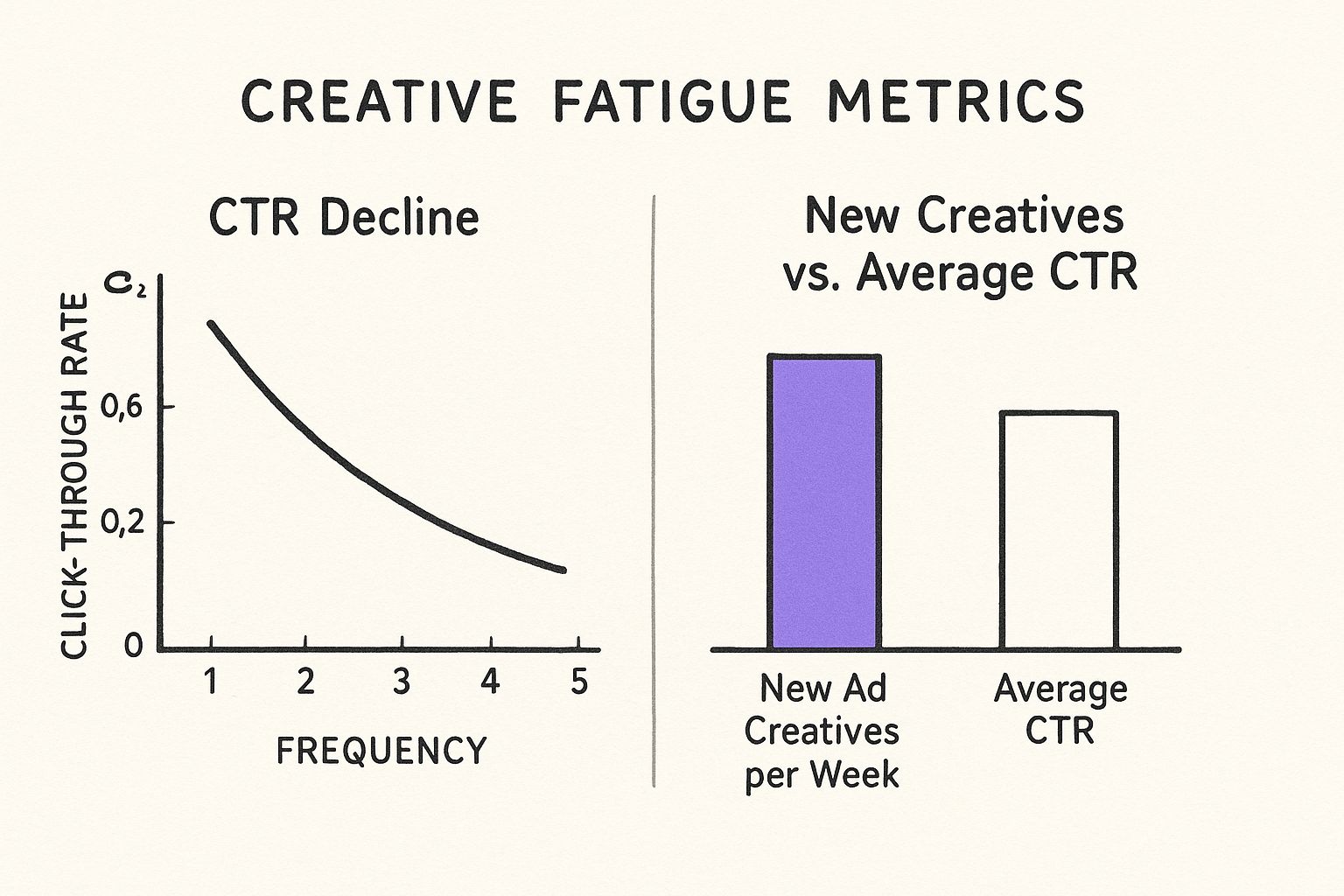
As you can see, the more someone sees your ad, the less likely they are to click. The lesson here is simple: you need a constant flow of new creative. It’s not just a good idea; it’s essential for scaling without burning out your audience.
Use a Creative Matrix to Test Smarter
Throwing random new ads into your campaigns and hoping for the best is a recipe for disaster. You need a system. That’s where a Creative Matrix becomes your best friend. It’s a framework for methodically testing different parts of your ad so you can figure out what’s actually driving results.
Instead of just testing one brand-new ad against your old winner, you break it down. You isolate the variables. Is it the hook in the first three seconds of the video? The gritty, user-generated photo? Or the new call-to-action in your copy? A matrix helps you find the answer.
I recommend building your matrix around these core elements:
- Hooks & Angles: How are you grabbing their attention? Are you leading with a pain point ("Tired of X?") or a solution ("Finally, a way to achieve Y.")?
- Visuals: What are they seeing? Test a slick studio photo against a raw, behind-the-scenes video.
- Copy & CTAs: What are you saying? Test different headlines, ad copy, and calls-to-action like "Shop Now" vs. "Learn More."
By mixing and matching these pieces, you can quickly test dozens of combinations and let the data—not your gut—tell you what to run with next.
Build a Pipeline for New Ad Content
You can't afford to wait until your ads are dying to start thinking about what's next. You need an "always-on" creative pipeline. This means you always have fresh assets in your back pocket, ready to deploy the second you see performance start to dip.
One of the most powerful ways to feed this pipeline, especially for e-commerce, is with user-generated content (UGC). Start asking your customers for photos and video reviews. Seriously. It’s authentic social proof and gives you a virtually endless supply of ad creative that looks and feels native to the Facebook feed.
Think about it: a skincare brand could take a customer's genuine video testimonial and turn it into a top-performing ad. It’s more relatable and a hundred times more believable than some glossy, overproduced commercial.
Pro Tip: The best ads at scale often don't even look like ads. They blend in, looking more like content from a friend or an influencer, which is why they grab attention so effectively.
Remember that 98.5% of Facebook users are on their phones, so everything you make must be mobile-first. And don't forget video—it’s known to outperform static images with up to 67% better CTRs. For more useful numbers, you can check out these Facebook ad statistics on amraandelma.com.
Ultimately, once you really get into scaling Facebook ads, you'll see that your creative strategy is just as crucial as your budget or targeting. A full creative pipeline is your best defense against ad fatigue and the key to staying profitable as you grow.
Use Advanced Campaign Structures and Bidding
https://www.youtube.com/embed/1vhrjUHL434
When you're ready to really scale your ad spend, you have to move beyond the basic campaign setups you started with. Simple, ad-set-level budget management is fine for testing the waters, but it hits a wall when you're pushing for serious growth.
Advanced structures and smarter bidding strategies are what truly unlock Facebook's optimization engine. This is how you start spending more money, more intelligently.
The old-school way of setting individual budgets for each ad set—what we call Ad Set Budget Optimization (ABO)—gives you a ton of control. That's great when you're trying to figure out which audience works. But when it's time to scale, you end up manually shifting money around, guessing which ad set is going to have a good day. It just doesn't work when you're managing dozens of ad sets.
Let the Algorithm Drive with CBO
The first big shift you need to make is embracing Campaign Budget Optimization (CBO). With CBO, you set one single budget for the whole campaign and let Facebook's algorithm figure out how to spend it across your ad sets. The system is designed to automatically push more of your budget, in real-time, to whichever ad sets are bringing in the best results.
Think of it like this: instead of giving each of your kids a fixed weekly allowance (ABO), you give them a shared pool of money and say, "Whoever does the best chores gets more of this money." One day, your best-performing lookalike audience might get $70, and the next day it might only get $30, all based on what's happening live in the auction.
This leap from manual budget shuffling to algorithmic optimization is a cornerstone of scaling. It saves an incredible amount of time and is almost always better at finding the cheapest conversions across your entire campaign.
For CBO to really work its magic, though, you have to give the algorithm enough to work with. A CBO campaign with just two tiny ad sets is like a race with only two runners—there’s not much competition. It works best when you have multiple ad sets (a healthy mix of different lookalikes, interest stacks, and maybe a broad audience) all fighting for a piece of that campaign budget.
Master Bid Strategies to Control Costs
Just flipping the CBO switch isn't the whole story. As you pour more money into your campaigns, you absolutely need a way to control your costs and protect your margins. That’s where bid strategies come in. Instead of just telling Facebook to get you the "Lowest Cost" results, you can give it very specific instructions on how to bid.
The two most powerful strategies for scaling are Cost Cap and Bid Cap.
Facebook Bid Strategy Comparison
When scaling, your bid strategy is your primary tool for controlling profitability. Moving beyond the default "Lowest Cost" option gives you direct influence over how Facebook spends your money in the auction. Here's a quick breakdown of the main players.
| Bid Strategy | Primary Goal | Best For Scaling When... |
|---|---|---|
| Lowest Cost | To spend your full budget and get the most results possible, regardless of individual cost. | You're in the early data-gathering phase or your profit margins are so high that you can afford some fluctuation in CPA. |
| Cost Cap | To keep your average Cost Per Acquisition (CPA) at or below a specific target amount. | You need to maintain a stable, profitable CPA as you aggressively increase your budget. This is the go-to for most advertisers. |
| Bid Cap | To control the absolute maximum you're willing to pay in any single ad auction. | You're an advanced advertiser who deeply understands auction dynamics and wants to avoid overpaying for the most competitive impressions. |
Each strategy serves a different purpose, but for consistent and profitable growth, Cost Cap is a game-changer.
My preferred method for scaling, hands down, is using a Cost Cap. Let's say you know your business is profitable as long as you acquire a customer for under $50. You can set a $50 Cost Cap. This tells Facebook's algorithm, "Go get me as many customers as you can, but make damn sure the average cost doesn't go over $50." It’s your financial safety net.
While Facebook ads still deliver a fantastic return for many, the space is getting more crowded and expensive. For instance, lead generation costs per lead (CPL) jumped by 21% year-over-year. Even so, the platform remains efficient, with average CPLs around $27.66 compared to Google's $70.11.
You can read more about the comparison of Facebook and Google ad costs on searchengineland.com. This data just reinforces why mastering these advanced structures and bid strategies is no longer optional—it's how you scale intelligently in a competitive market.
Analyze Your Data to Make Smarter Scaling Decisions
Scaling Facebook ads isn't a "set it and forget it" game. It’s an active, hands-on process. You have to constantly monitor your campaigns and really dig into the data to make sure your money is working for you. A lot of advertisers get stuck on vanity metrics like Cost Per Click (CPC) or Click-Through Rate (CTR). Sure, they can be good for a quick health check, but they won't tell you if you're actually profitable.
To scale without burning cash, you have to shift your entire focus to the numbers that directly impact your bottom line. These are the metrics that scream "this is working" or "pull the plug."
Focus on the Metrics That Actually Matter
When you're trying to grow, only a handful of key performance indicators (KPIs) truly tell the story. They give you a crystal-clear picture of your campaign's financial health and should guide every single scaling decision you make.
Here’s what you should be obsessed with:
- Cost Per Purchase (CPP) or Cost Per Acquisition (CPA): This is your bread and butter. It tells you exactly what you're paying to get a new customer. You need to know your target CPA like the back of your hand to have any hope of staying profitable.
- Return on Ad Spend (ROAS): This is the ultimate report card. For every dollar you put into ads, how many are you getting back? If your ROAS dips below your break-even point, you’re officially losing money. It's that simple.
- Customer Lifetime Value (LTV): This one’s a bit more advanced but absolutely critical for long-term growth. LTV helps you understand what a customer is worth over their entire relationship with your brand. Knowing this can give you the confidence to pay a higher CPA upfront, because you know you'll make it back over time.
By keeping your eyes glued to these three metrics, you'll know exactly when to push the accelerator on your budget and when to tap the brakes. It’s how you ensure every dollar you spend is actually building your business.
Use Ads Manager Tools to Find Hidden Opportunities
Facebook Ads Manager is packed with powerful tools that can help you pinpoint where to scale next. One of the most overlooked features is the "Compare" function. It lets you analyze performance across different time periods, demographics, and even placements.
For instance, you can compare this week's performance to last week's to see if your recent budget bumps are paying off. You might find out your ROAS is way higher on Instagram Stories than it is on the Facebook Feed. That’s a massive signal to create a new campaign targeting just that placement.
Never assume performance is the same across your entire audience. Use the "Breakdown" reports in Ads Manager to slice your data by age, gender, and region. You might just uncover a hidden goldmine, like a specific age bracket that converts at half the CPA of everyone else.
These insights are the fuel for smart horizontal scaling. By finding these high-performing pockets, you can launch new, hyper-targeted campaigns to capitalize on them without messing with what’s already working.
Spot Ad Fatigue Before It Kills Your Campaign
When you scale, you’re showing your ads to a lot more people, a lot more often. This inevitably speeds up ad fatigue—the point where people have seen your ad so many times they just start ignoring it. If you miss the early warning signs, you can watch a profitable campaign die a quick death.
There are two critical red flags for ad fatigue:
- Rising Frequency: This tells you the average number of times each person has seen your ad. Once this number starts creeping up (I usually get nervous when it hits 2.5 - 3.0 in a 7-day window), you're entering the danger zone.
- Declining ROAS and CTR: As people get sick of your ad, they'll stop clicking, and they'll definitely stop buying. You’ll see your click-through rate sag and your ROAS take a nosedive.
The moment you spot these trends, you have to act. Don't wait. This is exactly why you have a pipeline of fresh ad creatives ready to go. Swap in a new video or image to keep things interesting. By staying on top of your data and reacting fast, you can keep the momentum going and scale successfully.
Answering Your Top Questions About Scaling Facebook Ads
Scaling a campaign can feel like a high-wire act. You're trying to push for more growth while keeping your performance from falling off a cliff. It's totally normal to have questions, so let's tackle some of the most common ones I hear from advertisers.
What’s the Real Minimum Spend to Scale an Ad Set?
There’s no single magic number here, but you have to give the algorithm enough fuel to work with. For most of Facebook's optimization features to kick in properly, you're looking at a minimum of $20-$50 per day for each ad set.
Think of it this way: the algorithm's goal is to hit about 50 key actions (like a purchase or a lead) per ad set, per week. If your budget is too low, it can't get those conversions fast enough, and your ad set gets stuck in the "learning phase" forever. A budget in that $20-$50 range gives it a fighting chance to learn, stabilize, and actually perform.
How Soon Will I Know if My Scaling Is Working?
This is where patience becomes your best friend. The moment you hike up a budget or target a new audience, expect some turbulence for the first 3-7 days. It's completely normal. The algorithm is recalibrating and figuring out where to find people at this new, higher spend level.
You should start to see performance level out and become more predictable within about 7-14 days. If you’re two weeks in and your metrics are still all over the place or heading south, that's your cue to reconsider the strategy.
My Two Cents: Don't panic and make changes within the first 72 hours. Let the algorithm do its job and give the data time to settle before you judge whether a scaling decision was the right one.
Is My ROAS Guaranteed to Drop When I Scale?
Honestly, a small dip in Return on Ad Spend (ROAS) is almost expected when you first scale. You're pushing beyond the low-hanging fruit—the easiest and cheapest customers to acquire—and asking Facebook to find new people. Some of those new people will naturally cost more to convert.
The trick is to manage that dip so your ROAS stays profitable. If you see a massive drop that doesn't bounce back after a week, it’s a red flag. You've either scaled too fast or your audience is tapped out. That’s when you either pull back the budget or, better yet, introduce fresh creative to see if you can spark new interest.
Vertical vs. Horizontal Scaling: Which One Should I Use?
This isn't an "either/or" situation. The best advertisers use both, just for different reasons.
- Vertical Scaling (More Budget): This is your go-to when you've found a winning ad set. It's proven, it's working, and you want to pour more fuel on the fire to get as much as you can out of it.
- Horizontal Scaling (More Audiences/Creatives): This is what you do when your star ad set starts to fade or you need to find entirely new pockets of customers. You're looking for more things that can become winners.
A classic, effective workflow is to find a winner, scale it vertically until its performance starts to level off, then start scaling horizontally by duplicating it to test brand new audiences.
Stop wasting thousands on separate marketing tools. EcomEfficiency bundles over 50+ premium AI, SEO, and ad-spy tools like Semrush, Pipiads, and Midjourney into one simple subscription. Cut your software costs by up to 99% and unlock the tools you need to scale your e-commerce brand at https://ecomefficiency.com.