How to Research Your Target Audience: how to research target audience

To truly understand how to research a target audience, you have to stop guessing. It's about digging into your own customer data, dissecting what your competitors are doing, and actually talking to people through surveys and interviews. This is how you build customer profiles that work, ensuring your marketing dollars are spent wisely.
The goal is to scale without dubious shortcuts and without hurting your credibility.
Why Guessing Your Audience Is Costing You Sales
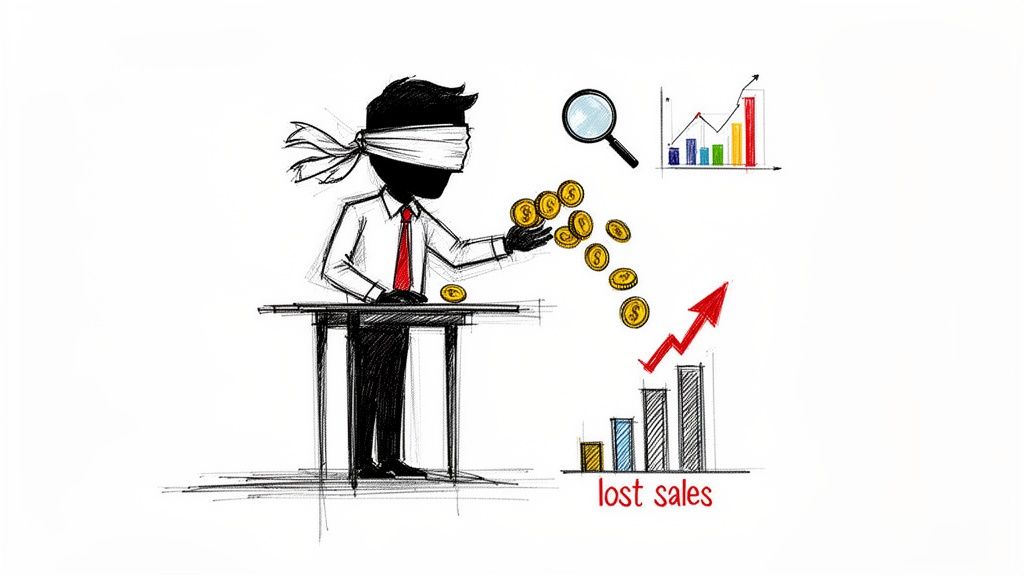
Running an e-commerce store without a deep understanding of your audience is like driving blindfolded. Sure, you might inch forward, but you’re probably burning through your ad budget on campaigns that don't connect and launching products no one is asking for.
Every marketing dollar aimed at the wrong person is a dollar down the drain. This directly hits your bottom line and grinds your growth to a halt.
The alternative is to get strategic and let data lead the way. Instead of just assuming you know your customers, you build a crystal-clear, evidence-based picture of their real needs, what drives them, and how they shop. Making this shift is the single most powerful thing you can do for your business's long-term health.
The Bedrock of E-commerce Success
In the cutthroat world of online retail, knowing your customer isn't just a "nice-to-have"—it's a matter of survival. Global e-commerce sales are on track to hit a staggering $7.4 trillion in 2025, accounting for almost a quarter of all retail.
By then, over 2.77 billion people will be shopping online. That’s a massive opportunity, but it's also an incredibly crowded space. For store owners, this makes sharp, effective audience research completely non-negotiable.
If you're just starting out and need to cover the basics, this guide on how to identify your target audience for social media success is a great place to get your bearings.
From Assumptions to Actionable Insights
So, how do you make this critical transition from guesswork to data-driven decisions? The entire process boils down to three core pillars. Each one builds on the last, turning raw information into a powerful strategic asset that guides everything from your ad creative to your next product launch.
Our entire approach in this playbook is built around this framework.
The Three Pillars of Audience Research
| Pillar | What It Is | Key EcomEfficiency Tools |
|---|---|---|
| Data Mining | Digging into the goldmine of data you already own. Think Shopify reports, Google Analytics, and customer purchase history. | Google Analytics, Shopify Analytics |
| Competitor & Market Analysis | Ethically spying on your rivals to see who they’re targeting and finding market gaps you can fill. | Similarweb, Ahrefs |
| Qualitative Research | Going beyond the numbers to understand the why. This is where surveys, interviews, and social listening come in. | Typeform, Reddit, Social Searcher |
By mastering these pillars, you'll stop throwing money away and start building a business that genuinely connects with the people it's designed to serve. Let's walk through each one with practical, step-by-step workflows you can put into action today.
Finding Actionable Insights in Your Own Data
Before you spend a dime on new research tools, take a look under your own hood. The most powerful, undeniable truths about your customers are often hiding in plain sight within your own analytics and sales data. This is where you get the real story.
This isn't about who you think is buying from you; it's about who actually is. The data from paying customers is pure gold because it’s factual, unbiased, and directly connected to your revenue.
Unlocking Your Analytics Platforms
Every e-commerce platform—from Google Analytics and Shopify to Amazon and TikTok Shop—comes with a dashboard full of audience reports. Most people glance at the big numbers like traffic and sales, but the real magic happens when you dig deeper.
Start with the basics: demographics and geography. Where are your customers located? What’s their primary age range and gender? This is your starting point for spotting obvious patterns.
Let's say you sell high-end coffee beans. You dive into your analytics and discover 70% of your sales come from major cities in the Pacific Northwest. Boom. You can immediately refine your ad targeting and lean into that specific regional culture in your messaging. It’s a simple move that takes you from guessing to knowing.
Interpreting User Behavior Signals
Beyond who your customers are, analytics show you how they act. These reports tell the story of their journey through your store, and you shouldn't ignore them.
- Acquisition Reports: Where are your best customers coming from? Organic search? Paid Instagram ads? Your email list? This tells you where your audience hangs out online.
- Behavior Flow: What path do people take on your site? Critically, where do they leave? If a product page has a massive exit rate, something’s wrong. It could be the price, the photos, or a disconnect between your ad and the actual product.
- Device Usage: Are people shopping on their phones or on a desktop? If your audience is 85% mobile-first, your site better be flawless on a small screen. A clunky mobile checkout will absolutely kill your sales.
I once worked with a Shopify store selling handcrafted leather goods. They saw a huge drop-off at checkout, but only for mobile users. A quick look at their analytics revealed the payment buttons were a mess on smaller screens. A simple UI fix led to a 25% jump in their mobile conversion rate in less than a week.
This is what turning data into action looks like. To get this right, you have to be comfortable with the key research data collection methods that give you this kind of clear, actionable information.
Analyzing Purchase History for Profitability Patterns
Your sales history is arguably the richest data source you have. Don’t just look at what products are popular; start looking at who is buying them. This is how you find your VIPs.
You're looking for customers with a high Customer Lifetime Value (CLV). These are your loyal, repeat buyers. Dig into their order history and ask yourself:
- What did they buy first? This often points to your best "gateway" products—the items that hook people and turn them into fans.
- How often do they come back? Knowing this purchase cycle helps you nail the timing for your email campaigns and retargeting ads.
- What's their Average Order Value (AOV)? Customers who spend more per order are your prime candidates for upselling premium items or bundling products.
By creating a segment of your top 10% of customers based on their CLV, you can build an incredibly detailed profile of your absolute ideal buyer. This isn't just about finding an audience; it's about pinpointing your most profitable one and then going out to find more people just like them.
Analyzing Competitor Strategies and Market Gaps
Your own data is a great starting point, but it only tells part of the story. To really get the full picture, you have to look sideways at your competitors. They’ve already spent a ton of time and money figuring out what works, and you can learn a lot by ethically dissecting their playbook.
This isn't about blind copying. It's about finding their strengths, their weaknesses, and—most importantly—the gaps they’ve left wide open for you.
Think of it this way: your rivals are essentially broadcasting their target audience strategy through their marketing. Every ad they run, every social post they make, and every platform they focus on is a clue. Your job is to become a detective, piecing it all together to figure out who they're targeting and how they're doing it.
This process quickly answers some critical questions. Who are they actually reaching? What kind of messaging is hitting home with that audience? And where are they not showing up? That's your opening.
Deconstructing Your Competitors' Digital Footprint
First things first, you need to map out where your competitors live online. Creating a repeatable workflow here is key. You want to break down exactly where their traffic comes from, who that traffic is, and what they do once they land on the site. This is where a tool like Similarweb is invaluable.
Just plug a competitor's URL into Similarweb, and you'll get an instant snapshot of their traffic sources. Are they pulling most of their visitors from organic search? Paid ads? Social media? This tells you exactly where they're putting their marketing dollars and what channels are paying off for them.
Let's say you see a competitor getting 60% of its traffic from TikTok. Boom. That's a massive clue that their target customer is hanging out on that platform. It’s a shortcut for your own channel strategy. From there, you can dig into their audience demographics—age, gender, interests—to see if it matches the profile you're building from your own data.
One of the biggest mistakes I see is people only looking at one or two direct competitors. To get a real feel for the market, you need to analyze at least 3-5 rivals. Include a mix of direct competitors selling similar stuff and "aspirational" brands you admire. This gives you a much richer dataset to work with.
Spying on Winning Ad Creatives and Targeting
Once you know which channels are working for them, you can zoom in on their advertising. This is where you uncover the exact ad creative and messaging that’s making them money. For anyone in e-commerce, especially on TikTok and Shopify, ad-spy tools are a must-have.
Here’s a practical workflow I've used with tools from the EcomEfficiency bundle:
- For TikTok Shop: I'd jump into a tool like Pipiads to see the top-performing ads in my niche. You can filter everything by country, engagement, and even platform. I always pay close attention to the video hooks, the calls-to-action, and especially the comments section to see raw, unfiltered audience reactions.
- For Shopify Stores: Something like ShopHunter is great because it lets you see the best-selling products and top ads for other Shopify stores. It helps you connect the dots between an ad angle and what’s actually converting visitors into paying customers.
This kind of intel is an absolute goldmine. You’re not just seeing what they sell; you’re seeing how they sell it. It gives your own creative process a massive head start and helps you skip a lot of the expensive trial-and-error that burns through ad budgets.
Identifying Emerging Trends and Untapped Needs
The final piece of the puzzle is looking beyond your direct competitors to spot broader market trends. The real goal here is to find emerging customer needs that nobody is properly serving yet. This is how you innovate and carve out a space that's uniquely yours.
Tools like Exploding Topics and BrandSearch are perfect for this. They constantly scan the web for conversations, searches, and social media chatter to flag topics and products that are blowing up before they hit the mainstream.
This kind of forward-looking research is what separates the good e-commerce operators from the great ones. History backs this up. The pandemic supercharged online sales from $4.2 trillion to over $6 trillion by 2024, with the number of digital buyers expected to hit 2.77 billion in 2025. For Shopify owners and media buyers, this explosive growth makes it more critical than ever to use analytics to get an edge. You can find more insights about global e-commerce markets on tekrevol.com.
When you combine a deep analysis of your competitors' current moves with a sharp eye on future trends, you’re setting your brand up to not just compete, but to lead. You'll know the audience that exists today and have a clear roadmap for capturing the audience of tomorrow.
Uncovering Customer Motivations with Qualitative Insights
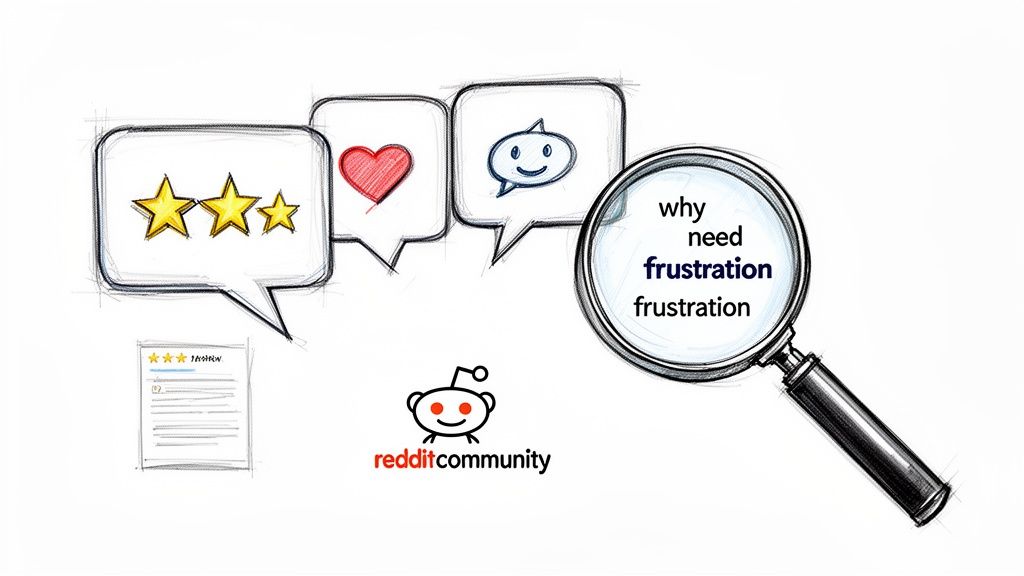
Analytics are great for telling you what your customers are doing. But to build a brand that truly connects, you need to find out why. Data shows you the click paths and conversion rates, but it won't tell you about the human emotions, frustrations, and desires that drive those actions.
This is where we go beyond basic demographics like age and location and dive into psychographics—the values, interests, and pain points that actually make your audience tick. It's the difference between knowing a customer is 35 versus knowing she’s a 35-year-old who values sustainability and will gladly pay more for eco-friendly packaging. That second piece of information is pure gold.
Conducting Simple and Effective Customer Surveys
You don't need a massive budget to get inside your customers' heads. A simple, well-designed survey sent to your email list or recent buyers can be incredibly insightful. The trick is to ditch the yes/no questions and use open-ended prompts that get people talking.
Instead of asking, "Do you like our product?" you'll get far more by asking, "What problem were you trying to solve when you bought our product?" The answers you get are a treasure trove of marketing language you can lift directly for your ads, product pages, and emails.
Here are a few of my go-to questions for any customer survey:
- "What was going on in your life that led you to look for a product like ours?" This reveals the real-world triggers behind a purchase.
- "What other options did you consider before choosing us?" This gives you a list of your actual competitors, straight from the customer's perspective.
- "If you could no longer use our product, what would you miss the most?" This pinpoints your most valuable feature or benefit.
A quick tip from my experience: Keep surveys short—5-7 questions is the sweet spot. Always offer a small incentive, like a 10% discount code, to boost your response rate. When people feel you value their time, they give much more thoughtful feedback.
Leveraging Social Listening in Niche Communities
Your potential customers are already online, talking about their problems and what they're looking to buy. You just need to know where to find them. Forget stuffy, old-school focus groups; the real, unfiltered conversations are happening in places like Reddit and niche Facebook Groups.
Find subreddits or groups dedicated to your niche. If you sell custom mechanical keyboards, you need to be a fly on the wall in r/MechanicalKeyboards. If you're in the vegan protein powder space, find the most active vegan fitness groups on Facebook.
Once you’re in, just listen. Don't jump in and start selling. Look for:
- The exact language and slang people use to describe their frustrations.
- Products they recommend (and more importantly, the ones they complain about).
- Questions that pop up over and over again, which signals a knowledge gap you can fill with helpful content.
This process gives you the literal voice of your customer. You'll learn their inside jokes and biggest headaches, allowing you to reflect their world back at them in your marketing. It’s the fastest way to build an authentic connection.
The Power of Customer Interviews
While surveys give you scale, nothing beats a real conversation. A 15-minute video call with a handful of your best customers can provide more clarity than a spreadsheet with a thousand rows of data.
You’re not looking for a statistically significant sample size here. The goal is to dig deep and hear the story behind the purchase. Offer a small gift card as a thank you, and people are usually happy to chat.
Ask them to walk you through their buying journey. You’ll hear about their initial hesitations, the "aha!" moment that sealed the deal, and how they actually use your product day-to-day. These personal stories are the raw material for compelling testimonials, case studies, and ad creative that truly resonates.
This deep dive into psychographics is critical. Ever wonder why some e-commerce brands seem to explode out of nowhere? They've almost always mastered this early on. With social commerce projected to hit a staggering $1.17 trillion in 2025 and $2.9 trillion by 2026, understanding what drives people is no longer optional. For sellers on platforms like TikTok Shop, it's everything. You can find more details in the future of e-commerce statistics from TextMaster.
Crafting Customer Personas That Drive Decisions
You’ve done the heavy lifting. All that data from your analytics, survey responses, competitor deep dives, and social media listening is sitting right in front of you. Now comes the fun part: transforming that raw information into your most valuable marketing asset. It's time to build your customer personas.
These aren't just fluffy, fill-in-the-blank exercises you do once and then file away. A genuinely useful persona is a living document—a guide that gives your entire team a crystal-clear picture of who you're actually talking to. We’re moving beyond spreadsheets and abstract data points to create a relatable human story that will anchor every decision you make, from ad copy to product development.
From Data Points to a Human Story
Think of a persona as a detailed character profile for your ideal customer. It’s where hard facts (demographics) meet the much more telling "why" behind their behavior (psychographics). You’re taking all that research and distilling it into 2-3 distinct profiles that represent the core segments of your audience.
A truly powerful persona digs much deeper than just age and location. It captures the world your customer lives in.
- Goals & Motivations: What are they trying to accomplish? What's the real driver pushing them to seek out a product like yours?
- Frustrations & Pain Points: What are the annoying, persistent problems they face every day? What’s the thorn in their side they desperately want to remove?
- Preferred Channels: Where do they actually hang out online? Are they lost in a TikTok scroll, religiously reading email newsletters, or geeking out in niche subreddits?
- Watering Holes: Who do they listen to? Which influencers, blogs, or brands have earned their trust?
Answering these questions turns a collection of data into a person. This is how you get to a place where you can confidently ask the single most important question in marketing: "What would [Persona's Name] think of this?"
A Real-World Persona Example
Let's say you run a direct-to-consumer skincare brand. You’ve crunched your Shopify data, pored over survey answers, and even read through the reviews on your competitor’s site. A clear segment emerges, and you decide to name this persona "Eco-Conscious Emma."
Here’s a practical template for how you could bring Emma to life for your team.
Customer Persona Template Example: "Eco-Conscious Emma"
| Attribute | Description |
|---|---|
| Demographics | Age 28-35, living in a progressive urban area (e.g., Austin, TX), works in a creative field, household income of $70k+. |
| Goals | To live a more sustainable and mindful lifestyle. She wants to simplify her routines and support brands that align with her values. |
| Frustrations | Overwhelmed by "greenwashing" from big brands. She finds it hard to trust product claims and is tired of excessive plastic packaging. |
| Motivations | Driven by a desire for transparency, quality ingredients, and making a positive impact with her purchases. |
| Communication | Highly active on Instagram and TikTok, follows micro-influencers in the sustainability space. Prefers email newsletters over aggressive ads. |
See how immediately actionable this becomes?
This level of detail is a game-changer. Your marketing team instantly knows to create TikTok ads showcasing your recyclable packaging. Your copywriter can craft email subject lines that speak to transparency and clean ingredients. Product development might even get the green light to prioritize a new refillable product line based directly on Emma’s frustrations.
Personas Are Living Documents
Here’s the most important thing to remember: personas are not set in stone. Your audience will evolve, the market will shift, and your brand will grow. You absolutely must revisit and update your personas at least once a year—or anytime you spot a major change in customer behavior.
Think of them as a compass, not a map. They give you direction and keep everyone on the same page, ensuring that as you scale, your connection to your customer only gets stronger. This ongoing refinement is what separates the brands that fade from the ones that stay sharp, relevant, and deeply connected to the people they serve.
From Research to Revenue: Making Your Personas Work for You
All that research you've done? It's just a stack of data until you put it to work. This is the moment your customer personas jump off the page and start driving real-world growth. The idea is simple: translate what you've learned about your audience into specific marketing actions you can actually test, measure, and improve.
Think of it as creating a feedback loop. You use your personas to guide your marketing, watch the results, and then feed that new data right back into refining your personas. It’s this ongoing cycle that builds a truly customer-focused business that knows exactly who it's talking to.
This is how you get from a mountain of raw data to a sharp, actionable marketing tool.
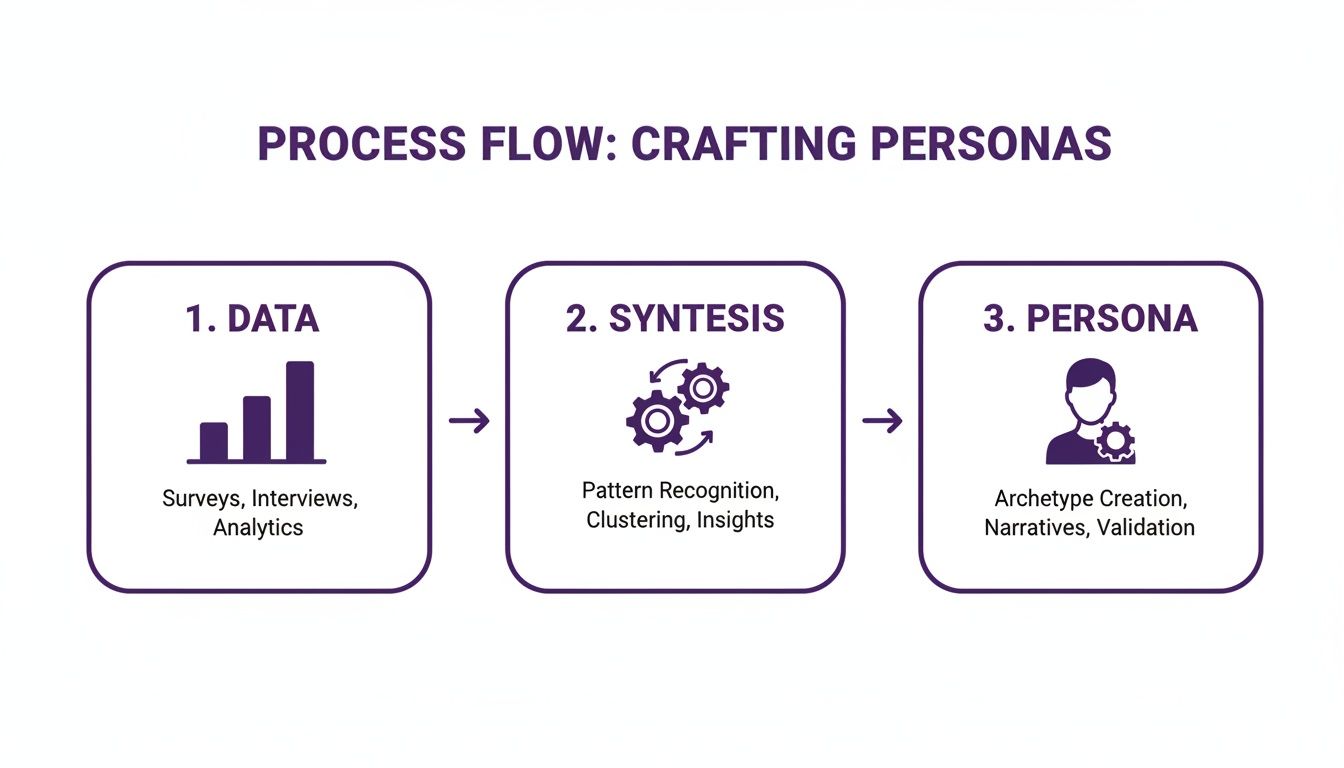
Personas aren't just a creative branding exercise. They're the practical output of careful data analysis, connecting the dots between scattered information and a focused strategy.
Bringing Your Personas to Life in Your Marketing
With detailed personas in hand, you can start fine-tuning every single touchpoint. This isn't about a massive, overnight overhaul. It's about making small, smart, persona-driven tweaks that add up.
On Your Website: Does your homepage headline speak directly to your primary persona's biggest pain point? Tweak your value propositions to echo their exact needs and language.
In Your Ads: It's time to A/B test. Run your current generic ad against a new version designed exclusively for one persona—using images and copy that reflect their world, not everyone's.
With Your Products: Could you create a special bundle or a limited-time offer that solves a very specific problem for one of your key customer segments?
Let’s say you’ve identified "Eco-Conscious Emma," who you know is deeply frustrated by excessive plastic waste. A targeted ad campaign that screams "New Sustainable Packaging!" will resonate far more powerfully—and drive more sales—than a generic "20% Off" banner.
Your personas are your secret weapon for creating marketing that feels personal and relevant. Instead of shouting to a crowd, you’re having a one-on-one conversation, and that’s what builds brand loyalty and drives conversions.
Measuring What Actually Matters
To know if all this research is paying off, you have to track the right numbers. I'm not talking about vanity metrics like likes or impressions. You need to focus on the Key Performance Indicators (KPIs) that directly tie back to profitability and loyalty.
These are the metrics that will tell you if your persona-driven strategies are actually moving the needle:
Conversion Rate by Persona: Are the campaigns you built for "Budget-Minded Brian" converting better than the ones for "Luxury-Loving Laura"? This tells you which segments are most responsive.
Customer Acquisition Cost (CAC): If your CAC drops for persona-specific campaigns, you know you're spending your ad dollars more efficiently. You're no longer wasting money on people who will never buy.
Customer Lifetime Value (CLV): This is the holy grail. A rising CLV shows that your personas are helping you attract—and keep—the right kind of high-value customers who stick around.
Your Questions, Answered
Even with the best game plan, you're bound to have a few questions as you start digging into your audience research. I've been there. Here are some of the most common ones I hear from other e-commerce sellers, along with some straight-to-the-point answers.
"How Often Should I Really Be Doing This?"
Audience research isn't a one-and-done project you can just check off the list. Think of it as an ongoing conversation. I recommend a major, deep-dive analysis at least annually. But don't stop there.
On a quarterly basis, do a smaller "pulse check" to make sure your personas are still on track. And every single week, you should have your eyes on your analytics and social media mentions. Things change fast.
Of course, if you're making a big move—like launching a new product or expanding into a new country—it's time to go back to square one and do a full research cycle.
"What’s the Biggest Mistake I Could Make?"
The single biggest pitfall I see is getting stuck on demographics and completely ignoring psychographics. Knowing your customer is a 30-year-old woman in Texas is a start, but it's barely scratching the surface.
What really matters is knowing she's passionate about sustainability, follows specific eco-influencers on TikTok, and gets genuinely frustrated by wasteful packaging. That's the stuff that helps you build a brand she'll actually care about. Demographics tell you who buys, but psychographics tell you why they buy.
"Can I Do This If I Have a Tiny Budget?"
Absolutely. You don't need a massive budget to get powerful insights. In fact, some of the best data is free.
Here’s how to get scrappy:
- Go deep with free tools: Google Analytics is a goldmine for understanding what people are doing on your site, and it doesn't cost a dime.
- Survey your existing audience: Use a free tool like Google Forms to ask your email subscribers and past customers what they're thinking. They're often happy to tell you.
- Just listen: Find the subreddits, Facebook Groups, or online forums where your ideal customers hang out. Don't post—just read. You’ll learn their language, their problems, and what they're looking for.
And if you want to level up without breaking the bank, a subscription to EcomEfficiency gives you access to a whole suite of premium tools for a fraction of what they’d cost individually.
"How Do I Know if My Personas Are Even Accurate?"
You test them. It's that simple. Once you have your personas, use them to build hyper-specific ad campaigns. For example, does your "Budget-Conscious Betty" persona click on an ad that screams "50% OFF," while "Quality-First Quentin" responds better to a message about premium materials and craftsmanship?
When your A/B tests show clear differences in behavior that match what you predicted for each persona, you know you're onto something. Keep a close eye on your KPIs—conversion rates, click-through rates, and engagement—for each persona-targeted campaign. The data will tell you if you've nailed it.
Ready to stop guessing and start building an e-commerce brand that truly connects with customers? EcomEfficiency bundles over 50+ premium tools for product research, competitor analysis, and marketing into one simple, affordable subscription. Cut your software costs and get the insights you need to grow. Explore the full toolkit at ecomefficiency.com and see why over 1,000 members trust us to fuel their success.