How to Negotiate With Suppliers The E-commerce Guide

Negotiating with your suppliers isn't about squeezing every last penny out of them. It's a strategic dance, a process of building real value for both sides. The best deals I've ever made came from focusing on shared goals, being transparent with my data, and looking for mutual benefits that go way beyond the cost per unit.
The goal is to scale without dubious shortcuts and without hurting your credibility.
The Realities of Modern Supplier Negotiation
Gone are the days when learning how to negotiate with suppliers was as simple as demanding a 5% discount and calling it a day. The e-commerce world we operate in now, with its wild supply chains and cutthroat competition, demands a much smarter playbook.
Honestly, the power dynamic has shifted. A successful negotiation today is less about one-upping the other guy and more about building a resilient, collaborative partnership that can weather any storm.
The whole game is built on a simple truth: your success is directly tied to your supplier's success. Think about it. A supplier you've pushed to the brink with razor-thin margins isn't going to prioritize your order when things get crazy. But one who sees you as a real partner? They're motivated. They'll give you better terms, faster production, and first dibs on new products.
Moving from Price to Total Value
The single biggest mental shift you need to make is from "unit cost" to "total value." This means you have to look at the entire relationship, not just the number on the invoice. A cheap but unreliable supplier comes with a ton of hidden costs that can kill your business.
- Stockouts: A supplier who can't hit a deadline will cost you thousands in lost sales, especially during crunch time.
- Quality Issues: A high defect rate means angry customers, bad reviews, and all that money you spent on marketing going down the drain.
- Poor Communication: Every minute you spend chasing down an update is a minute you're not spending on growing your brand.
The most effective negotiators change the entire conversation. It’s not "How can I pay less?" It's "How can we create more value together?" This could be you offering consistent order volumes for better payment terms, or even sharing sales forecasts to help them plan production. It's a two-way street.
A Partnership-Driven Approach
This isn't just a feel-good strategy; it's backed by serious data. Top-tier procurement teams that focus on creating broad value—not just slashing costs—unlock an extra 3–7 percentage points of EBITDA margin.
For an e-commerce seller, that could mean accepting a slightly higher unit cost to guarantee faster lead times in Q4. That single move could easily generate a far greater return than the initial "savings" on price. You can dive deeper into this with procurement research from McKinsey.
In today's market, you also need to know your options. Having a solid grasp of different production agreements and understanding white label solutions gives you a much bigger toolkit. When you position yourself as a strategic partner who brings more to the table than just a purchase order, you create leverage. Even small brands can use this to land incredible, long-term deals.
How to Prepare for a Winning Negotiation
Success in any supplier discussion is decided long before you ever send that first email. Honestly, walking into a negotiation unprepared is like showing up to a final exam without cracking a book—you might get lucky, but you’re probably going to leave a lot of money on the table.
This is where you build your leverage. The prep phase is all about arming yourself with hard data, figuring out your backup plan, and getting crystal clear on what a "win" actually looks like for your business. Remember, your supplier does this every single day. It's their home turf. Your prep work is what levels the playing field.
The old way of thinking was just about haggling over price. Today, it’s about building partnerships.
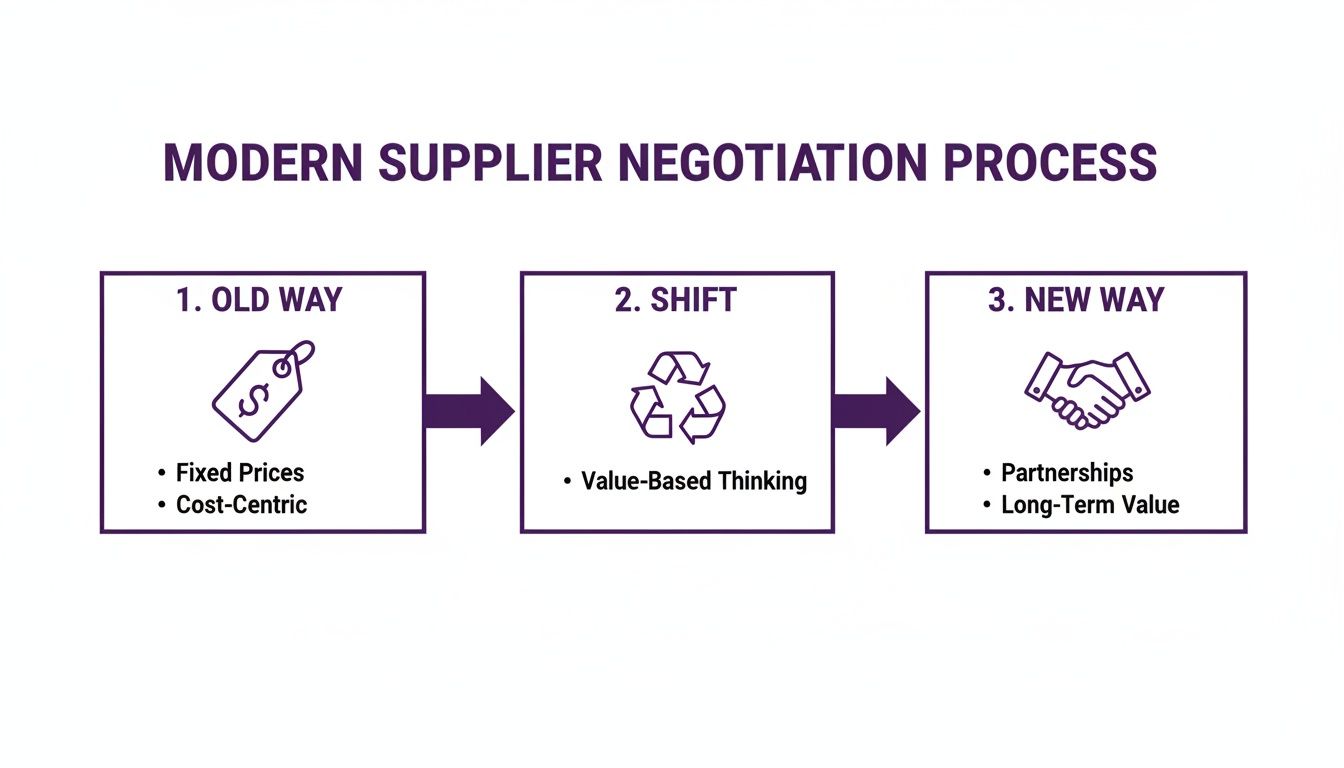
The real takeaway here is that smart negotiation has moved beyond a simple price squabble. It's about creating a collaborative, long-term relationship where both sides benefit.
Gather Your Data and Build Your Case
Data is everything. Without it, your requests are just opinions. With it, they become compelling business arguments that are hard to ignore. The goal is to walk into that conversation with a fact-based story about why you're a valuable partner worth giving good terms to.
It’s not just a theory, either. Organizations that bring structured spend analytics and market data to the table consistently achieve 3–10% savings over those that don't. These aren't just made-up numbers; they come from having concrete evidence like your own performance history and what’s happening with raw material costs. You can read more about how retailers can succeed in supplier negotiations to see just how powerful this is.
Before you even think about picking up the phone, you need to pull together a negotiation playbook. This starts with getting your numbers straight.
Here's a quick checklist to make sure you have the essential data points before you reach out to any supplier. Think of this as your pre-game homework.
Your Pre-Negotiation Data Checklist
| Data Category | Key Metrics to Collect | Why It Matters |
|---|---|---|
| Internal Metrics | Historical Order Volume (6, 12, 24 months), Sales Forecasts, Defect/Return Rates, On-Time Delivery Data | Shows your value and growth potential. Quantifies the real cost of quality or delivery issues. |
| Market Research | Competitor Pricing (get quotes!), Raw Material Cost Trends (e.g., cotton, plastic), Market Growth in Your Niche | Gives you context for their pricing and proves you've done your homework. Shows you're a partner in a growing market. |
| Supplier Intelligence | Get quotes from at least two other qualified suppliers. Understand their terms, MOQs, and lead times. | This builds your BATNA (your backup plan) and gives you confidence to walk away from a bad deal. |
Having this information on hand transforms your position from "I'd like a better price" to "Based on our projected 25% volume increase and current market rates for aluminum, a price of $4.75 per unit aligns our partnership for mutual growth." See the difference?
Define Your BATNA (Best Alternative To a Negotiated Agreement)
Okay, let's talk about your secret weapon: your BATNA. It stands for Best Alternative To a Negotiated Agreement, and it’s the single most powerful tool in your arsenal.
Simply put, what will you do if you can't reach a deal?
Your BATNA isn’t a vague idea like, "I'll find someone else." It needs to be a specific, viable, and fully researched alternative. Having a strong BATNA means you can negotiate from a position of confidence, not desperation. You'll have the power to walk away from a bad deal because you already have a good one lined up.
A well-researched BATNA gives you the power to say "no." Without it, you're just hoping for the best. With it, you're in control.
To make your BATNA real, you have to do the legwork. That means fully vetting at least two other potential suppliers. Get their quotes, test their samples, and understand their terms inside and out. Knowing you have a solid Plan B is what stops you from accepting unfavorable terms just to get a deal done.
Set Your Goals and Walk-Away Points
Finally, before you start talking, you need to know what you’re trying to achieve. Don't just fixate on a single target price. Create a prioritized list of all your objectives.
Think about all the levers you can pull during the conversation:
- Price: What is your ideal price (your opening "ask")? What's the absolute highest you'll pay (your "walk-away" point)?
- Payment Terms: Can you push for Net 30 or even Net 60 terms? This can be a game-changer for your cash flow.
- Minimum Order Quantity (MOQ): Is their MOQ too high for a new product test? Negotiating a lower initial MOQ can be a huge win.
- Lead Times: Can they guarantee a faster production time, especially ahead of a big sales season like BFCM?
- Quality Standards: Get specific. What defect rate is acceptable (e.g., less than 2%)? Can this be formally written into the agreement?
For each of these points, figure out your "must-haves" versus your "nice-to-haves." This gives you flexibility. You might be willing to concede on payment terms if it means securing a lower MOQ. This kind of structured prep turns a potentially stressful confrontation into a strategic business process you control.
Crafting Your First Outreach and Key Talking Points
That first email or phone call is more than just an introduction—it sets the entire tone for your business relationship. This is your moment to stand out from the noise in their inbox and prove you're a serious, professional partner who is worth their best terms.
Your initial outreach has to be sharp, confident, and packed with data. Suppliers get hit with countless inquiries every day, and most of them go nowhere. Your job is to immediately show you're different. You've done the research, you know your numbers, and you're thinking about a long-term partnership, not a one-time haggle.
It's a delicate balance. You need to come across as knowledgeable without being arrogant, and interested in a fair deal without seeming desperate. Think of it less like a demand for a price list and more like an invitation to a business discussion that benefits you both.
How to Structure Your First Email
A well-crafted email is your best opening move. It's quick, respects their time, and clearly lays out who you are and what you want. Ditch the vague introductions and get straight to the point. Professionalism starts with the very first line.
Make sure your email hits these three core points:
- A Professional Intro: Briefly introduce your brand and the exact product you’re interested in. Mentioning where you found them (like Alibaba or a trade show) shows you've done your homework.
- A Quick Snapshot of Your Value: This is where your prep work shines. Mention your brand's growth, your target audience, or your projected order volumes. Frame your business as a growth opportunity for them.
- A Clear Next Step: Don't just ask for a price. Ask to open a discussion about partnership terms, including pricing at different volumes, MOQs, and production lead times.
A powerful opening isn't about demanding a discount. It's about showing the supplier you're a high-potential partner. Instead of saying, "What's your best price?" try something like, "We're projecting strong growth in this category and are looking for a key manufacturing partner to scale with."
Sample Opening Email Script
Here’s a real-world example of an initial email that puts these ideas into practice. See how it immediately positions the buyer as a strategic partner, not just another customer.
Subject: Partnership Inquiry from [Your Brand Name] - [Product Name]
"Hi [Supplier Contact Name],
My name is [Your Name], and I'm the founder of [Your Brand Name]. We specialize in [Your Niche] and have seen 40% year-over-year growth by serving the [Your Target Market].
I was very impressed with the quality of your [Product Name] I saw on [Platform where you found them]. It aligns perfectly with what our customers are looking for.
We are currently forecasting an initial order of 500 units, with a projected volume of 3,000 units over the next 12 months as we scale. We are looking for a long-term manufacturing partner for this product line.
Could you please provide us with your pricing tiers for 500, 1,000, and 2,500 units? I’m also interested in discussing your standard lead times and any flexibility on the initial MOQ.
We are eager to find the right partner to grow with.
Best regards,
[Your Name]"
This email immediately separates you from the pack. It uses specific numbers (40% growth, 3,000 units) to build credibility and frames the entire conversation around a "long-term" partnership, which is music to a good supplier's ears.
Key Talking Points for Your First Call
Once you get them on the phone or a video chat, things get more dynamic. The goal is to build some real rapport while gently guiding the conversation toward your objectives. Don't just read from a script—have your key talking points ready to go.
Move Beyond the Unit Price
Kick off the call by reaffirming your interest in a partnership. Once the small talk is done, you can pivot to the details.
- Tiered Pricing: "We're planning for growth. What do your price breaks look like as we increase our order volume from 500 to 1,500 units?"
- MOQ Flexibility: "For new product launches, we prefer to test the market with a smaller run. Would it be possible to do an initial order of 300 units with a firm commitment to a larger reorder within 90 days?"
- Lead Times: "Our peak season is coming up. What is your current production lead time for an order of this size, and can we lock that in?"
When you frame your questions this way, you’re not just asking for favors. You're proposing business scenarios that work for everyone. Negotiating a lower MOQ in exchange for a guaranteed larger follow-up order de-risks the situation for both of you. This is how you build a solid foundation for a lasting supplier relationship.
Negotiating Terms Beyond the Unit Price
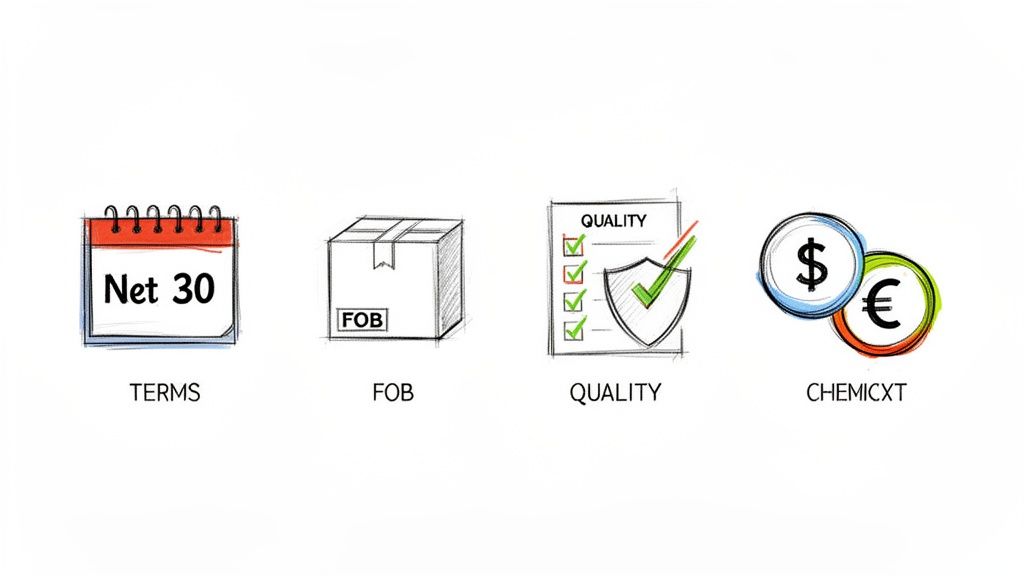
The unit price might be the headline number, but the real money is made—or lost—in the details. I’ve seen so many e-commerce sellers get fixated on shaving a few cents off the per-unit cost, only to get hammered on the back end. These "soft terms" are where savvy operators build a resilient business and protect their cash flow.
It’s a classic rookie mistake. A supplier offers you a killer price, but they demand 100% payment upfront and end up delivering a batch with a 5% defect rate. That "great deal" just tied up all your working capital and forced you to eat the cost of bad inventory. Your entire margin? Gone.
This is exactly why you have to learn how to negotiate with suppliers on every line of the agreement. Let's dig into the key terms that truly matter.
Mastering Payment Terms for Better Cash Flow
In e-commerce, cash is king. It's the lifeblood of your business, and your supplier payment terms are one of the biggest levers you can pull to manage it effectively. The dream is to align your payouts with your revenue, so you’re selling products before the invoice is even due.
When you're new, you'll likely face a standard 30% or 50% deposit, with the rest due when the goods ship. Your goal is to methodically work your way out of that model as you build trust and history.
Here’s what you should be pushing for:
- Net 30: This is the gold standard for most growing brands. You get 30 days to pay after the goods have shipped. That's a huge window. It gives you time for the product to arrive, get inspected, and maybe even start selling before you have to pay up.
- Net 60/90: Once you become a key account, you can aim even higher. Getting Net 60 terms is a massive win for your working capital. It frees up cash that can be poured back into marketing, product development, or just stocking up on more inventory.
Pro Tip: Don't just demand better terms; frame it as a mutual benefit. I've had a lot of success with this approach: "As we're planning to double our order volume this year, moving to Net 30 terms would let us invest more heavily in marketing. That means more sales for us, and more orders for you." It turns a request into a partnership strategy.
Defining Quality Control and Performance Metrics
Vague agreements on quality are a recipe for disaster. If it isn't written down, it doesn't exist. You need to get incredibly specific and bake your quality standards right into the purchase order.
Don't just hope for the best—define it. Set clear, measurable benchmarks that leave zero room for interpretation.
A rock-solid quality agreement includes:
- Defect Allowance: Be specific. For example, "cosmetic defects cannot exceed 1.5% of the total order."
- QC Process: Outline who does the inspection (you, a third-party service, or the factory), when it happens (e.g., pre-shipment), and what they're checking for.
- Remedies for Failure: What happens when things go wrong? State it clearly. Will they remake the faulty units? Issue a credit? Cover return shipping?
This isn't just about the product itself. The big players in retail bake service-level agreements (SLAs) into their contracts, covering things like on-time delivery rates. You can do the same. Tying future orders to a 98%+ on-time-in-full (OTIF) rate is a pro move that aligns your business with the best procurement teams in the world. You can find more supply chain statistics that prove how vital these practices are for staying competitive.
Negotiating Shipping and Packaging Details
Finally, don't sleep on logistics. Shipping and packaging can feel like minor details, but they can secretly destroy your landed cost and ruin your customer's unboxing experience.
You're going to run into two common shipping Incoterms: EXW and FOB. You absolutely must know the difference.
| Incoterm | Who Pays for Local Transport | Who Handles Export Customs | Where Responsibility Transfers |
|---|---|---|---|
| EXW (Ex Works) | You (The Buyer) | You (The Buyer) | At the factory door |
| FOB (Free On Board) | The Supplier | The Supplier | Once goods are on the ship |
For almost every e-commerce seller I know, FOB is the way to go. It makes the supplier responsible for getting your products from the factory, through local customs, and onto the ship. It simplifies your life and protects you from a world of potential headaches and surprise fees.
Beyond that, think about your packaging. Do you need custom boxes? Branded inserts? Special protective foam? These things have to be negotiated upfront. A surprise packaging fee of $0.25 - $0.50 per unit might not sound like much, but it adds up fast.
When you negotiate these "soft terms" with the same intensity you bring to the unit price, you’re not just saving money. You’re building a predictable, profitable, and much more resilient business.
Building Long-Term Supplier Partnerships

Getting a great price on your first order feels like a win, but it’s just the opening move. The real game-changer is turning that initial deal into a genuine, long-term partnership. A transactional relationship gets you a product for today; a strategic partnership gives you a resilient supply chain, priority service, and an ally who’s invested in your success.
This goes way beyond sending a holiday card once a year. It's an active, ongoing process of building trust and keeping the lines of communication wide open. Think about it: a supplier who sees you as a true partner is the one who will burn the midnight oil for you during a production crunch, not the one who just sees you as another PO number.
Cultivating Goodwill And Open Communication
The bedrock of any strong partnership is transparency. Your suppliers can't help you if they're in the dark. One of the most impactful things you can do is share your sales forecasts with them.
Giving them a rolling forecast transforms them from a reactive order-taker into a proactive planner. Suddenly, they can manage their own raw material inventory and production schedules more effectively, which translates directly into more reliable lead times and better service for you.
Here's another simple but powerful move: share your wins. Did a customer leave a glowing review about the product quality? Screenshot it and email it to your contact. This small act connects their work to real-world results and makes them feel like a valued part of your team.
Setting Up Performance Reviews
To keep your partnership healthy and growing, you need a way to measure what matters. This means defining and tracking key supplier performance metrics that align with your business goals. The best way to do this is through formal, regular performance reviews, whether you hold them quarterly or twice a year.
These meetings aren't about pointing fingers. They're collaborative check-ins to see what’s working and diagnose what isn’t.
Come prepared with data. Your agenda should be built around objective points like:
- On-Time Delivery Rate: Are shipments consistently arriving when promised?
- Defect Rate: Is the quality holding up to the standards you agreed on?
- Communication Responsiveness: How quickly are they getting back to you on important issues?
- Cost Competitiveness: Are their prices still aligned with the broader market?
A data-driven approach takes the emotion out of the conversation and focuses everyone on improvement. This is also the perfect time to give them a heads-up on your future plans, like new products you're developing or big promotions you're planning. It makes them feel like they're on the inside track.
A true partnership runs on mutual accountability. Regular reviews create a dedicated space to celebrate wins, tackle challenges together, and align on goals before small issues snowball into major problems.
Navigating Disagreements and Dips In Performance
Even the best suppliers will have an off day. A shipment will be late. A batch will have a few more defects than usual. How you handle these moments is what truly defines the strength of your partnership.
When a problem pops up, resist the urge to fire off an angry email. Your first move should be to get them on a call. Start by calmly laying out the facts and then—this is the important part—ask for their perspective. More often than not, there's a reason you're not aware of, like a sudden raw material delay or a local shipping snag.
From there, work on a solution together. Instead of simply demanding a discount, you could suggest a plan to prevent a repeat. Maybe they need to add another QC checkpoint on their end, or perhaps you need to provide a bit more lead time for a complex product.
By treating problems as shared challenges rather than one-sided failures, you reinforce the partnership. This approach doesn't just fix the issue at hand; it builds a more resilient and trusting relationship for the long haul.
Answering the Tough Questions in Supplier Negotiations
Even the most buttoned-up negotiation plan can go sideways once you're on the phone. You're going to get hit with tough questions and tricky situations. Knowing how to handle these moments is what separates the pros from the amateurs and can be the difference between a stalled deal and a major win.
Let's break down how to handle the most common curveballs suppliers will throw your way.
"What if a supplier refuses to lower their price?"
First, don't panic. When a supplier says their price is final, it's not a dead end—it's just a signal to change your approach. Price is only one piece of the puzzle. If they won't move on the per-unit cost, you immediately pivot the conversation to other areas where you can find value.
A great first move is to bring up the Minimum Order Quantity (MOQ). Ask them if they can be more flexible on the MOQ for your first order. This is a very common request, and it lowers your upfront cash risk. You can sweeten the deal by signaling a much larger reorder once you’ve proven the concept.
Next, talk about payment terms. This is a big one.
- Can they do a 30% deposit instead of the standard 50%?
- Can you get Net 30 terms on the final balance payment?
- Frame this as a cash flow benefit for you, which in turn allows you to place more frequent orders with them. It's a win-win.
You can also hunt for non-monetary wins. Can they speed up the production lead time? Can they throw in custom packaging for free? Honestly, sometimes these perks can be worth far more than a 5-cent discount on the unit price.
Don't get fixated on a single number. When a supplier says "no" to your price target, your immediate response should be, "Okay, I understand your position on unit cost. Let's explore some other ways we can make this partnership work for both of us."
"How do I negotiate as a small seller with a large supplier?"
Walking into a negotiation with a massive manufacturer when you're just starting out can feel like David vs. Goliath. But here's the secret: you have leverage they find incredibly appealing. Big companies are always hunting for new growth channels, and your small, nimble brand could be their ticket into a new market.
Your power isn't in your current volume; it's in your potential and your data.
You have to present yourself as a professional partner, not a small-time buyer. Build a business case. Show them real market data highlighting the potential of your niche. The key is to emphasize your agility. A huge corporation might need six months to approve a new product color; you can give them feedback in a week. They love that.
Try framing your first order as a "pilot program" or a "strategic market test." This language makes you sound thoughtful and strategic, and it lowers their perceived risk of working with a smaller company. A well-researched pitch makes you look like a future top account, and that's exactly what they're looking for.
"Should I mention I’m talking to their competitors?"
This is a powerful move, but you have to handle it with finesse, not aggression. Coming in hot with a competitor's quote and demanding they beat it will just create a hostile, transactional vibe. You'll probably get a lower price, but you'll kill any chance of building a real partnership.
Instead of an ultimatum, you want to subtly signal that you have other options. This demonstrates the strength of your BATNA (Best Alternative To a Negotiated Agreement) without picking a fight.
Here’s how to do it right:
- Don't say this: "Your competitor offered me a better price, so you need to match it or I'm walking."
- Try this instead: "We're in the final stages of reviewing proposals from a few select manufacturing partners to find the best long-term fit for our brand's vision."
This wording accomplishes the exact same thing. It lets them know they're in a competitive situation and need to put their best foot forward. It keeps the process respectful and professional, not a race to the bottom.
"How often should I renegotiate with my suppliers?"
Your supplier agreements are not "set it and forget it" documents. Your business is growing and changing, and your terms should reflect that. As a general rule, it's smart to schedule formal performance reviews annually or semi-annually. These meetings are the perfect time to go over your KPIs and discuss updated terms.
That said, you shouldn't always wait for a scheduled review. Certain events should trigger an immediate renegotiation.
Key moments to reopen the conversation:
- A big jump in volume: If your order quantities have shot up by 50% or more since you signed the last agreement, you have a ton of new leverage.
- Major shifts in the market: If the cost of a core raw material—like cotton or aluminum—plummets, it's completely fair to ask for those savings to be passed on to you.
- Consistent performance problems: If quality is slipping or deadlines are being missed, you need to address it right away. This is about re-establishing the standards you both agreed on.
Always come to these conversations with a partnership mindset. Frame it as a mutual check-in to make sure the agreement is still working for everyone as you both continue to grow.
Ready to slash your software costs and unlock the tools you need to dominate your market? With EcomEfficiency, you get access to 50+ premium e-commerce tools for product research, SEO, and advertising—all for one low monthly price. Stop overpaying and start outperforming. Explore your all-in-one toolkit at EcomEfficiency today