How to Increase Average Order Value with 5 Proven Strategies

Getting customers to spend more on each order is the secret sauce to scaling an ecommerce business. It's not about being pushy; it's about strategically showing them more of what they'll love through smart upsells, irresistible product bundles, and well-placed free shipping offers. Master these, and you'll turn the traffic you already have into much more profitable sales.
The goal is to scale without dubious shortcuts and without hurting your credibility.
Why Average Order Value Is Your Most Important Growth Metric
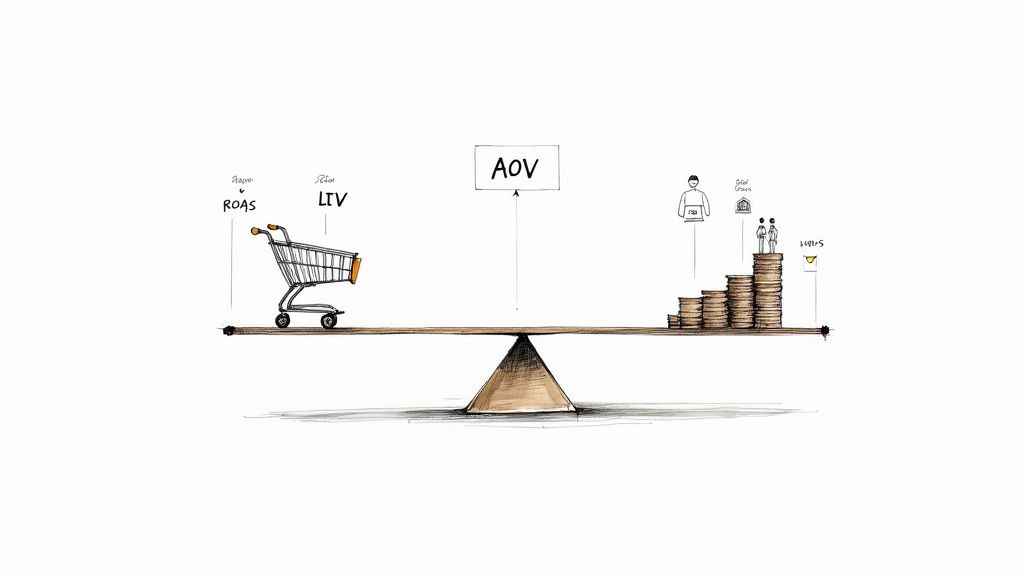
While everyone talks about conversion rates and traffic, Average Order Value (AOV) is the unsung hero quietly fueling your profitability. Think of it as a direct measure of how much value you're delivering to each customer in a single transaction.
Focusing on AOV isn’t about squeezing every penny out of shoppers. It’s about making their experience better by helping them discover more products they’ll genuinely love, all in one go.
When you get this right, you make your entire business more efficient. Suddenly, your customer acquisition costs (CAC) don't sting as much because each new customer brings in more revenue from their very first purchase. This directly juices your return on ad spend (ROAS), giving you the confidence to reinvest in growth.
The Real-World Financial Impact of a Higher AOV
A healthy AOV is the foundation of a scalable and sustainable business. It doesn't just bump up one number; it creates a positive ripple effect across your entire operation.
Here’s where you’ll feel the impact:
- Better Profit Margins: It's far cheaper to sell more to a customer who's already checking out than to find a new one. That means a bigger chunk of that extra revenue goes straight to your bottom line.
- Higher Customer Lifetime Value (LTV): Customers who make larger initial purchases are often more invested in your brand. They tend to stick around longer and buy again, which is a huge win for LTV.
- Smarter Marketing Spend: When your ROAS improves, your marketing dollars work harder. You can afford to bid more on competitive ad spots or test new channels, knowing each conversion is worth more to the business.
Here's a pro tip: Don't just look at the average (mean) order value. The real gold is often in the mode—the single most common order value. This tells you what most of your customers actually spend, giving you the perfect baseline to build offers that encourage them to add just one more item.
To give you a clearer picture, here’s a quick rundown of the most effective tactics we'll be covering.
Core Strategies for Increasing Average Order Value at a Glance
| Strategy | Primary Benefit | Potential AOV Uplift |
|---|---|---|
| Product Bundling | Increases perceived value and introduces new products. | 10-30% |
| Upsells & Cross-Sells | Encourages upgrades or complementary purchases. | 10-25% |
| Free Shipping Thresholds | Motivates customers to add more items to qualify. | 5-20% |
| Loyalty & Reward Programs | Incentivizes repeat purchases and larger baskets. | 5-15% |
| Subscriptions & Auto-Ship | Secures recurring revenue and higher LTV. | Varies (focus on LTV) |
These are just a few of the core levers you can pull, each with the potential to significantly boost your revenue per customer.
Keeping a Pulse on Market Trends and AOV
Consumer spending isn't set in stone; it breathes with the economy. After a 13% dip when the pandemic first hit in 2020, AOV has bounced back with incredible strength.
The global average order value climbed to $122.80 in 2023 and is on track to hit around $144 in 2024. This is a massive jump from 2019 levels and shows that shoppers are more comfortable than ever spending more online. This is a golden opportunity for brands that are ready to adapt.
To get a better handle on the key tactics driving this growth, check out these 10 Proven Strategies to Increase Average Order Value.
Mastering Upsells and Cross-Sells to Maximize Every Sale
If you're after the quickest way to bump up your average order value, upselling and cross-selling are your best friends. Think of it as the digital version of a great retail associate asking, "Need some batteries for that?" It's all about making offers that feel genuinely helpful, not just like a pushy sales tactic.
Get this right, and you're not just selling more stuff. You're actually improving the customer's experience by helping them find other products they’ll genuinely love. The secret is making your recommendations relevant, timely, and incredibly easy to act on.
The Art of the Relevant Recommendation
Throwing a generic "popular products" section on your site is a classic missed opportunity. Real success comes from using what you already know about your customer—their browsing history, past purchases, and what’s in their cart right now—to suggest something that truly makes sense for them.
Let’s say a customer is buying a high-end digital camera. A smart cross-sell would be to offer a memory card, a camera bag, or a lens cleaning kit. On the other hand, an upsell would involve showing them a slightly more advanced camera model with a few extra features for a bit more money.
Both of these tactics work because they tap into the customer's original goal, making the extra item feel like a no-brainer addition rather than a random pitch.
The golden rule of upselling is to keep the offer relevant and the price jump reasonable. I’ve found a good benchmark is to suggest an item that costs no more than 25-40% of the original. This makes the decision an easy "yes" for most shoppers.
Where you place these offers is just as crucial as what you're offering. The data is pretty clear: product recommendations at key moments can lift order values by 10-30%. Even better, the conversion rate on those offers can hit a staggering 37.8%, which directly translates into AOV increases of 31-68%. That’s a massive win. If you want to dive deeper, you can explore the data behind these AOV increases.
Key Moments to Present Upsell and Cross-Sell Offers
Timing is everything. Hit a customer with offers too soon, and you risk overwhelming them. Wait too long, and you've missed your shot.
Here are the prime spots to integrate your offers for the biggest impact:
- On the Product Page: This is your first real chance. A "complete the look" or "frequently bought together" section right below the main product is perfect. For a clothing store, this might mean showing a belt and shoes that go with a pair of jeans.
- In the Shopping Cart: Once something is in the cart, you know they're serious. A pop-up or a small section in the cart drawer suggesting a low-cost, high-value add-on works wonders. Think a screen protector with a new phone case.
- During Checkout: This is a delicate moment, so any offer needs to be completely frictionless. A simple checkbox to add an impulse buy—like a travel-size version of a popular moisturizer—can be incredibly effective.
- Post-Purchase (The Thank You Page): The sale is done, so there's zero risk of them abandoning their cart. This is the perfect place for a one-click upsell. Try offering a limited-time discount on a complementary product they can add to the order they just placed.
Real-World Examples That Actually Convert
Alright, let's get practical. Here’s how successful brands nail the art of the sell, turning a standard transaction into a much bigger, more valuable order. These examples show just how you can increase average order value with some simple, smart moves.
The One-Click Post-Purchase Upsell
- Scenario: A customer just bought a monthly supply of coffee beans.
- The Offer: Right on the thank you page, a one-click offer pops up: "Add our best-selling AeroPress coffee maker for 20% off and get it shipped with your order. Just click to add!"
- Why It Works: It's hyper-relevant, the discount creates urgency, and the one-click process removes every ounce of friction.
The "Build a Routine" Cross-Sell
- Scenario: A shopper adds a facial cleanser to their cart.
- The Offer: A section on the product page or in the cart shows a simple three-step routine: the cleanser they chose, a matching toner, and a moisturizer. They get a small discount for buying the whole bundle.
- Why It Works: This solves a bigger problem for the customer ("how do I build a good skincare routine?") and positions your brand as a helpful expert. It’s a natural way to encourage a larger cart.
Using Smart Bundles and Volume Discounts to Drive Larger Carts
Product bundling is one of my favorite tactics for increasing average order value because it completely reframes the conversation. You’re not just trying to sell more stuff; you're creating a convenient, high-value solution that feels like a genuinely good deal for the customer.
A great bundle does two things at once. It cuts through the noise and makes the buying decision easier for the shopper. At the same time, it can introduce them to products they might have otherwise ignored, which is a fantastic way to boost discovery and even move some stubborn inventory.
The trick is to be strategic. Anyone can throw a few products together. Smart bundling, on the other hand, is about understanding what your customers are trying to accomplish and then building a package that gets them there. That’s how you get people to want to add more to their cart.
Beyond the Basic Kit: Creating Compelling Bundles
Start thinking about your bundles less as "kits" and more as curated experiences. When you frame an offer around a customer's specific needs or goals, it becomes infinitely more appealing.
Here are a few bundling strategies I've seen work time and time again:
- The "Starter Pack" Bundle: This one is a no-brainer for new customers. Group your must-have, entry-level products to create a seamless onboarding experience. If you sell coffee, this could be your most popular roast, a simple grinder, and a pack of filters.
- The "Build Your Own" Bundle: People love having control. Let shoppers pick a certain number of items from a curated list for a single, discounted price. A skincare brand, for instance, could let customers create their own routine by choosing any cleanser, serum, and moisturizer for a set price.
- The "Frequently Bought Together" Bundle: Your own sales data is your best friend here. Dig into your orders to see what people are already buying together and then formalize it. If nearly everyone buys your shampoo and conditioner at the same time, package them as a one-click bundle and make it easy.
A classic mistake I see is bundling a slow-moving product with a bestseller just to get rid of it. This can actually devalue your hero product in the customer's eyes. It's often much smarter to pair your top seller with a complementary, high-margin accessory that actually makes the core product better.
Motivating Bulk Purchases with Tiered Discounts
While bundles are about grouping different items, tiered discounts are all about encouraging customers to buy more of the same thing. This is a killer tactic for consumables or any product people love to stock up on. It’s a simple psychological nudge that directly rewards them for spending more.
The structure is straightforward but incredibly effective. You create different pricing tiers where the savings get better as the quantity goes up.
For example, a supplement brand could set up their offer like this:
- Buy 1 bottle, pay full price.
- Buy 2 bottles, save 15%.
- Buy 3 bottles, save 25% and get a free shaker.
This simple setup almost gamifies the purchase. Customers feel like they're unlocking a better deal, and the key is making that next tier feel both valuable and easy to reach. It’s often just enough to push them beyond their original plan of buying just one.
How Different Industries Can Leverage Bundling
The beauty of bundling is its flexibility. The core principle of adding value works everywhere, but the execution will look different depending on your industry.
Think about the AOV benchmarks across different sectors. Recent data from October 2025 shows Consumer Goods at $296, Home & Furniture at $264, and Luxury & Jewelry at $253. Brands in these high-AOV spaces often use bundles to create premium "sets" or "collections." Meanwhile, stores with larger, more diverse catalogs can use dynamic pricing and volume discounts to give their overall basket size a lift. If you want to dive deeper, you can explore more AOV insights by industry.
Ultimately, it all comes back to your own data. Find those natural product pairings and buying patterns, then package them in a way that feels like an irresistible, smart solution—not just another sales pitch.
Using Shipping Thresholds and Loyalty Programs to Nudge Up AOV
Once you've nailed your upsells and bundles, there are two other incredibly powerful psychological levers you can pull: free shipping and customer rewards. Let's be honest, nobody likes paying for shipping, and everyone loves feeling special. If you play your cards right, you can use these two customer desires to consistently drive higher order values.
Think of free shipping less as a cost center and more as your secret weapon. Customers today pretty much expect it. Instead of just giving it away, you can turn that expectation into a powerful incentive that gets shoppers to add just one more thing to their cart.
Finding Your Free Shipping Sweet Spot
The whole point of a shipping threshold is to gently nudge a customer to spend a little more. You want to catch those shoppers who are almost there and make it a no-brainer to add another item.
But if you set that bar too high, you'll just annoy people and they'll abandon their cart. Set it too low, and you’re just giving away margin without actually increasing AOV.
The magic number is usually 15-30% above your current average order value. Better yet, dig into your data and find your modal order value—that's the single most frequent purchase amount. If your AOV is technically $45 but you see that a huge chunk of your orders are exactly $35, then setting a $50 free shipping threshold is a perfect, attainable goal for most of your customers.
Once you have your number, you need to make it painfully obvious. A dynamic banner at the top of your site or a progress bar in the cart works wonders.
- "You're only $12.50 away from free shipping!"
- "Add one more item to get free delivery."
This kind of messaging reframes the threshold as a helpful tip, not a barrier.
A huge mistake I see brands make is setting their shipping threshold once and then forgetting about it. Your AOV isn't static; it fluctuates with sales, holidays, and new product launches. You should be checking in on this number at least quarterly to make sure it's still doing its job.
This simple psychological push can work wonders, adding incremental revenue to a huge percentage of your orders.
Building Long-Term Value with Loyalty Programs
Shipping thresholds are fantastic for boosting a single transaction, but loyalty programs are your play for increasing customer lifetime value (LTV). When people know they get rewarded for coming back, they’re far more likely to make you their go-to brand.
A good loyalty program isn't just about handing out discounts. It’s about making your best customers feel like insiders. The rewards you offer should genuinely resonate with them.
Loyalty Program Ideas That Actually Work
- Points for Perks: The classic model for a reason—it's simple and effective. Customers earn points for every dollar they spend, which they can cash in for discounts, free products, or store credit. Take a look at OSEA Malibu; they make it incredibly clear how points translate to real savings.
- Tiered Systems: This approach gamifies the experience. Create different levels (think Bronze, Silver, Gold) that customers can climb by spending more. Each new tier unlocks better perks—maybe early access to sales, members-only products, or even a free gift with every purchase.
- Value-Based Rewards: Go beyond discounts. What could you offer that enhances the experience? Free expedited shipping for your top members, a dedicated VIP support line, or access to an exclusive community forum can often be more valuable than a simple 10% off coupon.
For a more comprehensive look at building these kinds of systems, this guide to understanding customer loyalty programs is a great resource.
Ultimately, these programs build a relationship. It becomes a two-way street where customers feel valued and you get their repeat business. A loyal customer doesn't just buy from you again; they actively choose to spend more with you over time. That's how you create a sustainable lift in your average order value for the long haul.
Optimizing Your Checkout and Post-Purchase Experience
The moment a customer clicks "checkout" is a huge win, but it’s not the end of the road. Far from it. The checkout flow and the moments immediately after the purchase are untapped goldmines for boosting your average order value.
Too many brands treat this as a simple finish line. In reality, it’s your last, best chance to add more value for the customer and your bottom line. With a few smart tweaks, you can turn a standard transaction into a much bigger sale. The secret is removing friction while presenting irresistible, last-minute offers that feel genuinely helpful, not pushy.
Streamline Checkout With Smart Payment Options
A clunky, confusing checkout is the number one reason people abandon their carts. With cart abandonment rates consistently hovering around 70%, any friction at this stage costs you money. One of the simplest ways to smooth out the process is by offering flexible payment options.
Services like Afterpay, Klarna, or Shop Pay Installments make bigger purchases feel way more manageable. When a customer sees they can split a $200 order into four interest-free payments of $50, the psychological barrier to spending more practically vanishes. Suddenly, adding that extra item to their cart doesn't feel like such a big deal.
This one change directly encourages customers to build a bigger cart without feeling the immediate financial hit, making it a powerful tool for increasing your AOV.
The Power of the Impulse Buy
Never, ever underestimate the power of a well-placed, low-cost item right before the final click. This is the digital version of grabbing a candy bar at the grocery store checkout. The customer is already committed, their credit card is metaphorically out, and they're ready to buy.
The goal here isn't a massive upsell; it’s a small, incremental boost to the order that adds up over time.
- What to Offer: Think low-cost, high-value accessories. If someone is buying a new backpack, offer a cable organizer for $7. If they're buying skincare, maybe a pack of high-quality cotton pads for $5.
- Where to Place It: This works best as a simple checkbox or a one-click "Add to Order" button right on the checkout page. Keep it visual but clean.
This tactic can add pure profit to an order without creating any friction that might risk the original sale. It's a gentle nudge that bumps your AOV up, one small purchase at a time.
Turn Your Thank You Page Into a Sales Engine
The post-purchase "Thank You" page is probably the most underutilized piece of real estate in all of ecommerce. Think about it: the customer has just completed a purchase. Their trust in your brand is at an all-time high. Instead of just showing an order number and calling it a day, you can turn this page into your next sales opportunity.
This is the perfect moment for a one-click post-purchase upsell. Since the initial transaction is already complete, there is zero risk of them abandoning their original cart.
Pro Tip: Offer a limited-time, exclusive discount on a related product. For example: "Thanks for your order! As a new customer, get our best-selling silk pillowcase for 30% off—add it to your shipment with just one click."
This strategy capitalizes on that peak buyer excitement and can easily add another 10-15% to the original order value. Your order confirmation emails offer a similar opportunity, letting you present another compelling offer a day or two later to keep the momentum going.
This simple flow chart shows just how effective this strategy can be. By getting the customer to add one item, you can then prompt them with an incentive to add more.
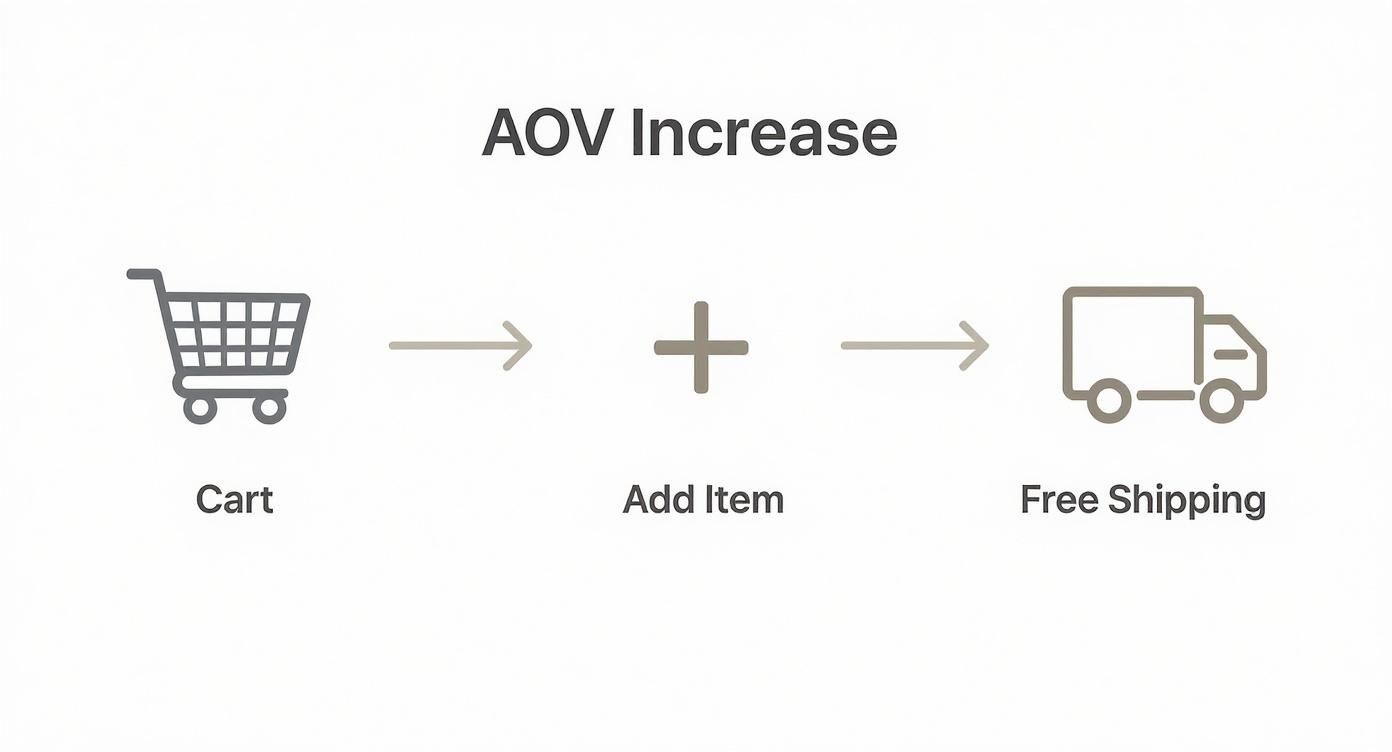
The visualization breaks it down: once an item is in the cart, you can guide the customer to add more to reach a free shipping threshold, directly boosting the total order value.
AOV Strategy Implementation Checklist
To help you put these ideas into practice, here’s a straightforward checklist. Use this to review your current setup and identify opportunities to start increasing your AOV today.
| Strategy | Implementation Step | Key Metric to Track |
|---|---|---|
| Pricing & Bundling | Create tiered bundles (e.g., Good, Better, Best) for your top-selling products. | Bundle Adoption Rate |
| Upsells & Cross-sells | Add a one-click post-purchase upsell offer on your "Thank You" page. | Post-Purchase Take Rate |
| Shipping Thresholds | Set a free shipping threshold that is 15-20% higher than your current AOV. | Orders w/ Free Shipping |
| Loyalty & Subscriptions | Launch a simple "subscribe & save" option on consumable products for a 10% discount. | Subscription Sign-ups |
| Checkout Optimization | Integrate an installment payment option like Afterpay or Klarna into your checkout. | Payment Method Usage |
| Personalization | Implement a "You Might Also Like" product recommendation widget on product and cart pages. | Click-Through Rate (CTR) |
| Retargeting | Set up an email sequence for first-time buyers offering a discount on their next purchase. | Repeat Purchase Rate |
| Measurement | Establish your baseline AOV and set up an A/B test for a new shipping threshold offer. | AOV (by variant) |
This checklist isn't exhaustive, but it covers the core strategies that deliver the biggest impact. Start with one or two, measure the results, and build from there.
Common Questions About Increasing AOV
As you start putting these AOV-boosting strategies into practice, you're bound to run into a few questions. I've been there. Let's tackle some of the most common hurdles and concerns I hear from merchants so you can move forward with confidence.
What’s a Good Average Order Value to Aim For?
This is the million-dollar question, and the honest-to-goodness answer is: it depends. There’s no universal magic number that means you’ve "made it." What’s considered a “good” AOV is completely relative to your niche, your product costs, and, most importantly, where your store is at right now.
Instead of chasing an industry benchmark you found in an article, start by competing with yourself. A great, achievable goal is to aim for a 10-15% increase over your current AOV in the next quarter. This gives you a concrete, measurable target to work towards.
Of course, a little context doesn't hurt. A luxury watch brand might have an AOV over $300, while a store selling phone cases might average closer to $70. Use those numbers as a rough guidepost, but always bring the focus back to your own data. The real goal is to find a target AOV that easily covers your customer acquisition costs (CAC) and still leaves a healthy profit margin in your pocket.
Pro Tip: Don't just look at the average (mean) AOV. Dig into your modal order value—that's the single most common purchase total. This number tells you what most of your customers actually spend, giving you the perfect starting point for offers designed to get them to add just one more thing to their cart.
Will Raising My Free Shipping Threshold Scare Away Customers?
It’s a valid fear. A poorly planned shipping threshold absolutely can spike your cart abandonment rate. But when you do it thoughtfully, the lift in AOV almost always outweighs the risk. The trick is to find that sweet spot that motivates shoppers instead of making them feel penalized.
So, how do you find it? Look at your median or modal order value, then set your new free shipping threshold about 15-20% higher. This makes the goal feel within reach. It encourages someone to add a small, impulse-buy item, rather than making the free shipping feel like an impossible mountain to climb.
How you communicate it is just as important. Don't spring the shipping cost on them at the very end. Use a dynamic site-wide banner or a progress bar in the cart that creates a helpful sense of urgency.
- "You're only $12 away from free shipping!"
- "Add one more item to get free delivery on your order."
This frames it as a reward they can unlock, not a fee they have to pay. For most stores, the revenue gained from those bigger baskets more than covers any tiny dip in the overall conversion rate.
What Are the Best Shopify Apps for Upselling?
The Shopify App Store is packed with fantastic tools, but the "best" one for you really boils down to your specific strategy and where you want to show your offers.
Here are a few of my go-to recommendations, broken down by what they do best:
- For Post-Purchase Upsells: You can't go wrong with apps like ReConvert Upsell & Cross Sell or Zipify OneClickUpsell. They excel at showing one-click offers on the "Thank You" page. This is a zero-risk way to bump up AOV because the initial sale is already locked in.
- For On-Page Recommendations and Bundles: To get that classic Amazon "customers also bought" feel, check out tools like Frequently Bought Together and Bundler - Product Bundles. They're perfect for suggesting complementary items right on your product pages where buying intent is high.
When you're picking an app, always look at how easy it is to use, how much you can customize it, and whether it plays nice with your store's theme. I always tell people to start with an app that has a free trial. It lets you see the impact on your AOV firsthand before you commit to another monthly subscription.
How Do I Know Which Products to Bundle Together?
Building a killer bundle is an art, but it needs to be grounded in data. If you just guess, you’ll end up with a bundle that collects digital dust. The best way is to let your customers’ past behavior point you in the right direction.
Start by digging into your own order history. Find the products that people are already buying together in the same transaction. These are your low-hanging fruit—the most natural bundle opportunities you have.
Once you’ve exhausted those, you can get creative with a few proven approaches:
- Solve a Complete Problem: Create a bundle that acts as an all-in-one solution. Think a "New Puppy Starter Kit" or a "Complete At-Home Coffee Bar."
- Pair a Bestseller with a Newcomer: Use the magnetic pull of a hero product to introduce customers to a newer, less-famous item that goes perfectly with it.
- Offer a "Build Your Own Bundle": This is my personal favorite. When you let customers pick, say, 3 out of 5 selected items for a set price, you empower them. They build a package they truly want, which often results in a higher AOV and happier customers.
Ready to stop juggling dozens of expensive software subscriptions? EcomEfficiency bundles over 50+ premium AI, SEO, and ad-spy tools like Semrush, Helium10, Midjourney, and ChatGPT into one affordable plan. Cut your software costs by up to 99% and unlock the tools you need to grow your e-commerce business.