How to Identify Market Trends for Business Growth

Spotting a genuine market trend isn't just about finding what's popular right now. It's about learning to see the difference between a temporary fad and a real, sustainable shift in what customers want. The whole game starts with picking up on early signals—a whisper of interest on social media, a slow burn in search traffic—and ends with confirming that whisper is turning into a roar.
The goal is to scale without dubious shortcuts and without hurting your credibility.
Laying the Groundwork for Trend Spotting
Before you dive in, you need a plan. Too many e-commerce sellers get burned chasing viral products that fizzle out in a few weeks, leaving them with dead stock and wasted ad spend. The goal is to build a repeatable system that helps you filter out the noise and focus on foundational shifts in the market.
It all boils down to knowing what kind of trend you're looking at and what signals point to real potential. Not every spike in interest is a goldmine; you have to learn to qualify your opportunities.
Differentiating Trend Types
First things first, you need to understand the two main flavors of trends you'll run into. Nail this, and you'll stop yourself from going all-in on a product that's already past its peak.
- Micro-Trends: Think of these as short-term crazes, often born on platforms like TikTok. They’re niche-specific and pop up fast. Remember the viral "sunset lamps" or those specific kitchen gadgets that were everywhere for a few months? They can offer quick wins, but their lifespan is brutally short.
- Macro-Trends: These are the big, slow-moving currents. They represent fundamental shifts in consumer values and behavior that play out over years. The growing demand for sustainable goods or the massive move toward at-home fitness are perfect examples. These are the trends that can support a business for the long haul.
A micro-trend gets you sales this quarter. A macro-trend builds the foundation for your business for the next five years. The real trick is to spot the underlying macro-trend that a viral micro-trend might be pointing to.
Spotting Early Trend Signals
Trends don't just appear out of thin air; they leave a trail of breadcrumbs. Your job is to find those clues before everyone else does. This is what separates proactive entrepreneurs from the ones always playing catch-up.
Look for subtle but consistent movement across different platforms. For example, a gradual, steady increase in Google searches for "plant-based protein for athletes" is a much stronger signal than a single viral video about a new vegan snack.
This simple process flow breaks it down: you spot a signal, figure out its type, and then validate its growth potential.
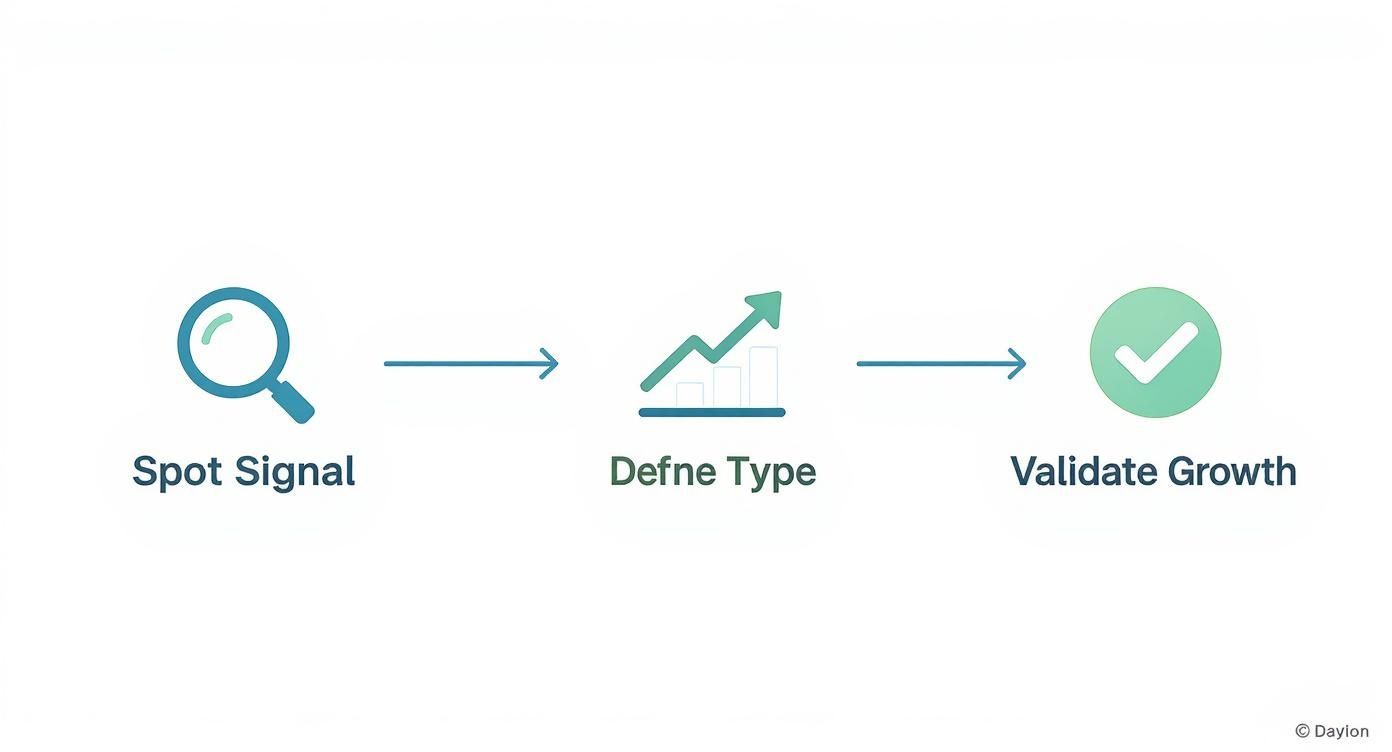
Following this model keeps you focused on qualifying trends before you commit time and money.
To get the full picture, it also helps to zoom out and look at broader economic movements. The volume of world trade today, for instance, is over eighty times larger than it was in the early 1900s. And with trade now making up over 50% of global economic output, our world is more connected than ever. This means a trend that starts in one country can go global in a heartbeat, making historical data a surprisingly potent tool for seeing what's coming next. You can dig into how global trade shapes modern e-commerce with the extensive historical data on Our World in Data.
Key Trend Indicators at a Glance
To help you get started, here's a quick summary of the primary signals that often point to an emerging market trend. Use this as a cheat sheet to quickly assess potential opportunities as you find them.
| Indicator Type | What to Look For | Example |
|---|---|---|
| Search Volume | A steady, month-over-month increase in searches for a specific keyword or category. Avoid sharp, short-lived spikes. | The search term "ergonomic office chair" seeing a 15% consistent monthly growth over 6 months. |
| Social Media Chatter | Rising mentions and engagement from both influencers and regular users. Look for authentic conversations, not just ads. | Hashtags like #mushroomcoffee gaining traction organically across Instagram and TikTok. |
| Marketplace Data | New products in a niche gaining high sales velocity or "Best Seller" badges on Amazon or Etsy. | Multiple new brands of "smart water bottles" appearing in Amazon's top 100 Sports & Outdoors category. |
| Media & Publisher Coverage | Niche blogs, industry publications, and even mainstream media starting to cover a topic more frequently. | Articles about the benefits of "nootropics" for focus appearing in publications like Forbes or Wired. |
This table isn't exhaustive, but it covers the core signals that can tell you if you're onto something big or just chasing a ghost. A strong trend will usually light up more than one of these indicators.
1. Gathering Actionable Market Intelligence
Spotting a genuine trend from all the noise out there starts with knowing where to look and what data actually matters. To do this right, you need to go beyond just one signal and build a complete intelligence picture. It’s about combining search demand, social proof, and hard sales data to see what’s really happening.
Think of it this way: a single data point is just a blip on the radar. But when you see consistent signals across multiple channels? That’s when you’ve found a real opportunity. For example, if you see a product blowing up on TikTok, your next move should be to check if that buzz is showing up in Google searches. If both are pointing up, you might be onto something big.
Ultimately, mastering competitive marketing intelligence strategies is the foundation here. This isn't about spying on competitors; it's about understanding the entire ecosystem—from customer chatter to what the other players are doing.
Uncovering Search Demand with Google Trends
Your first stop should almost always be search behavior. It's the purest signal of what customers want because they are actively typing their problems and needs into a search bar. For this initial gut check, Google Trends is your best friend, and it’s completely free.
The tool shows you the popularity of a search term over time, giving you a quick, high-level view of its trajectory. Is interest growing steadily? Is it a flash in the pan? Or is it slowly dying out? Answering that simple question can save you from sinking money into a product that’s already on its way out.

This kind of visual data immediately tells a story about where consumer focus is shifting, helping you zero in on terms with real, sustained momentum.
For any e-commerce seller, this is gold. Let's say you're thinking about selling "mushroom coffee." A quick look at Google Trends will tell you if this is a durable, growing interest or just a fleeting fad.
Pro Tip: Don't just look at the main trend line. Dig into the "Related queries" feature in Google Trends to find breakout keywords. These are terms that have seen a massive spike in search volume recently and can point you to very specific, untapped sub-niches.
Listening to Social Conversations
While search data shows intent, social media shows excitement. Platforms like TikTok, Instagram, and Reddit are basically live, 24/7 focus groups where trends are born, validated, and sometimes torn apart in real-time.
Social listening is more than just counting hashtags. You need to understand the context and sentiment. Are people posting unboxing videos? Are they asking where to buy something? Or are they complaining about a product's flaws?
TikTok & Instagram: Keep an eye out for sounds, challenges, or specific products that keep popping up in your feed from different creators. One big influencer pushing a product could just be a paid ad, but seeing it used organically by dozens of smaller accounts is a much, much stronger signal.
Reddit: This is where you find the brutally honest truth. Dive into niche subreddits related to your industry (like r/skincareaddiction or r/malefashionadvice). Look for posts where users are begging for recommendations or sharing their "holy grail" products. Those threads are treasure troves of unfiltered feedback.
Pinterest: This platform is all about future planning. Users create boards for things they want to buy or projects they want to start. Pay close attention to their annual "Pinterest Predicts" report—it has a shockingly good track record for calling what's next in home, fashion, and beauty.
By actively monitoring these channels, you tap directly into the cultural pulse and can spot what’s getting hot long before it’s saturated.
Analyzing Marketplace and Sales Data
At the end of the day, the only trend that matters is one people will actually pay for. Social buzz and search volume are great leading indicators, but you have to confirm that people are opening their wallets. This is where you get your hands dirty analyzing marketplaces like Amazon.
On Amazon, there are a few key signals I always look for:
Best Sellers Rank (BSR): Check the BSR for products in your niche. A consistently low BSR (closer to #1) that is either stable or improving means one thing: strong, steady sales.
New Arrivals: Keep an eye on the "Hot New Releases" section for your category. This is your window into which new products are catching fire right out of the gate.
Customer Reviews: Don't just read the reviews; look at their velocity. A product that’s racking up new, positive reviews every day is a dead giveaway for high sales volume and happy customers.
If you’re on Shopify, using tools that aggregate sales data across thousands of stores can give you an incredible advantage. They let you see which products are trending across the entire platform, confirming that a trend has broad appeal, not just in one isolated store.
By triangulating your data—pulling from search, social, and actual sales platforms—you build an undeniable case for a trend's potential before you ever invest a single dollar in inventory.
Separating Fads from Real Opportunities
Having piles of data is one thing; knowing how to read the story it tells is where you find your edge. This is the part where you stop just collecting information and start making smart decisions. It’s all about learning to spot the difference between a fleeting fad and a genuine market shift.
Your ability to correctly interpret a trend's momentum and staying power will determine whether you invest in a long-term winner or get stuck with a garage full of fidget spinners.

This is the skill that separates seasoned e-commerce operators from beginners. It’s about recognizing the subtle patterns that signal a trend has the legs to become a profitable, long-term venture.
Decoding a Trend's Momentum
Momentum is basically the speed and direction of a trend's growth. A trend with strong momentum isn't just popular; it's accelerating. You need to figure out if you're catching a wave as it's building or jumping on just as it's about to crash.
Think about the difference between fidget spinners and air fryers. Fidget spinners exploded with a near-vertical growth curve on Google Trends, peaked dramatically, and then vanished almost overnight. Air fryers, on the other hand, showed a slower, steadier climb over several years. That signaled a fundamental change in how people approach home cooking, and that sustained growth is the hallmark of a real opportunity.
To get a real feel for momentum, look for these signs:
- Diversifying Interest: The conversation expands beyond a single viral product. For instance, interest in "at-home coffee" grew from basic drip machines to include espresso makers, cold brew systems, and specialty beans. This shows a deeper consumer investment in the whole category.
- Broadening Demographics: At first, a trend might catch on with a niche group (like gamers or TikTok teens). As it gains momentum, you'll see it adopted by wider audiences. When your aunt starts asking about a tech product you saw on social media six months ago, that’s a pretty good sign.
- Media Maturation: Coverage starts shifting from niche blogs and influencer posts to features in mainstream publications and morning talk shows. This is the trend moving from early adopters to the mass market.
Distinguishing Seasonality from Sustained Growth
One of the most common traps is mistaking a seasonal spike for year-round demand. "Ugly Christmas sweaters" see a massive search surge every November, but that interest plummets on December 26th. That's pure seasonality. A true trend shows consistent interest outside of those predictable peaks.
To tell the difference, you have to look at year-over-year data.
A product with true growth potential will show a higher baseline of interest each year, even outside its peak season. If searches for "portable fire pits" are 20% higher in July this year than last July, that points to growing mainstream adoption beyond just the fall camping season.
Looking at historical data from other industries can also offer some powerful parallels. Financial analysts, for example, often study historical market volume to gauge trend strength. Big spikes in trading volume often confirm the direction of a price trend, showing high conviction from investors. The same principle applies here; a spike in social media chatter combined with rising search volume confirms high consumer conviction.
The Lifecycle of a Trend
Every trend follows a lifecycle, and your strategy depends entirely on where you enter. Figuring out which stage a trend is in helps you manage risk and set realistic expectations.
| Trend Stage | Characteristics | Your Strategy |
|---|---|---|
| Early Adopter | Low search volume but high engagement in niche communities. Limited competition. | Get in now. Focus on educating the market and building a community around the product. |
| Growth | Rapidly increasing search volume and social chatter. Competitors are popping up. | Scale your marketing aggressively. Differentiate your product with unique features or branding. |
| Maturity | Search volume is high but leveling off. The market is crowded with competitors. | Focus on brand loyalty and customer retention. Compete on quality, service, or a very specific sub-niche. |
| Decline | Search volume is consistently falling. Price wars are common as demand shrinks. | Liquidate remaining inventory. Avoid restocking and get to work finding the next emerging trend. |
Recognizing these stages is a core part of learning how to spot trends worth your time. The real money is usually made in the late Early Adopter or early Growth phases. Once a trend hits Maturity, the game shifts from discovery to fierce competition, often with razor-thin margins. To pinpoint these emerging spaces, it helps to learn how to find low competition keywords where demand is not yet fully met.
Building Your Automated Trend Monitoring System
Let's be honest: manually digging for trends is a losing game. It's slow, you're always playing catch-up, and it’s way too easy to get swayed by your own biases. To consistently get ahead of the curve, you need a system—an automated setup that acts as your eyes and ears, constantly scanning for opportunities and feeding them right to you.
This isn't about some complicated, custom-coded software. It's about cleverly stringing together a few powerful, off-the-shelf tools to build a workflow that does the heavy lifting for you. Think of it as your personal trend-spotting assistant, freeing you up to do what you do best: validating great ideas and actually building your business.
Setting Up Your Keyword Watchtowers
The easiest place to start—and one of the most effective—is with Google Alerts. Seriously. It’s your free, 24/7 scout on the web. Set up alerts for specific keywords, product categories, or even your competitors, and Google will drop an email in your inbox whenever new articles, blog posts, or forum threads pop up.
This gives you an immediate pulse on the earliest signals. For example, if you sell home goods, an alert for "home decor" is just going to create noise. You have to get more specific.
Try setting up targeted alerts like these:
- "mushroom lamp" review: This helps you catch product feedback and see who's talking about it.
- "boucle chair" alternative: A goldmine for understanding what shoppers are looking for next.
- inurl:forum "best coffee station setup": This lets you eavesdrop on real, organic conversations happening in niche communities.
Getting this specific is the key. It tunes out the static and delivers high-quality signals that point directly to what people want.
Creating a Social Listening Dashboard
While Google keeps an eye on the wider web, you need a dedicated tool for the chaos of social media. Conversations on TikTok or Instagram move at lightning speed, and you need to understand the vibe behind a hashtag, not just its volume. That’s where a social listening dashboard comes in.
Tools like Brand24 or Mention let you build a live feed that tracks keywords and hashtags across all the major platforms. You get to see not just how many people are talking about something, but how they feel about it. Are they excited? Frustrated? Complaining about a lack of options?
This is how you find problems you can solve. If thousands of people are using #TikTokMadeMeBuyIt for a product but are also complaining that it’s poorly made, you're not just looking at a trend. You're looking at a huge business opportunity.
Using Dedicated Trend Discovery Platforms
For a more analytical approach, trend discovery platforms are your secret weapon. These tools are built from the ground up to find products and topics that are just about to take off. They crunch millions of data points from search queries, social chatter, and online forums to pinpoint what’s next.
One of the best out there is Exploding Topics, which literally shows you the growth curve of emerging trends.
What's so powerful here is the visual gut-check. You can immediately see the difference between a slow-and-steady grower (a solid macro-trend) and something that shot up overnight (probably a fad). This helps you filter opportunities with a lot more confidence and avoid chasing trends that will be dead by next week.
Validating Trends Before You Invest
You’ve spotted a promising signal, tracked its momentum, and even accounted for the seasonal ups and downs. But all that data is just potential. Now comes the most critical part: validation.
This is where the rubber meets the road. Before you dream of ordering a container of inventory, you need to prove—with real-world customer actions—that people will actually pull out their wallets for your idea.
Think of this stage as your safety net. It’s what separates a calculated business move from a hopeful gamble, ensuring you only put serious money behind trends with proven demand.
Test the Waters with Small-Scale Ad Campaigns
One of the quickest ways to get real feedback is to put a little bit of money behind a test ad campaign. Platforms like Facebook and TikTok are perfect for this, letting you get a product concept in front of a very specific audience.
You don't even need a finished product. A simple ad with a product mockup or even a high-quality stock photo can be enough to see if the idea has legs. The goal here isn't to make sales—it's to measure intent.
The metric that matters most is your click-through rate (CTR). If you see a surprisingly high CTR for a product that doesn't even exist yet, that's a powerful signal. It tells you the concept and your messaging are hitting the mark.
Set Up a 'Coming Soon' Landing Page
So, where do those ad clicks go? To a simple "coming soon" or pre-launch landing page. This page has one job and one job only: to turn a curious click into a tangible lead, usually an email address.
This is the real acid test. Clicking an ad is easy, but someone giving you their email to be notified when a product launches? That's a much stronger sign of actual purchase intent.
Your landing page should be simple and direct:
- Compelling Imagery: Show them what the product will look like.
- Clear Value Proposition: Nail the main benefit in one punchy headline.
- A Simple Email Opt-in Form: Make it dead simple for them to sign up.
The conversion rate on this landing page is your most important early KPI. If you can get 5-10% of your ad traffic to sign up, you're looking at a very strong signal. If it's below 1%, it’s probably time to rethink the product angle or the trend itself.
Define What Success Looks Like for Your Tests
Running these small experiments without clear goals is just throwing money away. Before you launch anything, you have to define what success actually looks like. That means setting specific Key Performance Indicators (KPIs) for your validation tests. These aren't just vanity metrics; they're the hard data points that will give you a clear "go" or "no-go" decision.
This table breaks down a few low-cost ways to validate an idea before going all in.
Trend Validation Methods Comparison
| Validation Method | Best For | Key Metric to Track | Estimated Cost |
|---|---|---|---|
| PPC Ad Campaigns | Testing different product angles and audience interest quickly. | Click-Through Rate (CTR) and Cost Per Click (CPC). | $100 - $300 |
| 'Coming Soon' Page | Gauging direct purchase intent and building a pre-launch email list. | Email Opt-in Conversion Rate. | $20 - $50 (for a landing page builder) |
| Crowdfunding | Validating demand for a higher-cost product before manufacturing. | Number of Backers and Total Funds Pledged. | Platform fees (typically 5%) |
Having these benchmarks in place strips the emotion out of the decision. The data tells you whether to move forward, pivot, or cut your losses and find the next trend.
On a much larger scale, financial analysts use the same logic. They track economic indicators like interest rates and commodity prices from over 200 countries to validate the direction of global economic shifts. Just as a sustained change in those rates can signal a massive market shift, a strong email conversion rate signals genuine demand for your product. To see how this broad-scale data is used, you can explore the economic analytics tools used by experts at S&P Global.
By adopting this validation mindset, you let the market vote with its clicks and emails. That way, by the time you actually invest in inventory, you're not just hoping for a winner—you're building on proven demand.
Common Questions About Market Trend Analysis
https://www.youtube.com/embed/-nvJIfQnidw
Jumping into trend analysis can feel like you're trying to drink from a firehose. A lot of questions pop up once you start applying these ideas to a real-world e‑commerce store. Let's tackle some of the most common ones I hear from sellers.
How Much Data Is Really Enough to Confirm a Trend?
There's no magic number here. What you're really looking for is consistency across multiple sources over time. A single TikTok video that goes viral is a spark, not a fire.
But if you see that same product idea showing up in rising Google searches for three to six months, and marketplace sales data starts to reflect that interest, then you've got a real signal. The goal is to build a solid case for the trend, gathering evidence from different angles—search, social, and sales velocity—until you’re confident it has legs.
What If a Trend Already Seems Too Crowded?
Market saturation is a valid fear. You spot a trend, head over to Amazon, and see hundreds of competitors already duking it out. It’s easy to feel like you’ve missed the boat, but that’s not always the case.
Instead of backing away, get more specific. Find a niche within the niche. For example, rather than just jumping into the "weighted blanket" free-for-all, you could carve out a space with "eco-friendly weighted blankets for kids" or "cooling weighted blankets for hot sleepers."
A crowded market is often the best proof that strong demand exists. Your goal isn't necessarily to be the first, but to be different. Find an underserved angle, a specific customer complaint, or a unique brand story that sets you apart.
How Often Should I Actually Be Looking for New Trends?
Trend spotting can't be a once-a-year thing you cram into a planning session. For most e‑commerce brands, setting aside time for a dedicated "trend-spotting" deep dive once a month is a great cadence. It allows you to see meaningful patterns emerge without getting lost in the daily noise.
That said, your automated systems—things like Google Alerts or your social listening dashboards—should be running 24/7. These are your early-warning systems, flagging breakout opportunities so you can act fast while your competitors are still catching up.
How Do I Know When a Trend Is About to Die?
Knowing when to get out is just as crucial as knowing when to get in. The warning signs are usually the inverse of the signals you used to spot the trend in the first place.
Keep a close watch for these tell-tale signs of a decline:
- A Sustained Drop in Search Volume: If Google Trends shows a consistent, month-over-month slide, that's a massive red flag.
- Widespread Discounting by Competitors: When everyone else is running constant sales or slashing prices, it’s a race to the bottom. This usually means demand has tanked and they’re desperate to offload inventory.
- Shifting Social Sentiment: The online conversation changes. The initial excitement and discovery get replaced with complaints, boredom, or even ridicule.
Learning how to identify market trends is a full-circle process. It’s about discovery and validation, but it's also about knowing when to cut a product loose. This discipline protects your capital and keeps your business nimble enough to catch the next wave.
Ready to stop paying for dozens of separate tools and start identifying winning products with one subscription? EcomEfficiency bundles over 50+ premium AI, SEO, and ad-spy tools like Semrush, Helium10, and Exploding Topics to give you an unfair advantage, all for one low monthly price. Cut your software costs by up to 99% and find your next bestseller at https://ecomefficiency.com.