How to Find Suppliers for Dropshipping on TikTok Shop

Finding the right partners for dropshipping on TikTok Shop really boils down to exploring three main avenues: integrated app marketplaces (like the ones you'd find on Shopify), massive B2B platforms such as Alibaba and CJDropshipping, and more specialized supplier directories. The goal isn't just to find a supplier, but to find a partner who can nail TikTok's strict shipping deadlines. Mess that up, and you're looking at account penalties before you even get going.
The goal is to scale without dubious shortcuts and without hurting your credibility.
Understanding The TikTok Shop Supplier Landscape
Let’s be clear: TikTok Shop isn't just another sales channel. It's a ridiculously fast-paced, trend-driven ecosystem where your success is tied directly to your supplier's reliability. A great partner can help you scale from zero to a thousand orders overnight when a video goes viral. A bad one? They'll sink you with shipping delays, angry customers, and maybe even get your account suspended. Your first big strategic decision is picking the right type of supplier from the get-go.
TikTok Shop's growth has been nothing short of explosive. Its global gross merchandise value (GMV) shot up to $33.2 billion, which is nearly triple what it was the year before. In the U.S. alone, there were 398,000 TikTok stores by the end of the year. This insane growth is exactly why locking in a solid supplier is so critical if you want to jump on viral trends. You can get a deeper dive into these numbers from the latest dropshipping reports on cjdropshipping.com.
Key Supplier Categories
To actually find suppliers for dropshipping on TikTok Shop, you need to know where to look. Each source offers different perks, whether you're prioritizing ease of use, unique products, or rock-bottom prices.
App Marketplaces: Think of apps you can install directly into your ecommerce platform, like CJDropshipping or Zendrop found in the Shopify App Store. They automate almost everything—order fulfillment, inventory syncing, tracking updates—which makes them perfect for beginners.
B2B Platforms: These are the giants of the wholesale world, like Alibaba and AliExpress. They connect you directly with manufacturers, offering incredible product selection and competitive pricing. The trade-off is that it takes more legwork to vet suppliers and manage communication.
Specialized Directories: These platforms offer curated lists of pre-vetted suppliers, often focusing on a specific niche (like fashion) or region (like US-based suppliers for faster shipping). Think of services like Spocket or Trendsi. They usually prioritize quality and speed over having the largest catalog.
I've seen so many people make this mistake: assuming the cheapest supplier is the best one. On TikTok Shop, speed and reliability are way more valuable than saving a few cents on product cost. One viral video can bury a supplier who can't handle the volume, and your store’s reputation will get torched in the process.
The diagram below gives you a bird's-eye view of how these different supplier sources plug into your TikTok Shop, forming the backbone of your entire operation.
This simple flowchart shows the different routes you can take to source products. Each one has its own workflow and integration quirks. Getting familiar with these paths helps you build a supply chain that’s tough enough to handle whatever TikTok's wild algorithm throws at you.
Here's a quick comparison of the main types of suppliers to help you decide where to start your search.
Overview of TikTok Shop Supplier Types
| Supplier Type | Best For | Key Advantages | Example Platforms |
|---|---|---|---|
| App Marketplaces | Beginners & those prioritizing automation | Seamless store integration, automated fulfillment, easy to manage | Zendrop, CJDropshipping, AutoDS |
| B2B Platforms | Sellers looking for low costs & vast selection | Huge product variety, direct manufacturer access, lowest prices | Alibaba, AliExpress, 1688 |
| Specialized Directories | Niche stores & those needing fast shipping | Pre-vetted suppliers, faster US/EU shipping, higher quality products | Spocket, Trendsi, SaleHoo |
Ultimately, the right supplier type depends entirely on your business model. If you're just starting out, an app might be the safest bet. If you're an experienced seller chasing the best margins, a B2B platform could be your ticket.
Where to Find Your Perfect Dropshipping Partner
Finding the right supplier isn't about chasing a single "best" option. It’s about finding the right partner for your specific niche and business model. The options are all over the map, from automated apps that do the heavy lifting to massive global marketplaces. Your job is to cut through the noise and find a supplier who gets the need for speed, reliability, and trend-responsiveness that TikTok Shop demands.
Let's break down the main hunting grounds where you'll find these crucial partners.
Tap into Integrated App Marketplaces
For most sellers, the easiest on-ramp is an app marketplace like the Shopify App Store. This is where you'll find dropshipping apps built to plug directly into your store's backend. They automate the really tedious stuff—order processing, inventory syncing, the works. It's the fast track to getting products listed and sold.
The connection between dropshipping and social media is powerful, especially on a platform as explosive as TikTok. The data doesn't lie: stores active on platforms like TikTok pull in 32% more revenue on average. Even more telling, a staggering 7 in 10 shoppers buy something after seeing it on the app. This shows just how critical a smooth supplier integration is. When a video goes viral, you need a system that can handle a massive order spike without you manually entering a single thing. You can dig into more of these dropshipping statistics and their impact from SellersCommerce.
Here are a few of the heavy hitters to check out:
- CJDropshipping: A true giant in the space. CJDropshipping offers a ridiculous product catalog, custom branding, and has warehouses in key spots like the US and Europe for quicker shipping. They've built specific tools and integrations just for the TikTok ecosystem.
- Syncee: Think of Syncee as a global matchmaker. It connects you to a huge network of pre-vetted suppliers from the US, EU, and Australia. It’s a fantastic choice if you’re looking for unique, higher-quality products that aren't saturated on the bigger platforms.
- Spocket: Spocket’s bread and butter is its network of US and EU-based suppliers. If fast shipping times and quality are your top priorities, this is where you look. The products might cost a bit more, but the reliability can be a huge win for your TikTok Shop's reputation.
Here’s a peek at CJDropshipping's page on the Shopify App Store, which gives you a good sense of what to look for.
Notice how it calls out "Product Sourcing," "Fast Shipping," and "Branding"? Those are the golden tickets for building a brand that customers trust on TikTok Shop.
Navigate Major B2B Platforms
Once you get past the plug-and-play convenience of apps, you'll find massive B2B platforms like Alibaba and AliExpress. These sites offer an almost bottomless pit of products at rock-bottom prices. This is where you go to connect directly with manufacturers and wholesalers, but be warned: this route requires more hands-on work, especially when it comes to vetting and communication.
When you're searching, get smart with your filters. Don’t just look at the product—look at the supplier. Prioritize vendors who have been in business for several years, have high ratings, and show a strong transaction history. And don't just search for "headphones." Try something like "dropshipping noise-canceling headphones" to find sellers who already know the drill.
Pro Tip: One of my favorite tricks is to reverse-engineer my competitors' suppliers. See a successful TikTok Shop crushing it with a specific product? Screenshot the item and use the image search feature on Alibaba or AliExpress. More often than not, you'll find the exact manufacturer or a very similar one, giving you a direct line to a product that's already proven to sell.
Explore Specialized Supplier Directories
If your store is laser-focused on a specific niche, specialized supplier directories are absolute gold. These platforms do the initial legwork for you by curating lists of pre-vetted suppliers. They tend to prioritize quality over quantity, connecting you with brands and makers you’d never stumble upon on the bigger B2B sites.
A couple of great examples:
- Trendsi: If you're in fashion and apparel, Trendsi is a no-brainer. They focus on what's currently trending in clothing and accessories, and they manage all the inventory and shipping from their US warehouse.
- SaleHoo: This is a beast of a directory with over 8,000 pre-vetted suppliers. You'll find dropshippers, wholesalers, and manufacturers across almost every category imaginable. Their market research tools are also super helpful for spotting products with high potential before they blow up.
Leverage Print-on-Demand (POD) Services
Print-on-demand is a special flavor of dropshipping that’s practically made for TikTok's creative, community-driven vibe. Instead of selling someone else's products, you create your own designs for things like t-shirts, mugs, phone cases, or posters. When a customer orders, a POD service prints your design on the item and ships it for you.
With this model, you can build a real brand with zero inventory risk. Services like Printful and Printify connect seamlessly with platforms like Shopify, which then hooks right into your TikTok Shop. This lets you jump on viral memes, create products based on inside jokes with your followers, or sell unique art. It's a fantastic way to create a completely exclusive product line from scratch.
How to Properly Vet Potential Suppliers
So, you’ve got a list of potential suppliers. That’s the easy part. The real work is figuring out which ones are genuinely reliable partners who won’t sink your TikTok Shop before it even gets off the ground.
This vetting process is your first line of defense. It's how you separate the seasoned pros from the fly-by-night operations and protect your brand from the shipping disasters and shoddy products that lead to a graveyard of negative reviews. Don't even think about skipping these checks.
Believe me, supplier reliability is the biggest hurdle in dropshipping. A staggering 84% of e-commerce sellers point to it as their number one challenge, beating out every other problem. And on TikTok, where the platform is expected to turn 45.5% of its U.S. users into buyers, you absolutely cannot afford a weak link in your supply chain. You can dig into more of these crucial e-commerce statistics from Appscenic.
This journey always leads to one critical junction: the vetting stage.
No matter where you start your search—be it a huge marketplace, a B2B platform, or a specialized directory—you’ll end up with a pool of candidates that need a serious background check.
Scrutinize Reviews and Business Credentials
First things first, play detective. Dig into the supplier's reputation and look way beyond the star rating on their profile page, which can easily be gamed. Search their business name on third-party review sites, forums like Reddit, and private Facebook groups for dropshippers. You want to know what other sellers are really saying.
Pay attention to the substance of the reviews, not just the score. Are you seeing patterns?
- Do complaints about slow shipping pop up over and over again?
- Are multiple people mentioning that they received damaged or completely wrong items?
- How does the supplier handle negative feedback? Are they defensive or professional?
A legitimate supplier will have a verifiable business license, a physical address you can find on a map, and a solid history. On platforms like Alibaba, look for official badges like "Verified Supplier" or "Trade Assurance," which give you an added layer of security.
Key Takeaway: A few bad reviews are just part of doing business. But a pattern of the same complaint is a five-alarm fire. One person griping about a broken product could be a fluke; ten people saying the same thing points to a systemic quality control problem.
The Non-Negotiable Sample Order
I'll say this as clearly as I can: never, ever sell a product you haven't held in your own hands. Ordering samples is the single most important thing you will do in this process. It's not an expense—it's a critical investment in your brand's reputation.
When that sample arrives, you're not just checking the product. You're secretly evaluating their entire fulfillment operation from a customer's perspective.
- Product Quality: Does it actually look like the photos? Does it feel sturdy or cheap? Ask yourself honestly: would you be happy paying for this?
- Packaging: Was the item thrown in a flimsy bag, or was it packed securely enough to survive the journey? Crucially, is the packaging generic, or is it covered in the supplier's branding? The latter is a deal-breaker for dropshipping.
- Real-World Shipping Time: Forget their promises. How long did it actually take to get to your door from the second you clicked "buy"? This is your only reliable data point for fulfillment speed.
If a supplier on AliExpress claims 10-day delivery to the US but your sample takes 25 days, you've just dodged a bullet that could have destroyed your TikTok Shop ratings.
Test Their Communication and Support
Before you commit a single dollar beyond the sample, test their customer service. Send a simple inquiry with a few specific questions. Ask about their dropshipping process, their return policy for defective items, or stock levels for a product you’re watching.
You’re secretly grading them on two things: response time and response quality.
How long did they take to get back to you? In the fast-paced world of TikTok Shop, you need a partner who replies within 24 hours, max. A supplier who takes three days to answer a basic question now will be a ghost when you have an urgent customer fire to put out later.
And what about the answer itself? Was it clear, detailed, and professional? Or was it a vague, one-sentence reply that felt dismissive? A good partner will be happy to clarify their process. If they seem annoyed by your due diligence, run. That first interaction tells you everything you need to know about the support you'll get when things go wrong.
To keep your thoughts organized, use a simple scorecard. It forces you to be objective and compare suppliers on the factors that truly matter for your business's health.
Supplier Vetting Scorecard
| Vetting Criterion | What to Look For | Red Flags to Avoid | Score (1-5) |
|---|---|---|---|
| Communication | Responds within 24 hours; answers are clear, professional, and helpful. | Takes days to reply; vague or unprofessional responses; seems annoyed by questions. | |
| Product Quality | Sample matches description/photos; feels durable and well-made. | Item feels cheap, is defective, or looks nothing like the listing. | |
| Shipping Speed | Sample arrives within the promised timeframe or faster. | Significant delays beyond the stated delivery window; no tracking provided. | |
| Packaging | Secure, protective packaging; unbranded or suitable for dropshipping. | Flimsy packaging; item arrives damaged; covered in supplier's logos. | |
| Business Credentials | Verified status (e.g., Alibaba Verified); has a business license and physical address. | No verification; hard to find business info; brand new/unproven profile. | |
| Online Reputation | Mostly positive reviews on and off-platform; professional handling of complaints. | Patterns of negative reviews (slow shipping, bad quality); defensive responses. |
This scorecard isn't just a checklist; it's a tool to prevent you from making an emotional decision. Tally the scores. The suppliers with the highest numbers are your top contenders.
Mastering Supplier Outreach and Negotiation
Alright, you’ve done the legwork and have a solid shortlist of suppliers. Now comes the part where most people stumble: making that first contact.
How you reach out sets the entire tone for your future relationship. This isn't just about getting a price list; it's about convincing a professional operation that you’re a serious partner who can move their product, not just another fly-by-night dropshipper. A sloppy, one-line email gets you deleted. A professional one gets you a partner.
Your first message has to be sharp, respectful, and get straight to the point. It needs to show you've actually looked at their business. If you need a crash course on how to stand out in a crowded inbox, it's worth learning how to write cold emails that get replies.
Crafting Your First Message
Think of this initial email as a mini business proposal. You need to introduce yourself, show genuine interest in their specific products, and hint at the potential of a partnership.
Crucially, you should mention TikTok Shop. This isn't just a random detail; it signals that you have a clear strategy for a high-growth sales channel, which is exactly what a good supplier wants to hear.
Here’s a simple, effective template I've used that you can adapt.
Subject: Partnership Inquiry: TikTok Shop Dropshipping - [Your Store Name]
Body:
Hello [Supplier Contact Name],
My name is [Your Name], and I run [Your Store Name], an e-commerce brand focused on [Your Niche] for the TikTok Shop marketplace.
I came across your [Specific Product Name] and was incredibly impressed. I believe it would be a fantastic fit for our audience, and we're currently looking for a reliable dropshipping partner to help us scale.
To see if we're a good match, could you provide some information on the following?
- Do you offer dropshipping services, and can you integrate with platforms like Shopify?
- What are your policies for handling returns and defective items?
- Are there any options for custom packaging or private labeling, and what are the MOQs?
We see huge potential on TikTok Shop and are aiming for a long-term partnership. We’d be happy to start by ordering samples to confirm the quality.
Thanks for your time.
Best regards, [Your Name] [Your Store Name]
This works because it’s not generic. It’s professional, direct, and asks smart questions that immediately signal you know what you’re doing.
The Must-Ask Questions for Every Supplier
That first email is just the opener. Before you commit to anyone, you need to dig into the operational details. Getting clear answers to these questions now will save you from absolute chaos down the road.
A good supplier will welcome your diligence. A sketchy one will get defensive.
- Inventory & Stock Levels: "How do you communicate stock updates? Is there a live feed or a daily file I can access?" (You can't sell what they don't have.)
- Shipping & Fulfillment: "What's your typical processing time from order to shipment? Which couriers do you use for deliveries to the [Your Target Country]?" (Slow shipping kills TikTok shops.)
- Return Policies: "Walk me through your exact process if a customer gets a damaged item. Who is responsible for the return shipping cost in those cases?" (Get this in writing!)
- Branding Options: "Can we include a custom packing slip with our logo? What are the costs and MOQs for fully branded boxes?" (This is how you build a real brand, not just a store.)
If a supplier is vague or dodges these questions, that's a massive red flag. Move on.
Smart Negotiation Tactics for Better Terms
Forget about haggling over a few cents per unit, at least at first. For dropshippers, negotiating better terms is often far more valuable than a slightly lower price. You’re looking for deals that improve your cash flow, reduce your risk, and make your customers happier.
Your approach will depend entirely on who you're talking to.
When you're dealing with a big manufacturer on a platform like Alibaba, your leverage is volume—or at least the promise of it. Frame the conversation around growth. Ask something like, "What are your pricing tiers? At what monthly order volume could we get a 5-10% discount?" This shows you're thinking long-term.
But if you’re approaching a smaller, independent brand you found in a directory, the angle is completely different. Here, you sell them on the marketing value you bring. Try a pitch like this: "Our expertise is creating viral TikTok videos. If we commit to featuring your products, would you consider an exclusive dropshipping rate or covering the cost of branded inserts for our orders?"
This reframes the entire dynamic. You're not just another reseller; you're a valuable marketing partner.
Seamlessly Integrating Your Supplier with TikTok Shop
Alright, you've found a great supplier. That’s a huge win, but it’s really only half the battle. A fantastic partner with a clunky, disconnected process will cause just as many headaches as a bad one.
This next part is all about connecting the dots. We need to build a smooth technical bridge between your supplier's warehouse and your TikTok Shop storefront. Think of it as the engine that keeps your business running, because that's exactly what it is.
The ultimate goal here is automation. When a customer taps "Buy Now" on your TikTok Shop, that order information needs to fly over to your supplier instantly, without you lifting a finger. This is what separates the pros from the amateurs, and it's what will allow you to handle that massive sales spike when one of your videos inevitably goes viral.
Choosing Your Integration Method
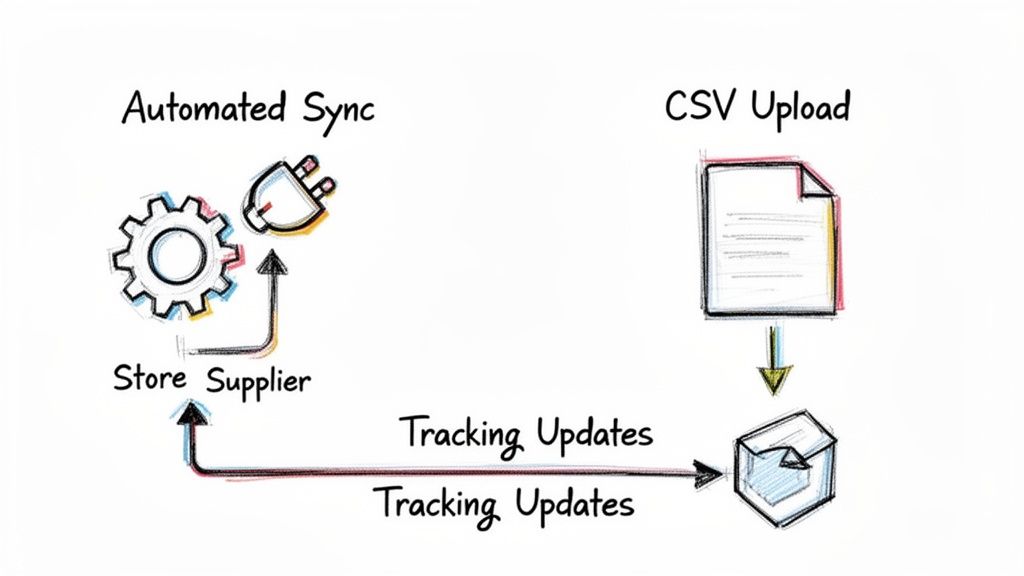
When it comes to linking everything up, you’ve basically got two main paths: fully automated systems or more hands-on, manual methods. The right choice really boils down to your supplier’s tech and how big you plan to scale.
Fully Automated App Connections: This is the dream setup. Suppliers like CJDropshipping or services you can find on the Shopify App Store offer direct integrations. Once you connect them, orders get forwarded automatically. Even better, when the supplier ships the item, the tracking number gets pushed right back to your store and sent to the customer. It's a hands-off approach that cuts down on human error and is pretty much essential if you want to scale.
Manual or Semi-Automated CSV Uploads: On the other hand, some suppliers—especially smaller or more old-school operations—might not have fancy app integrations. They’ll often send you a daily CSV or Excel file with all the tracking numbers for orders they’ve shipped. You'll then have to upload this file into your TikTok Shop or Shopify dashboard to update everything. It's more work, for sure, but it's a perfectly viable system for sellers with a more manageable order volume.
Setting Up Order Forwarding and Tracking Updates
Automated order forwarding is your new best friend. In a common setup—say, using a Shopify store connected to TikTok Shop—the flow is beautifully simple. A customer buys from your TikTok, the order pops up in Shopify, and your integrated dropshipping app (like Zendrop or AutoDS) sends it straight to the supplier.
But the real magic is in the tracking updates. TikTok Shop is incredibly strict about its fulfillment deadlines. Your store’s health and your ability to sell are directly tied to uploading a valid tracking number within their required timeframe.
Crucial Insight: Failing to meet TikTok Shop’s shipping deadlines is one of the fastest ways to get your store hit with penalties or even suspended. Automated tracking syncs aren't just for convenience; they are a critical compliance tool that protects your account.
Make absolutely sure your integration is set up to pull tracking data from your supplier and update the order status immediately. If you're going the manual CSV route, make it a non-negotiable part of your daily routine to get that file uploaded ASAP.
Aligning Shipping Settings with Supplier Capabilities
This is a big one. Your shipping settings inside TikTok Shop have to perfectly match what your supplier can actually deliver. If these don't line up, you're just setting yourself up for broken promises and angry customers.
Before you finalize anything, you need concrete answers from your supplier on two key points:
- Processing Time: How long does it actually take them to pick, pack, and ship an order after they receive it? If they tell you 2-3 business days, that needs to be built into your fulfillment timeline.
- Shipping Time: What are their realistic delivery estimates for your target countries? Don't just take their word for it. Use the shipping time from your sample order as your real-world benchmark.
Once you have this info, head into your TikTok Shop Seller Center and configure your shipping templates. Always set realistic delivery windows that give both you and your supplier a little breathing room. It’s always, always better to under-promise and over-deliver on shipping times.
Troubleshooting Common Integration Problems
Even the slickest setup can have a technical hiccup. The two headaches I see most often are inventory mismatches and failed order processing.
An inventory mismatch happens when your store says a product is in stock, but your supplier just ran out. This forces you to cancel orders, which is a killer for your store's reputation. A good integration app should be syncing inventory levels multiple times a day to prevent this from ever happening.
Failed order processing can be caused by anything from a bad customer address to a payment issue on your end with the supplier. The key is to have notifications set up so you’re alerted the second an order fails to go through. This lets you jump in and fix the problem before the customer even knows there was a delay.
Once you’ve successfully integrated your supplier, the focus shifts to a sales strategy. For a deeper dive into boosting your revenue, read more about how to increase online sales.
Your Top TikTok Shop Supplier Questions, Answered
Let's be honest, jumping into dropshipping on TikTok Shop brings up a ton of questions. Getting the right answers from the get-go can save you a world of headaches and lost sales. I've been there. Here are my straightforward answers to the questions I see pop up most often.
Can I Use AliExpress Suppliers For TikTok Shop?
Technically, yes, but you have to be incredibly careful. I can't stress this enough. The biggest landmine with using many AliExpress vendors is their shipping time. TikTok Shop is not forgiving with its fulfillment deadlines, and that standard ePacket from China just isn't going to cut it.
If you go this route, your first and only priority should be finding suppliers with warehouses in your target market—think US or UK. This is non-negotiable. It’s the only way to get delivery times down to an acceptable level. And please, for the love of your business, order samples. You need to see the product quality and time the shipping speed yourself before a single customer does. Remember, even if you use an integration app, TikTok holds you 100% responsible for your supplier's screw-ups.
What's The Best Way To Handle Returns?
First things first, you need to have "the talk" about returns with your supplier before you sign anything. Any supplier worth their salt will have a clear, no-nonsense process for dealing with defective or damaged goods. They should offer a full refund or send a replacement without a fuss.
Now, for "buyer's remorse" returns—when a customer just changes their mind—that's on you. You'll need to set your own store policy. A lot of dropshippers simply don't accept them because of the logistical nightmare. But here's a little insider tip: a flexible return policy can be a massive trust signal and seriously boost your conversion rates. Whatever you decide, make sure your policy is plastered clearly on your TikTok Shop page. No surprises.
A fair and transparent return policy isn't just about customer service; it's a sales tool. Shoppers are far more likely to impulse buy on TikTok if they know there's a safety net.
How Do I Find Suppliers For Private Labeling?
So you want to build a real brand? Awesome. For private label dropshipping, your search is going to be different. You'll be spending your time on B2B giants like Alibaba and CJDropshipping, where you connect straight with the manufacturers.
Your search terms are key here. Use phrases like "white label," "private label," or "OEM/ODM." Just be prepared for the Minimum Order Quantity (MOQ). You might have some wiggle room to negotiate, but they'll expect you to buy in bulk. When you reach out, be super specific about what you need—custom boxes, your logo on the product, branded thank-you cards, the whole nine yards. CJDropshipping is a great place to start, as they often offer these services with lower MOQs, which is a lifesaver when you're just getting off the ground.
What Are The Biggest Red Flags To Watch For?
I've learned to trust my gut. If something feels off with a potential supplier, it probably is. Here are the deal-breakers that should have you running for the hills:
- Ghosting or Bad Communication: If they're slow, vague, or unprofessional before they have your money, imagine what they'll be like when there's a problem.
- No Social Proof: A complete lack of reviews or a sea of terrible ones is a blaring alarm bell.
- Unbelievable Promises: Prices or shipping times that sound too good to be true? They are. Every time.
- Shady Return Policy: If they can't give you a straight answer on how they handle returns for faulty products, they're a massive liability.
- "No Samples" Policy: Any supplier who won't let you check out the product quality first is hiding something. End of story.
Ready to discover winning products and analyze your competition without breaking the bank? EcomEfficiency bundles over 50 premium e-commerce tools for SEO, ad-spy, and product research into one simple subscription. Cut your software costs by up to 99% and get the insights you need to scale your TikTok Shop. Start using EcomEfficiency today!