How to Find Profitable Niches That Actually Last

Finding a profitable niche isn't about some stroke of genius or random brainstorming session. The best ideas are usually hiding in plain sight, born from real problems that people are already trying to solve. It's about spotting those everyday frustrations and seeing them as business opportunities.
The goal is to scale without dubious shortcuts and without hurting your credibility.
Uncover Niche Ideas Hidden in Plain Sight
You’ve probably heard the advice to “follow your passion.” It sounds great, but it’s a trap. A passion for collecting rare sneakers doesn't automatically mean you can build a profitable business around it. A much better approach is to become a dedicated observer of problems and unmet needs.
Profitable niches come from market gaps, no matter how tiny they seem. The trick is to switch your mindset from being a consumer to being a problem-solver. A great place to start is with your own life.
Look at Your Own Experiences
Your personal frustrations are a goldmine. Seriously. Think about the last time you said, "I wish someone would just make a..." or spent hours searching for a product that didn't quite exist. That's a potential niche right there.
What have you bought recently? Especially the things you spent a lot of time researching. What problem were you trying to fix? Was the solution you bought perfect, or did you have to compromise? Those little compromises are where market gaps live.
For instance, maybe you’re a renter who’s into smart home tech but can't drill holes or rewire anything. This frustration could spark an idea for a whole line of renter-friendly smart devices that don't require permanent installation—a specific audience that big companies often ignore.
Become an Observer in Online Communities
If you want an unfiltered look at what customers really want, dive into online communities. Places like Reddit, niche Facebook Groups, or specialized forums are where people go to talk about their hobbies, share their passions, and—most importantly—complain.
Don't just scroll. Look for patterns:
- Recurring Questions: Are people in a homebrewing forum constantly asking for advice on a specific, tricky part of the process? Maybe there’s a need for a specialized tool or kit.
- Product Complaints: Listen to what people hate about the products they already own. If a subreddit for backpackers is full of complaints about how every popular pack fits poorly on shorter torsos, that's a huge clue.
- DIY Solutions: Pay close attention when people share their clever workarounds and "hacks." These are massive signals that existing products aren't cutting it, and people are desperate for a real solution.
A structured approach to identifying potential profitable niches involves a thorough market opportunity assessment, turning these raw observations into a viable business concept. This process helps you systematically evaluate the size, competition, and potential of the ideas you uncover.
Spot Trends Before They Peak
Jumping on a trend early can give you a massive head start. Tools like Google Trends are great for checking if an idea you already have has legs, but platforms like Exploding Topics are built to show you what's bubbling up before everyone else catches on.
The goal is to find that sweet spot where a niche has proven interest but isn't saturated yet.
This simple framework shows how you can move from your own habits to uncovering wider trends.
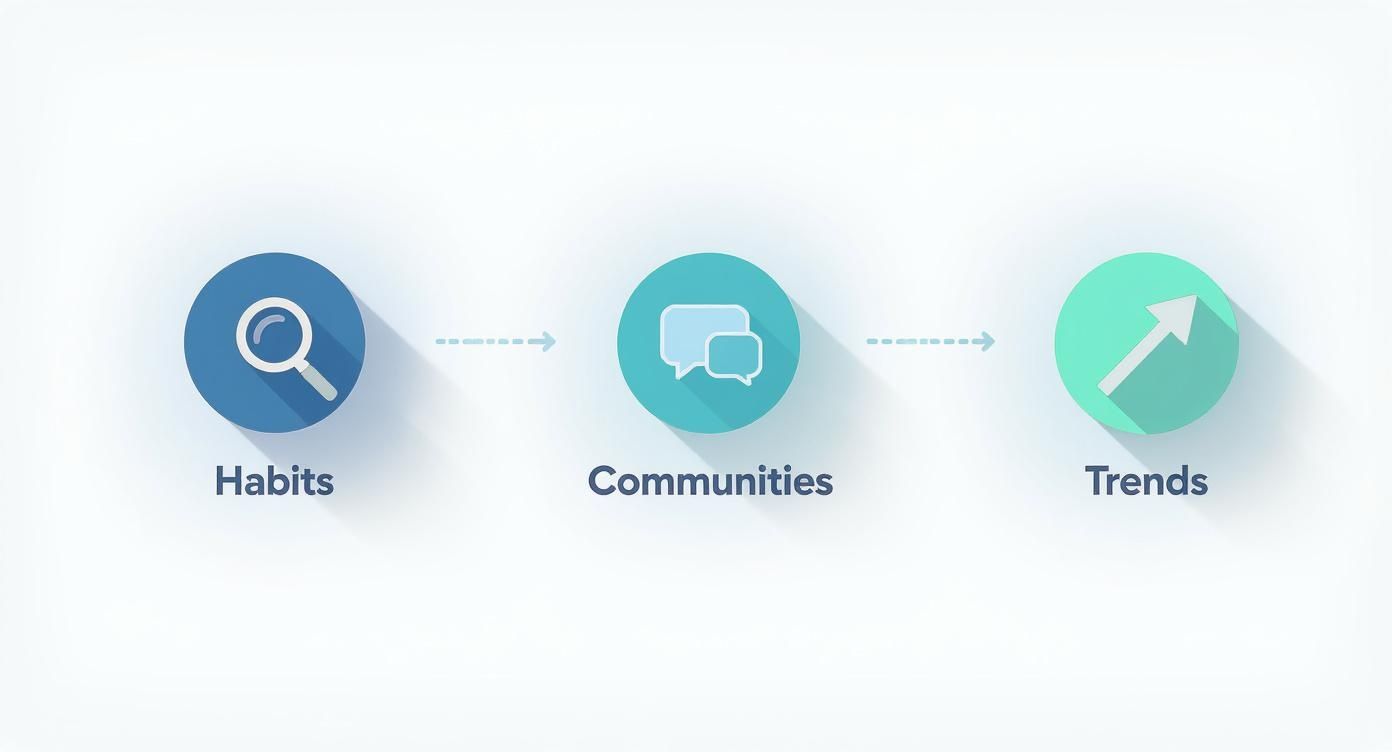
The strongest ideas live at the intersection of personal experience, community validation, and a rising market trend. By starting with yourself, confirming the need within a community, and then checking it against trend data, you build a solid foundation for a niche that actually has a fighting chance.
Validate Demand with Real Market Data
An exciting idea is a great start, but it's just a guess until you prove people are actively searching for it and, more importantly, willing to open their wallets. This is the step where you separate a potential business from an expensive hobby. Gut feelings can point you in the right direction, but hard data is what you build a profitable e-commerce store on.
Think of yourself as a data detective. Your mission is to use freely available tools to measure the market's pulse. It's less about finding a perfect "yes" or "no" and more about gathering enough solid evidence to make a smart, calculated bet.
Gauge Search Interest with Google Trends
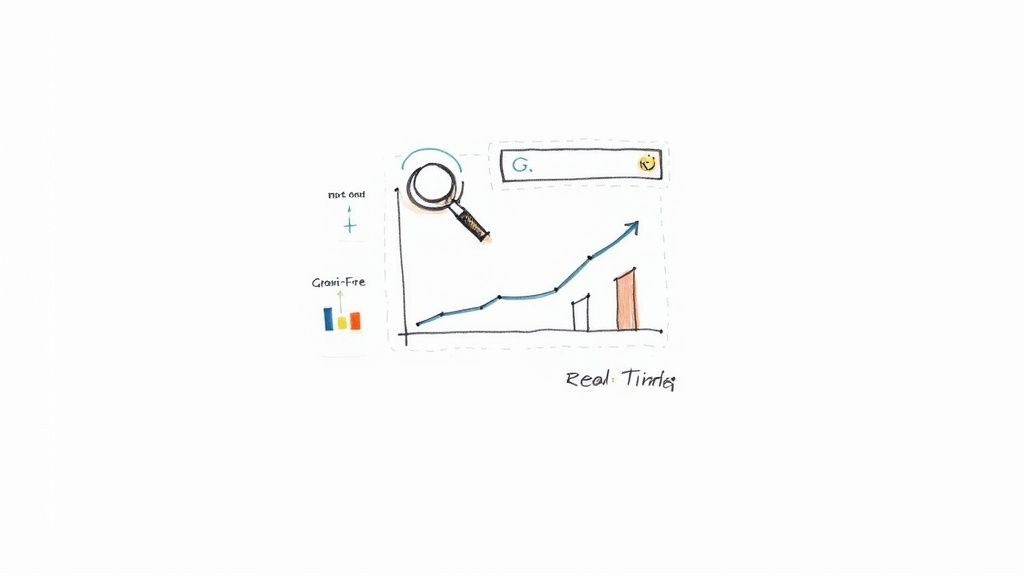
One of the first, and easiest, vital signs you can check is with Google Trends. This brilliant little tool shows you the relative popularity of a search term over time, giving you a quick snapshot of whether you’re tapping into a growing market or a dying fad.
Let's say you're debating two niches in the pet food world: 'vegan dog food' and 'grain-free dog food'. A quick side-by-side comparison on Google Trends can instantly show you which one has more sustained interest and better momentum.
While both have an audience, 'grain-free dog food' (red) clearly shows consistently higher search volume over the past five years. This tells you it's a larger, more established market right now. That single piece of insight is invaluable.
When you're digging into Trends, keep an eye out for these patterns:
- Steady Upward Trend: This is the dream. It means interest is growing organically, suggesting real long-term potential.
- Stable Interest: A flat line isn't a bad sign at all. It points to consistent, reliable demand that isn’t likely to disappear overnight.
- Big Seasonal Spikes: Be careful with niches that only pop at certain times of the year (think "ugly Christmas sweaters"). They can be profitable, but they require a completely different business model and cash flow management.
- Declining Trend: A clear downward slope is a massive red flag. This usually means the market is becoming obsolete, or worse, completely saturated.
Uncover Commercial Intent with Keyword Research
Google Trends is great for gauging general interest, but you need to know if people have intent to buy. That's where SEO tools like Ahrefs, Semrush, or even the free Ubersuggest come in. A solid grasp of the key types of market research is a huge help here for properly gathering and interpreting this data.
You’re hunting for keywords that scream "I want to buy something!" These are what we call "buyer intent" or "commercial" keywords. They often include modifiers like:
- buy
- review
- best
- for sale
- discount
Someone searching "what is a weighted blanket" is just kicking tires. But the person searching for "best weighted blanket for anxiety" is much, much closer to pulling out their credit card. That distinction is everything. A high volume of these commercial keywords is a very strong signal that there's money to be made.
Look at Broader Market and Consumer Reports
Okay, it's time to zoom out. Looking at search data is crucial, but you also need to see the bigger picture. Are you tapping into a small trend or a massive, thriving industry? Consumer spending reports and market growth projections will tell you.
For example, digging into the wellness market reveals some huge opportunities. The global weight loss market isn't just a niche; it's a behemoth projected to hit $295.3 billion by 2027. People are increasingly focused on health, and they're willing to pay for solutions.
The same goes for the pet care market, which is on track to reach a staggering $236.16 billion by 2030. Why? Because people treat their pets like family and aren't afraid to spend on premium products. Attaching your niche to one of these emotionally-driven, high-growth industries gives you a powerful tailwind.
Key Takeaway: You aren't looking for a magical niche with zero competition and millions of searches. You're looking for a healthy intersection of consistent audience interest, clear commercial intent, and a positive long-term market outlook.
Putting these three layers of data together—search trends, keyword intent, and market reports—is how you move beyond just having an idea. You start building a real, data-backed case for your niche, giving you the confidence to move forward.
Before you go all-in, it helps to run your top ideas through a simple checklist to keep your analysis organized and objective.
Niche Idea Validation Checklist
| Metric/Factor | What to Look For | Example Tool/Source |
|---|---|---|
| Search Trend | Stable or ideally growing interest over the past 5 years. Avoid sharp declines. | Google Trends |
| Search Volume | At least 1,000+ monthly searches for core keywords. | Ahrefs, Semrush, Ubersuggest |
| Commercial Intent | Presence of "buyer" keywords (e.g., best, review, buy). | SEO Keyword Research Tools |
| Market Size | Is the niche part of a larger, growing industry? | Statista, MarketResearch.com |
| Seasonality | Predictable demand year-round vs. extreme seasonal spikes. | Google Trends, Keyword Tools |
| Audience Passion | Does the niche solve a real problem or cater to a passionate hobby? | Reddit, Facebook Groups, Forums |
By methodically checking these boxes, you replace guesswork with evidence. This is the foundational work that sets you up for success and prevents you from pouring time and money into an idea that was doomed from the start.
Analyze Your Competition to Find a Winning Angle
Jumping into a new niche without scoping out the competition is a recipe for disaster. It’s like trying to navigate a maze blindfolded—you might get through eventually, but you're going to hit a lot of walls first. Smart competitor analysis isn’t about making a list of rivals to obsess over. It's about finding the gaps they’ve left wide open for you.
The whole point here is to find an underserved corner of the market you can absolutely own. This process illuminates where the real opportunities are, helping you sharpen your niche idea into something unique and, most importantly, defensible.
Identify Your True Competitors
Your competition isn't always who you think. When you're just starting to figure out how to find profitable niches, it’s tempting to only look at the big, famous brands. But the reality is, your true competitors are a much more diverse group.
Start by Googling your main keywords. The sites on page one are your most immediate SEO rivals. But don't stop there.
- Big E-commerce Players: Think Amazon, Walmart, or massive, established brands in your category. Don't get spooked by them. Instead, look for what they can't do well, like hyper-personalized customer service or catering to a tiny, passionate sub-niche.
- Niche Bloggers and Content Creators: These folks often have incredibly dedicated, engaged audiences. Watch what products they recommend and what problems they solve. They're a direct pipeline into what a passionate audience actually wants to buy.
- Social Media Influencers: Search for your niche on Instagram, TikTok, and YouTube. The influencers in your space are actively shaping what people want. Their content can reveal untapped product ideas and fresh marketing angles you'd never think of.
Dissect Their Business Strategy
Once you’ve got a list of 5-10 key players, it’s time to put on your detective hat. You need to get a feel for their entire operation, from how they get customers in the door to how they close the sale. I find it helpful to create a simple spreadsheet to track everything I find.
Go to their websites. Click around. What’s the user experience like? Is it clean and modern, or clunky and dated? A bad user experience is a weakness you can exploit. Sign up for their email list and see how they talk to their customers. What’s their pricing? Are they going for premium, budget, or somewhere in the middle?
Your objective is not to copy your competitors. It's to find a distinct angle by identifying what they are doing poorly, what they are ignoring completely, or which customer segment they are failing to serve.
Let's say you're looking into "sustainable travel gear." You might notice the top five brands all sell high-end, expensive luggage. Their websites are slick, their branding is on point, but their products are out of reach for anyone on a tight budget. That single observation reveals a huge gap in the market for affordable, eco-friendly backpacks and travel accessories. And just like that, you've found your winning angle.
Evaluate Their Marketing and SEO
A company's marketing tells you exactly who they're trying to reach and how they're doing it. Check out their social media profiles. What are they posting? Even more telling, what's the engagement like? If a post about a specific product feature is getting tons of comments and shares, that's a clear signal of strong customer interest.
Next, you'll want to peek behind the curtain of their website's performance. Using an SEO tool like Ahrefs or Semrush (both are part of the EcomEfficiency bundle) lets you see the keywords they rank for, which gives you a ton of insight into their content strategy.
Even more valuable, in my opinion, is checking out their backlink profile. This shows you who is linking to them. Are they getting press from major news outlets, or are they building their authority by guest posting on small, niche blogs? This kind of intel is gold; it basically hands you a roadmap for your own marketing.
By methodically breaking down what your competition is up to, you transform a vague idea into a sharp, focused strategy. You're no longer just "entering a market." You're entering it with a clear plan to serve a specific audience better than anyone else out there. This deep dive is one of the most critical steps to finding a niche that can actually be profitable for the long haul.
Get Your Numbers Straight Before Spending a Penny
https://www.youtube.com/embed/AMKgcBzK7cg
Look, a popular niche with raving fans and weak competition is completely useless if you can't actually make money. This is the point where you take off your researcher hat and put on your CFO hat. Before you ever think about buying inventory or running an ad, you have to know your numbers cold.
We call this unit economics, and it all comes down to one simple question: for every single item you sell, will you have enough left over to cover all your costs and actually grow the business? It's shocking how many entrepreneurs skip this part. They get swept up in the excitement of a new idea and then wonder why they're working 80-hour weeks with nothing to show for it in the bank.
Your Core Costs: The Big Three
To figure out if a niche is a financial winner, you first need a solid grip on the expenses that will eat into your revenue. These costs form the foundation of your entire financial plan.
Let’s break down the three big ones you absolutely must know:
- Cost of Goods Sold (COGS): This is the most straightforward cost—it's what you pay your supplier for the product itself. If you're buying a branded kitchen gadget for $10 a pop, your COGS is $10. Simple.
- Shipping & Fulfillment: This covers the entire journey of the product, from the supplier to your warehouse (if you use one) and finally to the customer's front door. For dropshippers, this is the fee your supplier charges to handle shipping for you.
- Customer Acquisition Cost (CAC): This is your marketing budget in action. If you spend $100 on Facebook ads and get five sales, your CAC is $20 per customer. Honestly, this number is often what makes or breaks an e-commerce store.
These three costs are your starting point. A quick back-of-the-napkin calculation can tell you almost instantly if an idea has legs. For example, if your product costs $15 to source and ship, and you estimate your CAC will be around $20, you have to sell that product for more than $35 just to break even. And that's before factoring in any other business expenses.
How Your Sourcing Model Shapes Your Profits
The way you get your products has a massive impact on your potential profit margins. Different business models come with different financial realities, and understanding them is non-negotiable for finding a truly profitable niche.
One path that's gaining a lot of traction is selling digital products. Just look at the explosion of AI-driven tools. The global AI market is on track to blow past $1.8 trillion, and digital goods like AI prompt packs, automation templates, and specialized software are seeing insane demand. We're talking 1 million monthly queries for AI-related topics, yet the average cost-per-click is still a manageable $1.24. Platforms like Shopify are even reporting a 40% year-over-year increase in digital product sales, largely because they come with juicy profit margins and almost no overhead. This shows a clear trend where tech and automation niches are a goldmine for both profit and scale. You can dig into more of these profitable digital niches and their market potential to see how they stack up against physical goods.
The sourcing model you choose isn't just a logistics decision; it's a financial one. Dropshipping is cheap to start but gives you thin margins. Manufacturing your own product is a huge upfront investment but offers the best possible profit potential.
To make this crystal clear, let's compare three of the most common sourcing models. This table gives you a quick snapshot of how your startup costs and profit potential can swing wildly depending on the path you choose.
Sourcing Model Profitability Comparison
| Sourcing Model | Upfront Cost | Typical Profit Margin | Operational Complexity |
|---|---|---|---|
| Dropshipping | Very Low | 15-30% | Low |
| Print-on-Demand | Low | 20-35% | Low-Medium |
| Manufacturing | High | 40-60%+ | High |
As you can see, it's a classic trade-off between risk and reward. Dropshipping a trendy gadget might be easy to get going, but with a 20% margin, you’ll be in serious trouble if your ad costs creep up. On the flip side, manufacturing a unique product could net you a fat 50% margin, giving you way more breathing room to spend on marketing and still be wildly profitable. This kind of financial foresight is exactly what you need when you're learning how to find profitable niches that can build a real, sustainable business.
Test Your Niche Idea with Low-Cost Strategies
You've done the research. The numbers look good on paper. But here’s the thing: spreadsheets don't buy products. People do. Before you go all-in, remortgage your house, or quit your day job, you absolutely have to see if real people will pull out their wallets for your idea.
The good news is you can do this without a massive budget. This whole stage is about running small, cheap experiments to get a clear "yes" or "no" from the market. A little validation now can save you from a world of pain and wasted cash later.
Set Up a Simple Pre-Launch Page
One of the easiest and most effective ways to gauge interest is with a pre-launch landing page. This is just a single webpage with one very specific goal: see if your product concept is exciting enough for someone to hand over their email address.
You don't need inventory. You don't even need a finished product. All you need is a killer description of what you're selling and a simple email signup form. You can get one of these pages live in an afternoon using tools like Carrd, Mailchimp, or a basic Shopify theme.
Make sure your page nails these three points:
- The Problem: What pain are you solving for them? Be specific.
- The Solution: How does your product make their life better?
- The Hook: Sweeten the deal with a small incentive for signing up, like a launch-day discount or an "early bird" special.
Once it's live, share the link in relevant online communities, forums, or subreddits where your ideal customers hang out. If you can get a 5-10% conversion rate (that's the percentage of visitors who sign up), you've got a fantastic signal that you're onto something good.
Run a Small Budget Ad Campaign
Want a faster, more data-heavy reality check? A small ad campaign can deliver that. You don't need to spend a lot; a $50-$100 budget on Facebook or Instagram Ads is plenty to get the initial feedback you need. Remember, the goal isn't to make sales yet—it's to measure intent.
Create a simple ad with a compelling image (a mockup or prototype photo is perfect) and sharp copy. Target a very specific, narrow audience you believe is your perfect customer.
By testing the market with small, controlled experiments, you shift from guessing to knowing. The data you collect—whether it's an email signup or an "add to cart" click—is the most reliable predictor of future success.
This is where you see how people react when you're actively trying to sell to them. The key metrics to watch are your Click-Through Rate (CTR) and Cost Per Click (CPC). A high CTR means your message is hitting the mark. A low CPC suggests you've found an audience that's actually affordable to reach.
Execute a Smoke Test
If you're looking for the ultimate form of validation, this is it. A "smoke test" is where you set up a basic e-commerce product page and let people try to buy the product, even though you can't ship it yet.
You list the product just like it's in stock. When a potential customer gets excited enough to click "Add to Cart" or "Buy Now," they're taken to a page that says something like "Out of Stock!" or "Coming Soon!" followed by a prompt to join your email list to be notified when it's available.
This test cuts through the noise. It measures true purchase intent, which is a much stronger signal than a simple email signup. The number of people who attempt to complete a purchase is the clearest sign you'll get that your niche has a real chance to be profitable.
This kind of validation is critical because it confirms you're tapping into real consumer behavior. Look at the wider market—areas like fintech, for example, are projected to hit a staggering $644.6 billion by 2029. Niches related to personal finance apps or digital banking tools are booming because they solve tangible problems for a huge, growing audience. To learn more about this, it's worth exploring the growth of specific consumer markets to see how your own ideas might align with these powerful, long-term trends.
Got Questions About Finding a Profitable Niche?
When you're digging for a profitable e-commerce niche, a few common questions always seem to pop up. Getting these sorted out is key to moving forward with confidence instead of getting stuck in "analysis paralysis." Let's dive into the three big ones I hear all the time.
How Do I Know if a Niche Is Too Saturated?
It's easy to see a crowded market and think, "no way, I can't compete here." But I want you to flip that thinking on its head. Saturation is actually a massive green light. It means there’s proven, consistent demand for what you're selling. The real trick isn't to avoid a busy market, but to carve out your own unique space within it.
Don't try to be everything to everyone. The smart move is to "niche down". For example, "sustainable pet products" is a huge and crowded space. But what about "compostable dog toys for heavy chewers"? Or "organic cat treats for sensitive stomachs"? Now you're talking. You're serving a very specific, often overlooked segment of a much larger, profitable market.
A saturated market is your proof of concept. Your job isn't to find an empty field, but to claim your own patch of fertile ground within it.
What’s the Difference Between a Niche and a Fad?
This one is crucial for building a business that lasts. A real niche solves an ongoing problem or serves a long-term interest. A fad is just a quick, flashy trend that burns out as fast as it appears.
The best way to tell them apart is to look at the data over time. Pull up Google Trends and check the five-year history. A fad, like some viral TikTok gadget, will look like a massive, near-vertical spike followed by a swift crash back to zero. A solid niche, like "home coffee brewing," shows steady interest or even slow, organic growth over the long haul. Stick to niches built around hobbies, lifestyles, or fundamental needs—they have staying power.
How Much Money Do I Really Need to Start?
This is the big one, and the answer is probably my favorite thing about modern e-commerce: far less than you think. Forget the old days of needing a huge loan and a warehouse full of inventory. Today, you can validate your ideas without risking your life savings.
Seriously, you can get started with a budget as small as $100-$200. That's easily enough to:
- Build a simple landing page to see if people will give you their email for updates.
- Run a small, targeted ad campaign on Facebook or Instagram to test the waters.
- Create a few product mockups to see if anyone would actually pull out their wallet.
The point isn't to launch a massive, perfect store on day one. It's all about low-cost testing to prove you have a winning idea before you pour any serious money into it.
Finding profitable niches boils down to having the right data and insights, and EcomEfficiency gives you the entire toolkit to do just that. Stop guessing and start validating with bundled access to over 50+ premium tools like Semrush, Exploding Topics, and dozens more, all for one low monthly price. Cut your software costs by 99% and find your next winning product at https://ecomefficiency.com.