How to Find Dropshipping Suppliers You Can Actually Trust

Finding the right dropshipping suppliers is less about a secret list and more about a smart strategy. You'll want to mix it up, exploring everything from vast supplier directories and marketplaces to direct outreach with manufacturers. The real trick is knowing your product niche inside and out first. From there, you can dig into channels like Spocket, AliExpress, or even local manufacturers to find partners who can actually deliver on your standards for shipping speed, quality, and profit margins.
The goal is to scale without dubious shortcuts and without hurting your credibility.
Laying The Groundwork For Your Supplier Search
Before you jump into a sea of supplier databases, you need a plan. Who you choose to partner with will define your entire business—from the quality of the products you sell and how fast they get to your customers, to the reputation you build. The perfect supplier for a high-end home goods store is going to be completely different from the one a shop selling viral TikTok gadgets needs.

This first step is all about matching your brand's goals with the right kind of supplier. Are you competing on the lowest price? Or are you building a brand around unique, high-quality products and lightning-fast shipping? Figure that out now, and your search will be a whole lot easier.
Understanding Different Supplier Models
The world of dropshipping suppliers isn't one-size-fits-all. They generally fall into a few distinct categories, and knowing the pros and cons of each is key.
- Marketplaces (e.g., AliExpress, Amazon): Think of these as massive digital malls with millions of products. You get incredible variety and super competitive prices, but the trade-off is often longer shipping times and a ton of other sellers offering the exact same stuff.
- Supplier Directories (e.g., Spocket, SaleHoo): These platforms are curated lists of suppliers who have already been vetted. Many specialize in US or EU-based vendors, which is great for faster shipping. The downside? They usually charge a subscription fee.
- Direct Manufacturers: Going straight to the factory can get you the best possible pricing and the option to private label your products. But this route takes a lot more work. You'll be doing a lot of outreach, and many manufacturers have minimum order quantities that just don't work for a dropshipping model.
- Local Suppliers & Wholesalers: Partnering with suppliers in your own country means incredibly fast shipping and much simpler returns. However, your product selection will likely be smaller, and costs are typically higher than sourcing from overseas.
It also helps to know who the big players are. In the US, for example, Amazon dominates with a 37.6% market share among suppliers. Globally, eBay is a giant with over 17.6 million seller accounts. Understanding these market dynamics helps you see the bigger picture of where products are coming from.
This table provides a quick comparison of the main channels for finding dropshipping suppliers, highlighting the key advantages and disadvantages of each to help you make an informed decision.
Comparison of Dropshipping Supplier Sourcing Channels
| Sourcing Channel | Best For | Pros | Cons |
|---|---|---|---|
| Marketplaces | Testing trendy products, wide variety | Massive product selection, competitive pricing, no upfront fees | Long shipping times, intense competition, inconsistent quality |
| Supplier Directories | Beginners, faster shipping (US/EU) | Pre-vetted suppliers, easy integration, reliable partners | Monthly subscription fees, can have limited product selection |
| Direct Manufacturers | Private labeling, best margins | Lowest cost per unit, customization options, unique products | High MOQs, difficult to find and communicate with, more effort required |
| Local Suppliers | Fast shipping, premium brands | Quick delivery, easy returns, higher perceived quality | Higher product costs, smaller product catalog, less competitive pricing |
Each channel has its place. Your job is to pick the one that aligns with the business you want to build.
Choosing Your Sourcing Strategy
Your sourcing strategy should be a deliberate decision, not something you just fall into. If your brand’s big promise is "fast, free shipping," then relying on suppliers from AliExpress is a recipe for disaster. On the flip side, if you want to rapidly test a dozen different trending products without buying inventory, a marketplace is your best friend.
Your supplier is the most important partner in your dropshipping business. Their reliability becomes your reliability. Their shipping speed becomes your shipping speed. Choose them as carefully as you would a co-founder.
If you're serious about sourcing from major manufacturing hubs like China, think about hiring a sourcing agent. A good agent on the ground is a massive advantage—they can negotiate better deals, conduct quality checks you could never do yourself, and handle any language barriers. It's an upfront investment that can save you from a world of expensive mistakes down the road.
Tapping Into Supplier Directories for a Head Start
Supplier directories are usually the first stop for new dropshippers, and for good reason. Don't think of them as just a list; they're more like a curated ecosystem of pre-vetted partners. These platforms do a lot of the initial heavy lifting for you, weeding out the sketchy operators you might otherwise run into on a wide-open marketplace.
Instead of spending weeks trying to figure out if a supplier is legit, directories like Spocket, SaleHoo, and Zendrop give you a solid baseline of trust. This lets you stop worrying about basic verification and start focusing on what really matters—finding the perfect partner for your specific brand and goals.
Go Beyond the Basic Search to Find the Real Gems
Most people just type "dog collars" into the search bar and pick the cheapest option. That's a huge mistake. The real magic of these platforms is in their advanced filters and search tools, which can help you uncover suppliers that give you a genuine competitive edge.
You're not just looking for a product; you're looking for a logistical partner. One of the most powerful filters you can use is "Ships From" or "Warehouse Location." Let's say your main customer base is in the United States. Filtering for suppliers with US-based warehouses is a total game-changer. This one simple click can slash shipping times from a painful three weeks down to just a few days—a massive selling point that customers will love.
Take a look at this screenshot from Spocket's platform. It shows just how easy it is to filter suppliers by their location.
This isn't just about browsing a global catalog. It's about pinpointing partners who can actually meet regional customer expectations, which is absolutely critical for building a brand people trust.
Real-World Scenarios for Strategic Sourcing
Okay, let's get practical. How does this kind of strategic filtering actually play out?
- The TikTok Shop Seller: You've got a viral gadget you're pushing on TikTok Shop, where speed is everything. Inside a directory like Zendrop, you’d specifically look for suppliers offering "Express Shipping" or those who integrate directly with TikTok. Many directories now tag their suppliers based on the sales channels they're best for.
- The Aspiring Private Label Brand: You want to build a real brand, not just move boxes. On platforms like Spocket or SaleHoo, you can filter for suppliers that offer "Branded Invoicing" or even private labeling. This means the package that lands on your customer's doorstep has your logo on the invoice, not the supplier's. It's a small detail that makes a huge difference.
- The Niche Specialist: Imagine you're selling eco-friendly yoga mats. You’d use specific keywords in your search, like "sustainable yoga mat" or "organic cotton," and then narrow down the results to suppliers based in the EU, who often have to meet much stricter environmental standards.
The goal isn't just finding someone who stocks your product. It's about finding a supplier whose operational capabilities are a perfect match for your brand promise, whether that promise is lightning-fast shipping, a premium branded experience, or top-notch product quality.
The key here is to start thinking like a supply chain manager, not just a product sourcer. Your supplier's location, shipping options, and extra services are every bit as important as the product itself.
The Value of a Vetted Network
One of the best ways to find reliable dropshipping suppliers is through these established directories because they solve a massive pain point. In fact, a whopping 84% of online sellers say that finding trustworthy suppliers is their single biggest challenge. Directories are the direct answer to that problem.
Spocket, for example, puts a heavy emphasis on US and EU-based vendors, which lets its users offer competitive 2-5 day delivery times. That kind of reliability is a must-have in a global dropshipping market that was valued at $365.67 billion and is projected to explode to $1,253.79 billion by 2030. These numbers show just how critical a scalable, dependable supplier network is for any kind of long-term growth. You can dig deeper into the data and future of the dropshipping market to see where things are headed.
Yes, some of these directories charge a monthly fee, but you should see that cost as an investment. It’s an investment in reducing your risk and boosting your efficiency. That subscription fee pays for the platform's vetting process, software integrations, and customer support—saving you countless hours and helping you avoid costly mistakes with unvetted suppliers you might find through a random Google search. Think of it as an insurance policy for your supply chain.
How to Properly Vet a Dropshipping Supplier
Finding a supplier is just the starting line. The real work—the part that separates a thriving dropshipping business from a failed one—is the vetting process. You're not just buying a product; you're forging a partnership. And trust me, you need to be sure they can hold up their end of the bargain.
Rushing this stage is a classic rookie mistake I see all the time. A supplier with a flashy website but terrible communication can single-handedly tank your brand’s reputation. A thorough vetting process is your best defense—it protects your business, your customers, and your hard-earned money.
Before you dive deep, you need a way to filter through the noise. This initial process helps you narrow the field and focus your energy on suppliers who are actually a good fit for your niche.
Let's get into what you should be looking for.
Initial Checks and Red Flags
You can learn a ton about a potential partner before you even think about ordering a sample. Think of this as a quick background check. Your focus should be on their communication style, their official policies, and their general online footprint.
Here are the immediate red flags that should make you think twice:
- Slow or Unprofessional Communication: If it takes days to get a simple email response, or you get back a one-sentence, unhelpful reply, run. Imagine trying to solve a real customer's shipping issue with that kind of support. It's a nightmare.
- Vague or Unfair Return Policies: A supplier’s return policy is your return policy. If it’s confusing, sticks you with all the costs, or has an absurdly short return window, just walk away. You’ll be the one fielding angry customer emails, not them.
- Ongoing Monthly Fees: Legitimate supplier directories might charge a fee, but an individual supplier should not be charging you a monthly subscription just for the "privilege" of working with them. Per-order or handling fees are standard; monthly retainers are a huge red flag.
- No Real-World Address or Phone Number: A real business has a real location. If you can’t find a verifiable address or a working phone number, you’re likely dealing with a middleman or a shady operation.
Your supplier's weaknesses will quickly become your brand's weaknesses. A slow supplier makes you a slow brand. A supplier with poor quality control makes you a brand that sells junk. There is no separating the two in the customer's mind.
Catching these early warning signs will save you a world of hurt down the road.
The Stealth Test Order
Emails and website policies only tell you part of the story. The single most important vetting step is placing a "stealth" test order. Nothing reveals the truth about a supplier's operation like experiencing it for yourself.
The key is to act like a regular customer. Don't announce it's a test. Just place an order for one of their products and have it shipped to your own address.
Once you hit "purchase," it's time to put on your detective hat. Scrutinize every single detail from the moment you order to the moment the package arrives:
- Order Processing Time: How long did it take them to actually process the order and get it out the door? A solid supplier should have your order processed and shipped within 24-48 hours.
- Shipping Speed: Did the package show up when they said it would? Compare the actual delivery date to their estimate. Was it even close?
- Packaging Quality: How did it arrive? Was it in a plain, unbranded box, or did it show up in a rival retailer's packaging? Marketplaces like Amazon have strict rules against this. More importantly, was the product secure, or was it just rattling around in a cheap, flimsy mailer?
- Product Quality: Now for the main event. Does the item in your hands actually look like the photos on their website? Check for defects, cheap materials, or any other sign that they’re cutting corners on quality.
This one simple test gives you an unfiltered look at the exact experience your customers will have. If you’re not impressed, you can bet they won’t be either.
Mastering Your Supplier Outreach and Negotiation
Once you’ve put together a solid shortlist of potential suppliers, it’s time to make your move. How you approach them for the first time speaks volumes about you as a business owner. Your mission is to come across as a serious, professional partner, not just another beginner who's still figuring things out.
The quality of this first impression really does set the tone for the entire relationship. A sharp, well-crafted email can open doors that a generic, sloppy message will slam shut. You need to show them you’ve done your research and are ready to build a partnership that benefits both of you.
After you've tracked down their contact info, your success hinges entirely on your messaging. Honing the skill of how to write cold emails that get replies is a game-changer that can help you land those first conversations and start building a real connection.
Crafting Your Initial Outreach Email
Your first email needs to be concise, professional, and get straight to the point. This isn't the time for a long, rambling story about your brand's origin. Make it easy for them to immediately see the value in working with you.
Here’s a simple structure that I’ve seen work time and time again:
- A Clear Subject Line: Something like "Partnership Inquiry from [Your Store Name]" is direct and professional.
- A Brief Introduction: Quickly introduce your store, your niche, and state that you're looking for a reliable dropshipping supplier.
- Show You've Done Your Homework: Mention a specific product of theirs you're interested in. This small detail shows you're not just blasting out a generic template to hundreds of companies.
- Ask Key Questions: Inquire about their dropshipping program, whether you'll have an account manager, and their general pricing structure.
- A Professional Closing: End with your name, store name, and a link to your website.
This approach immediately positions you as an organized entrepreneur who respects their time. It separates you from the mountain of low-effort inquiries they probably get every single day.
Key Questions To Ask Potential Suppliers
Once you’ve made contact and have their attention, it’s time to dig deeper. This isn’t just about getting a price list; it's about really understanding how their operation works. The questions you ask should be designed to probe their capabilities, reliability, and how they handle things when they inevitably go wrong.
Remember, you're essentially interviewing them for a critical role in your company. Their performance directly impacts your customer satisfaction, so don't be afraid to ask detailed questions. A good supplier will welcome them.
Here are the non-negotiable questions you absolutely need answers to:
- Who is my dedicated point of contact? Having a specific account manager to call or email is a lifesaver. You want to avoid suppliers where your only option is a generic support inbox.
- What are your average order processing times? You need to know exactly how long it takes them to get an order out the door. Anything over 48 hours is a potential red flag that can lead to unhappy customers.
- What shipping carriers do you use? Knowing if they use reliable services like USPS, UPS, or DHL versus slower, less-trackable options is critical for managing your customers' expectations on delivery times.
- How do you handle returns and defective products? Get a crystal-clear picture of their process. Who pays for return shipping? What kind of proof do they require for a defective item claim?
- Do you offer tiered pricing as my order volume grows? This is a key negotiation point for the future. A great partner will be willing to reward your loyalty and increased business with better margins down the road.
Negotiating a True Partnership
Real negotiation isn’t just about haggling for the lowest possible price—that’s a rookie mistake. The most successful dropshippers I know build strong, long-term relationships with their suppliers. It’s all about creating a partnership where both sides win.
Start by discussing payment terms. While most suppliers will require payment upfront, some might be open to Net 30 terms once you’ve established a consistent order history. Also, think beyond the price tag. You can negotiate for value-adds like branded invoicing, where your store's logo appears on the packing slip. This is a small touch that goes a long way in building your own brand identity.
At the end of the day, a supplier who communicates well, solves problems quickly, and is genuinely invested in your growth is far more valuable than one who offers a slightly lower price but is a nightmare to work with. Treat them with respect, pay your bills on time, and keep your communication clear. That foundation of trust will pay dividends far beyond any small discount you might secure upfront.
To help you stay organized during this critical phase, I've put together a checklist. Use it to make sure you don't miss any important steps as you vet and reach out to your top candidates.
Supplier Evaluation and Outreach Checklist
This checklist will guide you through the process, ensuring you cover all critical points when evaluating and contacting a potential dropshipping supplier.
| Evaluation Stage | Key Action | What to Look For / Ask |
|---|---|---|
| Initial Research | Vet their online presence (website, reviews, social media). | Professionalism, positive feedback, clear contact info, signs of an active business. |
| First Contact | Send a concise, professional outreach email. | "Partnership Inquiry," mention their product, ask about their dropshipping program. |
| Capability Assessment | Ask about order processing and shipping. | Processing time under 48 hours? Use of reliable carriers (USPS, UPS, etc.)? |
| Support & Returns | Inquire about their support system and return policy. | Will I have a dedicated account manager? What is the exact process for returns/defective items? |
| Partnership Potential | Discuss pricing and long-term opportunities. | Do you offer tiered pricing for volume? Is branded invoicing or custom packaging an option? |
| Final Vetting | Place a test order to your own address. | Evaluate packaging quality, actual shipping time, and the overall customer experience. |
| Decision & Onboarding | Finalize terms and integrate with their system. | Confirm payment terms, understand their ordering process, and set up any required software/integrations. |
By systematically working through these stages, you ensure a thorough evaluation, which significantly increases your chances of finding a reliable partner who will help your business thrive.
Automating Your Supply Chain for Scalability
Finding a trustworthy supplier is a massive win, but it’s only half the battle. A fantastic partnership means nothing if your day-to-day operations are a chaotic mess of manual data entry and missed orders. This is where you build the engine for your business—a seamless, automated connection between your supplier and your ecommerce store.
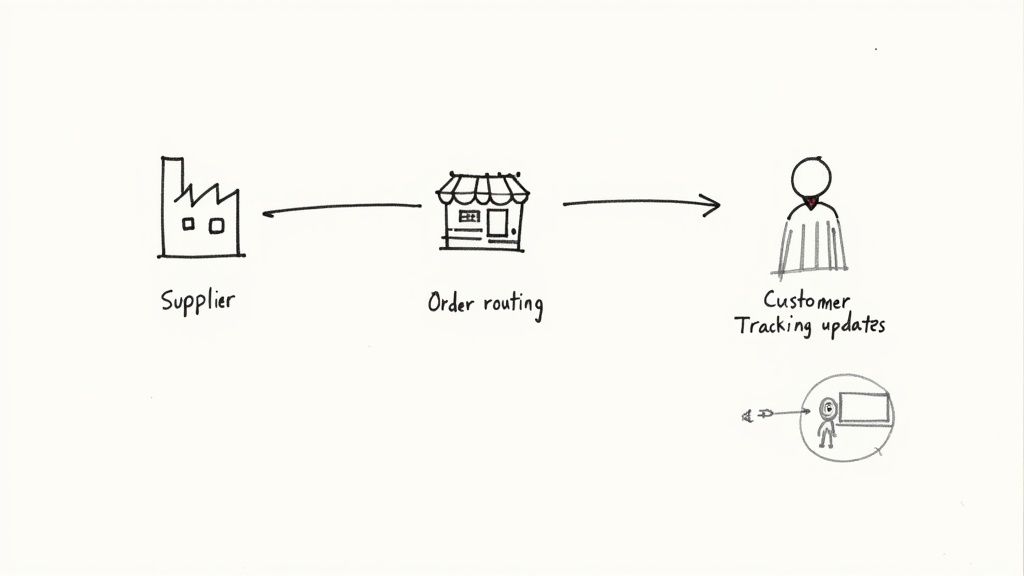
This is the moment you graduate from being a store owner who processes orders to an entrepreneur who builds systems. Automation is what lets you scale past what you can personally handle, taking care of the tedious but vital tasks so you can actually focus on growth.
Why Manual Order Processing Is a Dead End
When you're starting out, it's tempting to think, "I'll just email my supplier each order. It's only a few per day." This approach works perfectly fine—until it suddenly and spectacularly doesn't. A single viral TikTok or a well-timed ad can turn five daily orders into five hundred overnight.
Manually forwarding every order creates a bottleneck that will choke your business. It's not just slow; it's a breeding ground for expensive, reputation-damaging mistakes.
- Mistyped addresses: A single wrong digit in a zip code can send a package to the wrong state, leaving you to deal with a justifiably angry customer.
- Incorrect SKUs: You accidentally order the blue widget instead of the red one, leading to a frustrated customer and a logistical nightmare of returns.
- Inventory mismatches: Your supplier runs out of stock, but you don't realize it until after you've made a sale. Now you have to cancel the order and hope the customer doesn't blast you on social media.
These "small" mistakes add up fast. They create a poor customer experience that can absolutely kill a young brand. To truly scale, you have to get yourself out of the middle of the process.
Choosing Your Integration Method
Connecting your store to your supplier isn't a one-size-fits-all deal. How you do it will really depend on your sales platform, what your supplier can handle technically, and, of course, your budget.
App and Plugin Integrations
This is the go-to route for most dropshippers, especially if you're on a platform like Shopify. Tools like AutoDS, Spocket, or DSers are pretty much plug-and-play. You install the app, connect it to your supplier's product feed, and the software takes over.
These apps act as a bridge. They automatically pull product info, sync inventory levels in real-time, and fire off new orders to your supplier the second they come in. For anyone who isn't a developer, this is absolutely the place to start.
Direct API Integration
If you're a more established business or you're working directly with a large manufacturer, you might need a direct API (Application Programming Interface) connection. Think of an API as a private, secure hotline between your store's software and your supplier's system. It's a much more powerful and flexible setup but almost always requires a developer to build it. It’s a bigger upfront investment, but you get a completely custom, rock-solid solution in return.
Your goal is to create a workflow where a customer can place an order, have it sent to your supplier, fulfilled, and receive a tracking number—all without any manual intervention from you. That is the essence of a scalable dropshipping operation.
Core Automation Workflows to Implement
Once you're connected, there are three key areas you need to automate. These are the pillars of an efficient, hands-off supply chain.
- Inventory Syncing: This is non-negotiable. Your store needs a live, or at least near-live, link to your supplier's stock levels. This single function prevents you from selling products that are out of stock—one of the quickest ways to torpedo customer trust.
- Order Routing: The moment a customer clicks "buy," the order details—what they bought, how many, and where it's going—should be automatically zapped over to your supplier for fulfillment. No more copying and pasting addresses at 2 AM.
- Tracking Updates: As soon as the supplier ships the package, the tracking number needs to be pulled from their system and sent back to your store. Your ecommerce platform can then automatically trigger that "Your order has shipped!" email, keeping your customer happy and informed.
Nailing these workflows is critical, especially when you're juggling suppliers from different parts of the world. A major trend right now is a regional shift; smart sellers are targeting the Asia-Pacific (APAC) region for volume but are prioritizing US-based suppliers for major markets to offer 2-7 day shipping instead of the 15-30 days common from Asia. While platforms like Amazon and eBay are good hunting grounds for US vendors, an estimated 84% of sellers run into serious supplier problems. This has fueled the rise of apps like Zendrop or Inventory Source that manage these automated workflows for you.
You can learn more about the key dropshipping statistics and trends shaping the industry. Tools like these often provide lists of pre-vetted suppliers and built-in integrations, helping you build a more reliable and efficient operation right from the start.
Common Questions About Finding Suppliers
When you're digging into the world of dropshipping suppliers, a ton of questions pop up. It's totally normal. These are big decisions that can make or break your business, so let's tackle some of the most common ones I hear from other entrepreneurs.
Should I Use a Domestic or Overseas Supplier?
This is the age-old dropshipping dilemma: speed vs. cost. There's no magic answer here; it really comes down to what kind of brand you want to build and who you're selling to.
Working with domestic suppliers (think US or EU-based) is all about a better customer experience. You get lightning-fast shipping, often in just 2-7 days. That kind of speed can be a huge competitive edge, making customers happier and allowing you to charge a bit more. Plus, communication is usually a breeze, and dealing with returns isn't a logistical nightmare.
Now, on the other side of the coin, you have overseas suppliers, mostly from Asia. Their main draw? Unbeatable prices and a mind-boggling selection of products. Lower costs mean you have the potential for much healthier profit margins. But there's a trade-off. You're staring down shipping times of 15-30 days or even longer, plus the fun of potential customs headaches and the occasional language barrier.
My favorite strategy? Use both. I often source my core, proven bestsellers from a reliable domestic supplier to keep my loyal customers happy with fast shipping. At the same time, I’ll test out new, trendier products with an overseas supplier. The lower cost minimizes my risk if an item doesn't take off.
This hybrid approach gives you a stable, reliable foundation while still letting you experiment and chase bigger margins.
How Do I Handle Returns With a Dropshipping Supplier?
This is a big one. Your return policy is completely handcuffed to your supplier's policy. Before you sign anything or agree to a partnership, you need to understand their process inside and out. Your website's return policy has to be a mirror image of theirs, or you'll end up losing money.
Here's how it usually works: your customer contacts you to start a return. You then have to act as the go-between, contacting the supplier to get the process rolling for your customer.
It is absolutely critical to nail down these specifics before you commit:
- What is their exact return window? (e.g., 14 days, 30 days from delivery)
- Who is on the hook for return shipping costs? This can be a major point of frustration for customers.
- How do they deal with items that arrive damaged or defective? Do they need photo evidence? Will they send a replacement and cover all costs?
If a supplier is wishy-washy on their return process or makes it expensive and difficult, walk away. It’s a giant red flag that signals future problems that will drain your bank account and damage your brand's reputation.
What Is a Good Profit Margin in Dropshipping?
After you've paid for the product, shipping, marketing ads, and transaction fees, a healthy net profit margin in dropshipping generally lands somewhere between 15% and 30%.
Of course, this number isn't set in stone. Your niche plays a huge role. If you're selling high-volume, low-cost gadgets, your margin percentage might look great, but the actual cash profit per sale is small. On the flip side, selling a high-ticket item with a 20% margin can be incredibly lucrative.
Always map out every single cost associated with a sale before you lock in a retail price. Don't forget the small stuff like payment processing fees—it all adds up.
When you're talking to potential suppliers, don't be shy about asking for tiered pricing. Many are willing to drop the per-unit cost once you start sending more orders their way. This is one of the best ways to scale your profitability. A great partner wants you to succeed, and they'll often reward your growth with better margins.
Ready to slash your software costs and supercharge your e-commerce growth? With EcomEfficiency, you get access to 50+ premium tools like Semrush, Pipiads, and Midjourney for a single, low monthly price. Stop juggling subscriptions and start building your empire. Unlock your all-in-one toolkit today for just $19.99.