How to Build an Email List That Drives E-Commerce Sales

At its core, building an email list is a simple trade. You offer something valuable—a discount, a helpful guide, early access—and in exchange, your audience gives you their email address. This is done using lead magnets and on-site capture tools like pop-ups, all managed through an email platform that gives you a direct line to your customers.
The goal is to scale without dubious shortcuts and without hurting your credibility.
Why an Email List Is Your Most Powerful E-commerce Asset
Social media algorithms are constantly changing, and ad costs just keep climbing. Amid all that chaos, your email list is the one marketing channel you truly own. It's not a rented audience on TikTok or Instagram; it's a direct, stable connection to your customers' inboxes.
Think about it. A viral video might give you a temporary traffic boost, but what happens next week when the algorithm shifts? That reach can vanish overnight. An email list, on the other hand, is a real asset that you build over time, giving you a reliable way to drive traffic and sales no matter what happens on other platforms.
The Unmatched ROI of Email Marketing
The numbers don't lie. Email marketing consistently crushes other channels when it comes to return on investment. The latest data shows that email delivers an average ROI between 3600% and 3800%. That's about $36 back for every $1 you spend. For any Shopify or DTC brand, that kind of efficiency makes list building a top priority.
It gets even better. Nearly one in five companies reports an email marketing ROI of 7000% or more. That's just incredible.
With this direct line to your audience, you can:
- Drive repeat business: It’s so much easier to get an existing customer to buy again than to find a new one. Email is perfect for nurturing those relationships.
- Build real brand loyalty: Share your story, offer exclusive perks, and make your subscribers feel like true insiders.
- Launch products with a bang: Announce new arrivals to a warm audience that's already eager to hear from you.
- Lower your acquisition costs: Marketing to people who already know and trust you is far cheaper than constantly paying for new clicks and eyeballs.
The real advantage here is ownership. You're just a guest on social media platforms, but your email list is your own private property. It's the bedrock of sustainable growth and your best defense against market volatility.
More Than Just a List of Contacts
Ultimately, a healthy email list isn't just a database of contacts; it's a community of your biggest fans and most likely buyers. For a deeper look into the mechanics of how to build an email list that drives real SaaS revenue, this guide offers some fantastic insights that translate perfectly to the e-commerce space.
When you invest in your email list, you're building a powerful direct-to-consumer channel that will pay you back for years.
Laying the Groundwork for Real List Growth
Before you even think about designing your first pop-up or drafting a welcome email, we need to talk about your foundation. I’ve seen too many brands jump straight into tactics, only to have it all crumble later. Trying to grow a list without the right tools and legal framework is like building a house on sand.
There are two critical pillars to get right from the very beginning: choosing the right Email Service Provider (ESP) and understanding your legal responsibilities. Nail these, and you're set up for sustainable, long-term growth. This is about more than just grabbing email addresses; it's about building a powerful, compliant, and manageable marketing channel.
Choosing Your Email Service Provider
Think of your ESP as the engine of your entire email operation. It’s the command center where you’ll manage subscribers, build emails, and run automated campaigns. For an e-commerce brand, a generic, one-size-fits-all provider just won't cut it. You need a platform that’s truly built to drive sales.
From my experience, there are a few non-negotiable features you should be looking for:
- Deep E-commerce Integration: Your ESP has to play nice with your store, whether that’s Shopify, WooCommerce, or another major platform. This is what lets you sync customer data, track purchase history, and trigger crucial automations like abandoned cart reminders.
- Powerful Segmentation: Blasting the same email to every single person on your list is a rookie mistake. A solid ESP lets you slice and dice your audience based on things like what they’ve bought, how often they open your emails, or where they live. This is the key to sending super-relevant (and effective) campaigns.
- A Visual Automation Builder: Let’s be real—most of us aren't coders. Setting up automated sequences like a welcome series or a win-back flow should be intuitive. Look for a simple drag-and-drop builder that helps you map out these customer journeys visually.
As this diagram shows, social media is great for building an audience, but your email list is what turns that audience into actual sales.
The email list is the essential bridge between a "rented" social media audience and owned revenue you can count on.
Staying on the Right Side of the Law
Let's be clear: legal compliance is not optional. Ignoring regulations like GDPR (General Data Protection Regulation) in Europe and the CAN-SPAM Act in the U.S. can land you in hot water with massive fines and, just as bad, a trashed brand reputation.
While the specifics of these laws differ, they all boil down to protecting consumers and being transparent.
Remember, this isn't just about avoiding penalties. It's about building trust. When subscribers know you respect their privacy and their inbox, they’re far more likely to stick around and become loyal customers.
Here's a quick, no-nonsense checklist to keep your email program clean and compliant:
- Get Explicit Consent: Never, ever add someone to your marketing list without their direct permission. Pre-checked boxes are a huge no-no, especially under GDPR. People have to actively opt-in.
- Include Your Physical Address: The CAN-SPAM Act says you must include a valid physical postal address in every commercial email. Most brands just pop this into the email footer.
- Provide a Clear Unsubscribe Link: Every single email needs an obvious, easy-to-use unsubscribe link. And once someone clicks it, you have to honor that request immediately. No delays.
- Be Honest in Your Subject Lines: Don't use spammy or misleading subject lines just to get an open. Your from-name and subject line need to accurately reflect who you are and what’s in the email.
By picking the right ESP from the start and baking these legal best practices into your process, you’re setting your brand up for real success. You'll have the technical horsepower to scale and the peace of mind that comes with growing your list the right way.
Creating Lead Magnets Shoppers Actually Want
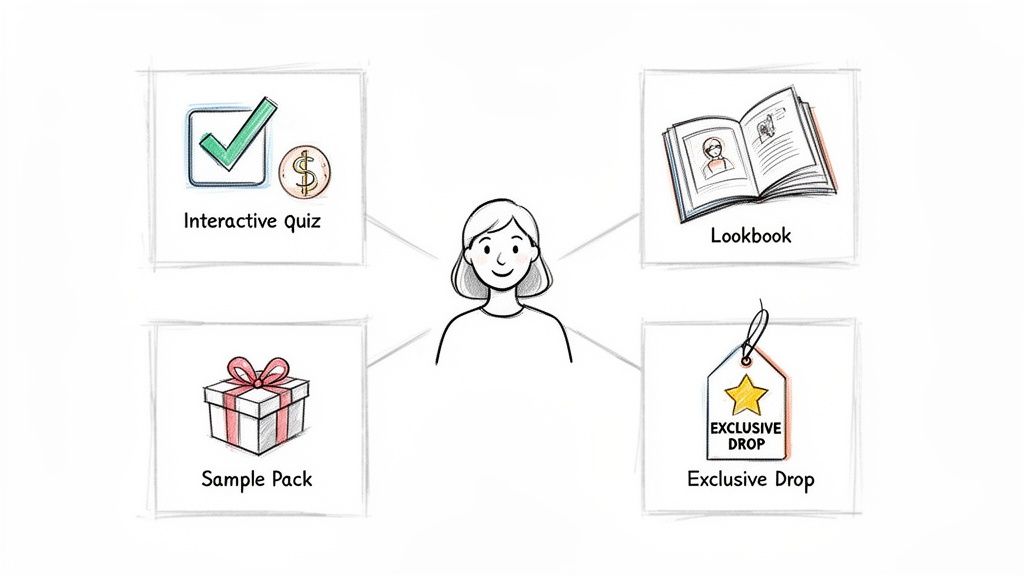
Let's be honest: getting a shopper's email is a transaction. They're handing over access to their personal inbox, and a generic "10% off" coupon just doesn't cut it anymore. It's a tired offer that everyone expects.
The brands winning at list building understand this. They offer something genuinely valuable upfront. This "something" is called a lead magnet—an irresistible incentive offered in exchange for an email address. A great lead magnet doesn't just get you any email; it gets you the right email from a shopper who is actually interested in what you sell.
Moving Beyond the Standard Discount
Sure, discounts can get you signups. But they often attract bargain hunters who buy once and then vanish. If you want to build a list of loyal, repeat customers, you need to think bigger.
Your goal is to attract people who are genuinely into your brand's world, not just your prices. So, get creative. What problem can you solve for your ideal customer right now? What quick win can you give them that also happens to position your products as the perfect next step?
Instead of a simple discount, try one of these proven strategies:
- Interactive Quizzes: These are engagement gold. A beauty brand can create a "Find Your Perfect Skincare Routine" quiz. A coffee company could offer a "What's Your Ideal Coffee Blend?" quiz. The shopper gets instant, personalized value, and you get incredibly useful data for segmenting your list later.
- Exclusive Content: Give them something they can't find anywhere else. A home goods store could offer a downloadable "Seasonal Decor Lookbook." A fashion brand could provide a "5-Piece Capsule Wardrobe Checklist."
- Early Access & VIP Perks: Everyone wants to feel like an insider. Offer subscribers first dibs on new product drops, access to limited-edition items, or an invitation to a private VIP community. This creates immediate brand loyalty.
Here's the secret: stop focusing on what you want (their email) and start thinking about what they want (a solution, a shortcut, a feeling of being special). When your offer solves a real problem, handing over an email feels like a no-brainer.
Tailoring Your Offer to Your Niche
The most powerful lead magnets feel like they were made just for that specific customer. The more you tailor your offer to your niche, the higher your signup rate will be. This is where you separate the amateur email marketers from the pros.
Here’s a quick look at how this plays out in a few different niches:
- Fitness Apparel: Ditch the discount. Offer a free "7-Day Home Workout Plan" PDF instead. You’ll attract people who are actively into fitness and actually need workout gear, positioning your brand as a helpful authority.
- Pet Supplies: A "New Puppy Checklist" or a guide to "Choosing the Right Dog Food" is immensely valuable to new pet owners. You're building trust from the very first interaction.
- Gourmet Food: Instead of a coupon, offer a "Digital Recipe Book" that uses your products. Sell fancy olive oil? Give away five exclusive recipes that feature it. This not only gets the email but also shows them exactly how to use your product.
To help you get started quickly, you can use frameworks like these high-converting lead magnet templates as a foundation. Just customize them with your branding and unique expertise.
The table below breaks down some more ideas to get your creative juices flowing.
Lead Magnet Ideas for E-Commerce Niches
This table provides a snapshot of different lead magnets you can create that align perfectly with specific product categories and customer needs.
| E-Commerce Niche | High-Converting Lead Magnet | Why It Works |
|---|---|---|
| Beauty & Skincare | Skincare routine quiz or a "Shade Finder" guide | Provides personalized recommendations, solving a common customer problem. |
| Fashion & Apparel | Style guide, lookbook, or a "Capsule Wardrobe" checklist | Offers aspirational and practical value, helping customers visualize using the products. |
| Home Decor | A "Room Makeover" planner or a seasonal decor guide | Taps into the customer's desire to improve their living space and inspires purchases. |
| Health & Wellness | 7-day meal plan, workout challenge, or a smoothie recipe book | Attracts a highly motivated audience already seeking to improve their lifestyle. |
| Hobbies & Crafts | Beginner's guide, project template, or a free digital pattern | Provides a quick win and empowers the customer to start a new project (using your supplies). |
| Kids & Baby | Printable activity sheets or a "New Parent Survival Guide" | Solves a direct need for parents (entertaining kids or navigating parenthood). |
By creating a lead magnet that delivers real value, you completely change the conversation. You’re not just a company asking for their data; you’re a helpful brand starting a genuine relationship. That simple shift is the key to building an email list full of engaged fans ready to become loyal customers.
Turning Your Website Into an Email Capture Machine
Your website is so much more than a digital catalog. It should be your number one tool for growing your email list, turning every visitor into a potential long-term relationship. The trick is to thoughtfully place your opt-in forms where they’ll grab attention without completely disrupting the shopping experience.
This isn’t about just blasting pop-ups everywhere. It's a delicate dance. You need to present a genuinely valuable offer at the perfect moment to convince a casual browser to hand over their email. Get this right, and your site transforms into an automated lead-gen engine that works for you around the clock.
Master the Art of the Pop-Up
Pop-ups get a bad rap, but that's only because so many stores get them wrong. When used with a bit of strategy, they're absolute powerhouses for list growth. The two you absolutely need to have are entry and exit-intent pop-ups.
An entry pop-up shows up a few seconds after someone lands on your site. This is your first handshake, your chance to make a great impression with a juicy lead magnet. A classic example is greeting a new visitor with an offer for "Free Shipping On Your First Order" just for signing up.
Then you have the exit-intent pop-up. This is your last-ditch effort to keep a visitor from leaving for good. It uses cursor-tracking to sense when someone is about to click away and then—boom—it presents one final, compelling offer. This is where you can be a bit more aggressive, like offering "15% off if you order today," to save a sale and win a subscriber.
To make your pop-ups actually work, stick to these ground rules:
- Time it right: Don't ambush visitors the second they arrive. Give them at least 5-10 seconds to look around first.
- Offer an easy out: A tiny, hidden 'X' button is infuriating. Make it obvious and easy to close the pop-up.
- Get smart with targeting: Don't annoy your existing subscribers with the same signup offer. Use cookies to show them a different message or hide pop-ups altogether for people already on your list.
Your goal is quality over quantity. A smaller, highly engaged list is far more valuable than a massive list of uninterested contacts. It’s about building a community, not just a database.
Industry data backs this up. A quality B2B list of just 500 engaged contacts will consistently outperform a list of 50,000 generic recipients. The same logic applies to e-commerce; even 100-200 genuinely interested subscribers can drive serious revenue. For more on this, check out the comprehensive guide from Lake B2B.
Go Beyond Pop-Ups with Embedded Forms
While pop-ups are your heavy hitters, they shouldn't be your only play. By integrating static, or embedded, signup forms into key parts of your site, you create permanent, non-intrusive ways for people to join your list. These forms work quietly in the background, capturing emails from your most interested visitors.
Here are a few prime spots to place them:
- Website Footer: This is a no-brainer. It's standard practice, and anyone who scrolls all the way down is clearly engaged with your brand.
- Blog Posts: If you’re creating content, embed a signup form within or at the end of each article. Someone who just read your 1,000-word guide to skincare is the perfect audience for your beauty brand's newsletter.
- About Us Page: Visitors here are trying to connect with your story. It’s the ideal place for a soft invitation like, "Join our community and follow our journey."
Slide-in boxes are a great middle-ground option. These smaller forms usually slide in from the corner of the screen as a user scrolls, making them less jarring than a full-screen pop-up but more noticeable than a static form. They’re fantastic for promoting content-specific offers on your blog.
Bridge the Gap from Social Media and Marketplaces
So what about all the traffic you don't fully control, like from your TikTok Shop or Amazon storefront? You can't put pop-ups on those platforms, but you can build a bridge to your own audience with dedicated landing pages.
A landing page is a simple, standalone page with one single goal: capturing an email address. You can create one with a killer offer and link to it from your social media bio, your TikTok videos, or even from a small insert card you include in your Amazon packages. For instance, your TikTok bio link could go to a page offering an exclusive "TikTok Fam" discount for new subscribers.
This strategy is absolutely essential for pulling customers from third-party platforms into your own ecosystem. It gives you a way to build a direct line of communication with people you acquire elsewhere, turning a one-time Amazon buyer or a fleeting TikTok viewer into a loyal fan you can market to for years.
Turn Subscribers into Customers with a Killer Welcome Series
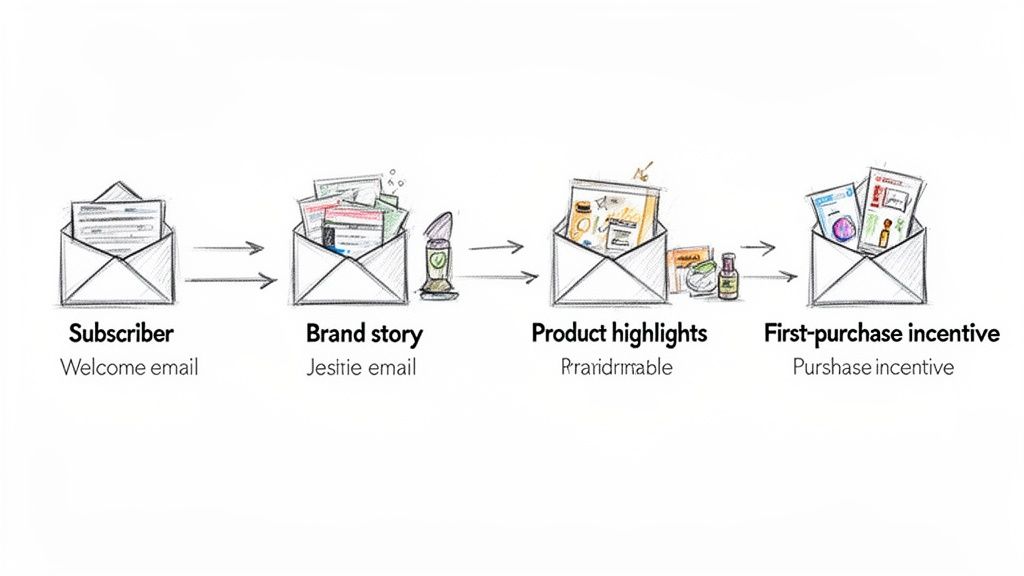
The moment someone signs up for your list is pure magic. Their interest is at its absolute peak. They've literally raised their hand and said, "I want to hear from you." This is your golden opportunity to make a real connection, and a generic "Thanks for subscribing!" email just isn't going to cut it.
An automated welcome series is your secret weapon here. Think of it as your brand's personal onboarding concierge—a pre-built sequence of emails that automatically goes out to every new subscriber. It’s not just about slinging a discount code; it’s your chance to tell your story, build trust, and gently guide them toward that all-important first purchase.
The Anatomy of a High-Converting Welcome Flow
A great welcome series is like a good conversation spread over a few days. You’re not trying to bombard them, but you absolutely want to keep the momentum going while their interest is hot. It’s all about nurturing that initial spark into a genuine customer relationship.
Here’s a proven, five-email sequence that works like a charm for e-commerce stores. You can adapt it to fit your brand's voice.
- Email 1 (Immediately): Deliver the Goods. This one has to go out instantly. No delays. Its only job is to deliver what you promised, whether that’s a discount code, a free guide, or early access. Keep it short, sweet, and laser-focused.
- Email 2 (Day 2): Tell Your Story. Now that they have their incentive, it's time to build a connection. Share why you started your business. What problem were you trying to solve? People connect with purpose, not just products.
- Email 3 (Day 4): Show Off Your Best-Sellers. You can't assume a new subscriber knows what you’re famous for. Use this email to introduce your hero products. I like to frame this as "Fan Favorites" or "Top-Rated Picks" to sneak in some social proof.
- Email 4 (Day 6): Solve Their Problem. Show them you get it. If you sell skincare, this email could tackle common issues like acne or dryness. This move positions you as an authority and your products as the clear solution.
- Email 5 (Day 7): The Final Nudge. This is your last shot to drive that first purchase with their initial offer. Create a little urgency by reminding them their discount code is about to expire. A ticking clock works wonders.
This multi-step approach achieves so much more than a single email ever could. It systematically builds trust, educates the subscriber, and makes a compelling case for them to click "add to cart."
Start Personalizing from Day One
Even within an automated flow, you can—and should—personalize the experience. The easiest way to start is by segmenting people based on how they joined your list. This lets you tailor the welcome journey to their specific context right from the get-go.
For example, someone who signed up via a pop-up offering a 15% discount is in a completely different headspace than someone who downloaded your "Ultimate Skincare Routine" PDF from a blog post.
You can set up simple rules in your email service provider (ESP) to automatically tag subscribers based on where they came from:
- Tag:
source-popup-discount - Tag:
source-blog-skincare-guide - Tag:
source-tiktok-giveaway
With these tags in place, you can create slightly different versions of your welcome series. The "discount" subscriber might get a more direct path to your shop, while the "guide" subscriber might receive an extra email with more skincare tips. It’s a simple tactic that makes your automation feel incredibly personal.
Key Takeaway: Your welcome series is a powerful relationship-building tool. Its goal isn't just to convert a subscriber into a customer, but to turn a customer into a loyal fan who feels seen and understood from their very first interaction.
Finding the Right Sending Rhythm
As your list grows, you’ll find that the best email strategies balance personalization with a consistent sending frequency to keep engagement high. Right now, the sweet spot for many brands is sending between 9-16 emails per month, which can drive an average ROI of an incredible 4600%. The most successful brands are using behavioral data—targeting users based on what they look at on your site, what they’ve bought before, and how they interact with your emails. You can dig into more benchmarks in this deep dive on EmailMonday.com.
Your welcome series is the first step in establishing this cadence. It trains your new subscribers to expect valuable content from you regularly, setting the stage for a long and profitable relationship. By automating this crucial first impression, you ensure every new lead gets the same VIP treatment, turning your list-building efforts into a consistent revenue engine.
Got Questions? Let's Talk Email List Building
Even after you've got your popups running and your lead magnets dialed in, questions are going to pop up. It's just part of the process. You might wonder if you're emailing too much (or not enough), or get frustrated when your growth hits a wall. That's totally normal.
This is where we'll tackle some of those nagging questions that every e-commerce owner has at some point. Think of it as a quick-reference guide to get you unstuck and back to growing your list with confidence.
How Often Should I Actually Email My List?
Ah, the million-dollar question. The honest answer? It depends. What works for a daily deals site would be suicide for a high-end furniture brand. But for most e-commerce and DTC brands, a solid starting point is one to two times per week.
This cadence keeps you on your customers' radar without becoming background noise in their inbox. It gives you enough runway to announce new products, share a promotion, or send out some genuinely useful content. Later on, you can get fancy and send more frequent, targeted emails to your superfans while pulling back a bit for your less-engaged subscribers.
The real goal here is consistency, not just blasting out emails. A smaller, engaged list that knows they'll hear from you every Tuesday will always, always outperform a huge, cold list that gets spammed randomly. Find a rhythm you can stick with.
Remember, if an email doesn't have a clear purpose, you probably shouldn't send it.
What Do I Do If My List Growth Stalls?
First, don't panic. List growth isn't a straight line—it has its peaks and valleys. Hitting a plateau is super common and is usually just a signal that it's time to shake things up, not that your whole strategy is broken.
Here are a few things I've seen work time and time again to kickstart growth:
- Roll Out a New Lead Magnet: If that "10% off" offer has been running for a year, it might be getting a little stale. Why not try something fresh, like a product finder quiz, a free gift with the first purchase, or a seasonal style guide?
- Run a Giveaway: Team up with a brand that shares your audience but isn't a direct competitor. A giveaway where an email signup is the price of entry can bring in a rush of new, highly relevant subscribers for both of you.
- Actually Promote Your List on Socials: Don't just rely on the link in your bio. Create specific posts, Stories, and Reels that scream about the exclusive perks of being an email subscriber. Send that traffic to a slick, dedicated landing page built just for signups.
Testing new offers and channels is how you break through those plateaus and get the growth curve moving up and to the right again.
Seriously, How Big Does My Email List Need to Be?
So many founders get hung up on the raw number of subscribers. But I'll tell you right now: list quality crushes list quantity, every single time.
I’d rather have a list of 500 die-hard fans who open every email and jump on every offer than 10,000 subscribers who couldn't care less. A small, mighty list is a revenue-generating machine.
Instead of obsessing over a vanity metric, get laser-focused on the numbers that actually matter to your bottom line:
- Open Rate: Are people actually seeing what you send?
- Click-Through Rate (CTR): Are they interested enough to click?
- Conversion Rate: Are they buying?
These metrics tell you the true story of your list's health. So if you have a highly engaged list of 1,000 subscribers, celebrate it! That’s a massive asset. As long as you're consistently adding qualified leads, you're winning.
Ready to streamline your marketing and get access to all the tools you need to grow your e-commerce brand? With EcomEfficiency, you get 50+ premium SEO, ad-spy, and AI tools in one affordable subscription. Cut your software costs by up to 99% and unlock the resources to find winning products, analyze competitors, and create killer campaigns. Start your EcomEfficiency plan today and see why over 1,000 members trust us to power their growth.