The Group Buy SEO Guide to Premium Tools on a Budget

Group buy SEO is a clever, if not a bit risky, workaround for accessing premium SEO tools like Ahrefs or Semrush without paying the steep monthly fees. Think of it like a digital co-op; instead of everyone buying their own expensive power tool, a group pitches in to share one. This approach puts incredibly powerful, and often prohibitively expensive, marketing software within reach for freelancers and small businesses.
The goal is to scale without dubious shortcuts and without hurting your credibility.
Understanding the Group Buy SEO Model

The mechanics are pretty simple. A third-party provider, the "host," buys a top-tier subscription to a popular SEO tool. Then, they divvy up access to that single account among many different users, each paying a small fraction of the retail price. So, instead of shelling out hundreds of dollars a month, you might pay as little as $10 or $20.
This practice effectively opens the gates to enterprise-level data, allowing smaller players to punch above their weight. It's a game-changer for anyone who needs high-octane analytics but can't stomach the high overhead of an individual license.
To put this into perspective, let's break down the core differences in a quick comparison.
Group Buy SEO At a Glance
This table offers a snapshot of what you get—and what you give up—when choosing a group buy service over a direct subscription.
| Aspect | Group Buy SEO | Individual Subscription |
|---|---|---|
| Cost | Extremely low (e.g., $10-$30/month) | High (e.g., $100-$1000+/month) |
| Access | Shared, often via a browser extension or portal | Direct, private login credentials |
| Legality | Violates most tools' terms of service | Fully compliant and legal |
| Support | Relies on the group buy provider, if any | Direct access to official customer support |
| Security | High risk; shared credentials and data exposure | Low risk; secure, private account |
| Features | May have limitations on usage or features | Full, unrestricted access to all plan features |
While the cost savings are the main draw, it's clear there are significant trade-offs in every other category.
Who Benefits from This Approach
The appeal of group buys is broad, touching nearly every corner of the digital marketing world. Different folks find value in it for different reasons, but it always comes back to getting access to crucial tools on a shoestring budget.
- Freelancers and Solopreneurs: For a one-person show, a group buy can mean the difference between guessing and making data-driven decisions for clients. The full cost of a premium tool could easily wipe out the profit from a small project.
- Small Agencies: Bootstrapped agencies can use group buys to expand their service offerings. It allows them to provide clients with in-depth reports and competitive analysis without a massive upfront investment.
- Startups and Small Businesses: When every dollar counts, group buys give new companies a fighting chance. They can conduct vital keyword research and competitor analysis needed to gain that first foothold in the market.
The demand for these tools is undeniable. The global SEO services market was valued at around USD 74.9 billion in 2025 and is on track to hit USD 127.3 billion by 2030, growing at a compound annual rate of 12.3%. This explosive growth shows just how critical SEO is, and why so many smaller players turn to solutions like group buys to keep up. You can learn more about the SEO market's rapid expansion and what it means for businesses.
Key Takeaway: At its heart, the group buy SEO trend is driven by one thing: economic accessibility. It’s a bridge over the chasm separating the high cost of top-tier tools from the tight budgets of most marketing professionals.
The Tradeoff Between Cost and Risk
Here’s the catch: while the savings are real, group buy services operate in a legal and ethical gray area. This isn't a feature officially endorsed by companies like Ahrefs or Semrush. In fact, sharing accounts almost always violates their terms of service, plain and simple.
This creates a fundamental dilemma every user has to grapple with. On one hand, you get incredible cost savings and access to a treasure trove of data. On the other, you're exposing yourself to potential security threats, legal trouble, and spotty performance. Before you jump in, it's absolutely vital to weigh the benefits against the very real risks involved, which we'll unpack throughout this guide.
The Financial Appeal of Sharing SEO Tools
Let's be honest about why group buy SEO services are so popular. It all comes down to one thing: the massive cost savings. For a lot of people, this isn't just about saving a few bucks; it's the only way they can get their hands on the powerful data needed to run a real digital marketing campaign. Premium SEO tools have a seriously high price of entry, and group buys smash that barrier down.
Think about one of the big names, like Ahrefs or Semrush. A standard plan can easily set you back $199 a month, sometimes more. That kind of cash is a non-starter for most freelancers or a startup running on fumes. But a group buy service? They might offer you access to the very same tool for just $15 per month.
That’s not a discount; it’s a total game-changer. You could potentially get a whole bundle of ten different premium tools for less than the price of one official subscription. This huge price gap is what makes the whole idea so attractive.
Putting Big-League Data in Everyone's Hands
This affordability isn't just about saving money—it's about leveling the playing field. Not too long ago, only big agencies and corporations with deep pockets could afford the kind of software needed to do deep competitor research, check backlinks, or find the best keywords.
Group buy SEO services flip that script completely.
- Solo Freelancers: Can finally give their clients the same high-level reports as a big agency, without watching their profits evaporate. This lets them go after bigger, better-paying projects.
- Bootstrapped Startups: Get the insights they need to find their footing and grow in a competitive market, instead of just guessing or relying on free tools that barely scratch the surface.
- Small Marketing Agencies: Can add more powerful services to their lineup and deliver more value without having to pass on insane software costs to their clients.
The appeal is simple: group buys take essential, expensive tools and turn them from a luxury into a utility. For a small operation, that can be the difference between spinning your wheels and actually getting somewhere.
The financial logic gets even stronger when you consider the potential payoff. For instance, e-commerce businesses often see an average SEO ROI of 317%, and for real estate, that number can skyrocket to an unbelievable 1,389%. Leads from SEO also close at a 14.6% rate, which blows outbound marketing's 1.7% conversion rate out of the water. With stakes this high, it's no surprise people are looking for a cheaper way in. You can dig into more compelling SEO statistics that show just how much impact a solid strategy can have.
How This Affordability Plays Out in the Real World
Picture a freelance content writer who’s just starting out. A client asks for a full competitive content analysis—a job that’s impossible to do right without a top-tier tool. The freelancer is stuck. Do they turn down the most valuable part of the project, or do they find a way to get the software? A group buy SEO plan makes that second choice a reality.
Or think about a small e-commerce shop owner. With a shared tool, they can uncover those niche, long-tail keywords that their multi-million dollar competitors are ignoring. That's the power of accessible data right there. It lets you be smart and nimble with your marketing, instead of just relying on a big budget.
While the cost savings are what get people in the door, it’s this democratizing effect that truly captures the appeal of sharing SEO tools. It gives a new wave of entrepreneurs and marketers the chance to compete, armed with the same intelligence as the biggest players in the game.
Navigating the Dangers of Group Buy SEO

The idea of getting a full suite of premium SEO tools for the price of a couple of coffees is tempting, I get it. But that convenience comes with some serious baggage that you absolutely need to consider. Opting for a group buy SEO service isn't just a clever hack; it's a gamble, and knowing the stakes is the only way to protect yourself and your business.
At its heart, the group buy model operates completely outside the rules. When you sign up, you're not just getting a discount. You're stepping into a grey area where all the normal protections and guarantees simply vanish.
Legal and Ethical Red Flags
The first and most obvious problem is that you're breaking the rules. Every major tool provider, from Semrush to Ahrefs, explicitly forbids sharing accounts in their terms of service (ToS). No, the ToS police won't show up at your door, but the consequences can be swift and final.
If the software company discovers the shared account, they will terminate it. Immediately. That means everyone in the group—including you—loses access in a blink. You'll have no recourse, no chance of a refund, and no way to recover any of the project data you had saved.
It's a fundamental breach of contract. You are knowingly using a service in a way the provider has prohibited, which removes any expectation of support or reliability from the official company.
This gets even trickier if you're doing work for clients. Using these tools means you're handling their project data—keyword lists, site audits, competitive research—on a platform that is non-compliant and fundamentally insecure. This could put you in serious breach of your client agreements and tarnish your professional reputation.
The Unseen Security Threats
Beyond the legal and ethical mess lies a minefield of digital security risks. To make this whole thing work, many group buy services require you to install their own browser extension or log in through some shady third-party portal. This is where things get really dangerous.
These extensions aren't vetted by the Google or Firefox app stores and can be packed with malicious code. They can act as a "man in the middle," watching everything you do online, not just how you use the SEO tool.
Here's a taste of what you might be signing up for:
- Malware and Spyware: That sketchy extension could easily install malware on your system to steal your information or just wreck your computer.
- Data Theft: These add-ons can log your keystrokes, capturing logins for your bank, email, and other critical accounts.
- Client Data Exposure: Any client info you plug into the tool could be siphoned off by the group buy provider or even seen by other users on the shared account.
- Phishing Schemes: The provider now has your email and payment details—the perfect recipe for a targeted phishing attack.
You are putting an incredible amount of trust in an anonymous, unregulated provider whose entire business model is built on breaking the rules.
Performance and Reliability Headaches
Let's say you dodge all the worst-case security threats. The day-to-day experience of using a group buy service is still often a nightmare of frustration and unreliability. You're sharing a single account's resources with dozens, maybe hundreds, of other people.
This leads to a ton of practical problems:
- Sudden Lockouts: The real tool provider often detects suspicious activity and will lock the account, sometimes for good.
- Exceeded Usage Limits: Premium tools have daily or monthly caps on reports, keyword lookups, and site crawls. With a crowd of users, those limits are often hit by the 2nd of the month, leaving the tool useless until it resets.
- Constant Login Changes: To fly under the radar, providers are constantly changing the login details, forcing you to chase them down for the new password.
- Zero Customer Support: If a tool glitches or you're locked out, you can't just call the official support line. Your only hope is the group buy provider, whose support is notoriously slow, unhelpful, or completely nonexistent.
The bottom line is that the cheap price tag of a group buy SEO service comes at a cost. You're trading legality, security, and reliability for that discount. Before you jump in, you have to ask yourself if the savings are truly worth it.
How to Choose a Safer Group Buy Provider
So, you've weighed the pros and cons and decided a group buy SEO service is a risk you're willing to take. Great. Your next step is absolutely critical. Let’s be clear: there's no such thing as a "safe" provider in this space. The real goal here is harm reduction—finding a service that’s at least more reliable and less sketchy than the outright scams.
Making a good choice requires a bit of detective work. You can't just jump on the first promising offer you see. Think of it less like online shopping and more like vetting a contractor to build your house. You need to dig into their history, know the warning signs, and protect yourself at every step.
This means hunting for "green flags"—positive signs that a provider is trying to run a legitimate, stable operation. At the same time, you have to be on high alert for the "red flags" that are basically giant, flashing signs telling you to run.
Evaluating a Provider's Reputation and History
In this gray market, a provider's history is one of the only real things you have to go on. Fly-by-night operations are everywhere, so a service that's been around for a while is a decent sign. A provider that's been in business for a couple of years is far less likely to vanish with your money than some brand-new site that popped up last week.
To figure this out, you'll need to do some digging in the right online communities.
- Check longevity: Look for providers that have been operating for at least two or more years. A track record suggests they've managed to keep enough customers happy to stay afloat.
- Search for community feedback: Dive into Reddit forums like r/SEO, Black Hat World, and marketing-focused Discord servers. Search for things like "[Provider Name] review" or "[Provider Name] scam" to see what real people are saying. Be skeptical of reviews that sound too perfect—they could be fake.
- Look for an active community: Some of the better-known providers run their own forums or Discord channels. An active community where users can openly ask questions and report problems is a much better sign than a service run by some anonymous person with no public feedback loop.
Key Insight: Reputation in the group buy world is all relative. You're not looking for a perfect, 5-star service. You're looking for a consistent pattern of decent service and a willingness to fix problems when they come up. A provider with a few public complaints that they actually resolved is often more trustworthy than one with no public presence at all.
This checklist can help you stay organized as you evaluate different options. Print it out or keep it handy.
Provider Vetting Checklist
| Vetting Criteria | What to Look For (Green Flags) | What to Avoid (Red Flags) |
|---|---|---|
| History & Longevity | In business for 2+ years. | Brand new site with no history. |
| Community Reviews | Balanced, real-world feedback on Reddit, forums. | Only perfect reviews or widespread "scam" reports. |
| Pricing & Promises | Realistic monthly or annual pricing. | "Lifetime Access" for a one-time fee. |
| Operator Identity | A known persona or registered company. | Completely anonymous operators. |
| Sales Tactics | Straightforward, transparent offers. | High-pressure tactics, countdown timers. |
| Payment Options | PayPal or credit card (buyer protection). | Crypto or direct bank transfer only. |
| Support System | Active Discord, forum, or ticket system. | No clear way to contact support. |
A provider that ticks more green flags than red is a better bet, but remember, no provider is completely risk-free.
Spotting Critical Red Flags
While looking for good signs, it's honestly more important to know what to avoid. Some practices are instant deal-breakers and almost guarantee you're walking into a scam, a data-theft operation, or just a terrible service. Avoiding these red flags is your best defense.
Be on high alert for any provider that:
- Promises "Lifetime Access": This is the oldest trick in the book. The economics just don't work. The provider has to pay for the real tool subscriptions every single month, so a one-time fee from you isn't a sustainable business model. It's a classic cash grab.
- Operates Anonymously: If you can't find a name, a company registration, or a consistent online handle behind the service, walk away. Anonymous operators have nothing to lose and can disappear overnight without consequence.
- Uses High-Pressure Sales Tactics: Watch out for aggressive pop-ups, fake countdown timers, and claims like "only 3 spots left!" This is all designed to make you panic and hand over your money before you can think it through.
- Lacks Secure Payment Options: If the only way to pay is with cryptocurrency or a direct bank transfer, that's a huge red flag. Those methods give you zero recourse if things go wrong. Stick to providers that accept PayPal or credit cards, as they offer buyer protection and a way to dispute charges.
Essential Security Measures to Protect Yourself
Even if you find a provider that seems decent, you're still playing in a risky sandbox. The last step is to build a digital firewall to keep your personal and client data safe from any potential fallout.
- Use a Dedicated Browser Profile: Create a completely separate profile in your browser (Chrome, Firefox, etc.) that you only use for the group buy service. Never log into your email, bank account, or anything else important from that profile.
- Install a Trusted VPN: Using a reliable Virtual Private Network (VPN) is not optional. It hides your real IP address, adding a crucial layer of privacy and shielding your internet traffic from prying eyes.
- Create Unique Passwords: Never, ever reuse a password you use somewhere else. Generate a strong, unique password just for the group buy service. That way, if their database ever gets breached, your other accounts won't be at risk.
By methodically vetting providers and taking these security steps, you can drastically lower—though never completely eliminate—the dangers of using a group buy SEO service. This is about taking a calculated risk, not a reckless one.
Legitimate and Affordable Alternatives to Group Buys
If the security and ethical gray areas of a group buy SEO service make you a little queasy, you're not alone. The good news is, you don't have to choose between shelling out a fortune for a direct subscription and diving into the sketchy world of shared accounts. Plenty of safe, legitimate, and seriously powerful options are out there that won't break the bank.
This is a common crossroads for small and mid-sized businesses. In fact, 2025 data shows that these businesses account for nearly 65% of the global demand for SEO services, often working with monthly budgets between $1,500 and $5,000. That budget squeeze is exactly why group buys for giants like Ahrefs and Semrush have exploded in popularity.
But you can absolutely build a professional-grade toolkit without taking that risk. Let's walk through some of the best alternatives.
Tap Into Generous Free Tiers and Trials
Before you spend a single dollar, you need to squeeze every bit of value out of what the major players offer for free. These aren't just flimsy demos; they're powerful tools designed to give you a real taste of their capabilities.
- Ahrefs Webmaster Tools (AWT): This is non-negotiable for any site owner. It gives you a full-blown site audit, backlink analysis, and keyword tracking for any website you can verify—all completely free.
- Semrush Free Account: Semrush keeps a free account on hand that gives you a set number of keyword lookups, domain analyses, and site audits every day. It's perfect for those quick, on-the-fly research tasks.
- Extended Trials: Keep your eyes peeled for extended trial offers. Tool providers often team up with influencers to offer 14 or even 30-day trials, which is more than enough time to knock out a major project or a deep-dive audit.
Explore Powerful Low-Cost SEO Tools
While the big names grab the headlines, there’s a whole ecosystem of lower-cost tools that deliver incredible bang for your buck. These platforms often specialize in one or two areas of SEO, or they're built from the ground up to be more user-friendly for smaller teams.
If you're hunting for legitimate and affordable options, a dedicated SEO software for small businesses can be a game-changer, offering robust features without the group-buy risks.
Pro Tip: Don't get hung up on finding one tool that does it all. A great specialized keyword tool paired with a separate, top-notch rank tracker can often give you better data than an expensive all-in-one suite—and for a fraction of the price.
Here are a few excellent alternatives worth checking out:
- Ubersuggest: Famous for its deep keyword research and competitor analysis, Ubersuggest gives you a ton of data without the hefty price tag.
- Mangools: This suite—which includes KWFinder and SERPChecker—is wrapped in one of the most intuitive and clean interfaces you'll find anywhere. It's a joy to use.
- SEO PowerSuite: This is a desktop-based suite, but its "free forever" version has a surprising amount of firepower for rank tracking, site audits, and backlink analysis.
Stack Your Tools for Maximum Impact
One of the smartest strategies for any budget-conscious marketer is "tool stacking." The idea is simple: you combine several free or low-cost tools to create a custom toolkit that mirrors the functionality of a single, expensive enterprise platform.
You essentially become the architect of your own SEO arsenal, picking and choosing the best features from each provider to suit your specific needs.
A solid SEO stack could look something like this:
- Foundation: Start with Ahrefs Webmaster Tools for your core site health monitoring and backlink profile.
- Keyword Research: Add a subscription to Ubersuggest or Mangools for in-depth keyword discovery and competitive analysis.
- Rank Tracking: Layer on a dedicated, affordable rank tracking tool to keep a close eye on your keyword performance.
- Quick Checks: Use your free Semrush account for daily spot-checks on competitors or brainstorming new keyword ideas.
This approach gives you a secure, reliable, and highly effective way to execute professional-grade SEO without the high cost—or the high risk—of a group buy SEO service.
Making the Right Call for Your Business
So, what's the right move? It really comes down to a hard look at your own situation. Picking between a direct subscription, a smart alternative, or a group buy SEO service isn't about finding one "best" answer. It’s about matching the tool to your business needs, your budget, and how much risk you’re willing to stomach.
To get there, you need to ask yourself some honest questions. What's the absolute maximum you can spend on tools? How much sleep will you lose over the security and legal gray areas we’ve talked about? And maybe most importantly, could your business handle it if your tool access just vanished overnight?
Be real with your answers. They’ll point you in the right direction.
A Quick Framework for Your Choice
- Tiny Budget, High Risk Tolerance: If you're just starting out and every dollar counts, a carefully chosen group buy service might feel like a risk worth taking. Just make sure you lock down your security first.
- Moderate Budget, Low Risk Tolerance: This is where most people land. Your best bet is to get creative by stacking affordable, legit tools or squeezing every bit of value out of the free plans from the big players. It's a much safer and more sustainable way to go.
- Working With Client Data: Don't even think about it. If you're handling sensitive client information, group buys are a non-starter. The security risks are just too high. Stick with direct subscriptions or vetted alternatives—it's the only professional choice.
This flowchart maps out how you can build a solid tool stack, no matter where you're starting from.
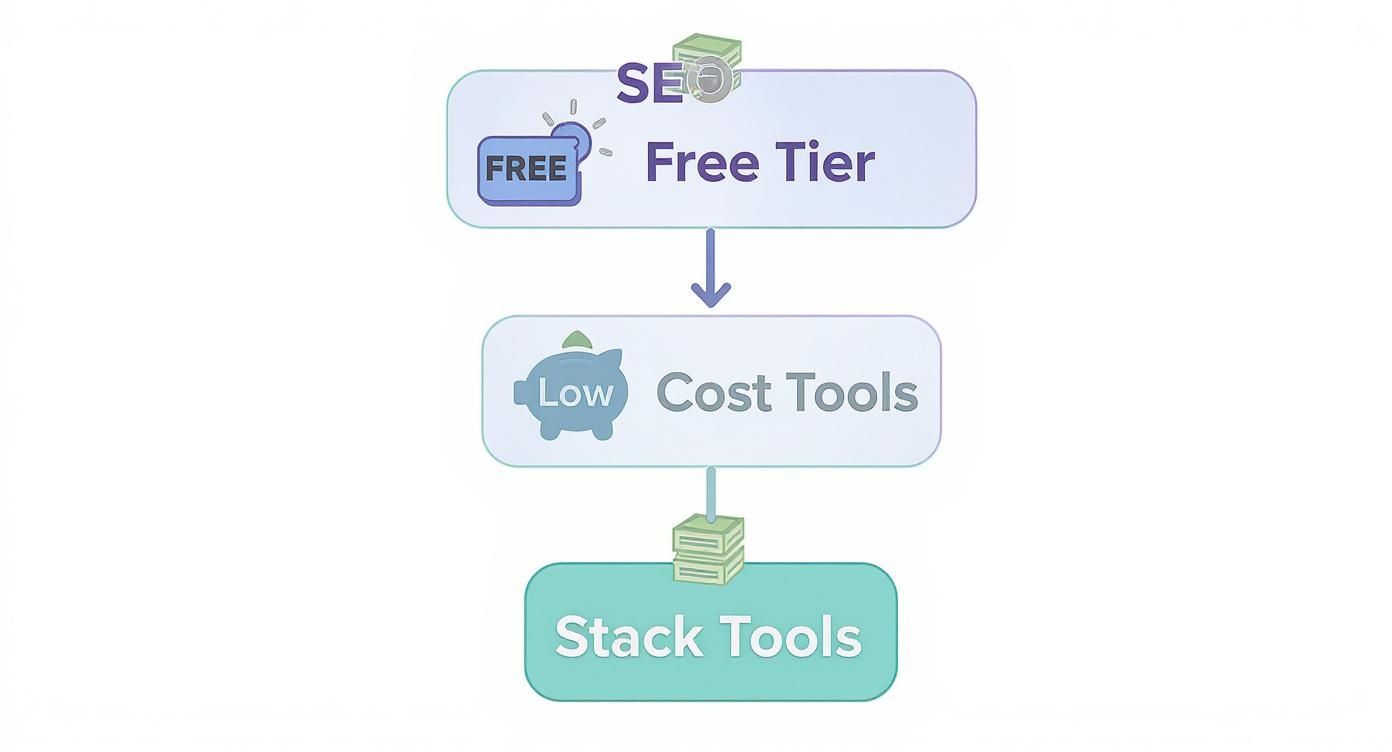
As the guide shows, you can often get the power of a premium suite by cleverly combining several free or low-cost tools—without the headaches and risks.
In the end, this is a business decision. You're weighing immediate savings against long-term stability, security, and peace of mind. My goal is just to give you the information you need to make that call with confidence, whichever path you take.
Your Top Questions About Group Buy SEO, Answered
Even after breaking it all down, you probably still have some nagging questions about how these group buy SEO services actually work. I get it. Let's tackle the most common concerns head-on to clear up any confusion before you even think about diving in.
We'll cover the big ones, from the sticky legal situation to the very real security risks you need to be aware of.
Is Using a Group Buy Service Illegal?
This is the number one question, and the answer isn't a simple yes or no. Using a group buy service is not illegal in a criminal sense—you won't see the police at your door. However, it is a direct violation of the Terms of Service (ToS) for pretty much every tool out there, including giants like Ahrefs and Semrush.
Breaking the ToS is a civil issue, not a criminal one. The worst-case scenario isn't jail time; it's the tool provider discovering the shared account and shutting it down instantly. They do this all the time, and when it happens, you lose access and any money you paid.
Can My Data Actually Be Stolen?
Absolutely, and this is probably the single biggest risk. The danger isn't just theoretical; it comes from the sketchy methods these providers use to give you access. Many require you to install their own browser extension or log in through some strange, third-party portal.
Think about what that means. These unvetted pieces of software can be coded to do anything, like:
- Log every keystroke, capturing passwords for your email, social media, or even your bank account.
- Scrape your browsing history and sell that data to the highest bidder.
- Inject malware or viruses onto your computer.
- Expose your client or project data to the provider or, even worse, other anonymous users on the shared account.
You're essentially handing over the keys to your digital life to an anonymous operator whose entire business is built on breaking rules. The risk of data theft isn't just a possibility; it's baked into the system.
What Happens If the Tool Just Stops Working?
When a group buy SEO service goes down, you're on your own. There’s no official customer support to call, because you're not a legitimate customer of Ahrefs or Semrush. Your only option is to message the group buy provider and hope for the best.
Good luck with that. Support from these operators is famously unreliable. They might take days to reply, offer no real solution, or just vanish completely, taking your money with them. You have zero guarantees—no uptime promise, no service level agreement (SLA), nothing. If a tool breaks right before a huge client report is due, you're simply out of luck.
Do Companies Like Ahrefs Have Official Shared Plans?
Nope. Not a single one. Major players like Ahrefs, Semrush, Moz, and their competitors structure their pricing around individual or team subscriptions.
They do offer multi-seat plans for legitimate agencies and large businesses, but they absolutely do not endorse, permit, or offer any kind of "group buy" plan. Any service claiming otherwise is operating completely outside the rules and against the tool creator's direct policies.
Ready to access over 50+ premium e-commerce and marketing tools without the risks of typical group buys? With EcomEfficiency, you get secure, curated access to everything you need—from Semrush and Helium10 to Midjourney and ChatGPT—all for one low monthly price. Unlock your all-in-one toolkit and start saving today!