9 Ecommerce SEO Best Practices for 2025

In the competitive world of online retail, visibility is the ultimate currency. Driving qualified traffic to your store requires more than just great products; it demands a sophisticated SEO strategy tailored to the unique challenges of ecommerce. Many store owners get stuck on the basics, missing the crucial optimizations that turn search engine users into loyal customers. This guide cuts through the noise, providing a detailed and actionable roadmap of the ecommerce SEO best practices you need to implement for measurable growth.
The goal is to scale without dubious shortcuts and without hurting your credibility.
We will move beyond generic advice and dive deep into specific techniques for every aspect of your site. You will learn how to structure product pages for maximum impact, master technical SEO fundamentals like site speed and schema, and build a content strategy that attracts high-intent buyers. We'll also cover how to develop a powerful internal linking architecture and leverage user-generated content to build authority and trust.
This isn't a theoretical overview. It's a structured roundup of proven tactics designed to enhance your rankings, increase organic traffic, and ultimately boost your sales. Whether you're launching a new Shopify store or scaling an established brand, these strategies will provide the foundation for sustainable success in a crowded market.
1. Optimize Product Page URLs with Keyword-Rich Structure
Creating clean, descriptive URLs is a foundational element of effective ecommerce SEO best practices. Your URL is often the first thing a search engine crawler or a user sees, making it a prime opportunity to communicate relevance and hierarchy. A well-structured URL acts as a clear signpost, guiding both search engines and potential customers to understand the page's content at a glance.
This approach involves moving away from generic, system-generated URLs (like domain.com/product/?id=87321) and toward a descriptive, keyword-rich format. A logical structure, such as domain.com/category/subcategory/product-name, helps establish a clear site architecture that Google rewards. For example, a URL like rei.com/c/camping-and-hiking/tents instantly tells users and search engines what the page is about, improving relevance and user experience.
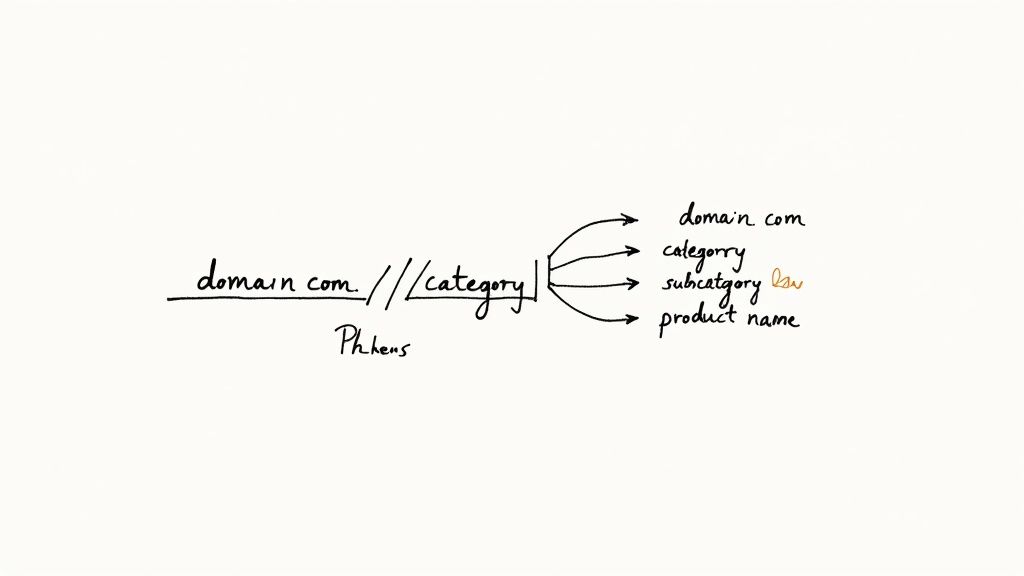
Actionable Tips for URL Optimization
To implement this on your e-commerce site, follow these targeted guidelines. They ensure your URLs are optimized for both crawlers and conversions.
- Be Concise: Aim to keep URLs under 60 characters. Shorter URLs are easier to read, copy, and share.
- Use Hyphens: Always use hyphens (-) to separate words, not underscores (_) or spaces. Hyphens are Google's preferred word separator.
- Prioritize Keywords: Place your primary target keyword as close to the beginning of the URL slug as possible. For instance, use
/mens-running-shoes/instead of/shoes-for-men-running/. - Avoid Dynamic Parameters: Steer clear of using parameters like
?sessionid=or&source=in your indexable URLs, as they can create duplicate content issues. - Match Breadcrumbs: Ensure your breadcrumb navigation path mirrors the structure of your URL. This creates a consistent and intuitive user journey, reinforcing your site's hierarchy.
2. Create Unique, Detailed Product Descriptions
Writing original, comprehensive product descriptions is one of the most impactful ecommerce seo best practices for differentiating your store. Simply copying and pasting manufacturer-supplied text creates duplicate content issues, which can hinder your rankings. Instead, crafting unique narratives for each product allows you to stand out, address customer pain points directly, and capture valuable long-tail keyword traffic.
This practice transforms a generic product listing into a powerful sales and SEO asset. By going beyond basic specifications, you can connect with customers, answer their unasked questions, and provide the detailed information they need to make a confident purchase. For example, Beardbrand excels by weaving storytelling into its descriptions, while Crutchfield offers extensive technical details and installation advice, turning their product pages into valuable resources that rank for informational and commercial queries.

Actionable Tips for Product Descriptions
To implement this on your e-commerce site, follow these targeted guidelines to create descriptions that convert browsers into buyers and satisfy search engine algorithms.
- Prioritize High-Value Products: Start by rewriting descriptions for your bestsellers or highest-margin items to see the quickest return on your effort.
- Mine Customer Feedback: Use reviews, questions, and support tickets to identify key benefits, common concerns, and the language your customers actually use.
- Write for Humans First: Create engaging, persuasive copy that speaks to your target audience's needs and desires. Once the narrative is strong, naturally weave in primary and semantic keywords.
- Incorporate Comparison Data: If you sell similar products, add a small comparison table to help users differentiate between them, which can reduce bounce rates and increase time on page.
- Leverage User-Generated Content: Supplement your descriptions with a section for customer reviews or photos to add social proof and fresh, relevant content.
- Add FAQ Schema: Include a mini FAQ section at the bottom of the product page and use FAQ schema markup. This helps answer specific user questions and can result in rich snippets in search results.
3. Implement Technical SEO Fundamentals for Site Speed
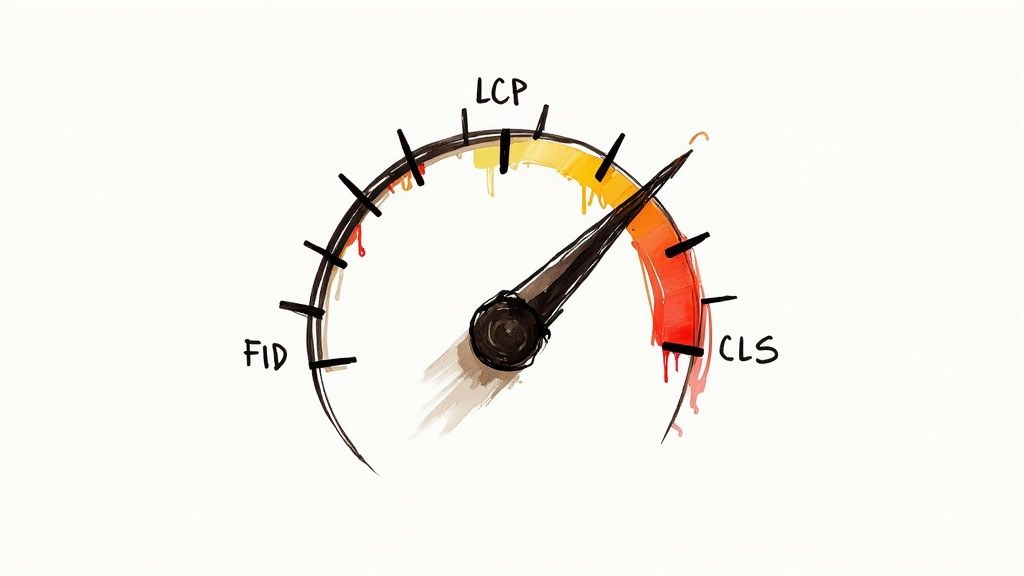
Optimizing your ecommerce site speed is a non-negotiable technical SEO fundamental. Page load time directly impacts user experience, bounce rates, conversion rates, and, crucially, your search engine rankings. With Google’s Core Web Vitals now a confirmed ranking factor, a slow site can significantly harm your visibility, pushing potential customers to faster competitors.
A fast-loading site keeps users engaged and improves crawl efficiency for search engines. For example, Amazon discovered that just 100ms of added latency cost them 1% in sales, showcasing the direct link between speed and revenue. This makes speed optimization one of the most impactful ecommerce SEO best practices you can implement.
Actionable Tips for Site Speed Optimization
To enhance your site's performance, focus on these technical adjustments. They are designed to improve load times and Core Web Vitals scores.
- Compress and Optimize Images: Use modern image formats like WebP or AVIF for superior compression without losing quality. Pay special attention to your largest product images, as they often cause Largest Contentful Paint (LCP) issues.
- Minify and Defer Code: Minify your CSS, JavaScript, and HTML files to remove unnecessary characters and reduce file sizes. Implement critical CSS inline to render above-the-fold content instantly and defer non-critical CSS to load later.
- Limit Third-Party Scripts: Each third-party script (e.g., for analytics, live chat, or ads) adds to your load time. Audit your scripts, remove non-essentials, and load the remaining ones asynchronously so they don't block page rendering.
- Leverage Browser Caching: Configure browser caching to store static assets like logos, CSS, and JavaScript on a user's device. This dramatically speeds up load times for repeat visitors.
- Monitor Performance Regularly: Use tools like Google PageSpeed Insights and GTmetrix to continuously monitor your site's speed and Core Web Vitals. Regular checks help you catch and fix performance regressions before they impact your SEO.
4. Develop Strategic Internal Linking Architecture
A well-planned internal linking structure is one of the most powerful and underutilized ecommerce SEO best practices. It distributes page authority, or "link equity," throughout your site, improves search engine crawlability, and enhances user navigation. By strategically linking from high-authority pages to those you want to rank, you create topical relevance and guide both users and search engines through your site's hierarchy, significantly boosting rankings without relying solely on external backlinks.
This approach involves moving beyond basic navigation and intentionally connecting category pages, product pages, and informational content. For example, a high-traffic blog post about "choosing the right hiking boots" should link directly to relevant boot category and product pages. Similarly, Home Depot excels at this by using comprehensive category linking and "related product" recommendations to create a dense, logical web of internal connections that helps both users and Google understand its vast inventory.
The diagram below illustrates a clean internal linking hierarchy, showing how authority flows from top-level pages down to more specific product pages.
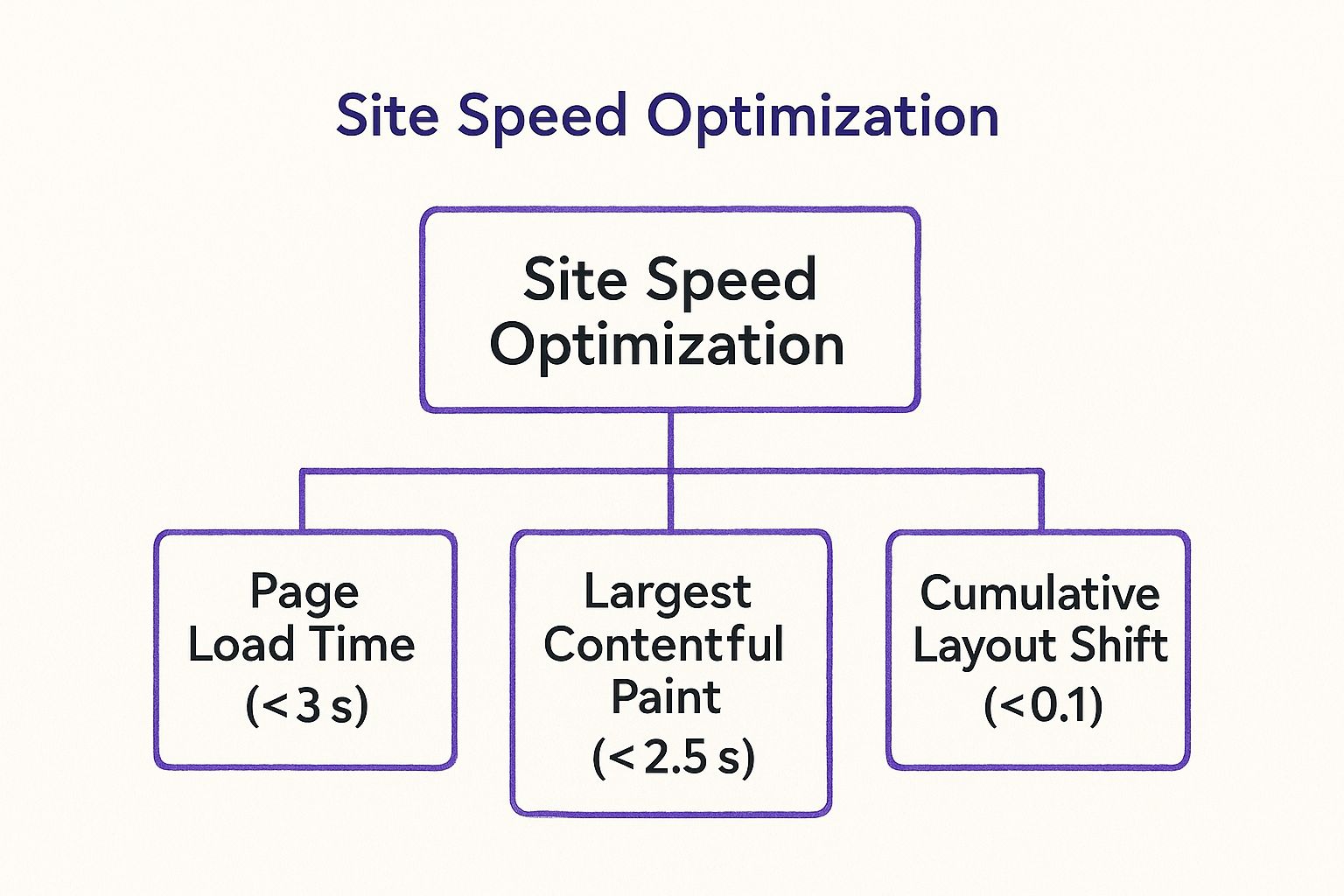
This visual demonstrates how to channel link equity from the homepage to categories and ultimately to individual products, strengthening the SEO value of each page in the funnel.
Actionable Tips for Internal Linking
To build a powerful internal linking architecture for your e-commerce store, apply these focused strategies. They ensure your links effectively distribute authority and improve site navigation.
- Link from High-Authority Pages: Identify your top-performing pages (like your homepage or popular blog posts) and link from them to important category or product pages you want to boost.
- Use Keyword-Rich Anchor Text: Instead of generic text like "click here," use descriptive, keyword-focused anchor text such as "men's waterproof hiking boots" to provide context to search engines.
- Implement "Related Products": Use "Related Products" or "Frequently Bought Together" sections on product pages to create relevant links and increase average order value.
- Create Buying Guides: Develop comprehensive buying guides or blog content that naturally links out to the products and categories you discuss.
- Use Breadcrumbs: Implement breadcrumb navigation to reinforce your site structure and provide an easy way for users to navigate back to parent categories.
5. Optimize for Long-Tail and Transactional Keywords
Targeting specific, lower-competition long-tail keywords with high purchase intent is one of the most effective ecommerce SEO best practices. This strategy moves beyond broad, highly competitive head terms like "running shoes" to focus on more descriptive, multi-word phrases that signal a user is ready to buy, such as "men's trail running shoes for wide feet."
While these queries have lower individual search volume, they attract highly qualified traffic, resulting in significantly higher conversion rates. By creating dedicated content and product pages for these specific needs, you capture customers at the exact moment they are looking to make a purchase. For example, Chewy successfully ranks for niche queries like "grain-free dog food for sensitive stomachs," directly meeting a specific customer need and bypassing broader, more competitive searches.
Actionable Tips for Keyword Optimization
To effectively capture this high-intent traffic, integrate these long-tail keyword strategies across your ecommerce site.
- Mine Customer Data: Analyze your internal site search data, customer service inquiries, and product reviews. These sources are goldmines for discovering the exact language and long-tail phrases your customers use.
- Leverage SERP Features: Use Google’s "People Also Ask" and "Related Searches" sections for any of your core product keywords to uncover common questions and related long-tail variations.
- Target Transactional Modifiers: Actively build keyword lists that include purchase-intent modifiers like "best," "review," "deals," "under $100," or "buy online" to attract users in the final stages of the buying cycle.
- Create Dedicated Pages: For high-value long-tail keyword clusters, consider creating dedicated landing pages, category filters, or detailed blog posts that specifically address that query.
- Optimize for Voice Search: Structure content to answer questions naturally. Voice search queries are often longer and more conversational, making them inherently long-tail (e.g., "what are the best noise-canceling headphones for running?").
6. Build High-Quality Category Pages with Rich Content
Transforming category pages from simple product grids into content-rich hubs is a powerful ecommerce SEO best practice. Instead of just listing products, these pages should serve as comprehensive resources that target high-volume, competitive keywords. By adding unique descriptions, buying guides, and interactive tools, you create valuable assets that attract organic traffic and guide users toward a purchase.
This strategy shifts the focus of category pages from pure navigation to destinations in their own right. Well-optimized category pages can rank for broad commercial intent keywords (e.g., "men's hiking boots") that individual product pages can't capture. For example, REI excels at this by integrating expert advice and buying guides directly onto their category pages, establishing authority and helping customers make informed decisions.
Actionable Tips for Category Page Enhancement
To turn your category pages into SEO powerhouses, implement these targeted strategies to balance rich content with user experience.
- Add Valuable Content: Write unique, descriptive content (300+ words) that introduces the category, highlights key features, and answers common customer questions. Place this content above the product grid or within an expandable "read more" section.
- Include Buying Guides: Embed links to or summaries of detailed buying guides. This helps users navigate complex purchasing decisions and positions your brand as an expert.
- Use Rich Media: Incorporate high-quality videos demonstrating product uses or offering category-specific tips to increase engagement and time on page.
- Leverage Schema Markup: Implement
CollectionPageschema to help search engines understand the purpose and content of your category page more effectively. - Update Seasonally: Keep content fresh by adding relevant seasonal information, such as featuring winter coats on a "jackets" page during colder months or creating holiday gift guides.
7. Implement Comprehensive Schema Markup
Implementing comprehensive schema markup is a powerful technical ecommerce SEO best practice that translates your page content into a language search engines can easily understand. This structured data vocabulary helps Google and other search engines interpret specific details on your product pages, such as price, availability, and ratings, and then display them as "rich results" or rich snippets directly in the search results.
This process gives your listings a significant visual advantage in the SERPs, making them more attractive and informative to potential buyers. For example, a search result for a product on Best Buy might prominently display a sale price, star ratings, and stock status, all powered by schema. This enhanced visibility can directly lead to higher click-through rates, as users are more likely to click on a result that provides immediate, valuable information.
Actionable Tips for Schema Implementation
To effectively leverage structured data, focus on providing detailed and accurate information. These guidelines will help you implement schema that enhances your search presence.
- Use JSON-LD: Implement schema using JSON-LD (JavaScript Object Notation for Linked Data). This is Google's recommended format as it's easier to implement and manage without altering the HTML structure.
- Include Key Product Properties: Ensure your
Productschema includes essential properties likename,image,brand,sku, and product identifiers such asGTINorMPNfor better entity recognition. - Validate Your Markup: Before and after deploying, always test your structured data using Google's Rich Results Test tool to ensure it's free of errors and eligible for rich snippets.
- Add Aggregate Ratings: If your products have genuine customer reviews, use
AggregateRatingschema to display star ratings in search. This builds trust and can dramatically improve CTR. - Sync with On-Page Content: The data in your schema markup must match the information visible to users on the page. Discrepancies can lead to a manual action from Google.
8. Generate and Leverage User-Generated Content (Reviews)
Encouraging and displaying customer reviews is one of the most powerful ecommerce SEO best practices for generating authentic, keyword-rich content. This user-generated content (UGC) provides a steady stream of fresh text that search engines value, all while building trust and social proof with potential buyers. A robust review system turns your customers into an extension of your content marketing team.
This strategy involves more than just enabling reviews; it requires actively soliciting feedback and strategically showcasing it. By integrating customer comments, photos, and ratings directly onto your product pages, you create a dynamic content source that often includes the exact long-tail keywords and natural language questions that real shoppers use. Amazon’s review ecosystem is a prime example, where millions of reviews create an unparalleled depth of unique content that drives both SEO performance and conversions.
Actionable Tips for Leveraging Reviews
To effectively implement a UGC strategy on your e-commerce site, follow these targeted guidelines. They ensure your reviews boost SEO, credibility, and sales.
- Automate Review Requests: Send automated email or SMS requests 7-14 days after delivery, giving customers enough time to experience the product.
- Implement Review Schema: Use structured data (schema markup) to enable star ratings to appear directly in search engine results pages (SERPs), which can significantly improve click-through rates.
- Respond to All Feedback: Actively engage with both positive and negative reviews. Responding professionally to criticism shows that you value customer feedback and builds brand trust.
- Incentivize (Carefully): Offer a small discount on a future purchase for leaving a review. Be sure your policy rewards participation, not just positive feedback, to maintain authenticity.
- Feature Reviews Prominently: Display reviews and star ratings high on the product page, preferably "above the fold." Also, include review counts on category pages to encourage clicks on highly-rated products.
9. Execute Mobile-First Optimization Strategy
Executing a mobile-first optimization strategy is no longer optional; it's a critical component of modern ecommerce SEO best practices. Since Google predominantly uses the mobile version of a site for indexing and ranking (mobile-first indexing), your mobile experience directly dictates your search performance. With the majority of ecommerce traffic now originating from smartphones, a seamless mobile journey is directly tied to both visibility and revenue.
This approach involves designing for the smallest screen first and then scaling up to larger devices, rather than the other way around. It prioritizes responsive design, touch-friendly interfaces, simplified navigation, and fast mobile loading speeds to cater to on-the-go shoppers. E-commerce giants like ASOS, which saw a significant increase in mobile sales after a mobile-first redesign, and Nike, with its flawlessly optimized mobile site and app, exemplify the powerful impact of this strategy.
Actionable Tips for Mobile-First Optimization
To ensure your ecommerce site thrives in a mobile-first world, implement these targeted guidelines. They are designed to enhance user experience and boost mobile conversions.
- Test Your Site: Regularly use Google's Mobile-Friendly Test tool to identify and fix usability issues that could harm your rankings.
- Optimize Mobile Speed: Compress images specifically for mobile screens using
srcsetattributes. Consider implementing Accelerated Mobile Pages (AMP) for blog or content pages to ensure near-instant load times. - Simplify Checkout: Reduce friction by implementing one-tap payment options like Apple Pay, Google Pay, or Shop Pay. Simplify forms with autofill features and mobile-specific keyboards (e.g., numeric keypads for phone numbers).
- Streamline Navigation: Use a well-organized hamburger menu that doesn't hide essential category pages. Ensure all buttons and links are large enough to be easily tapped.
- Enable Easy Contact: Make customer service numbers "click-to-call" so mobile users can contact you with a single tap, improving the customer experience.
9 Ecommerce SEO Best Practices Comparison
| Strategy | Implementation Complexity 🔄 | Resource Requirements ⚡ | Expected Outcomes 📊 | Ideal Use Cases 💡 | Key Advantages ⭐ |
|---|---|---|---|---|---|
| Optimize Product Page URLs with Keyword-Rich Structure | Medium - requires site architecture updates and redirects | Low - mostly developer time and CMS customization | Improved crawlability, indexing, click-through rates | Ecommerce sites needing better URL clarity and SEO basics | Clear URLs boost SEO & UX, easier sharing, better CTR |
| Create Unique, Detailed Product Descriptions | High - content creation is time-intensive and ongoing | High - skilled writers and content tools required | Reduced duplicate content, higher conversions, rich snippets | Large catalogs aiming for SEO differentiation and conversions | Unique content targets long-tail keywords, improves sales |
| Implement Technical SEO Fundamentals for Site Speed | High - technical optimizations and monitoring needed | Medium to High - developer expertise plus tools & CDN costs | Faster load times, better rankings, reduced bounce rates | Sites with performance issues or competitive ecommerce platforms | Direct SEO impact, improves user experience and conversions |
| Develop Strategic Internal Linking Architecture | Medium - planning and ongoing maintenance required | Low to Medium - mostly SEO & content team effort | Better crawl efficiency, page authority distribution, increased engagement | Large ecommerce sites needing stronger site structure and link equity | Enhances crawlability, distributes authority without backlinks |
| Optimize for Long-Tail and Transactional Keywords | Medium - extensive keyword research and content creation | Medium - SEO tools and content development resources | Higher conversion rates, targeted traffic, easier rankings | Stores targeting specific buyer intents and niche products | Cost-effective traffic with higher intent and less competition |
| Build High-Quality Category Pages with Rich Content | Medium to High - content development and SEO balance needed | Medium - content creators and SEO collaboration | Ranks for competitive keywords, reduces bounce, establishes authority | Ecommerce sites with broad inventories looking to rank category terms | Strong commercial keyword targeting, improves user engagement |
| Implement Comprehensive Schema Markup | Medium to High - requires technical SEO and ongoing maintenance | Medium - developer and SEO collaboration | Enhanced search listings with rich results and higher CTR | Sites focused on rich snippets and improving search visibility | Increases click-through rates, better search appearance |
| Generate and Leverage User-Generated Content (Reviews) | Medium - system implementation and moderation required | Medium - review platforms or custom solutions | Fresh content, trust signals, conversion boost, rich snippets | Ecommerce platforms wanting authentic content and social proof | Continuous unique content and improved conversions |
| Execute Mobile-First Optimization Strategy | High - design and development for multiple devices | High - design, development, and testing across devices | Improved mobile rankings, user experience, and conversions | Ecommerce sites with significant mobile traffic | Captures mobile market, enhances UX, future-proofs site |
Putting It All Together: Your Blueprint for Ecommerce Growth
Navigating the landscape of ecommerce SEO can feel overwhelming, but it doesn't have to be a complex puzzle. The journey from digital obscurity to consistent organic traffic is built on a foundation of methodical, strategic actions. We've explored nine critical pillars that, when combined, create a powerful engine for sustainable growth. From crafting keyword-rich URLs and unique product descriptions to implementing a robust internal linking structure, each practice plays a vital role in signaling relevance and authority to search engines.
The key takeaway is that success isn't about finding a single secret hack; it's about holistic execution. A technically sound, lightning-fast website (thanks to technical SEO fundamentals) is only effective if its category and product pages are filled with rich, user-focused content. Similarly, leveraging long-tail keywords and user-generated content like reviews creates a multi-layered strategy that captures customers at every stage of their buying journey. These elements work in concert, not in isolation.
Your Actionable Roadmap to SEO Mastery
Think of these ecommerce seo best practices as your blueprint. Your immediate next step is to conduct a thorough audit of your own online store using these nine points as a checklist.
- Prioritize Low-Hanging Fruit: Which areas present the biggest opportunity for immediate impact? Is it your slow mobile site speed? Or perhaps your thin, duplicated product descriptions? Start there.
- Embrace a Continuous Process: SEO is not a "set it and forget it" task. It requires ongoing refinement, monitoring, and adaptation. Regularly review your keyword performance, update your content, and keep an eye on your technical health.
- Integrate Technical and Content Efforts: Ensure your technical team and content creators are aligned. Implementing schema markup, for example, requires both technical know-how and well-structured content. This synergy is what separates good sites from great ones.
By consistently applying these principles, you move beyond simply competing and start building a formidable competitive moat. You create an online store that not only ranks well but also delivers an exceptional user experience, turning searchers into loyal customers. The ultimate value of mastering these concepts is creating a predictable, profitable, and scalable channel for customer acquisition that isn't dependent on fluctuating ad spend. Your future customers are actively searching for the products you sell. Following this guide ensures they find you first.
Ready to streamline your workflow and execute these ecommerce seo best practices more efficiently? EcomEfficiency consolidates powerful tools for keyword research, competitor analysis, and content optimization into one affordable platform. Stop juggling multiple subscriptions and start building your organic traffic engine today by visiting EcomEfficiency.