Ecommerce Platform Comparison Choosing the Right Solution

Picking your ecommerce platform is one of those make-or-break decisions. It’s not just a piece of tech; it’s the engine that runs your entire online operation, dictating how you grow, how you market, and how efficiently you can get things done day-to-day.
The goal is to scale without dubious shortcuts and without hurting your credibility.
This guide isn't another generic feature list. We're digging into what actually matters for your business. The "best" platform doesn't exist—only the one that’s the right fit for your specific goals, your team's technical comfort level, and your budget.
Setting the Stage for Your Platform Decision
Let’s be clear: choosing an ecommerce platform is a strategic business decision, not just an IT one. This choice will define your daily workflows, shape your customer's experience, and ultimately determine how easily you can scale. Get it wrong, and you're looking at operational headaches and a painful, expensive migration later on.
Think of this comparison as your strategic framework. We’re here to help you cut through the noise and make a choice you can stand behind, one that sets you up for success from day one. We’ll be zeroing in on the major players, looking at how they handle the critical stuff, what they really cost, and how they hold up under pressure.
The Major Contenders
Our analysis will focus on the platforms that dominate the market, each one built for a different kind of business. The main contenders we’ll be putting head-to-head are:
- Shopify: The undisputed favorite for startups and direct-to-consumer (DTC) brands who need to get to market fast without a lot of technical fuss.
- WooCommerce: An open-source powerhouse for anyone already running on WordPress and craving total creative control.
- BigCommerce: A strong candidate for growing brands and B2B sellers who need powerful features baked right in.
- Magento (Adobe Commerce): The go-to enterprise solution for large, complex businesses that require deep, custom functionality.
These four platforms pretty much cover the ecommerce landscape. As of 2025, WooCommerce and Shopify are the two giants in terms of global usage, but they cater to different crowds. WooCommerce is on a massive number of sites—somewhere between 20% and 37% of the market—while Shopify is hovering around 21% but growing faster, especially with bigger merchants in North America. You can dive deeper into the numbers with these current market share reports on storeleads.app.
At its core, every ecommerce platform comparison boils down to one central conflict: simplicity versus control. Hosted platforms like Shopify give you security and convenience, but open-source options like WooCommerce hand you the keys to unlimited flexibility—if you're willing to handle the technical heavy lifting.
To get you started, here's a quick cheat sheet showing which platform typically aligns with different types of businesses.
| Business Profile | Top Recommendation | Key Differentiator |
|---|---|---|
| Startups & DTC Brands | Shopify | Unmatched ease of use and a massive app store for quick launches. |
| Existing WordPress Users | WooCommerce | Seamless integration with WordPress, offering maximum customization. |
| B2B & Complex Catalogs | BigCommerce | Powerful built-in features for wholesale and complex product variants. |
Use this table as a starting point. Now, let’s get into the nitty-gritty and really break down how these platforms stack up on features, scalability, and the true cost of ownership.
Comparing Core Features and Functionality
When you start comparing ecommerce platforms, you quickly realize it's not about which one has the longest feature list. The real key to success is finding the platform whose tools actually match your business model. What’s non-negotiable for a clothing brand, like detailed product variants, might be completely useless to someone selling digital downloads.
This is where we get past the marketing hype and look at how these platforms handle the real, day-to-day work of running an online store. We'll dig into the practical differences in payment processing, inventory management, and shipping to give you a clear sense of what it’s like to live with each platform.
To set the stage, let's look at who's leading the pack. The chart below shows the current market share of the two biggest players, which helps explain their widespread use.
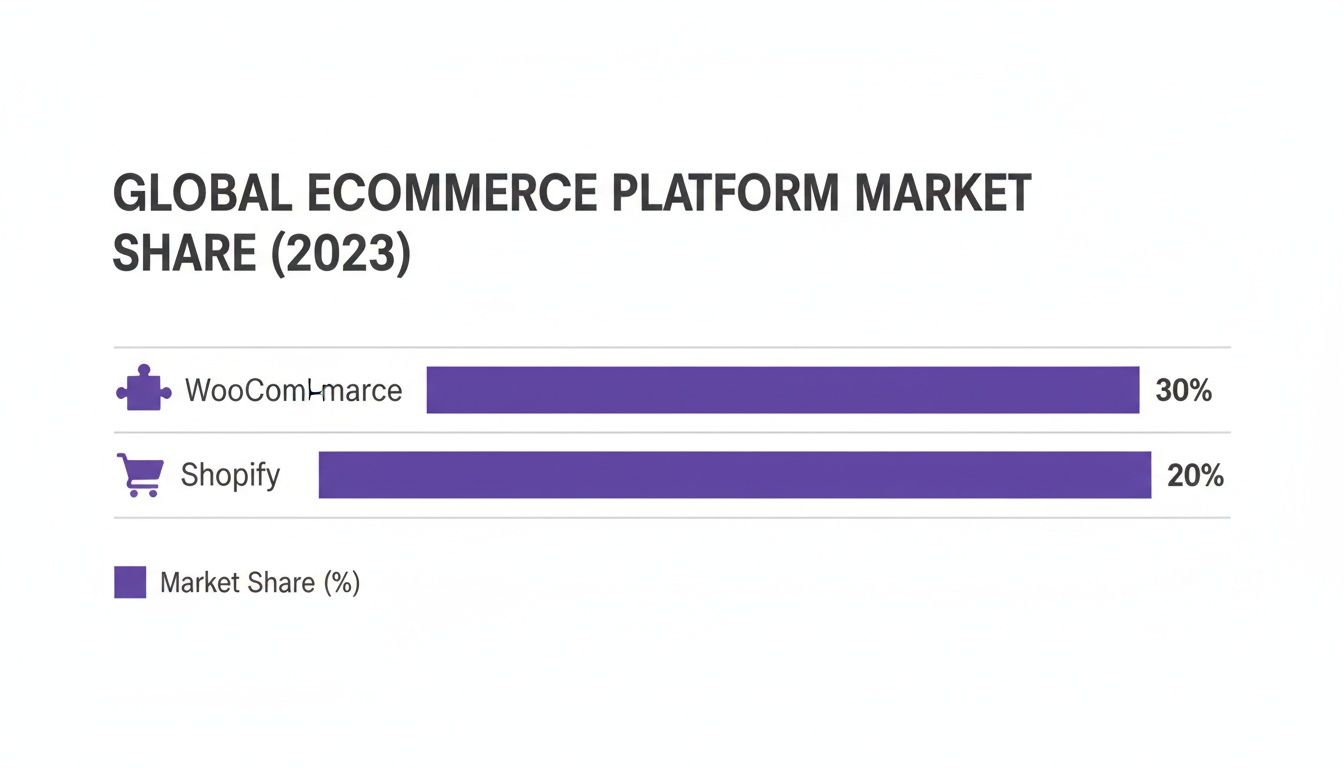
This data really puts the dominance of WooCommerce and Shopify into perspective, showing how they've carved out distinct, massive chunks of the ecommerce world.
Payment Gateway Integration and Flexibility
Getting paid is, of course, the most critical part of your business. The way a platform handles payments—forcing you into their system versus letting you choose your own—has a huge impact on your costs and the customer's checkout experience.
Shopify strongly encourages you to use its built-in solution, Shopify Payments (which is powered by Stripe). The big incentive? They waive their own platform transaction fees if you use it, making your costs more predictable. But if you decide to use an outside gateway like PayPal or Authorize.net, Shopify adds its own transaction fee on top of what your payment processor is already charging you. Those fees can add up.
WooCommerce, on the other hand, is completely open. Because it's open-source, it can connect with just about any payment gateway you can think of through an extension. This gives you the total freedom to hunt for the lowest rates. You only pay the fees your chosen processor charges; WooCommerce never takes an additional slice.
BigCommerce finds a nice middle ground. It proudly advertises zero platform transaction fees on all of its plans, no matter which gateway you use. This gives you the flexibility to work with popular options like PayPal without getting hit with extra costs from the platform itself.
This table offers a clear, side-by-side view of how leading platforms manage core ecommerce functions, highlighting their strengths for specific business needs.
Essential Feature Comparison for Top Ecommerce Platforms
| Feature | Shopify | WooCommerce | BigCommerce | Magento (Adobe Commerce) |
|---|---|---|---|---|
| Payment Gateways | Native Shopify Payments (no fees), but charges fees for third-party gateways. | Open; integrates with hundreds of gateways via plugins with no extra platform fees. | No transaction fees on any plan, regardless of the gateway used. | Highly flexible; integrates with nearly any gateway, often requiring custom development. |
| Product Variants | Highly intuitive UI for creating and managing variants (size, color). Capped at 100 variants per product. | Unlimited variants, but the setup process is more technical and less streamlined. | Advanced native support for complex product options and rules without needing apps. | Extremely powerful and customizable for complex B2B catalogs, but requires expert setup. |
| Multi-Channel | Excellent native integrations with Facebook, Instagram, TikTok, and major marketplaces. | Relies on third-party plugins (e.g., WP-Lister Pro) for marketplace integration. | Strong built-in tools for syncing with Amazon, eBay, and social commerce channels. | Capable of complex multi-store and multi-channel setups, but requires significant development. |
| Ease of Use | The benchmark for user-friendliness. Ideal for beginners and non-technical users. | Steeper learning curve; requires some familiarity with WordPress. | User-friendly dashboard but with more advanced features exposed than Shopify. | Requires deep technical expertise; not suitable for beginners or small teams. |
The right choice really depends on what you value most: the all-in-one simplicity of Shopify, the total control of WooCommerce, or the built-in power of BigCommerce and Magento.
Inventory and Product Management Nuances
Your product catalog is something you'll be working in every single day, and platforms handle this with very different levels of polish. If you have a simple catalog with a few dozen products, honestly, any of them will work just fine. The real test comes when your products get complicated.
Imagine you're selling a t-shirt that comes in five sizes and ten colors. That's 50 unique combinations (SKUs) to manage. On Shopify, this is a breeze. The interface is clean and built for this exact scenario, letting you manage the inventory for every single combination from one screen.
For businesses with highly complex B2B needs or intricate product rules, BigCommerce's native functionality is a key differentiator. It handles advanced product options and wholesale pricing tiers out-of-the-box, features that often require expensive third-party apps on other platforms.
WooCommerce can absolutely handle the same task, but it just doesn't feel as smooth. You first have to set up "attributes" (like size and color) and then tell it to generate all the variations. It’s a multi-step workflow that feels a bit more clunky and technical than what its hosted competitors offer.
Multi-Channel Selling and Shipping Logistics
Modern retail isn't just about your website anymore. Selling on marketplaces like Amazon and eBay, or through social media channels like TikTok, is how you find new customers.
This is an area where Shopify and BigCommerce really shine. They have powerful, built-in integrations that sync your inventory and orders across all these different sales channels right from your main dashboard. Having that central hub is a massive time-saver for anyone trying to manage a brand on multiple fronts. To see just how different these channels can be, check out a detailed comparison between TikTok Shop and Amazon.
With the global ecommerce market expected to reach $6.8 trillion by 2025, having a mobile-friendly store is no longer optional—it's essential. Mobile commerce is on track to account for nearly 60% of all online sales, so your platform's ability to provide a perfect mobile checkout experience is vital for turning visitors into buyers and tackling the shocking 70% average cart abandonment rate.
Evaluating Scalability and Performance Under Pressure
Picking an ecommerce platform isn't just about what works for you today. It's a strategic bet on what will support your business a year, or even five years, from now. Real scalability is more than just handling a traffic spike; it's about how the platform grows with you—supporting a bigger product catalog, more complex orders, and new international markets without grinding to a halt. Let's look at how the top contenders hold up when the pressure is on.
The single biggest factor dictating how a platform scales comes down to its core architecture: is it a fully managed, hosted solution, or are you in the driver's seat with a self-hosted one? Hosted platforms like Shopify and BigCommerce take care of the heavy lifting for you. Self-hosted options like WooCommerce put the responsibility for performance squarely on your shoulders.
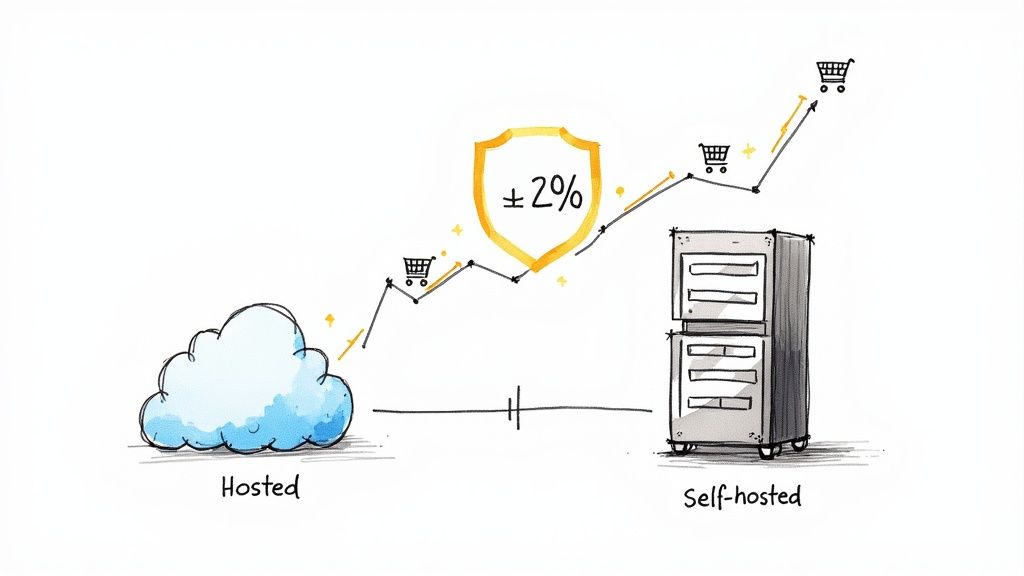
This distinction becomes critical during high-stakes sales events like Black Friday, where even a few minutes of downtime can mean thousands in lost revenue. The data doesn't lie: a 1-second delay in page load time can cause a 7% drop in conversions. Performance is not a feature; it's a necessity.
Managed Infrastructure for Predictable Growth
For most businesses, the "set it and forget it" nature of a hosted platform like Shopify is a massive draw. You don't have to think about servers, security patches, or uptime—ever. Shopify’s entire business model is built on providing a fast, reliable experience that scales on demand. When your product goes viral on TikTok, its infrastructure handles the surge without you lifting a finger.
This baked-in reliability is why Shopify has become the go-to for so many direct-to-consumer brands that just want to focus on their product and marketing. Growth on Shopify is a clear, predictable ladder: you simply move up their pricing tiers to get lower transaction fees and more powerful features. For hyper-growth brands, the leap to Shopify Plus offers virtually unlimited bandwidth and dedicated support, ensuring the platform is never the bottleneck.
BigCommerce delivers a similar promise of managed scalability. It truly shines for businesses with large, complex product catalogs, effortlessly handling thousands of SKUs and intricate product variations without slowing down. Just like Shopify, its plans are tiered based on your annual sales volume, making sure you always have the resources you need.
The Flexibility and Responsibility of Self-Hosting
With WooCommerce, scalability is a completely different ballgame. Since it’s a plugin for WordPress, your site's performance is directly tied to the quality of your web host and your team’s technical chops. A small store can run just fine on basic shared hosting, but a sudden traffic spike will almost certainly bring it to its knees.
As a WooCommerce store grows, you have to actively manage its growth. This means investing in more powerful infrastructure like a Virtual Private Server (VPS) or specialized managed WordPress hosting, which can easily cost hundreds of dollars per month. It also requires a hands-on approach to performance tuning, security monitoring, and updates.
The classic trade-off with self-hosted platforms is control versus convenience. WooCommerce gives you the keys to build a perfectly tuned, high-performance machine, but it demands serious technical oversight to keep it running smoothly, especially under pressure.
This model gives you complete freedom, but it also makes you solely responsible for preventing a crash in the middle of a flash sale.
Comparing Performance Under Stress
Let's imagine a real-world scenario: a post about your product goes viral, and your site is suddenly flooded with traffic.
- Shopify & BigCommerce: Their systems would instantly and automatically scale to handle the influx. Your site would stay fast, the checkout would work seamlessly, and your only job would be to figure out how to fulfill all the new orders.
- WooCommerce: The outcome here is entirely dependent on your prep work. If you've invested in a robust, scalable hosting plan and meticulously optimized your site, it might handle the surge without a problem. But if you're on an inadequate server, the site will likely slow to a crawl or crash entirely, torching sales and damaging your brand's reputation.
Ultimately, the right choice boils down to your resources and priorities. If you value peace of mind and predictable performance, a managed platform is the clear winner. If you have the in-house technical talent and need absolute control over every aspect of your store's environment, the raw power of a self-hosted solution like WooCommerce is hard to beat.
Analyzing SEO, Marketing Tools, and App Ecosystems
A gorgeous online store with the best products in the world is completely useless if nobody can find it. The built-in Search Engine Optimization (SEO) and marketing tools your ecommerce platform provides are the very foundation of how you’ll win customers. A great platform doesn't just display products; it actively helps you pull in shoppers and turn them into buyers.
But the built-in stuff is only half the story. The platform's app ecosystem is the real game-changer, acting as a force multiplier for your efforts. This is where you find specialized tools for everything from sophisticated email marketing and customer loyalty programs to advanced analytics. We’ll look at both the out-of-the-box features and the strength of each platform's app marketplace to see what kind of marketing firepower you're really getting.
Core SEO Capabilities and Control
Nailing your technical SEO is non-negotiable if you want to rank on Google. This is all about how a platform handles things like URL structures, site speed, and structured data—all critical signals that search engines rely on.
Shopify is famous for making things easy, and it handles a lot of the heavy lifting on technical SEO for you. It automatically generates sitemaps and canonical tags, and simple tasks like editing page titles or meta descriptions are a breeze. The trade-off for this simplicity is a lack of control. Its rigid URL structure, which always includes /products/ or /collections/, is a long-standing frustration for SEO pros who want full customization.
On the other end of the spectrum, WooCommerce offers almost total flexibility. Because it’s built on WordPress, you can use incredibly powerful plugins like Yoast SEO to tweak every last detail, from custom URL structures to advanced schema markup. This gives you the power to fine-tune your site for peak performance, but it also means the responsibility for setup and ongoing management is entirely on you.
BigCommerce really hits a sweet spot here. It gives you much more native SEO control than Shopify, letting you create fully custom URLs without any forced subfolders. This built-in flexibility is a major advantage right from the start, and it doesn't require the deep, hands-on technical management that WooCommerce demands.
Evaluating Native Marketing and Sales Tools
Good marketing tools are what turn your website traffic into actual revenue and help you recover sales you might have otherwise lost. A perfect example to look at when comparing platforms is abandoned cart recovery.
- Shopify and BigCommerce: Both platforms include powerful abandoned cart recovery email sequences as a standard feature in most of their paid plans. This lets you automatically reach out to shoppers who left items behind—a proven tactic for boosting conversions that works right out of the box.
- WooCommerce: This kind of functionality isn't part of the core free plugin. To get this essential marketing tool, you have to buy and install a paid extension. This highlights a common theme: features that are standard on SaaS platforms often come as add-ons in the open-source world.
When you're weighing a platform’s marketing power, it's smart to look beyond the built-in features and see what's possible with add-ons. For example, a good AI advertising tools comparison can give you a sense of how you can expand your reach and optimize your campaigns.
A platform's app ecosystem is a direct reflection of its strategic focus. Shopify's massive marketplace is a goldmine for direct-to-consumer marketing, while BigCommerce's more curated apps often solve for B2B and multi-channel selling. WooCommerce’s strength is the sheer, overwhelming volume of the WordPress plugin repository.
The Power of the App Marketplace
Let's be real: no single platform can do everything perfectly on its own. The quality, variety, and cost of third-party apps are what truly unlock a platform's potential, letting you mold it to your exact business needs.
Both Shopify and BigCommerce have enormous app stores filled with thousands of integrations. Shopify’s is the largest by a wide margin, offering a tool for nearly any marketing task you can dream up, from loyalty programs to SMS campaigns. While this variety is a huge plus, the quality can be all over the place, so you have to do your homework.
BigCommerce tends to feature more deeply integrated, enterprise-grade applications, which makes sense given its focus on more complex business models. For instance, you’re more likely to find robust solutions for things like advanced B2B quoting or multi-warehouse inventory syncing.
WooCommerce taps into the vast WordPress plugin library, offering an unparalleled number of choices. This gives you incredible power, but it also comes with risks. Poorly coded or conflicting plugins can drag your site to a crawl or open up security holes. It’s absolutely essential to choose reputable tools and manage them carefully. This reliance on plugins also means the total cost of ownership for a "free" platform can quickly climb to match or even exceed that of a subscription-based one like Shopify.
Getting Real About Pricing and Total Cost of Ownership
When you're comparing ecommerce platforms, that shiny monthly price tag is just the tip of the iceberg. To get a true picture of what you'll actually spend, you need to think in terms of Total Cost of Ownership (TCO). This isn't just the subscription fee; it's every single cost required to keep your store running and, more importantly, growing.
A platform that looks like a bargain at first can quickly bleed your budget dry once you account for transaction fees, payment processing, and the apps you absolutely need to function. These "hidden" costs are where most merchants get their budget wrong, so let's pull back the curtain on what you'll really be paying.
Beyond the Monthly Subscription
The subscription is the obvious line item, but it's the variable fees that take a slice of every single sale that often have a bigger impact on your profit margin.
Here’s what to watch out for:
- Payment Gateway Fees: This is the cost of doing business online, plain and simple. Every platform needs a processor like Stripe or PayPal to handle credit card payments, and they typically charge a percentage plus a flat fee (think 2.9% + 30¢) for each transaction.
- Platform Transaction Fees: Now this is a critical difference between platforms. Some, like Shopify, will charge you an additional percentage on top of the payment gateway fee unless you use their in-house processor, Shopify Payments. In stark contrast, BigCommerce famously charges 0% in platform transaction fees across all its plans—a huge plus for businesses that want predictable costs as they scale.
The Real Cost of Apps and Themes
Let's be honest: no platform does everything you need right out of the box. You'll inevitably rely on themes and apps to add crucial features, whether it's an advanced SEO tool, a customer loyalty program, or a subscription engine. This is where your TCO can quietly inflate.
Take a "free" platform like WooCommerce. The core software costs nothing, but building a store that can actually compete means buying premium plugins. A solid setup for security, shipping, and marketing can easily run you over $500 a year.
Even on hosted platforms, the app costs add up fast. It’s not uncommon for a growing Shopify store to spend an extra $100-$300 per month just on app subscriptions. Suddenly, the TCO of an open-source platform starts looking a lot like a SaaS solution. The main difference is who you're paying—one company or a dozen different developers.
The initial price tag is a distraction. A platform's true cost is revealed over time through transaction fees and mandatory app subscriptions. The cheapest option today is rarely the most cost-effective solution a year from now.
Cost Scenarios for Different Business Stages
The right platform choice really depends on where your business is today and where it's headed. Here’s a rough idea of how TCO plays out at different stages:
The Bootstrapped Startup (Under $50k/year)
At this stage, a basic Shopify or BigCommerce plan usually offers the lowest TCO. Their all-in-one nature means you don’t have to worry about separate hosting costs or a long list of paid apps, giving you a predictable monthly bill that’s perfect for a tight budget.
The Growing Mid-Market Brand ($500k/year)
This is where the calculation gets a bit more complex. A self-hosted WooCommerce store might seem cheaper on paper. But once you add the cost of premium hosting, developer maintenance, and all those plugin subscriptions, its TCO often ends up right alongside a mid-tier Shopify or BigCommerce plan—which comes with bundled support and security.
The market reflects this diversity of needs. As of 2025, Shopify holds about 30% of the U.S. market, making it the dominant player. Yet, Wix follows with 23%, while WooCommerce and Squarespace each serve around 15%, proving that different cost models resonate with different types of businesses. You can explore more on the latest U.S. platform market share on Statista.com.
Making Your Final Decision
Choosing the foundation for your store is a serious commitment. It's time to move past the feature lists and get down to what really matters: your business goals. The truth is, there's no single "best" platform—only the one that fits your specific needs like a glove.
The right platform has to align with your budget, your team's technical skills, and where you see your business in the next few years. Get this choice right, and your platform will feel like a true partner in your growth. Get it wrong, and it can quickly become a massive operational headache.
Recommendations For Your Business Type
To cut through the noise, I’ve matched common business models with the platforms where they tend to thrive. Think of this as a compass pointing you in the right direction based on what you’re trying to build.
For Startups and DTC Brands Needing Simplicity and Speed
There's a reason so many modern direct-to-consumer brands flock to Shopify. Its all-in-one system is incredibly reliable and the interface just makes sense. It lets you focus on your products and marketing instead of getting stuck in the technical weeds. If getting to market fast is your number one goal, Shopify is the obvious frontrunner.
For Businesses with B2B Needs or Complex Catalogs
This is where BigCommerce really starts to pull ahead. It's built from the ground up to handle complexity, offering far more powerful native features for B2B, wholesale, and stores with huge, intricate product catalogs. If you need robust functionality out-of-the-box without having to patch everything together with a dozen apps, BigCommerce is the stronger choice.
Your final decision isn't about ticking boxes on a spreadsheet; it's a strategic choice. Are you prioritizing ease of use, built-in power, or total creative freedom? Each platform masters one of these domains.
For WordPress Veterans Who Demand Total Control
If your business already lives on WordPress, or if you're the type who wants to control every last pixel and line of code, WooCommerce is the undisputed king. It definitely requires more hands-on technical management, but its flexibility is second to none. You get the power to build a completely bespoke experience, as long as you have the technical chops (or the team) to back it up.
This final matrix should help visualize these recommendations, letting you see how your priorities stack up against each platform's strengths.
| Business Priority / Use Case | Shopify | WooCommerce | BigCommerce |
|---|---|---|---|
| Ease of Use for Beginners | ⭐⭐⭐ | ⭐ | ⭐⭐ |
| B2B & Complex Catalogs | ⭐⭐ | ⭐⭐ | ⭐⭐⭐ |
| Content-Focused Commerce (Blog) | ⭐⭐ | ⭐⭐⭐ | ⭐⭐ |
| International Sales | ⭐⭐⭐ | ⭐⭐ | ⭐⭐⭐ |
| Unlimited Customization | ⭐ | ⭐⭐⭐ | ⭐⭐ |
A Few Final Questions
Even after a deep dive into platform features, you probably still have a few questions buzzing around. That’s completely normal. Let's tackle some of the most common things merchants want to know before they make their final decision. Getting these right is key to picking a partner you'll stick with for years.
Which Ecommerce Platform Is Actually Best for SEO?
This is a classic question, but there's no magic bullet. Your SEO success hinges on your strategy, not just the platform itself. That said, they offer different levels of control.
If you want to get under the hood and tweak every last detail, WooCommerce is your playground. Because it's open-source, you have total freedom. Pair it with a powerhouse plugin like Yoast SEO, and you can fine-tune everything from URL structures to advanced schema markup. It's the ultimate setup for control freaks.
On the other hand, platforms like Shopify and BigCommerce give you a solid SEO foundation right out of the box. Their built-in features are more than enough for most businesses to rank well, and you won't need a developer on speed dial to manage them. They're a fantastic choice if you'd rather focus on content and marketing than technical tinkering.
Can I Just Switch Platforms Later If I Pick the Wrong One?
Technically, yes, you can migrate. But I’ll be blunt: it’s a major undertaking. Moving your entire business—products, customer data, order history—is a delicate operation. You'll almost certainly need specialized migration tools or to hire a developer to make sure nothing gets lost or broken along the way.
Think of it like moving your brick-and-mortar store to a new building. Sure, you can pack up your inventory (your data), but you have to completely rebuild the store's layout, shelving, and decor (your theme and apps) from the ground up. The cost and disruption are significant, which is why it’s so much smarter to choose a platform that can grow with you from day one.
Your ecommerce platform isn't just a piece of software; it's the foundation of your business. Picking a scalable solution from the start is the single best way to future-proof your store and avoid a painful migration down the road.
What's the Real Difference Between Hosted and Self-Hosted?
This is one of the most fundamental choices you'll make, and it all comes down to control versus convenience. It directly impacts your responsibilities, your freedom, and what you’ll pay over time.
- Hosted Platforms (SaaS): Think of Shopify or BigCommerce. For a set monthly fee, they handle everything for you—the servers, security patches, software updates, and performance. It's an all-in-one package designed for peace of mind.
- Self-Hosted Platforms (Open-Source): This is where tools like WooCommerce or Magento (Adobe Commerce) live. You download the software for free but have to install it on your own web hosting. This gives you complete control to customize anything, but it also means you’re on the hook for all the technical stuff: security, updates, and keeping the site fast.
So, you have to decide what you value more: the ease of a managed service or the total freedom of a DIY setup.
How Do Transaction Fees Really Work on These Platforms?
This is where the hidden costs can bite you, so pay close attention. The way platforms handle transaction fees can make a real difference to your bottom line.
Shopify, for instance, has its own processor, Shopify Payments. If you use it, you pay a standard processing fee (from 2.9% + 30¢ down to 2.4% + 30¢). But here's the catch: if you decide to use an external payment gateway like Stripe or Authorize.net, Shopify charges you an additional platform fee on top of what your processor takes.
BigCommerce famously charges 0% in platform transaction fees across all its plans. This is a huge selling point. You still pay your payment processor, of course, but BigCommerce doesn't take an extra cut, which makes your costs much more predictable.
With WooCommerce, since it's just software, there are no platform fees at all. Your only transaction costs are what your chosen payment processor, like Stripe or PayPal, charges you directly.
Instead of juggling dozens of expensive tools for research, SEO, and creative production, simplify your stack with EcomEfficiency. Get bundled access to over 50 premium e-commerce tools for one low monthly price, cutting your software costs by up to 99%. Join EcomEfficiency today and equip your team with everything needed to outcompete the market.