Your Ecommerce Content Marketing Strategy to Drive Sales

A solid ecommerce content marketing strategy is your plan for creating and sharing genuinely useful content. The goal? To attract, engage, and keep customers, ultimately leading them to make a purchase. It's about building trust and becoming a go-to resource, not just pushing product ads.
The goal is to scale without dubious shortcuts and without hurting your credibility.
Building Your Ecommerce Content Foundation
Before you even think about writing a blog post or filming a video, you have to lay the groundwork. A powerful content strategy isn't built on guesswork; it’s built on a deep, almost obsessive understanding of your customer and a clear vision of what you’re trying to achieve.
Skipping this foundational work is like building a house without a blueprint. Sure, you might get some walls up, but the whole thing is likely to collapse. This is where you move from vague ideas to specific, actionable insights, creating a framework that ensures every single piece of content has a purpose.
Define Your Ideal Customer with Buyer Personas
You can't create content that clicks if you don’t know who you’re talking to. Old-school demographics like "women, ages 25-40" just don't cut it anymore. What you need are detailed buyer personas—vivid profiles of your ideal customers, pieced together from real data and research.
If you want your content to actually connect with people, you first need to figure out who they are. A great starting point is learning how to identify your target audience.
Go deeper than just age and location. Dig into the why behind their behavior:
- Motivations: What really drives them to buy? Is it a commitment to sustainability, a need for total convenience, or a passion for a specific hobby?
- Pain Points: What problems are they trying to solve? What are the little frustrations in their day that your product can fix?
- Content Habits: Where do they hang out online? Are they scrolling through quick TikTok videos, watching in-depth YouTube tutorials, or reading detailed blog posts on their lunch break?
Imagine you sell high-performance running shoes. You might have a persona like "Competitive Chris," a 32-year-old marathoner who geeks out on performance data and follows pro athletes on Instagram. But you could also have "Casual Kelly," a 45-year-old who runs for her mental health and wants comfortable, stylish gear she discovered on Pinterest. Their needs are worlds apart, and your content has to reflect that.
Creating these personas forces you to think like a real person, not just a faceless demographic. This is the secret to making content that truly resonates and feels personal.
Set Sharp, Measurable Goals
Every piece of content you create needs a job to do. Without clear goals, you're just making noise online. Vague objectives like "increase brand awareness" are impossible to measure and, frankly, not very useful. Instead, you need to connect your content directly to specific business outcomes.
The goal isn’t to create content. The goal is to create content that achieves a specific business objective. Every article, video, and social post should have a purpose tied directly to a key performance indicator (KPI).
Here are a few examples of sharp, actionable goals for an ecommerce store:
- Increase organic traffic to our blog by 30% in Q3.
- Boost the conversion rate from blog posts to product pages by 15% over the next six months.
- Generate 500 new email subscribers each month from our downloadable buying guides.
- Cut down on customer support tickets about product usage by 20% by creating better how-to videos.
These precise targets turn your content from a simple creative task into a powerful growth engine for your business.
To make sure all your efforts are aligned, it helps to organize them into a clear structure. Think of your strategy as having a few core pillars that support everything you do.
Key Pillars of an Ecommerce Content Strategy
This table breaks down the essential components that form the backbone of any successful ecommerce content plan.
| Pillar | Objective | Key Activities |
|---|---|---|
| Audience & Goals | Define who you're talking to and what you want to achieve. | Create buyer personas, conduct keyword research, set SMART goals. |
| Content Creation | Produce valuable content that addresses audience needs. | Develop topic clusters, build a content calendar, write briefs. |
| Distribution & Promotion | Get your content in front of the right eyes. | SEO, email marketing, social media promotion, paid ads. |
| Measurement & Optimization | Track performance and continuously improve. | Set up analytics, monitor KPIs, run A/B tests, update old content. |
With these pillars in place, you have a repeatable framework for turning ideas into measurable results, ensuring that your content marketing isn't just a cost center, but a genuine revenue driver.
Creating Content That Actually Sells
Alright, you’ve laid the groundwork. Now comes the fun part: moving from planning to actually creating content that gets people to click “add to cart.”
The secret here isn't a hard sell. Far from it. The goal is to create content so genuinely helpful and engaging that buying from you feels like the most natural next step for your customer. We're not just creating things to be read or watched; we're crafting experiences. This requires a small but crucial shift in mindset—stop thinking like a seller and start acting like a problem-solver. Your content is the bridge that connects a customer's need to your product's solution.
Go Beyond Specs with Story-Driven Product Descriptions
Let's be honest: your product descriptions are some of the most valuable real estate on your entire website. Yet so many brands treat them like a chore, slapping up a dry list of features and dimensions. This is a huge missed opportunity. A great product description doesn't just inform; it inspires.
Stop listing features and start translating them into real-world benefits. Don't just tell me your hiking boots are "waterproof." Paint a picture for me. Describe the feeling of confidently splashing through a mountain stream, knowing my feet will stay perfectly dry and comfortable for the rest of the hike.
- Spark an Emotion: Use sensory language that helps shoppers feel what it’s like to use your product.
- Tell a Story: Where did this product come from? What inspired its design? Give it a backstory that makes it more than just an object.
- Be the Solution: Speak directly to the pain points you identified in your customer personas and frame your product as the hero they’ve been looking for.
When you do this, you’re no longer selling an item. You're selling an experience, an outcome, and a solution to a problem.
Become a Trusted Advisor with Guides and Comparisons
When people are on the fence about a purchase, where do they go? Straight to Google. This is your moment to shine and become their go-to expert.
By creating in-depth buying guides and honest comparison articles, you position your brand as a knowledgeable, trustworthy resource. This lets you capture shoppers right when they're in that critical consideration phase.
Think about it. If you sell coffee gear, a post titled "French Press vs. Pour-Over: Which Is Right For You?" is pure gold for someone looking to level up their morning ritual. By giving them a fair, comprehensive breakdown, you build immediate trust.
Shoppers are already doing their homework; over 81% dig into online research before making a purchase. When your brand provides the answers, you're not just another store—you're the expert they trust to help them make the right choice.
This kind of content does more than just pull in traffic. It pre-qualifies your visitors, meaning the people who end up on your product pages are already educated, confident, and much closer to making a purchase. To really nail this, you need to ensure your content is built to convert. This guide on strategies to improve ecommerce conversion rates in fashion has some great, practical tips you can apply.
Embrace High-Impact Visual and Video Content
Words are essential, but let's face it—visuals are what stop the scroll. In today's market, high-quality images and video aren't just nice-to-haves; they're non-negotiable.
The data doesn't lie. By 2025, short-form video, images, and livestreams were already crowned the most effective content formats for ecommerce. Video is especially powerful—a staggering 87% of consumers said they've been convinced to buy something after watching a brand's video. This trend has only been accelerated by the rise of m-commerce, which now accounts for an estimated 60% of all online sales, making mobile-first visuals an absolute must. You can find more of these insights in this breakdown of ecommerce marketing statistics on seoprofy.com.
And no, you don't need a Hollywood-level production budget. Modern tools have made creating professional-looking visuals incredibly accessible.
For example, here’s a peek inside Canva, a popular design tool, showing how simple it is to whip up a branded Instagram story from a template.
This just goes to show you don't need to be a graphic designer to create visuals that look polished and on-brand.
Here are a few formats to start weaving into your content plan:
- How-To Videos: Don't just tell people how your product works—show them. Demonstrate it solving a real-world problem.
- User-Generated Content (UGC): Nothing builds trust like social proof. Feature photos and videos from your actual customers.
- Infographics: Have complex information or data to share? Break it down into a visually appealing and highly shareable format.
- 360-Degree Product Views: Let shoppers explore your product from every angle. This boosts confidence and can seriously cut down on returns.
Visuals grab attention, make your message easier to digest, and are far more likely to be shared, multiplying your reach and impact.
How To Build a Scalable Content Workflow
A brilliant e-commerce content strategy is just a dream without a solid system to bring it to life. Without a structured workflow, even your best ideas will get lost in a chaotic mess of missed deadlines and inconsistent quality. The secret to scaling your content isn't about working harder; it's about working smarter by building a repeatable process that actually grows with your business.
This means leaving behind random acts of content. It’s time to establish a predictable, organized production cycle. When you have a real workflow in place, you eliminate that last-minute panic and can finally ensure a steady stream of high-quality content flows out to your audience, building momentum and driving sales.
Think of your content as building blocks. You start with the essentials and expand from there, as this flow illustrates.
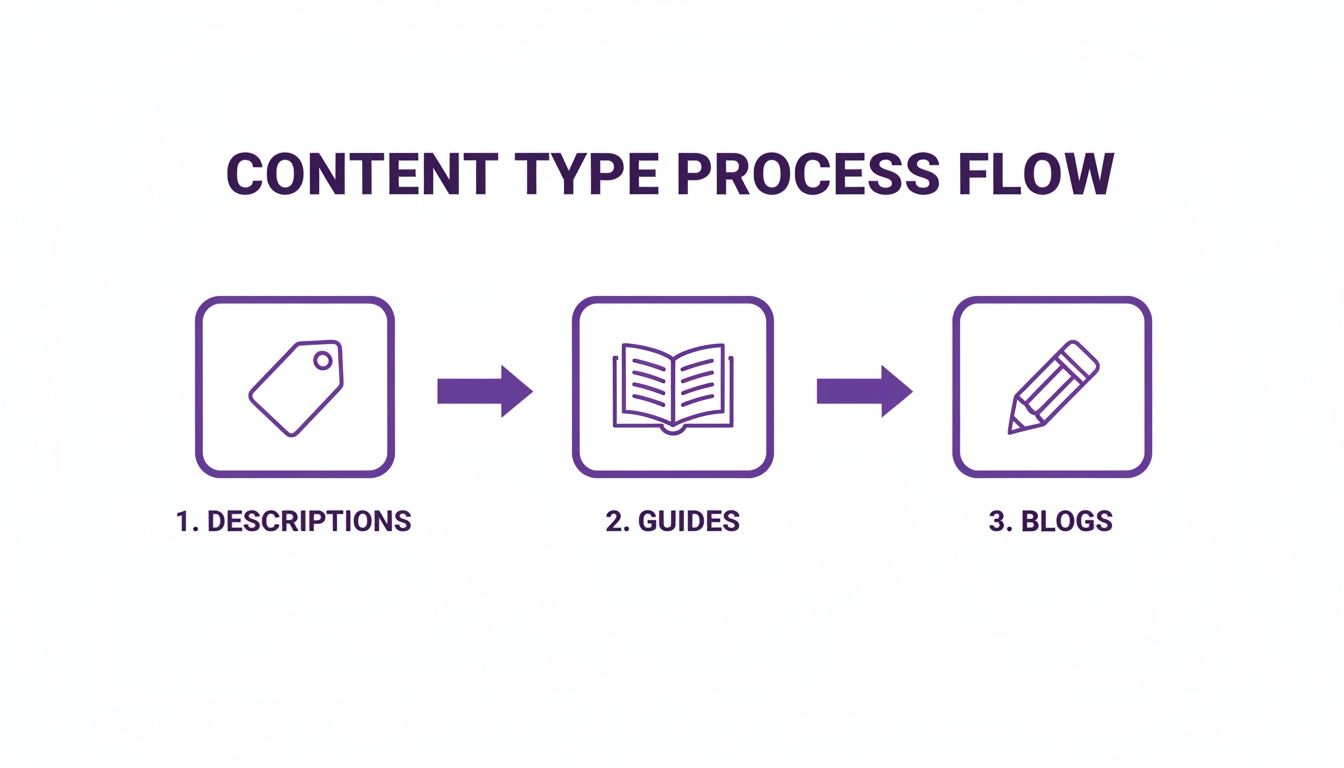
You can see how different content types build on each other—starting with product-focused descriptions and then expanding into educational guides and blogs to catch customers at different points in their journey.
Master Your Output with a Content Calendar
Your content calendar is the command center for your entire content operation. Forget thinking of it as just a list of due dates; it's a strategic tool that gets your team on the same page, prevents awkward content gaps, and keeps everything on track. A well-managed calendar is what turns your strategy into an actual plan.
A good calendar needs more than just a publish date. You should be tracking key details like:
- Topic & Title: The main subject and a working headline.
- Content Format: Is it a blog post, a video, an infographic, or maybe a social media carousel?
- Target Persona: Which of your customer personas are you speaking to?
- Primary Keyword: The main search term you're targeting for SEO.
- Status: Keep it simple with labels like "Brief Created," "In Progress," "In Review," and "Scheduled."
You don't need fancy software to start. Tools like Trello, Asana, or even a well-organized Google Sheet can work wonders. The goal is a clear, at-a-glance view of your entire production pipeline.
Create Crystal-Clear Content Briefs
Ever get a piece of content back and wonder if the creator read your mind... or just guessed? Inconsistent quality is almost always a symptom of unclear instructions. A detailed content brief is your insurance policy against work that misses the mark. It gives your writers, designers, and editors everything they need to get it right the first time, saving you countless hours in painful revisions.
A great content brief doesn’t just tell a creator what to make; it explains why it matters. It connects the individual piece of content back to the larger business goal, inspiring better, more strategic work.
Every brief should be a blueprint for success. To make sure your team creates content that’s not just well-written but also perfectly aligned with your strategy, a brief is non-negotiable.
Here’s a simple but effective template you can adapt. It forces you to think through the critical details before you assign the work.
Sample Content Brief Template
| Section | Description | Example |
|---|---|---|
| Working Title | A clear, descriptive headline for the piece. | "The Ultimate Guide to Choosing Sustainable Yoga Mats" |
| Target Audience | Who is this for? Be specific about the persona. | "Eco-conscious millennials (Persona: 'The Mindful Mover')" |
| Primary Keyword | The main SEO keyword to target. | "sustainable yoga mat" |
| Secondary Keywords | Related terms to include naturally. | "eco-friendly yoga mat," "cork yoga mat," "natural rubber mat" |
| Core Goal | What should this content achieve? | "Drive organic traffic and capture emails via our 'Eco Fitness Guide' lead magnet." |
| Key Talking Points | Must-have points or sections to cover. | "1. Why materials matter. 2. Compare cork, rubber, and jute. 3. How to clean/care for it." |
| Tone & Voice | How should this content sound? | "Informative, friendly, and slightly aspirational. Avoid overly technical jargon." |
| Call-to-Action (CTA) | What's the next step for the reader? | "Primary: Download our 'Eco Fitness Guide.' Secondary: Shop our new yoga mat collection." |
| Internal Links | List of relevant pages on your site to link to. | Link to the cork mat product page and a blog post on "5 Beginner Yoga Poses." |
This structure leaves little room for error and empowers your team to produce their best work consistently.
Assemble Your Content Creation Team
As you grow, you'll hit a fork in the road: hire an in-house team, or work with freelancers and agencies? Honestly, there's no single right answer, and many successful brands find a sweet spot with a hybrid model.
In-House Team: This route gives you deep brand knowledge, total alignment, and super-fast communication. It's perfect for core strategic roles like your content manager or lead writer. The downside? Higher fixed costs and a much slower hiring process.
Freelancers & Agencies: These guys offer specialized skills on demand—think graphic design, video editing, or technical SEO—without the overhead of full-time staff. The main challenge is making sure they truly get your brand voice and maintaining that consistency across different creators.
I've found the best approach is often an in-house content lead who manages a trusted network of freelancers. This gives you tight strategic control while keeping the flexibility to scale production up or down as your needs change.
Use AI as a Smart Assistant Not a Replacement
AI tools can be an incredible partner in content creation, but they are most effective as assistants, not as the final author. Relying on AI to write entire articles often results in soulless, generic content that completely fails to connect with your audience. Worse, it can damage your brand's credibility.
Instead, think of AI as a way to supercharge your workflow:
- Brainstorming & Outlining: Use tools to bust through writer's block by generating topic ideas or creating detailed outlines for your human writers.
- First Drafts: Let an AI tool handle the rough first draft. Then, your writer can focus their expert time on refining it, editing, and injecting your brand’s unique personality.
- Repurposing Content: Ask an AI to summarize a long-form blog post into a dozen punchy social media captions or bullet points for an email newsletter.
This balanced approach lets you seriously increase your output without sacrificing the authentic human touch that builds real trust and loyalty with your customers.
Getting Your Content in Front of the Right People
You've done the hard work of creating some genuinely fantastic content. That's a huge win, but it's only half the job. A brilliant blog post or an insightful buying guide doesn't do you much good if no one ever sees it. Now it's time to switch gears from creator to promoter and make sure all that effort pays off.
This isn't about just spamming links across the internet. It's about a smart, multi-channel distribution plan that puts your content on the digital doorsteps of the people you want to reach. You need a system that consistently drives traffic, sparks conversation, and ultimately, grows your business.
Dominate Search with Smart SEO
For most ecommerce brands, organic search is the gift that keeps on giving. It’s your most valuable and sustainable source of traffic. When someone is actively searching for a solution you provide, you need to be the answer they find. That means getting serious about search engine optimization (SEO).
SEO is a deep rabbit hole, but a few core practices will deliver the biggest bang for your buck.
- Nail Your Keywords: Go back to that content brief you made. Are your primary and secondary keywords naturally woven into your title, main headings (H1, H2s), meta description, and the opening paragraph?
- Build Your Internal Web: This is one of the easiest yet most powerful SEO tactics. From your new blog post, make sure you link out to relevant product pages and other related articles on your site. This is great for Google, but it also keeps visitors clicking around your site longer.
- Think Mobile-First: This is non-negotiable. With over 60% of online sales now happening on mobile, your content has to look and feel great on a smartphone. If it’s a pain to read, you’re losing customers. Period.
A tool like Ahrefs is invaluable here. You can literally see what keywords your competitors are ranking for, giving you a clear roadmap for what topics your audience is hungry for.
Engage Your Biggest Fans with Email
Your email list is pure gold. These aren't just random people; they've explicitly asked to hear from you. So, don't just hit them with sales promotions. Use this channel to show off your great content.
Your email subscribers are your built-in fan club. They're far more likely to read, engage with, and share your content than anyone else. Sending them valuable, non-salesy content is how you build a real relationship and earn long-term loyalty.
When you publish a new guide or post, send a dedicated email letting them know. Frame it as something helpful you created just for them. This simple act builds incredible trust and keeps you top-of-mind long after they've made a purchase.
Tailor Your Content for Each Social Platform
Simply blasting the same link across all your social channels doesn't work. Every platform has its own vibe, its own language, and its own content formats. You have to play by their rules.
- Instagram: It's a visual world. Pull a few key stats from your article and turn them into a slick infographic for a carousel post. Or, film a quick Reel summarizing the top 3 tips from your guide.
- Pinterest: Treat Pinterest like a visual search engine, not a social network. Create beautiful, vertical pins with bold text overlays that link back to your buying guides and how-to articles. It’s a slow burn, but it can drive traffic for years.
- TikTok: This is the king of short-form video. Don't just talk about your product; show it in action, solving a problem in a quick, entertaining clip. Remember, a staggering 49% of TikTok users have bought something after seeing it on the platform.
The secret is to repurpose, not just repost. A single, well-researched blog post can be sliced and diced into a video, an infographic, a handful of tweets, and a Pinterest board—dramatically expanding its reach.
Partner with People They Already Trust
Sometimes the quickest way to find a new audience is to borrow one. Partnering with influencers and creators who have already earned the trust of your ideal customer can be a game-changer.
Forget the mega-celebrities. Look for micro-influencers whose followers and values are a perfect match for your brand. Their endorsement comes across as a genuine recommendation from a trusted friend, not a clunky ad. A single, authentic product review or tutorial from the right creator can introduce your brand to thousands of engaged and ready-to-buy customers.
How to Measure and Optimize Your Content Performance
Creating amazing content is really just the beginning. If you want to build an ecommerce content strategy that actually moves the needle, you have to let data lead the way. Without measurement, you're just guessing—throwing things at the wall to see what sticks, with no real way of knowing what's working, what's a waste of time, and where your best opportunities are hiding.
This is where you close the loop. You turn your creative work into a predictable engine for growth. The cycle is simple but incredibly powerful: measure what matters, learn from the results, and then refine your approach. This continuous feedback loop is what separates the brands that get lucky once in a while from the ones that build lasting success.
Identifying KPIs That Actually Matter
Forget about vanity metrics. Sure, seeing a big number for page views feels good, but it doesn't pay the bills. For any ecommerce business, your focus needs to be on Key Performance Indicators (KPIs) that draw a straight line from your content to your bottom line.
- Content-Assisted Conversions: This is the big one. How many sales can be traced back to a customer interacting with a specific piece of content? This metric is the ultimate proof of your content’s ROI.
- Traffic-to-Lead Conversion Rate: For your top-of-funnel guides and articles, what percentage of readers are signing up for your email list? This shows how well you're turning casual visitors into valuable leads you can nurture.
- Average Engagement Time: Are people actually sticking around to read or watch what you've created? Longer engagement times are a strong signal that your content is high-quality and truly connects with your audience.
- Organic Keyword Rankings: Are your articles climbing the search results for the keywords you're targeting? This is a fundamental indicator of your long-term organic health and visibility.
Tracking these KPIs tells a much more compelling story than traffic alone. It shows you which content formats and topics are not just pulling in an audience, but are actively guiding them toward a purchase.
Setting Up Your Content Dashboard
You can't act on data you can't easily see. Pulling all your most important KPIs into a single dashboard is essential for making quick, informed decisions. It saves you from the headache of digging through a dozen different reports and gives you an immediate, at-a-glance view of your content's health.
Google Analytics 4 (GA4) is a fantastic, free tool for this. You can build a custom "Explorations" report that’s dedicated entirely to your content's performance.
Your dashboard isn’t just a report; it’s your command center. It should tell you a clear story about what’s working and what isn’t, allowing you to confidently decide where to invest your time and budget next.
A simple but highly effective dashboard could include widgets for:
- Top Performing Blog Posts by Conversions: See exactly which articles are driving sales.
- Conversion Rate by Traffic Source: Find out if organic search, social media, or email is bringing in your most valuable customers.
- New vs. Returning Users from Content: Understand if your content is attracting new people or doing a great job of nurturing your existing audience.
- Top Landing Pages from Organic Search: Pinpoint which pieces of content are your biggest SEO powerhouses.
Once this is set up, data stops being something you check once a month and becomes a daily tool for strategic thinking.
The Power of Continuous Optimization
The best brands in the game never consider their content "done." They are constantly testing, learning, and refining. This process of continuous optimization is how you squeeze every last drop of value out of the content you create.
A great way to get started is with simple A/B testing, where you compare two versions of something to see which one performs better. You don't need fancy, expensive software to begin.
Here are a few easy A/B tests you can run right away:
- Headlines: Write two different titles for a blog post and test them in your email newsletter to see which one gets a higher click-through rate.
- Calls-to-Action (CTAs): Try different button text (e.g., "Shop Now" vs. "Explore the Collection") or even different button colors to see what drives more clicks to your product pages.
- Content Formats: If you have a blog post that's performing really well, try repurposing it as a short video or an infographic. Then, see how the engagement compares when you share it on social media.
This constant cycle of measuring, learning, and tweaking is the real secret to a content strategy that doesn't just launch but actually evolves. It's how you ensure your efforts become more effective—and more profitable—over time.
Common Ecommerce Content Questions Answered
Even with the best-laid plans, jumping into a content marketing strategy for your store is bound to bring up some questions. It's totally normal to hit a few snags or find yourself wondering if you're putting your energy in the right places.
Let's walk through some of the most common questions I get from ecommerce owners. Consider this your go-to guide for clearing up confusion and making sure your content efforts are actually paying off.
How Long Does Content Marketing Take to Work?
This is the big one, isn't it? The honest, no-fluff answer is that it's a long game. Unlike paid ads that can switch on traffic overnight, think of content marketing—especially the SEO side of it—like planting a tree. It needs time to grow roots before it can bear fruit.
Generally, you can expect to see the first signs of life, like a small bump in organic traffic or some new keyword rankings, within 3 to 6 months of consistently publishing great, optimized content. But the kind of significant, business-changing results you’re really after? That often takes closer to 9 to 12 months.
So why the long wait? It's because search engines need time to find, understand, and trust your content. Building real authority and earning those crucial backlinks that drive rankings simply can't be rushed.
The real secret is consistency. A store that publishes two genuinely helpful blog posts every single week for a year will blow past a competitor that drops ten posts in one month and then goes silent. Patience and persistence are your superpowers here.
How Much Should I Budget for Content Marketing?
Your budget can be all over the map. It really depends on your goals, how competitive your niche is, and whether you're handling content yourself or bringing in outside help. A small startup might get by on a few hundred dollars a month, while a bigger brand could be investing tens of thousands.
A more practical way to look at this is as a percentage of your overall marketing spend. Many successful stores put between 10% and 30% of their total marketing budget toward content.
To get a clearer picture, break down where the money goes:
- Content Creation: This is what you pay writers, videographers, designers, or anyone actually making the content.
- Tools & Software: Think SEO tools like Ahrefs or Semrush, social media schedulers, and design software.
- Promotion & Distribution: This includes any budget you set aside for paid social ads to give your content an initial boost.
Instead of asking, "How much should I spend?" try asking, "What can I realistically invest to hit my specific goals?" My advice is always to start small, prove what works by tracking your return on investment (ROI), and then scale up your budget confidently.
What’s More Important: Quantity or Quality?
Quality. Every single time. No contest.
In the early days of the internet, you could win by just churning out more content than your competitors. That era is long gone. Today, publishing one single, outstanding, in-depth guide will do more for your brand than ten mediocre articles you rushed out the door.
A high-quality piece of content does a few key things:
- It completely answers the user's question or solves their problem.
- It's well-researched, accurate, and shows you know your stuff.
- It's engaging and easy to read, with good formatting and visuals.
- It's properly optimized for search engines so people can actually find it.
Think about it this way: low-quality content doesn't just get ignored; it can actively damage your brand's reputation. Your mission should be to create the absolute best resource on the internet for any topic you decide to tackle. Once you've nailed the process for creating amazing content, then you can focus on increasing your output. It’s a "quality first, then scale" mindset.
Ready to stop paying thousands for individual marketing tools? EcomEfficiency bundles 50+ premium AI, SEO, and ad-spy tools into one affordable subscription. Discover winning products, analyze competitors, and create high-converting ads—all while cutting your software costs by up to 99%. Join over 1,000 ambitious e-commerce operators and get started for just $19.99/mo at https://ecomefficiency.com.