Boost Business Efficiency with Ecommerce Automation Software

Picture this: your online store has a digital crew working around the clock. They never sleep, never take a break, and never make a mistake. They’re handling abandoned cart emails, updating inventory, and managing customer segments while you focus on the bigger picture. That’s exactly what ecommerce automation software does—it’s designed to manage repetitive tasks automatically, freeing you up to actually grow your business.
The goal is to scale without dubious shortcuts and without hurting your credibility.
What Is Ecommerce Automation and Why You Need It
At its heart, ecommerce automation software is a system that runs tasks and processes you’d otherwise have to do by hand. The easiest way to think about it is setting up a series of "if this happens, then do that" rules for your store. For example, when a customer buys a product (the trigger), the software automatically sends a confirmation email (the action). Simple, right?
The real value here is solving the classic problem every growing business faces: there’s just not enough time or people to do everything. As you get more successful, the mountain of small, daily tasks gets bigger. Trying to manually process every order, update inventory, answer support tickets, and run marketing campaigns is a recipe for burnout, costly errors, and missed opportunities.
The Shift from Luxury to Necessity
Not too long ago, automation was a tool reserved for giant corporations with deep pockets. That’s not the case anymore. These tools have become accessible and are leveling the playing field for businesses of all sizes.
The numbers back this up. The global e-commerce automation market was valued at a whopping $10.5 billion in 2024 and is on track to hit $28.5 billion by 2032. This explosive growth isn't just a trend; it signals a fundamental shift in how successful online stores operate. You can find more insights about the market growth from Future Data Stats.
This technology is a direct answer to the biggest operational headaches for online sellers. Instead of getting bogged down in administrative busywork, you can pour your energy into strategy, sourcing new products, and building real relationships with your customers.
Automation isn't about replacing humans; it's about empowering them. It handles the monotonous work so your team can focus on the creative, strategic, and high-impact tasks that drive real growth.
Core Problems Solved by Automation
So, what specific pain points does this software actually fix? It zeroes in on the areas most vulnerable to human error and inefficiency.
- Time-Consuming Repetitive Tasks: Think about all the little things—tagging customers based on their purchase history, updating spreadsheets, printing shipping labels. Automation takes over these jobs, giving your team back hours every single week.
- Costly Manual Errors: One wrong number typed into a spreadsheet can throw off your entire inventory or lead to a shipping mistake. By removing manual data entry, automation cuts down on errors that lose you money and frustrate customers.
- Delayed Customer Communication: In today's world, customers expect instant updates. Automation ensures they immediately get order confirmations, shipping notifications, and timely responses, which goes a long way in building trust.
- Inefficient Inventory Management: Nothing is worse than overselling a popular item or getting stuck with dead stock. Automation keeps your inventory levels perfectly synced across all sales channels in real time, preventing these costly headaches.
In the end, bringing ecommerce automation software into your business isn't just about efficiency. It's a strategic decision to build a more resilient, scalable, and profitable operation.
What Are the Real-World Benefits of Automation?
Think of bringing in ecommerce automation software as giving your business a new, incredibly efficient operations manager who never sleeps. The impact isn't just about getting things done faster; it’s about fundamentally reshaping your capacity for growth, profitability, and creating happy customers. These aren't just buzzwords—they are tangible results you'll see in your day-to-day work and on your bottom line.
At its heart, automation frees you from the two biggest bottlenecks every growing business faces: time and resources. By taking over the repetitive, manual tasks that eat up the day, it drastically cuts down on the hours your team spends on work that doesn't move the needle. It's not just about trimming labor costs; it's about freeing up your team's creativity for bigger things like strategy, marketing, and genuine customer connection.
This infographic lays out how these core benefits ripple outward from the central idea of automation.
As you can see, the key outcomes of using ecommerce automation software are all connected. They create a positive feedback loop that strengthens your entire operation.
Slash Your Operational Costs
One of the first things you'll notice is a serious drop in operational spending. Manual work isn't just slow—it's a breeding ground for human error, and those little mistakes add up quickly. A single mistyped SKU can snowball into a wrong shipment, an unhappy customer, and the cost of handling a return and sending a new product.
An automated system doesn’t get tired and make typos. It processes orders, updates inventory levels, and moves data with near-perfect accuracy, wiping out an entire class of costly operational blunders.
Think about the real money tied up in these common manual jobs:
- Order Processing: Keying order details from your store into your shipping or accounting software is tedious and error-prone. Automation makes it instant and accurate.
- Inventory Syncing: Without automation, overselling is a constant risk, forcing you to cancel orders and disappoint customers. Automated sync across all your sales channels stops this problem cold.
- Customer Segmentation: Manually sorting customers into email lists is a time sink. Automation does it instantly based on their actual behavior, making your marketing spend go much further.
By plugging these small but frequent financial leaks, automation directly improves your profitability.
Create a Better Customer Experience
In today's crowded market, the experience you provide is your best competitive advantage. Automation is the key to delivering a consistently great experience at scale, making customers feel looked after from their very first visit through to their post-purchase follow-up. This is where automation stops being just an internal tool and becomes a powerful, customer-facing asset.
Picture this: a customer buys something from your store at 2 a.m. They immediately get a branded confirmation email. A few hours later, as soon as a shipping label is created, they get another notification with a tracking number. This kind of smooth, proactive communication builds incredible trust and cuts down on the constant "Where's my order?" emails.
Here’s how automation helps:
- Instant Communication: Automated order confirmations, shipping updates, and delivery alerts keep customers in the loop without you lifting a finger.
- Personalized Marketing: You can send perfectly timed, relevant emails based on what someone browsed, what they bought before, or if they left something in their cart. In fact, personalized emails have been shown to deliver 6x higher transaction rates.
- Proactive Support: Automatically flag a negative review for follow-up or create a support ticket when an order has an issue. It shows customers you’re on top of things and you care.
This kind of responsiveness makes your brand feel professional and reliable, which is exactly what builds loyalty and brings people back. The right ecommerce automation software ensures every single customer gets the VIP treatment, building a rock-solid brand reputation one order at a time.
Where Automation Really Moves the Needle
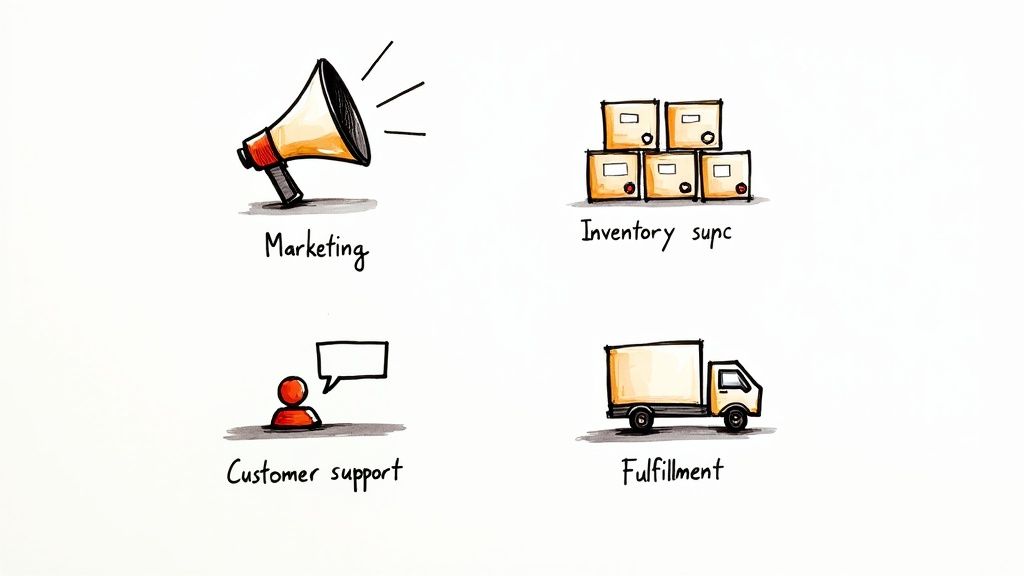
So, where do you actually apply this stuff? Thinking of automation as one giant tool is a mistake. It’s more like a specialist’s toolkit, with different instruments for specific, high-impact jobs in your business. The trick is knowing which tool to use where.
We can break down the most impactful applications into four critical zones. These are the core functions of any online store where repetitive manual work creates bottlenecks and slows you down. By focusing your automation efforts here, you can start seeing powerful results almost immediately.
Marketing and Sales Automation
This is usually the first stop on the automation journey, and for good reason. It's where you can directly influence your bottom line by engaging shoppers at just the right moment. Forget generic email blasts; we’re talking about creating personalized experiences that guide customers toward a purchase and keep them coming back for more.
The goal is simple: make every customer feel seen and understood.
- Abandoned Cart Recovery: This is the low-hanging fruit of ecommerce automation. When a shopper leaves items in their cart, the system can fire off a sequence of gentle reminders—maybe even with a small discount—to coax them back to finish the order. It's a classic for a reason: it works.
- Welcome Series for New Subscribers: Your first impression matters. Automation lets you send a perfectly timed series of emails to new subscribers, introducing your brand story, showing off best-sellers, and maybe offering a little welcome gift.
- Personalized Product Recommendations: Using a customer's browsing history or past purchases, you can automatically send them suggestions for products they’ll actually want. This isn’t just good service; it’s a powerful way to increase conversions.
- Smart Customer Segmentation: You can automatically group customers based on their behavior—tagging them as "VIPs," "first-time buyers," or "at-risk." This allows you to run incredibly targeted campaigns that resonate much more deeply than a one-size-fits-all message.
Order and Inventory Management
Behind every great storefront is a backend that runs like a well-oiled machine. This is where ecommerce automation software steps in as your tireless operations manager, keeping everything accurate from the second an order is placed. Let's be honest, manual inventory management is a recipe for disaster, leading to overselling, stockouts, and shipping errors.
Think of automation as the central nervous system for your inventory. It syncs data across all your sales channels in real-time, creating a single source of truth. This prevents stockouts and ensures the product availability your customers see is always accurate.
Having this solid foundation is what allows a business to scale without collapsing under its own weight. It's no surprise that the e-commerce platform software market, valued at $7.22 billion in 2024, is projected to hit $23.43 billion by 2033. This explosion is fueled by platforms like Shopify and WooCommerce baking powerful automation directly into their systems. You can dig deeper into this market's rapid expansion on Straits Research.
To see the difference in black and white, let's compare the old way with the new way.
Manual vs Automated Ecommerce Tasks: A Comparison
The table below starkly illustrates how automation transforms the daily grind of running an online store into a series of efficient, error-free processes. It highlights the shift from time-consuming manual labor to strategic, system-driven operations.
| Task Area | Manual Process Example | Automated Process Example | Key Benefit of Automation |
|---|---|---|---|
| Inventory Sync | Manually updating stock levels on Shopify after a sale on Amazon. | Software automatically deducts stock from a central inventory pool the instant a sale is made on any channel. | Eliminates overselling and saves hours of tedious data entry. |
| Order Processing | Copying and pasting customer shipping details from the order page into a shipping carrier's website. | An order is placed, and the system automatically generates a shipping label with the correct details and service. | Drastically reduces shipping errors and speeds up fulfillment. |
| Customer Comms | Manually emailing a tracking number to a customer after an order ships. | The system automatically sends a branded email with the tracking number as soon as the shipping label is created. | Improves customer experience and reduces "Where is my order?" inquiries. |
| Marketing | Sending the same weekly newsletter to every single person on your email list. | Segmenting customers by purchase history and sending targeted emails with relevant product recommendations. | Increases engagement, conversion rates, and customer loyalty. |
As you can see, the benefits go far beyond just saving time. Automation introduces a level of precision and scalability that's simply impossible to achieve manually.
Customer Service Automation
Great customer service can make or break your brand, but it's also incredibly demanding on your team's time. Automation helps you deliver fast, consistent support around the clock. It’s perfect for handling the common, repetitive questions, which frees up your human agents to solve the truly complex issues that require empathy and a personal touch.
Here’s how it works in practice:
- Automated Helpdesks: Chatbots can be set up to answer the most frequent questions instantly, like "What's your return policy?" or "Where is my order?"—even at 3 a.m.
- Smart Ticket Routing: When a support request comes in, automation can analyze it and assign it to the right person or department automatically. No more manual sorting.
- Proactive Issue Resolution: Imagine a shipping carrier reports a delay. An automation can find all the affected customers and send them a notification before they even notice a problem. That turns a potential complaint into a moment of impressive customer care.
Fulfillment and Shipping Automation
The final mile—getting the product into your customer's hands—is packed with opportunities for automation. This is where you can significantly speed up your workflow and cut down on costly mistakes, like sending the wrong product to the wrong address. A smooth fulfillment process is absolutely critical for keeping customers happy.
Here are some of the most common automations in the warehouse:
- Automated Label Printing: The moment an order is confirmed, the system can automatically print the correct shipping label based on the customer’s address and chosen shipping method.
- Smart Order Routing: If you have multiple warehouses, automation can instantly send an order to the location that can fulfill it fastest and most cheaply.
- Automatic Tracking Updates: Once a shipping label is created, the software pushes the tracking number back to your store and sends an update to the customer. Everyone stays in the loop without you lifting a finger.
How AI Is Supercharging Ecommerce Automation
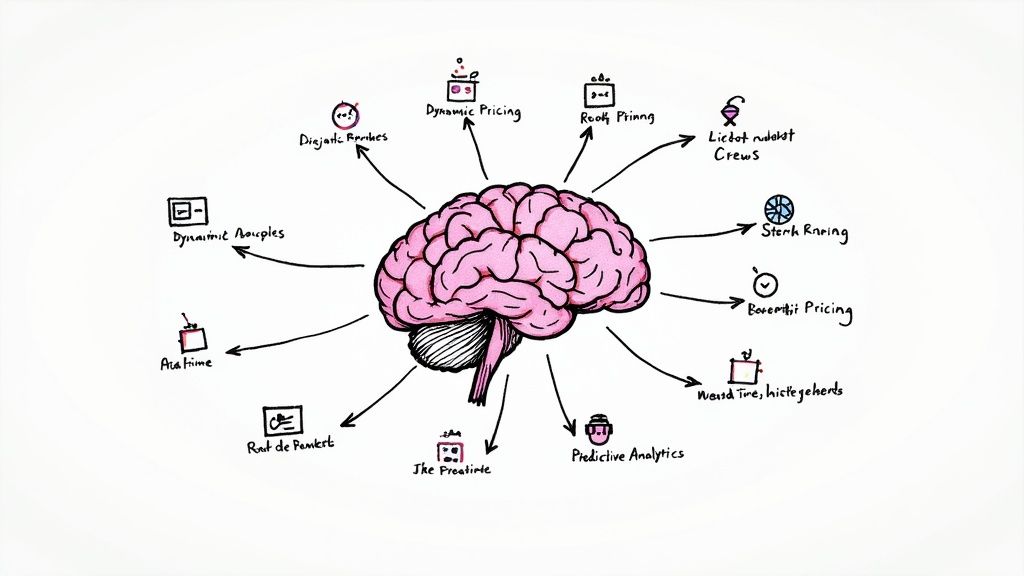
If standard automation is your tireless digital crew, meticulously following a set of instructions, think of Artificial Intelligence (AI) as the brilliant strategist leading them. Traditional automation is fantastic at executing fixed "if this, then that" rules—like sending a follow-up email when a cart is abandoned. But AI takes this a giant leap forward by adding the ability to learn, adapt, and make smart decisions on its own.
This isn't about some far-off, futuristic concept. It's about making your existing ecommerce automation software smarter and far more responsive. AI moves beyond simple triggers to analyze complex patterns, understand context, and predict what might happen next. It helps your systems shift from being reactive to truly proactive, anticipating what your customers need before they even realize it themselves.
From Static Rules to Dynamic Intelligence
The real game-changer between basic automation and AI-powered automation is the move from pre-programmed logic to adaptive learning. A standard workflow follows the exact path you design, every single time, no matter what. An AI-driven system, on the other hand, soaks up new data from every single customer interaction to continuously tweak its approach for better results.
This isn't just a minor upgrade; it's a fundamental shift happening across the industry. The global AI in e-commerce market jumped from $6.63 billion in 2023 to $7.57 billion in 2024, and it shows no signs of slowing down. This explosion is fueled by real-world results, with stores using AI chatbots reporting a 25% jump in lead conversions by personalizing experiences at a massive scale. You can dig deeper into these numbers and AI's growing role in ecommerce on Ecomposer.io.
This transition unlocks some seriously powerful new tools for online stores.
- Predictive Analytics for Inventory: Instead of just sending an alert when stock is low, AI can dig into historical sales data, spot market trends, and even factor in upcoming holidays to forecast demand. This means you order the right amount of stock at the perfect time, dodging both costly overstock and frustrating "out of stock" messages.
- Dynamic Pricing Engines: AI can keep an eye on competitor pricing, demand, and your inventory levels in real time. It then automatically adjusts your product prices to maximize profit and stay competitive, all without you having to lift a finger.
- Hyper-Personalized Recommendations: Basic automation might suggest a bestseller. AI, however, analyzes a customer’s unique browsing habits, purchase history, and what similar shoppers have bought to recommend items they're genuinely likely to love. It's how you create a bespoke shopping experience that naturally increases the average order value.
Creating a Truly Personal Customer Journey
Perhaps the biggest win with AI is in how you interact with your customers. It gives you the power to deliver a level of personalization that used to be reserved for retail giants with massive data science teams. AI-powered systems can grasp the nuances of human language and behavior, making every conversation feel surprisingly natural and helpful.
AI doesn't just automate tasks; it automates understanding. It can figure out a customer's real intent from a vague support question or pinpoint the perfect moment to present a cross-sell offer, turning routine interactions into genuine opportunities to connect and convert.
Just look at modern AI-driven chatbots. They're worlds away from the old, clunky bots with canned responses. These virtual assistants can understand complex questions, guide shoppers to the right product, and even process a return, all within the chat window. Best of all, they learn from every single conversation, constantly getting better at providing instant, accurate, and context-aware support, 24/7.
This kind of intelligent engagement builds stronger customer relationships and directly fattens your bottom line. By making every touchpoint feel relevant and personal, AI transforms your ecommerce automation software from a simple efficiency tool into a powerful engine for growth and loyalty. It’s how you make every single customer feel like they’re your most important one.
Choosing the Right Ecommerce Automation Software
Picking the right ecommerce automation software can feel overwhelming. With so many options out there, it’s easy to get lost. But thinking about it the right way makes all the difference. Don’t think of it as just buying a tool; think of it as hiring a digital employee. You need to be sure it has the right skills, fits in with your current team (your tech stack), and can handle more responsibility as you grow.
This isn't about finding the software with the longest feature list. It’s about finding the one with the right features—the ones that will actually solve your biggest operational headaches and give you a clear return on your investment.
Start with Seamless Integration
First things first: your automation software has to play nice with everything else you're already using. It needs to be the central hub that connects all your different applications. If it can’t talk to your ecommerce platform, email provider, or shipping software, you’ll end up creating more manual work, not less.
This is the non-negotiable first step in your evaluation.
- Ecommerce Platforms: Does it have a solid, ready-to-go connection for Shopify, BigCommerce, WooCommerce, or whatever you use?
- Marketing Tools: Can it sync data smoothly with email and SMS platforms like Klaviyo or Mailchimp?
- Operational Software: Will it connect to your shipping solution (like ShipStation), your helpdesk, and your accounting software?
A tool with poor integrations is like a star employee who refuses to talk to their colleagues. No matter how skilled they are in isolation, they can't function effectively as part of a team, and the whole operation suffers.
This foundational compatibility is what allows data to flow freely between your systems, which is the whole point of automation. Without it, you're back to square one, patching things together or doing manual data entry.
Evaluate Scalability and Growth Potential
The software that works for you today might not be able to keep up a year from now. You need a partner that can grow with you. A tool that handles 100 orders a month perfectly might completely fall apart when you hit 10,000.
Think about how the software scales in a few key ways:
- Workflow Complexity: Can you build simple, two-step automations today but also create complex, branching workflows later on? A great platform won’t box you in as your needs get more advanced.
- Volume Handling: Look closely at the pricing tiers. Are they based on the number of "tasks" or "workflows" run each month? Make sure the limits can handle your peak seasons without forcing you into a surprise upgrade.
- Feature Roadmap: Is the company constantly releasing new features and integrations? An active development cycle is a great sign that the platform will evolve with your business.
Choosing a scalable ecommerce automation software from the start saves you from a massive headache down the road. You won’t have to switch systems right when your business is taking off.
To help you stay organized during your search, use a structured checklist. This ensures you're comparing each option fairly and focusing on what truly matters for your business.
Software Selection Checklist Key Evaluation Criteria
Use this checklist to evaluate and compare different ecommerce automation software options based on your business needs.
| Evaluation Criterion | Question to Ask | Importance (High/Med/Low) |
|---|---|---|
| Platform Integration | Does it natively connect to my ecommerce platform (e.g., Shopify, BigCommerce)? | High |
| Marketing Tool Sync | Can it integrate seamlessly with my email/SMS marketing tools (e.g., Klaviyo)? | High |
| Operational Sync | Does it connect to my shipping, inventory, and accounting software? | High |
| Scalability | Can the software handle a 10x increase in order volume without performance issues? | High |
| Workflow Builder | Is the interface intuitive? Can non-technical users build automations? | High |
| Pricing Model | Is the pricing clear and predictable? Will it scale affordably as we grow? | Medium |
| Feature Set | Does it have the specific features needed to solve my top 3-5 pain points? | High |
| Customer Support | Is support readily available (live chat, phone)? Are they responsive and helpful? | Medium |
| API Access | Does it have a well-documented API for potential custom integrations? | Low (but High for larger businesses) |
| Security & Compliance | Does the software meet industry security standards (e.g., GDPR, CCPA)? | High |
This checklist isn't just a to-do list; it's a framework for making a smart, strategic decision that will pay off for years to come.
Focus on Features That Solve Your Problems
It’s easy to get wowed by a long list of flashy features, but most of them you'll probably never touch. A much smarter approach is to first identify your biggest bottlenecks.
Make a quick list of your top 3-5 most time-consuming manual tasks. Maybe it’s tagging high-value customers, managing pre-orders, or syncing inventory. Now, find a tool that is exceptional at solving those specific problems.
For instance, if abandoned carts are draining your revenue, you should prioritize a tool with powerful and flexible recovery workflows. If keeping inventory levels accurate across multiple channels is a nightmare, look for software known for its rock-solid inventory management. This focused approach gets you a tangible win right away.
Assess User-Friendliness and Support
Finally, even the most powerful software is worthless if your team finds it impossible to use. Look for a platform with a clean, visual interface. Many of the best tools now offer drag-and-drop workflow builders, which empower people who aren't developers to create incredibly useful automations.
Always take advantage of free trials. See if you can get a basic workflow up and running without digging through help docs. And when you do need assistance, how good is the customer support? A responsive, knowledgeable support team and an intuitive design are crucial for making your ecommerce automation software a long-term success.
Your First Steps to Implementing Automation
Diving into ecommerce automation software can feel like a huge commitment, but it doesn't have to be. The smartest way to start is to forget about overhauling your entire business overnight. The real secret? Start small and win fast.
Focus on one or two key areas where you can score an immediate, measurable victory. This isn't about automating everything; it's about solving a real problem and seeing the results, which builds the confidence and momentum you need to keep going.
Think about the most mind-numbing, repetitive tasks on your plate. Are you manually flagging potentially fraudulent orders? Do you spend hours trying to segment customers for an email campaign? Those are the perfect places to start.
Identify Your Quick Wins
The best starting point is always a task that’s either costing you time or leaving money on the table. These "quick wins" deliver a clear return on your investment and prove the value of automation to you and your team right away.
Not sure where to begin? Try one of these proven workflows:
- Abandoned Cart Recovery: This is often the low-hanging fruit with the biggest payoff. Setting up a simple, automated email sequence to nudge shoppers who left items behind can bring back a surprising amount of lost revenue almost instantly.
- Welcome Email Series: First impressions matter. Instead of manually sending a welcome note, automate a series of emails that introduces new subscribers to your brand, highlights your best products, and maybe even offers a small discount to get them to make that first purchase.
- Low-Stock Alerts: Stop guessing about inventory levels. An automation can ping you or your supply manager the second a popular item’s stock dips below a certain number, helping you avoid frustrating stockouts and lost sales.
These are great first steps because they're relatively simple to set up, and you can easily see the impact on your bottom line.
Adopting automation is like building with LEGOs. You don't start with a giant, complicated castle. You start by connecting two or three simple bricks, see how they fit, and then confidently add the next piece.
Set Clear and Measurable Goals
Once you’ve picked your first process to automate, you need to know what success actually looks like. A vague goal like "improve efficiency" is impossible to track. Get specific.
For example, if you’re automating abandoned cart recovery, a solid goal would be: "Recover 15% of abandoned carts within the first month." If you're tackling customer tagging, try something like: "Cut the time we spend manually segmenting customers by 5 hours per week."
Test, Monitor, and Iterate
Before you set your new automation loose on live customers, always run it through a test. Most good ecommerce automation software will have a "test mode" so you can see exactly how the workflow will play out without any real-world consequences.
Once you go live, keep a close watch on the numbers. Are you hitting your goals? Is that abandoned cart sequence converting like you hoped? Are your inventory alerts triggering correctly? Don't just set it and forget it.
This is where the real magic happens. By monitoring the results, you can make small adjustments based on actual data, fine-tuning your automations until they’re running perfectly. By proving the value one small step at a time, you’ll build a powerful, automated engine for your business, one successful workflow at a time.
Got Questions About Automation? We've Got Answers.
Jumping into ecommerce automation can bring up a lot of questions. It's totally normal. Most store owners wonder about the cost, the learning curve, and what it means for their team. Let's clear up some of the most common concerns so you can feel confident about taking the next step.
Is This Really for Small Stores, or Just Big Retailers?
This is a huge misconception. While the big players definitely rely on automation, many of today's best tools are built specifically for small and medium-sized businesses. Think of ecommerce automation software as your secret weapon.
It gives you the kind of operational firepower that was once only available to massive competitors. By taking over repetitive tasks like processing orders or sending out marketing emails, it frees up your small, agile team to focus on what really matters—growing the business.
Automation isn't about how big your company is today; it’s about how big you want to be tomorrow. It lets a small team punch way above its weight, operating with the efficiency of a much larger organization.
Will This Make My Customer Service Team Obsolete?
Not at all. The goal is to augment your team, not replace it. Automation is fantastic at handling the simple, high-volume questions that eat up your team's day—things like "Where is my order?" or basic return policy questions.
By handling the easy stuff, automation lets your human support pros shine. They can now focus their energy on the work that truly requires a human touch:
- Solving tricky problems that need creativity and real empathy.
- Building lasting relationships with customers through meaningful conversations.
- Managing sensitive situations where a human connection makes all the difference.
Essentially, automation acts as a filter, allowing your team to become more effective and deliver an even better customer experience.
So, What's the Price Tag on Something Like This?
The cost can vary quite a bit. It really depends on the features you need, how many tasks you're running, and the provider you choose. You can find some platforms that offer free starter plans for very basic needs.
More typically, you'll see tiered subscription plans that range anywhere from $20 to several hundred dollars a month.
The key is to look beyond the monthly fee and think about the return on your investment. Calculate the time you'll save, the money you'll avoid losing to manual errors, and the extra sales you can generate with perfectly timed marketing. Often, the software pays for itself and then some.
Ready to slash your software costs and streamline your operations? EcomEfficiency bundles 50+ premium ecommerce tools into one affordable subscription. Start discovering winning products, analyzing competitors, and optimizing your store today. Explore our plans and join over 1,000 savvy e-commerce operators at https://ecomefficiency.com.