Your Ultimate Dropship Toolkit For E-Commerce Success

Think of a dropship toolkit less like a single piece of software and more like a professional contractor's toolbox. You wouldn't hire someone to build your house if they only showed up with a hammer, right? They need drills, saws, levels, and a whole host of specialized equipment to do the job right.
The goal is to scale without dubious shortcuts and without hurting your credibility.
Your dropshipping business is no different. A well-stocked toolkit is your collection of essential software and apps that handle everything from finding hot products to automating your marketing. It’s what separates the pros from the hobbyists.
What Is A Dropship Toolkit And Why Is It Essential?
Trying to run a dropshipping store without the right tools is a recipe for frustration. You'd be stuck doing everything manually, guessing which products might sell, and hoping your marketing sticks. Meanwhile, your competition is using sophisticated software to make data-backed decisions and automate their most time-consuming tasks.
A proper dropship toolkit is your unfair advantage. It's the digital arsenal that lets you move faster, make smarter choices, and compete effectively in a very crowded market. Instead of spending weeks manually hunting for a promising product, a good research tool can pinpoint high-demand, low-competition items in a matter of minutes.
Building Your E-commerce Operations On Solid Ground
At its core, a good toolkit helps you confidently answer the three most important questions every dropshipper faces:
- What should I sell? Product research and market analysis tools give you the hard data.
- What is my competition doing? Ad-spy and competitor intelligence tools pull back the curtain on their winning strategies.
- How do I run this thing without losing my mind? Automation software takes care of the tedious work like order fulfillment and inventory updates.
Without clear answers to these questions, you’re flying blind. Sure, you might get lucky and stumble upon a winning product once, but you won't have a repeatable system for success. A toolkit provides that exact framework.
Here's a quick look at the core categories of tools you'll be putting into your own toolkit. Each one plays a crucial role in building and scaling a successful dropshipping business.
Core Components Of A Modern Dropship Toolkit
| Tool Category | Primary Function | Why It's Essential |
|---|---|---|
| Product Research | Identifies trending products with high-profit potential. | Takes the guesswork out of product selection. |
| Supplier Discovery | Vets and connects you with reliable suppliers. | A good supplier is the backbone of your business. |
| Store Analytics | Tracks key metrics like traffic, conversion rates, and sales. | Shows you what's working and what's not. |
| Ad-Spy | Reveals your competitors' most successful ads. | Saves you thousands on testing ad creative. |
| Creative Generation | Helps create compelling product photos and video ads. | Professional-looking creative builds trust and drives sales. |
| SEO & Keyword Research | Optimizes your store and listings for search engines. | Attracts free, high-intent organic traffic. |
| Automation | Manages repetitive tasks like order processing. | Frees up your time to focus on growth. |
| Conversion Rate Optimization (CRO) | Improves your store's ability to turn visitors into buyers. | Maximizes the value of every visitor you get. |
| Fulfilment & Inventory | Syncs inventory levels and automates order routing. | Prevents overselling and keeps customers happy. |
As you can see, each category solves a specific, critical problem. Neglecting any one of these areas leaves a major gap in your operational foundation, making it much harder to grow.
A huge mistake I see new entrepreneurs make is underestimating the sheer amount of work that goes into dropshipping. They think a toolkit is a luxury. In reality, it's the core infrastructure that lets a single person compete with bigger brands by automating the grunt work and delivering crucial market insights.
The need for a solid toolkit is only getting more intense. The global dropshipping market is expected to hit a staggering $476.1 billion this year. According to recent dropshipping statistics from Zikanalytics.com, sellers who effectively use automation and data analysis tools are the ones capturing the biggest slice of that pie.
Ultimately, putting together your dropship toolkit is the moment you transition from an amateur playing around with an idea to a professional business owner. It’s about building a sustainable, profitable e-commerce machine driven by smart decisions and reliable data, not just gut feelings.
The Nine Essential Tool Categories You Need To Master
Building a successful dropshipping business isn't about hoarding a random collection of software. Think of it like putting together a championship sports team. You don't just sign a bunch of flashy players; you strategically pick specialists for each position. Your dropshipping toolkit needs that same deliberate construction.
Each tool plays a specific role, and when they work together, that’s when the magic happens. If you neglect a key area, you’re leaving a huge gap in your defense. But with a complete roster, you’ll have the power to spot winning products, run circles around your competitors, and scale your operations without burning out.
This framework shows how these tools fall into the three core pillars of any dropshipping operation: finding great products, analyzing the competition, and automating the day-to-day grind.
As you can see, a well-rounded toolkit creates a powerful feedback loop. Let's break down the nine positions on this all-star team.
1. Product and Market Research Tools
This is your talent scout, the tool that finds hidden gems before anyone else. Without solid product research, your entire business is basically a lottery ticket. These tools dig through mountains of data to pinpoint products with soaring demand and weak competition.
Platforms like Dropship.io or TrendTrack aren’t just about what's hot right now. They spot trends before they go viral, track real sales data from thousands of stores, and give you a clear picture of potential profit margins. It's the difference between gambling and making a calculated business decision.
2. Supplier Discovery and Vetting Tools
Okay, you've found a killer product. Now what? You need a reliable supplier who won't disappear on you. A fantastic product means nothing if it’s delivered late, looks cheap, or is constantly out of stock.
That's where supplier discovery platforms like CJ Dropshipping or Zendrop come in. They're essentially curated directories of pre-vetted suppliers, often with fulfillment systems already built-in. This is how you ensure your customers get what they ordered, on time, every time—the bedrock of building a brand people trust.
3. Ad-Spy and Competitor Analysis Tools
This is your secret agent. It tells you exactly what your competition is doing to make sales. Why blow thousands of dollars guessing which ads will work when you can see what’s already crushing it in your niche?
Tools like Pipiads are absolute goldmines for this. They have massive databases of ads from TikTok, Facebook, and more. You can filter by product, country, or even likes and shares to see the top-performing campaigns. It’s like getting a copy of your competitor’s marketing playbook.
4. Creative Generation and Editing Tools
Let’s be honest: in e-commerce, visuals do the selling. Your ad creatives and product photos are the first thing a potential customer sees. If they look cheap or boring, you've lost the sale before it even started.
AI-powered creative tools have been a game-changer here. With platforms like Midjourney for images or Runway for video, you can produce professional-looking ad creatives in minutes. They help you create unique visuals that actually stop people from scrolling, which is half the battle on social media.
5. SEO and Keyword Research Tools
Paid ads get you traffic today, but Search Engine Optimization (SEO) builds an asset that pays you for years. Ranking on the first page of Google for your product keywords means a constant flow of free, ready-to-buy customers.
This is impossible without a good keyword research tool like Semrush. It helps you find the exact phrases people are typing into Google, see how many people are searching for them, and figure out how hard it will be to rank. Optimizing your store around these keywords is how you build a long-term, sustainable business.
6. Store Analytics and Conversion Rate Optimization (CRO)
Getting people to your store is just the first step. The real challenge is turning those visitors into paying customers. This is where store analytics and Conversion Rate Optimization (CRO) come in.
When you're building out your toolkit, apps that improve your sales funnel are non-negotiable. You can find some great examples in this list of 10 Essential Shopify Apps For Higher Conversion Rates. These tools help you see how people behave on your site, find the exact spots where they're dropping off, and test changes to improve your numbers.
Think of your store like a physical shop. If people are walking in, looking around, and then leaving empty-handed, you need to find out why. Analytics tools are your security cameras and customer feedback forms, all rolled into one. They show you exactly where you’re losing money.
7. Automation for Order Fulfillment
Once you start getting consistent orders, you’ll realize that manually processing each one is a nightmare. You'll spend your entire day copying and pasting addresses instead of working on things that actually grow your business.
Automation tools are the only way to scale. They connect your Shopify store directly to your supplier's system. When an order comes in, all the details are sent over for fulfillment automatically, without you having to do a thing. This isn't a luxury; it's a necessity.
8. Fulfillment and Inventory Management
Overselling is a brand killer. There's nothing worse for a customer than paying for a product, only to get an email a few days later saying it's out of stock.
Inventory management tools solve this by syncing your store's stock levels with your supplier's in real-time. If your supplier is running low, the tool can automatically mark the item as "sold out" on your site. This simple function saves you from countless customer service headaches and protects your reputation.
9. Productivity and Content Tools
Finally, this category covers the support crew—all the software that makes your life easier. This could be a project management tool to keep your tasks organized, an AI writer to help you knock out product descriptions, or a social media scheduler to plan your content.
These are the unsung heroes of your dropship toolkit. They save you time, clear up mental space, and make sure all the moving parts of your business are working together smoothly. This frees you up to focus on the big-picture strategy that will truly move the needle.
Feature Comparison Of Key Tool Categories
To help you prioritize, let's zoom in on the "Big Three" tool categories that have the most immediate impact on finding and selling a product. Understanding the core features here is crucial when you're deciding where to invest your budget.
| Tool Category | Key Features to Look For | Example Tool (from EcomEfficiency) |
|---|---|---|
| Product Research | Real-time sales data from active stores, trend-spotting algorithms, profit margin calculators, and a database of top-performing products. | Dropship.io |
| Ad-Spy | A large, searchable library of recent ads (video & image), advanced filtering (by platform, country, engagement), and competitor ad spend estimates. | Pipiads |
| Creative Generation | AI-powered image/video creation from text prompts, easy-to-use editing interfaces, templates for different ad formats, and high-resolution outputs. | Midjourney |
This table highlights what you should be looking for in each of these critical areas. While every category is important, nailing your product research, competitive intelligence, and ad creative is the foundation for everything else you'll do.
How to Evaluate and Choose the Right Tools
Choosing tools for your dropshipping business is a bit like packing for a long-distance hike. If you bring too much gear, you'll be weighed down by unnecessary costs and complexity. But if you pack too little, you'll find yourself unprepared for the challenges on the trail. The real goal is to build a lean, powerful, and perfectly suited dropship toolkit that matches your specific journey.
One of the fastest ways to burn through your budget is by overspending on software you don't actually need. A recent analysis revealed a surprising statistic: a whopping 57.4% of top dropshippers use ten or more apps to run their stores. It’s easy to see how those subscription costs can spiral out of control. Your job is to avoid that trap by making smart, strategic choices from the very beginning.
To do that, you need a clear framework for evaluating any tool before you commit your time and money. It's easy to get distracted by flashy features, so you have to stay focused on the core value it brings to your business.
Define Your Core Needs First
Before you even start browsing for software, stop and identify your single biggest operational bottleneck. What's slowing you down the most? Are you sinking hours into searching for products? Is creating ad content a slow and painful process? Or are you just staring at your analytics, completely lost?
Answering that question first is crucial because it sets your priorities. If product research is your main roadblock, a tool like Dropship.io should be at the top of your list. If your ads just aren't converting, then an ad-spy tool like Pipiads is where you should focus your investment. The key is to solve specific problems, not just collect tools for the sake of it.
Key Evaluation Criteria For Any Tool
Once you know what problem you’re trying to solve, run every potential tool through this checklist. This will help you build a truly effective dropship toolkit.
- Core Functionality: Does the tool do the one thing you need it to do, and do it exceptionally well? A product research tool, for example, absolutely must provide accurate, real-time sales data. Anything less is a dealbreaker.
- Ease of Use: How steep is the learning curve? A super-powerful tool is completely useless if you can't figure out how to use it. Look for clean, intuitive interfaces and check reviews on their customer support.
- Integration Capabilities: How well does it play with your existing setup? It needs to connect seamlessly with your e-commerce platform, whether that’s Shopify or WooCommerce. Bad integrations create more manual work, which defeats the entire purpose of using a tool.
- Scalability: Will this tool grow with your business? A simple automation app might work when you have ten orders a day, but will it crash and burn when you hit 100? Always think about where you want to be in six months or a year.
The best tools feel less like a complex piece of software and more like a natural extension of your workflow. They should simplify tasks and provide clear, actionable insights, not create more confusion or administrative overhead.
Balancing Cost And Value
Finally, you have to consider the return on investment (ROI). This isn't just about the monthly subscription fee; it's about the total value the tool delivers. A $99/month ad-spy tool that saves you $1,000 in wasted ad spend is a fantastic investment. On the flip side, a $19/month tool you never use is just a money pit.
This is where all-in-one platforms like EcomEfficiency really shine. Instead of trying to piece together a dozen individual subscriptions and evaluate each one, you get a curated collection of best-in-class tools for a single, low price. This approach takes the guesswork and high costs out of the equation, letting you build a professional-grade toolkit from day one without breaking the bank. Your evaluation process becomes much simpler—you can focus on mastering the tools you have instead of just trying to afford them.
Building Your Toolkit: Stacks for Every Budget and Ambition
Alright, let's get down to the fun part: turning all this theory into a real, money-making business. To help you get there, I’ve broken down the essential tools into three "stacks." Think of them like pre-packed kits for different stages of your dropshipping journey—from just starting out to scaling like a pro.
Each stack builds on the one before it, giving you the right firepower at the right time. This way, you’re not shelling out cash for advanced features you don’t need yet, but you’re also not trying to compete with a hand tied behind your back. The whole idea is to match your dropship toolkit to where your business is right now.
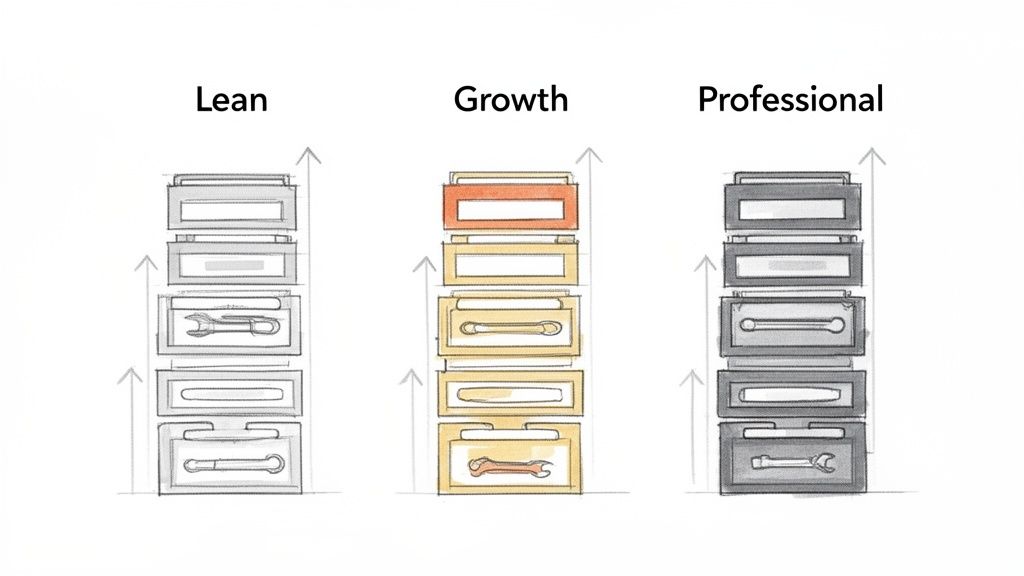
The Lean Starter Stack: Proving Your Concept
This is your ground-zero toolkit. It’s designed for one thing: validating your idea with the least amount of financial risk. The goal isn’t to get rich overnight; it's to prove you can find a product, get it in front of people, and make those first few sales. Every tool here is either free or dirt cheap.
- Product Research: Forget paid tools for now. Your best friends are Google Trends and good old-fashioned scrolling. Manually search TikTok, Pinterest, and Instagram to see what’s catching fire.
- Supplier Discovery: Hop on platforms like CJ Dropshipping, which are free to browse. You can find products and connect with suppliers without spending a dime.
- Store Platform: Shopify’s low-cost trial is perfect for this stage. It gives you a world-class storefront to test your products without a hefty commitment.
- Ad Creatives: You can create solid, effective ads for free. Use Canva for basic image ads and a mobile app like CapCut for simple video editing.
The Lean Starter Stack is all about being scrappy. It demands more of your time and effort, but it keeps your startup costs incredibly low while you test the e-commerce waters.
The Growth Hacker Stack: Scaling Your Wins
Okay, you’ve got sales coming in. You've found a winning product and have proof of concept. Now it's time to pour some fuel on the fire. The Growth Hacker Stack is where you start investing in paid tools that automate tedious work and feed you better data, freeing you up to focus on what really matters: marketing and growth.
This is the point where you graduate from manual guesswork to data-driven strategy. You’ll make your first real investments in dedicated product research and ad-spy tools. These aren't luxuries anymore; they're necessities for staying ahead of the competition and making sure your ad budget is working for you, not against you.
The second you start putting real money into ads, a good ad-spy tool pays for itself almost immediately. It can save you thousands in wasted ad spend by revealing the exact creatives, copy, and targeting that are already working for your competitors.
The Professional Scaler Stack: Dominating Your Niche
You've moved beyond a side hustle—this is a real, scalable business. At this stage, your goal is to own your niche. That requires the absolute best data, the smartest automation, and the deepest competitive intel you can get your hands on. The Professional Scaler Stack is a full arsenal of best-in-class tools.
- Advanced Product Research: Using powerhouse tools like Dropship.io and TrendTrack for real-time sales data and product validation.
- Deep Competitor Analysis: Subscribing to services like Pipiads and Semrush to reverse-engineer every part of your competitors' funnels.
- AI-Powered Creatives: Getting premium access to AI tools like Midjourney and Runway to generate endless, high-converting ad creatives.
- Full Automation: Implementing robust systems for everything from order fulfillment and inventory management to customer support.
Here’s the catch: pieced together individually, these premium subscriptions can easily run you over $1,000 per month. This steep cost is often the wall that stops talented entrepreneurs from reaching the next level.
The EcomEfficiency Advantage: Professional Tools at a Starter Price
But what if you could sidestep that wall entirely? Imagine having access to the Professional Scaler Stack from day one, but at a price that fits a Lean Starter budget.
That's the exact problem a platform like EcomEfficiency was built to solve. It bundles dozens of these elite tools—from Dropship.io and Pipiads to Midjourney—into one simple, shockingly affordable subscription. Instead of juggling a dozen expensive logins, you get a single dashboard with everything you need to compete with the top players in your niche.
This completely changes the game. It removes the financial gatekeeping that holds so many dropshippers back. You no longer have to wait to be successful to afford the best tools; you can use the best tools to get successful, right from the start.
The Hidden Costs of a DIY Toolkit and How to Avoid Them
Building your own dropship toolkit feels like a great idea at first. You get to play expert, hand-picking each tool you think you need. A product research platform here, an ad-spy service there, an AI creative generator to top it off. But this à la carte approach comes with a bill that snowballs much faster than most new entrepreneurs ever see coming.
The most obvious hit is right to your bank account. A solid product research tool can easily set you back $50-$100 a month. A good ad-spy platform? That’s often $99 per month, if not more. Throw in a top-tier SEO tool, an AI video generator, and store analytics, and suddenly your monthly software bill is pushing $500-$1,000. That kind of overhead can sink a new business before it even learns to swim.
The Inefficiency Tax of a Patchwork System
But the monthly fees are just the tip of the iceberg. The real, hidden costs of a do-it-yourself toolkit are the brutal inefficiencies it bakes right into your daily routine. Think of it as a "time tax" that can be far more damaging than the hit to your wallet.
When your tools don't talk to each other, you’re forced to be the overworked, underpaid middleman. You end up bouncing between a dozen browser tabs—pulling product data from one app, cross-referencing competitor ads in another, and then struggling to feed that info into a third to make creatives. This constant context switching is a proven productivity killer. It completely drains your focus and mental energy.
Every minute you spend logging into yet another platform, manually copying and pasting data, or just trying to remember how a specific tool works is a minute you aren't spending on marketing, customer service, or big-picture strategy. A fragmented toolkit forces you to work in your business instead of on it.
This disjointed setup also creates massive data silos. The killer insights you uncover in your product research tool live on a completely separate island from your ad-spy data. You're left trying to connect the dots on your own, a process that’s ripe for missed opportunities and expensive mistakes.
Beyond the Monthly Fees: The Real Costs Add Up
Let's get real about the other hidden costs that pile up when you're juggling a dozen different subscriptions:
- Wasted Time: Just managing all the different logins, billing cycles, and support tickets is a part-time job you didn't sign up for.
- Lost Productivity: Every tool has its own unique interface and workflow. Switching between them creates friction and grinds your momentum to a halt.
- Mental Overhead: Trying to keep track of what each tool does and how to use it adds a layer of complexity that leads straight to burnout.
- Steep Learning Curves: Each new subscription demands its own training time, pulling you away from the activities that actually make you money.
How to Get a Pro-Level Toolkit Without the Pro-Level Price Tag
The answer isn't to give up on powerful tools—it's to find a smarter way to get them. This is where a consolidated platform like EcomEfficiency completely flips the script. Instead of cobbling together an expensive and clunky DIY toolkit, you get a curated suite of premium, essential tools under a single, affordable subscription.
With one login, you get your hands on the same high-end product research, ad-spy, and creative generation tools the six- and seven-figure sellers are using. This approach eliminates all those hidden costs by design. You can slash your subscription fees by up to 99%, kill context switching for good, and get a unified workflow that frees you up to focus on growth.
It’s simply the most effective way to arm yourself with a professional-grade dropship toolkit from day one, without the crippling expense.
Your Quick Start Checklist To Build A Better Toolkit
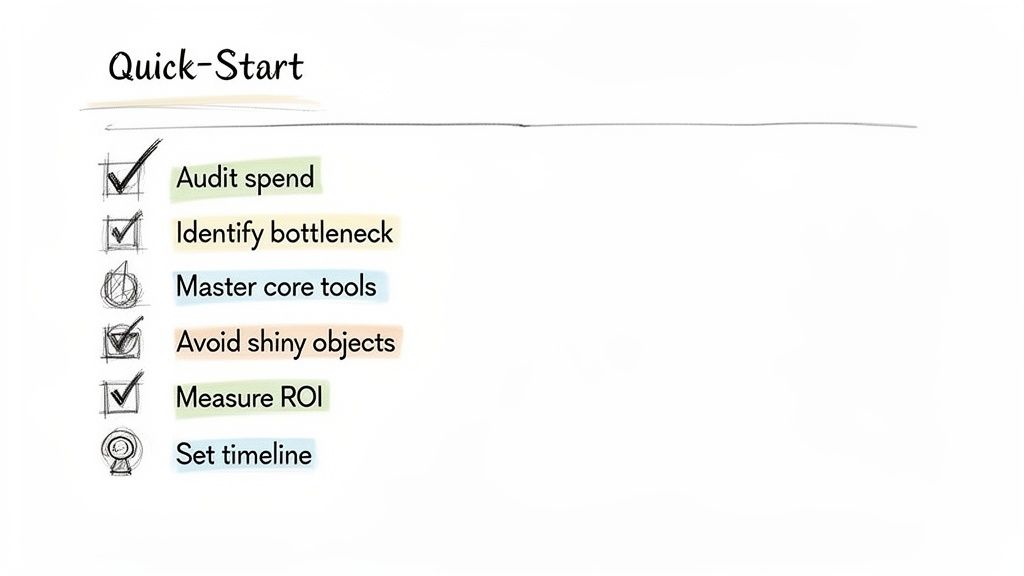
Alright, let's turn that messy folder of software subscriptions into a lean, mean, money-making machine. A truly effective dropship toolkit isn’t built by accident; it's the result of a few smart, deliberate choices.
This checklist is your roadmap. It's designed to help you cut through the clutter and build a system that actually works for you. No more theory—it's time to take practical steps. The whole point is to have the right tools working together, not just a bunch of them. Every dollar you spend on software should bring a clear return.
Phase 1: Audit Your Current Setup
First things first: you need a brutally honest look at what you’re already doing. This isn’t about feeling bad about past decisions; it's about getting a clear baseline so you can move forward intelligently. You might be shocked at where your money is actually going.
- Map Your Monthly Tool Spend: Get a piece of paper or open a spreadsheet and list every single software subscription you pay for. Add it all up to get your true monthly software overhead.
- Assess Your Tool Usage: Next to each tool, rate how often you actually use it on a scale of 1-5 (1=never, 5=daily). Be real with yourself. If you haven't logged in this month, it's a 1.
- Identify Your Biggest Bottleneck: What one task is eating up most of your time? Is it the endless grind of product research? The headache of making ad creatives? Figure out your number one pain point.
Phase 2: Strategize And Consolidate
Now that you have a clear picture of your current reality, you can start building a toolkit with intention. This phase is all about cutting the waste and putting your resources where they’ll make a real difference. Think strategic simplification, not just collecting more tools.
One of the biggest mistakes entrepreneurs make is succumbing to 'Shiny Object Syndrome'—the constant chase for the next "game-changing" tool. A great dropship toolkit isn't about having the most tools; it's about mastering the essential few.
This is where you trim the fat and get serious about what works. It's also the perfect moment to check out consolidated solutions that can save you a ton of money and simplify your entire workflow.
- Cut Underused Subscriptions: Look at your list. Anything you rated a 1 or 2? Cancel it. Seriously. If you find you desperately need it later, you can always sign up again.
- Focus on a Core Stack: Pick one primary tool for each of the top three bottlenecks you identified. For example, one for product research, one for spying on ads, and one for making creatives. Get really, really good at using those.
- Measure True ROI: For the tools you decide to keep, ask this simple question: "Does this tool save me more time or make me more money than it costs?" If the answer is a clear "no," it's time for it to go.
- Explore All-In-One Platforms: Instead of juggling a dozen different logins and bills, look into a service like EcomEfficiency. It bundles dozens of top-tier tools into a single, affordable plan, solving both the cost and complexity problems at once.
Frequently Asked Questions About Dropship Toolkits
Diving into the world of dropshipping software can feel like a lot, especially when you're just starting. Let's clear up some of the most common questions entrepreneurs have when putting together their first real dropship toolkit.
How Many Tools Do I Actually Need to Start?
You can technically get a store live with just the bare bones: an e-commerce platform like Shopify, a way to find suppliers, and one product research tool. That’s enough to find a product and list it.
But let's be realistic—listing a product is just the first step. To actually compete and make sales, you’ll almost immediately need tools for checking out competitor ads (ad-spy) and making your own creatives. This is where a service like EcomEfficiency comes in handy, giving you a full professional toolkit right from the start so you're ready to grow when you need to be.
Is There One Single Tool That Does Everything?
Honestly, no. There isn't a single piece of software that truly nails every part of the dropshipping process. You'll see some platforms branded as 'all-in-one' solutions, but they almost always have a weak spot, usually in critical areas like ad intelligence or in-depth product research.
The pros build a hand-picked toolkit using the best tool for each specific job. The big hurdle has always been the cost and the headache of juggling a dozen different subscriptions.
This is exactly why consolidated services are such a game-changer. They bundle all those specialized, premium tools into one simple plan you can actually afford. You get the power of best-in-class software without the typical high price tag and complexity.
Should I Use Free Tools or Invest in Paid Ones?
Free tools are great for getting your feet wet. You can learn the basics and play around with ideas without risking any money. The downside is they're often limited, with less accurate data and fewer features, which will eventually hold you back.
If you're serious about building a business that can scale, investing in paid tools isn't really optional. They give you the accurate data, automation, and deep competitive insights you need to find an edge and grow profitably. A subscription like EcomEfficiency helps bridge that gap, giving you access to premium tools for a fraction of what they'd cost individually, so you can operate like a pro from day one.
Stop overpaying for your dropshipping tools. With EcomEfficiency, you get access to over 50+ premium e-commerce apps for product research, ad-spy, AI, and more—all for one low monthly price. Start building your professional toolkit today at ecomefficiency.com.