The Best Cheaper Alternative to Semrush Today

Let's be honest, Semrush is an absolute beast of an SEO platform. But for many businesses, finding a cheaper alternative to Semrush isn't just a nice-to-have, it's a necessity. If you're looking for serious SEO power without the enterprise-level price tag, you've got great options. Tools like SE Ranking, Mangools, and our own bundled solution, EcomEfficiency, offer incredible value at a much more manageable cost.
The goal is to scale without dubious shortcuts and without hurting your credibility.
Why Look For a Cheaper Alternative to Semrush?
There’s no denying Semrush is an industry leader. It's a true all-in-one suite, packed with tools for everything from keyword research and competitor analysis to site audits and content marketing. But all that power comes at a premium, and that price tag is often a deal-breaker.

Cost is the number one reason marketers and business owners start searching for more affordable solutions. For freelancers, startups, and most small to medium-sized businesses (SMBs), those hefty monthly fees are tough to justify. Beyond the initial sticker shock, a few common frustrations with Semrush's model push people to look elsewhere.
Common Pain Points with Semrush Pricing
A big issue for many is "feature bloat." You're paying for a massive arsenal of tools, but you might only use a handful for core tasks like rank tracking or backlink checks. That means a good chunk of your monthly payment is going towards features you never even touch.
On top of that, the entry-level plans can feel pretty tight. The limits on projects, keywords, and users often push growing businesses into expensive upgrades much faster than they'd like. Need to add just one more team member? That simple change can spike your monthly bill significantly.
The search for a cheaper alternative to Semrush makes perfect sense when you look at who their customers are. A huge portion of them are smaller businesses; 43% are companies with fewer than 50 employees, and 69% report less than $50 million in annual revenue. This data, which you can dig into on Enlyft, shows that a big part of their user base is likely very price-sensitive.
The problem isn't that Semrush lacks value. It's that its all-or-nothing, high-cost structure doesn't align with the focused, budget-conscious reality of most businesses.
This guide is here to fix that. We're not framing the search for a cheaper alternative to Semrush as a downgrade. Think of it as a smart, strategic decision. By picking a tool that gives you exactly what you need—without the fluff—you can hit your SEO goals and make sure every dollar in your marketing budget is working hard for you.
Setting the Semrush Standard: What Are We Comparing Against?
Before we can find a genuinely good, cheaper alternative to Semrush, we have to be honest about what we're up against. Semrush isn’t just another tool in the box; it's a full-blown competitive intelligence suite, and its premium price tag is tied directly to the massive amount of data it sits on. This data is the benchmark.
At its core, Semrush is an enterprise-level data engine. It’s constantly crawling the web, crunching petabytes of information to power its toolkits. This isn’t a small-time operation, and it's this foundation that provides the deep insights marketers build entire strategies around.
It All Starts with the Database
The scale here is hard to overstate. By 2025, Semrush plans to track 26.3 billion keywords globally, with monthly updates for both desktop and mobile search. Its bots keep tabs on 774 million desktop domains and 32 million mobile domains, building out incredibly detailed profiles for competitive analysis. You can dig into more of the numbers in these Semrush statistics.
This sheer volume, updated frequently, is what really sets the standard. Cheaper tools often work with smaller databases or refresh their data less often—maybe quarterly instead of monthly. That lag directly impacts the accuracy of your keyword volume estimates, the freshness of competitor data, and how deep you can go with backlink analysis.
The benchmark isn't just about ticking a feature box like "keyword research." It's about the quality, size, and recency of the data behind that feature. A smaller, stale dataset can easily send your SEO strategy in the wrong direction.
To properly evaluate any tool, you have to know what foundational SEO metrics matter. A huge part of this is understanding your backlink profile, which is a direct reflection of a tool’s power to crawl and index the web.
The All-in-One, Integrated Experience
Beyond the raw data, Semrush’s other big strength is how everything works together. It’s not just one tool, but a suite of specialized toolkits that are seamlessly connected. This integration is what creates a smooth, comprehensive workflow that covers almost everything in digital marketing.
A user can jump from keyword research to content creation to ad analysis without ever leaving the platform. That interconnected experience is a big part of what you're paying for.
Here’s a quick look at the integrated toolkits that define the Semrush benchmark:
- SEO Toolkit: The bread and butter. This covers everything from on-page SEO checkers and technical site audits to sophisticated rank tracking and backlink analytics.
- Content Marketing Toolkit: This part helps you research topics, write SEO-friendly content with live feedback, and track how that content is actually performing.
- Advertising Toolkit: Here, you can dissect competitor PPC strategies, research display ads, and find new keyword opportunities for your paid campaigns.
- Competitive Research Toolkit: This gives you that 30,000-foot view of a competitor’s entire digital game, from their organic traffic channels to their social media strategy.
So, when we look at a cheaper alternative, the real question is: which pieces of this benchmark do you actually need? Very few tools will match Semrush across the board, but many are fantastic at one or two of these areas, offering focused value for a much lower price. The key is knowing what trade-offs you're willing to make.
Comparing the Top Semrush Alternatives Head-to-Head
Choosing the right cheaper alternative to Semrush isn't just about ticking boxes on a feature list. You have to ask how each tool actually performs the core SEO jobs you rely on every day. A platform might claim to have a "site audit" function, but does it catch the same critical technical problems Semrush does? Let's break it down.
We’re going to look at three of the most popular, budget-friendly options out there: SE Ranking, Mangools, and SpyFu. Each has its own personality and is built for a slightly different kind of user.
The All-Rounder: SE Ranking
For anyone looking for a near-Semrush experience without that enterprise-level price tag, SE Ranking is almost always the first stop. It nails the balance between having a ton of features, reliable data, and an interface that doesn't make you want to pull your hair out. It’s a true jack-of-all-trades.
On Keyword Research:
SE Ranking’s keyword tool feels immediately familiar and capable. It gives you all the standard metrics you'd expect—search volume, keyword difficulty, CPC—but it also digs into SERP feature analysis. You can quickly spot which keywords are triggering featured snippets or "People Also Ask" boxes, which is table stakes for modern SEO.
On Site Auditing:
The Site Audit tool is incredibly thorough for what you pay. It neatly sorts issues by severity (errors, warnings, notices) and gives you straightforward, actionable advice on how to fix them. Sure, a Semrush audit might flag a few more obscure technical points, but SE Ranking reliably catches over 95% of the critical stuff most websites will ever need to worry about.
Look, if you need a one-to-one Semrush replacement on a tight budget, SE Ranking is as close as you're going to get. Its real power is in that balanced feature set. It’s perfect for people who need to do a bit of everything—from technical SEO to content strategy—without a huge learning curve.
Many smaller businesses are figuring this out, realizing they can slash their analytics budget by 30-50% annually by switching from Semrush to a tool that delivers more than enough value for their needs.
The Usability Champion: Mangools
Mangools plays a different game. Instead of trying to replicate every single feature Semrush offers, it focuses on doing a few core things exceptionally well and wrapping them in a beautiful, intuitive interface. The whole suite is designed for ease of use.
On Finding Low-Competition Keywords:
This is where Mangools absolutely shines. Its main tool, KWFinder, is famous for how simple and accurate it is for unearthing long-tail keywords. The user interface is clean, and its "Keyword Difficulty" score is often praised for being more realistic for smaller sites than what you might see on bigger platforms.
- Simple UI: The dashboard is clean and uncluttered, making it a godsend for beginners or anyone who gets overwhelmed by Semrush's walls of data.
- Visual Data: Metrics are shown in colorful, easy-to-digest charts.
- SERPChecker Integration: With a single click, you can analyze the top-ranking pages for any keyword, checking out their domain authority and backlink stats on the fly.
On Backlink Analysis:
LinkMiner, their backlink tool, is just as straightforward. You can quickly pull the backlink profile for any domain and filter it down by the metrics that matter. While its link database isn't quite as massive as Semrush's, it’s more than enough to keep tabs on your main competitors and spot new link-building opportunities.
The Competitor Intelligence Specialist: SpyFu
SpyFu carved its niche by going incredibly deep on one thing: competitive analysis. Just like the name implies, it’s built to let you "spy" on every move your competitors make, from their most profitable keywords to their entire Google Ads history.
On PPC and SEO Competitor Research:
This is SpyFu's home turf. You can plug in any competitor's domain and get a full rundown of every keyword they've ever ranked for organically and every ad they've ever run. That historical data is a goldmine for understanding what’s worked for others in your industry.
Its "Kombat" feature, for example, is brilliant. It shows you the keyword overlap between your site and two competitors, instantly highlighting the keyword gaps you need to start targeting.
Core Strengths of SpyFu:
- Historical Data: Access to more than a decade of ranking and ad data.
- PPC Insights: Unmatched detail on competitor ad copy, ad spend, and campaign history.
- Lead Generation: A unique tool for agencies that helps find clients by showing which businesses are already spending money on ads.
While SpyFu has some basic rank tracking and backlink tools, they aren't the main event. You choose SpyFu when your primary goal is to reverse-engineer your competitors' strategies to find quick wins. If you're weighing your options, a good startup's guide to comparing SEO software can really help put these differences into perspective.
A Head-to-Head Workflow Comparison
To make this more concrete, let's see how you would handle a common SEO task in each tool compared to Semrush.
| Workflow Task | Semrush Approach | SE Ranking Approach | Mangools Approach | SpyFu Approach |
|---|---|---|---|---|
| Finding New Content Ideas | Use the Topic Research tool for ideas based on a seed keyword, then dive into the Keyword Magic Tool for competitor analysis. | Use the Keyword Research tool for suggestions and the Competitive Research module to see what's driving traffic to rivals. | Brainstorm in KWFinder, focusing on low-difficulty long-tails. Then, analyze the SERPs with SERPChecker. | Plug in a competitor to see their top organic pages and keywords, then create something better on those topics. |
| Performing a Site Health Check | Run a massive Site Audit that scans for 140+ technical and on-page issues and generates detailed reports. | Launch a Website Audit, which covers all the crucial health checks, groups issues by priority, and gives clear fix instructions. | Use the SiteProfiler tool for a high-level health overview, domain authority, and top content. It's less technical. | SpyFu doesn't have a dedicated technical site audit feature; its focus is entirely on external competitor analysis. |
| Tracking Competitor Backlinks | Use Backlink Analytics for a deep dive into a competitor's link profile, plus the Backlink Gap tool to find easy opportunities. | Use the Backlink Checker for a solid profile overview and the Backlink Gap Analyzer to compare profiles. | Use LinkMiner to analyze a competitor's links, filtering by strength. The database is smaller but still effective. | Use the Backlinks tool to see a competitor's inbound links, often framed by which keywords those links help them rank for. |
Laying it out this way makes it clear: the best cheaper alternative to Semrush really depends on matching a tool’s specific strengths to your most important, day-to-day SEO activities.
Is It Really a "Cheaper" Alternative if the Features Don't Stack Up?
When you’re looking for a cheaper alternative to Semrush, it’s easy to get caught up in a simple feature checklist. But that's a mistake. The real question isn’t if a tool has rank tracking, but what kind of value you’re actually getting for your money. A feature might exist on paper, but if its data limits, accuracy, or update frequency are subpar, you're not really saving anything.
This is where you have to put on your analyst hat. We need to dissect the core functions that actually move the needle in SEO and see how the price you pay translates into real-world results. For most small businesses and e-commerce stores, paying a premium for Semrush's massive toolkit means a chunk of your budget is going toward features you’ll rarely, if ever, touch.
Let’s Talk Rank Tracking Value
Rank tracking is the perfect example of where the devil is in the details. Pretty much every SEO tool on the market offers it, but the way they do it—and what they charge for it—can be wildly different. Semrush is known for its incredibly accurate tracking, but that precision comes with a hefty price tag, especially if you need daily updates or granular local SERP data.
So, how do the value propositions really stack up?
- Cost Per Keyword: Cheaper tools often blow Semrush out of the water here, giving you a much higher keyword allowance for a lower monthly fee. A basic Semrush plan might cap you at 500 keywords, while a competitor like SE Ranking could easily give you 750 or more for a fraction of the cost.
- Update Frequency: Daily updates are the gold standard, and Semrush delivers. But here's the kicker: many alternatives now offer daily updates on their mid-tier plans, which often still cost less than Semrush's most basic subscription.
- Local and Mobile Tracking: For local businesses, knowing where you stand at a city or even zip code level is non-negotiable. While Semrush is excellent at this, many budget-friendly tools now provide precise local tracking that's more than good enough for most businesses.
For a growing e-commerce store, the difference between tracking 500 keywords weekly and 1,000 keywords daily is massive. It's the key to spotting trends early and outmaneuvering your competitors, and often, a more affordable tool actually delivers this superior capacity.
Site Audits and Technical SEO: Overkill vs. Actionable
A technical site audit is another core function where you have to measure true value. The Semrush Site Audit tool is a beast, scanning for over 140 potential issues. That’s incredible for an enterprise-level site or a deeply technical SEO consultant, but it can be complete overkill for a standard Shopify store.
A smart cheaper alternative to Semrush doesn't try to find every conceivable issue. Instead, it focuses on the critical, high-impact errors that directly affect your rankings—things like broken links, missing meta tags, and site speed bottlenecks. They might scan for 80-100 of these crucial issues, giving you an actionable, prioritized to-do list without overwhelming you with minor warnings. The real value here is getting the insights you need to make improvements, without paying for the ones you don't.
The Hidden Costs: Data Limits and User Seats
One of the biggest gotchas with premium tools like Semrush is how restrictive their entry-level plans can be. As your team or client list grows, you’ll quickly run into limits that force you into some very expensive upgrades.
Need to add a team member? A single extra user seat on a Semrush plan can set you back an additional $45-$100 per month. That's a lot. In contrast, many alternatives include multiple user seats right out of the box or charge a much more reasonable fee (think $20 per extra user). That kind of flexibility is a game-changer for growing agencies and collaborative teams. The same logic applies to the number of projects you can manage, where cheaper tools are almost always far more generous.
To make this crystal clear, let's break down how the value differs, even when the features have the same name.
Semrush vs Alternatives Feature Value Comparison
On the surface, many tools seem to offer the same core features. But when you dig into the limits, costs, and practical applications, a very different picture emerges. This table compares what you actually get for your money.
| Feature | Semrush (Pro Plan) | Alternative 1 (e.g., SE Ranking) | Alternative 2 (e.g., Mangools) | Value Verdict |
|---|---|---|---|---|
| Rank Tracking | 500 keywords, daily updates. Excellent local accuracy. | 750+ keywords, daily updates. Good local accuracy. | 700 keywords, daily updates. Solid local features. | Alternatives offer more keyword tracking for less money, delivering better value for most businesses. |
| Site Audit | Scans for 140+ technical issues. Extremely detailed. | Scans for 120+ critical issues. Action-focused. | Scans for 100+ core issues. Simple and direct. | Alternatives provide the essential, high-impact audit data most users need at a lower cost. |
| Backlink Analysis | Massive historical database. Detailed link attributes. | Large, fresh index. Focus on active links. | Growing index. Good for top-level analysis. | Semrush leads in historical depth, but alternatives give more than enough data for ongoing link building. |
| User Seats | 1 seat included. Additional seats are very costly. | 1-3 seats included. Extra seats are affordable. | 1-10 seats depending on plan. Great for teams. | Alternatives deliver far superior value for teams, allowing for growth without penalizing your budget. |
At the end of the day, picking the right SEO tool isn't about finding the cheapest option—it's about getting the most value for every dollar you spend. A detailed analysis shows that a cheaper alternative to Semrush doesn't have to mean sacrificing capability. It just means you stop paying for the features you don't actually use.
How to Choose the Right Tool for Your Business
Picking a cheaper alternative to Semrush isn't about finding some mythical "best" tool. It's about finding the right tool for your specific day-to-day work. What works for a freelance SEO consultant juggling ten clients is completely different from what a small business owner needs to rank locally. The real secret is matching a platform’s core strengths to your actual goals.
To cut through the noise, I've broken this down into a few common real-world scenarios. Find the one that sounds most like you, and you'll get a clear, no-fluff recommendation to help you make a confident decision.
The Freelance SEO Consultant
As a freelance consultant, you're not just doing SEO; you're running a business. You're constantly spinning plates—managing multiple client projects, tracking countless keywords, running deep site audits, and, crucially, proving your worth with professional-grade reports. Your reputation is built on delivering clear, data-driven results that make clients happy to keep paying you.
For this role, SE Ranking is my top pick, hands down. Its white-label reporting is a game-changer, letting you slap your own branding on polished, professional reports. You can scale up your client list without your software bill getting out of hand, thanks to generous project limits and affordable seats for extra users.
For a freelancer, client management is everything. SE Ranking's built-in Lead Generator tool is a killer bonus. It helps you find and pitch new prospects by creating a mini-audit of their site, showing them value before they’ve even signed a contract.
This chart breaks down how different tools stack up on the three things that matter most: cost, keyword tracking, and site audits.
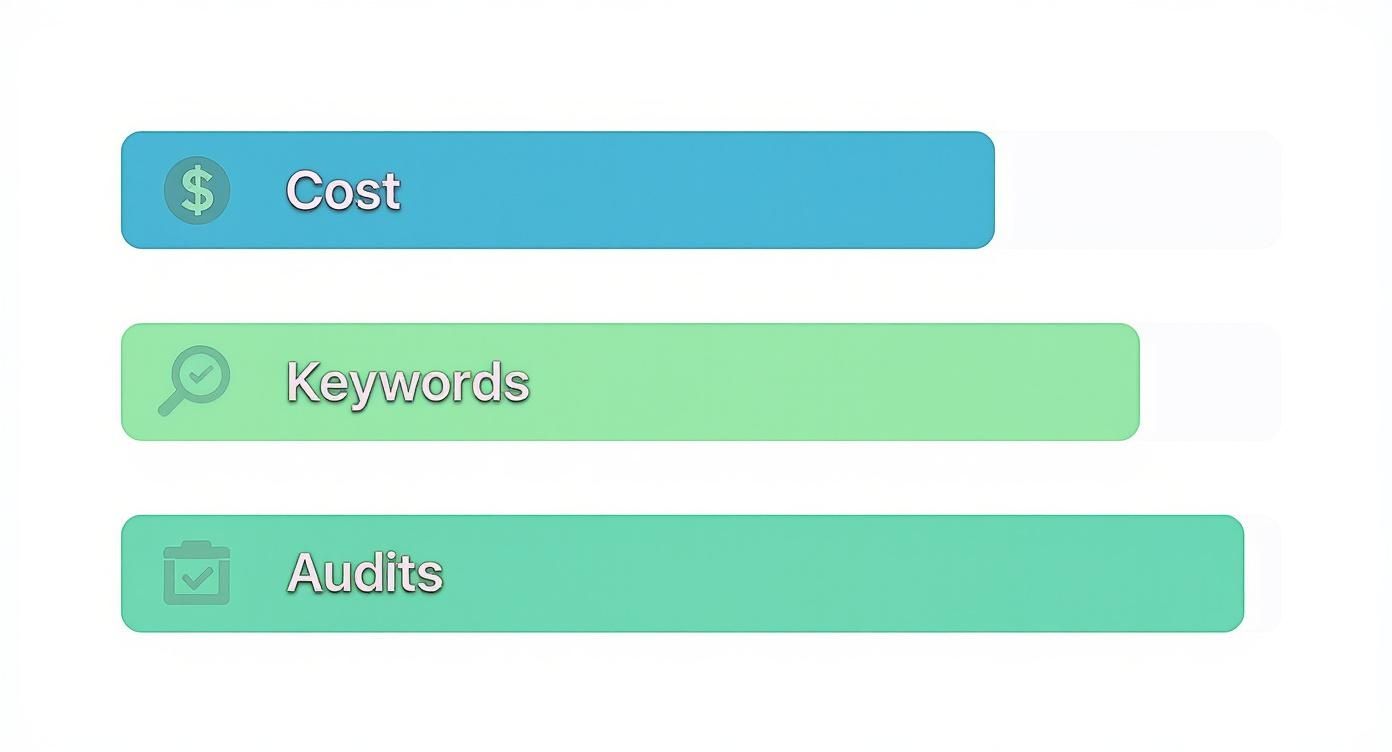
It’s easy to see that while some tools are one-trick ponies, others offer a much more balanced toolkit. That balance is exactly what a versatile consultant needs.
The Small Business Owner
If you’re a small business owner, you’re the CEO, the marketer, and probably the janitor. You need SEO software that's powerful but doesn't require a PhD to operate. Your time is precious, so you need actionable insights, not a wall of data. The goal is simple: get more local traffic, beat your direct competitors, and create content that actually leads to sales—all without breaking the bank.
This is where Mangools truly shines. It’s perfect for the business owner who’s short on time. Its flagship tool, KWFinder, is famous for being incredibly intuitive. You can find profitable, low-competition keywords in minutes, not hours. The whole interface is clean and visual, making complex SEO data dead simple to understand and act on.
- Spot Quick Wins: Use the SERPChecker to quickly size up the authority of the top-ranking pages. This tells you instantly if a keyword is a realistic target or a waste of time.
- Zero Learning Curve: You can genuinely log in and start finding useful information right away. No training manuals required.
- Budget-Friendly: The price is hard to beat. It delivers a massive amount of value without putting a dent in your marketing budget.
The Niche Blogger or Content Creator
For bloggers and content creators, SEO is all about two things: keyword research and content optimization. Your success literally depends on your ability to unearth underserved topics and juicy long-tail keywords that attract a loyal readership. You don’t need a bunch of technical bells and whistles; you need a tool that is an absolute master at finding content opportunities.
Once again, Mangools' KWFinder is a standout. Its keyword difficulty score is one of the most trusted in the industry, especially for smaller sites, because it gives you a realistic shot at ranking. It has an uncanny knack for surfacing those specific long-tail queries that bigger, bulkier tools often miss. This laser focus on the content creation process makes it a blogger's best friend.
Another fantastic option is Ubersuggest. It's a great fit if you want AI to help generate content ideas and outlines as part of your workflow. It connects the dots from keyword discovery to first draft, which can be a huge time-saver. Your choice really boils down to this: do you want the hyper-focused keyword data of KWFinder, or the all-in-one writing assistance of Ubersuggest? Both are excellent, affordable choices for anyone with a content-first strategy.
Making a Smooth Transition from Semrush
Changing your go-to SEO tool can feel daunting, but shifting to a cheaper alternative to Semrush doesn’t have to throw your workflow into chaos. The trick is to treat it like a planned migration, not just flipping a switch overnight. A little prep work ensures you keep your valuable historical data and get the new platform humming in no time.
Before you even think about hitting "cancel" on your Semrush subscription, the first order of business is saving your data. You want to export everything that gives your SEO strategy its long-term context. This gives you a performance baseline and makes sure years of hard-won insights don't just vanish.
Your Pre-Migration Export Checklist
First thing's first: create a dedicated folder on your computer for all your Semrush exports. Trust me, staying organized now will save you a massive headache later when you're importing everything into your new tool.
- Keyword Data: Get a full export of all your keywords from Position Tracking campaigns. Make sure it includes any tags you've used, locations, and all the historical ranking data. This is your performance history.
- Backlink Audits: If you've spent time cleaning up your link profile, export the whole thing. Don't forget to grab any disavow lists you’ve painstakingly created.
- Site Audit Reports: Download the PDF or export the raw data from your latest site audit. This gives you a perfect snapshot of your site's technical health right before you made the switch.
- Organic Research Reports: Pull reports for your top organic keywords and pages. This is your historical traffic data, and you'll want it for before-and-after comparisons.
This isn't just about making backups. It's about building a bridge between the old and the new. These files are the foundation you'll use to set up projects in your new tool, letting you measure future results against a consistent past.
With all your data safely tucked away, you can start exploring your new platform. Most solid alternatives, like SE Ranking, have simple import features. You can usually just upload your keyword CSV files to kick off new rank tracking projects. For site audits, just run a fresh crawl on your domain. While you can't import old audit history, your exported report from Semrush gives you that crucial starting point to measure improvements against.
Common Questions About Semrush Alternatives
Thinking about switching from Semrush to a more affordable option? It's a smart move, but it naturally brings up some big questions. Let's tackle the ones I hear most often so you can feel confident in your choice.
Is the Data from Cheaper Tools Just as Good?
This is the million-dollar question, isn't it? While Semrush has a massive, impressive data infrastructure, top-tier competitors like SE Ranking and Mangools have built their own seriously reliable datasets. For the core jobs—checking keyword volume, tracking your rankings, and spying on competitors—their data is plenty accurate for most businesses.
Where you might see a difference is in historical data. Semrush might be able to pull up data from further back. But for the day-to-day decisions that actually drive your strategy, the accuracy you get from the best alternatives is more than solid. It won't steer you wrong.
Will I Miss Out on Important Features?
Honestly, yes, but that’s often the point. A good Semrush alternative focuses on perfecting the 80% of tasks most of us do every day: keyword research, site audits, and rank tracking. They cut out the fluff.
You might not get the ultra-specific, enterprise-level PPC tools or some of the more obscure features. But the trade-off is you stop paying for a bloated toolkit you never fully use. It's all about matching the tool's core strengths to what you actually need to get done.
Can These Tools Grow With My Business?
Absolutely. This is a huge priority for platforms like SE Ranking, which was built from the ground up for growing agencies and businesses.
Their pricing is designed to be flexible. You can add more users, projects, and keywords without getting hit by the crazy price hikes you see with some of the bigger players. It lets your software budget scale sensibly as your business grows.
Many of these tools are designed for that exact journey, from a small operation to a much larger one, offering the right features at a fair price every step of the way.
Ready to slash your software bill without sacrificing the tools you need to grow? EcomEfficiency bundles over 50 premium SEO, AI, and ad-spy tools, including access to top-tier platforms, for one low monthly price. Stop overpaying and start outranking at https://ecomefficiency.com.