Best AI Tools for Ecommerce to Grow Your Store

Think of the best AI tools for ecommerce as your newest, most efficient team member—one that works 24/7 to help you grow. These aren't just faceless algorithms; they are specialized platforms that create deeply personal shopping journeys, like Rebuy and Octane AI, or act as operational wizards like Gorgias to keep your customer support and inventory humming.
The goal is to scale without dubious shortcuts and without hurting your credibility.
Why AI Is Your New Ecommerce Superpower
AI is no longer some far-off, futuristic concept. For any ecommerce store that wants to compete today, it's an absolute necessity. But don't get bogged down by the technical jargon. Instead, think of AI as your most valuable employee. It’s a master personal shopper, a brilliant data analyst, and a sharp operations manager all rolled into one, working in sync to drive real results.
This guide is all about showing you how the right AI tools are genuinely changing the game for online retail. We won't just list a bunch of features. We’ll dive into the real-world outcomes you can expect from day one—how AI can automate tedious marketing work, find revenue opportunities buried in your data, and craft shopping experiences so personal they build real, lasting loyalty.
Understanding Your AI Team Members
The market for these tools is exploding. The global AI-enabled ecommerce market is currently valued at around $8.65 billion and is on track to hit $22.60 billion by 2032. This isn't just hype; this massive growth shows just how critical these tools have become. You can dig deeper into these market trends and their retail impact to see the full picture.
To make sense of it all, it helps to group these tools into three core functions that directly map to your business goals.
The diagram below breaks down how a cohesive AI strategy can be thought of as three specialized roles working together for your store.
Each branch represents a key area where AI delivers tangible value, from personalizing every step of the customer journey to fine-tuning your backend processes.
Key Takeaway: The real magic of AI in ecommerce isn't about finding one miracle tool. It's about building a small, focused "team" of AI assistants to handle personalization, analytics, and operations. This frees you up to focus on the big-picture strategy that only a human can drive.
To give you a clearer picture of what's out there, here's a quick breakdown of the main categories of AI tools and what they actually do for your business.
Overview of AI Tool Categories for Ecommerce
| AI Tool Category | Primary Function | Key Business Impact |
|---|---|---|
| Personalization Engines | Creates unique, one-to-one shopping experiences. | Increases Average Order Value (AOV) and customer loyalty. |
| Customer Support Bots | Automates responses to common customer inquiries 24/7. | Reduces support costs and improves customer satisfaction. |
| Marketing Automation | Generates and optimizes ad copy, emails, and content. | Drives higher conversion rates and saves significant time. |
| Data & Analytics Tools | Analyzes customer behavior and sales data to find trends. | Uncovers hidden revenue opportunities and informs strategy. |
| Operational & SCM AI | Optimizes inventory, forecasting, and fulfillment. | Prevents stockouts, reduces waste, and improves margins. |
This table serves as a simple map to the AI landscape. As we move through this guide, we'll explore specific tools that excel in each of these areas. We’ll start right at the top of the funnel—attracting new customers—and work our way through creating unforgettable on-site experiences and finally, streamlining the operational backbone of your business.
Attracting New Customers with AI Marketing Tools
Before you can sell anything, you need to get people through your virtual doors. This is the very top of your sales funnel, and it’s where AI marketing tools really shine. Think of them as your in-house strategist, content creator, and media buyer, all rolled into one smart system. They go way beyond simple automation to pull in qualified traffic—the kind of people who are actually likely to buy.
Imagine an AI that doesn’t just write a blog post, but first scans your top competitors, finds the keyword gaps they’ve missed, and then writes the perfect article to fill that void. That's what we're talking about. These tools don't just churn out marketing assets; they build a smart, data-backed path from the first time someone hears about you to the moment they click "add to cart."
Finding Your Audience with AI Content Generation
Content is the engine that drives customer acquisition, and AI has completely changed the game. The best AI tools for e-commerce aren’t just glorified article spinners. They operate more like a complete content strategy team.
These platforms can tackle several key jobs to bring new customers to your site:
- Spotting Keyword Opportunities: AI can analyze the entire web to find underserved keywords and topics your audience is searching for. This gives you a clear roadmap for what content to create next for maximum impact.
- Creating SEO-Optimized Content: Many tools can now generate high-quality blog posts, product descriptions, and landing pages designed to perform well on search engines from day one.
- Refreshing and Optimizing Old Content: An AI can audit your existing content, flag pages with declining traffic, and suggest specific updates to help them climb back up the search rankings.
For example, an AI tool might notice your competitor ranks for "sustainable activewear for runners" but has zero content about "eco-friendly hiking gear." It can then help you create an in-depth guide on that exact topic, opening up a whole new stream of organic traffic. This strategic approach makes sure your content efforts are always pointed directly at growth.
Automating Personalized Outreach at Scale
Once you have traffic coming in, the next challenge is to engage people with communication that feels personal. This is where AI excels. It can make one-to-many outreach feel like a one-to-one conversation, which is critical for building trust and getting people to take action.
Here’s an analogy: a traditional email blast is like a billboard on the highway. Everyone sees the same generic message. An AI-powered campaign, on the other hand, is like a personal shopper texting you about a new jacket they know you'll love based on your past purchases.
AI marketing lets you connect the dots in the customer's journey—from the moment they discover your brand through an AI-optimized article to receiving a perfectly timed, personalized ad. This kind of cohesive experience is what turns casual browsers into loyal fans.
This level of personalization is now possible across all your channels. For instance, AI can build hyper-targeted email campaigns based on a user's browsing behavior, like sending a discount code for a specific pair of shoes they looked at but didn't buy. It can also manage your social media ads, creating different versions for very specific audience segments.
Optimizing Ad Spend for Maximum ROI
Paid ads are often the fastest way to get new customers, but they can also be the fastest way to burn through your budget if you aren't careful. AI advertising tools bring a new level of precision to paid media, making sure every dollar you spend is working as hard as it can.
These platforms analyze campaign performance in real-time, making constant micro-adjustments that a human team just couldn't keep up with. They can automatically shift your budget toward the ads, audiences, and channels that are performing best, maximizing your return on ad spend (ROAS).
Here’s a quick look at how AI gets it done:
- Smarter Audience Targeting: It identifies lookalike audiences and entirely new customer segments by analyzing data from your most valuable existing customers.
- Automated Creative Generation: Some tools can create dozens of ad copy and image variations, then test them to see which combinations resonate best with different audiences.
- Intelligent Bid Management: AI automatically adjusts your bids on platforms like Google Ads and Facebook Ads to ensure you’re paying the ideal price for every click and conversion.
This creates a continuous optimization loop where your campaigns get smarter over time. By letting an AI handle the nitty-gritty details of ad management, you're freed up to focus on the bigger picture: your brand's story and overall strategy. That's the key to finding and attracting the right customers without breaking the bank.
Creating Personalized On-Site Experiences with AI
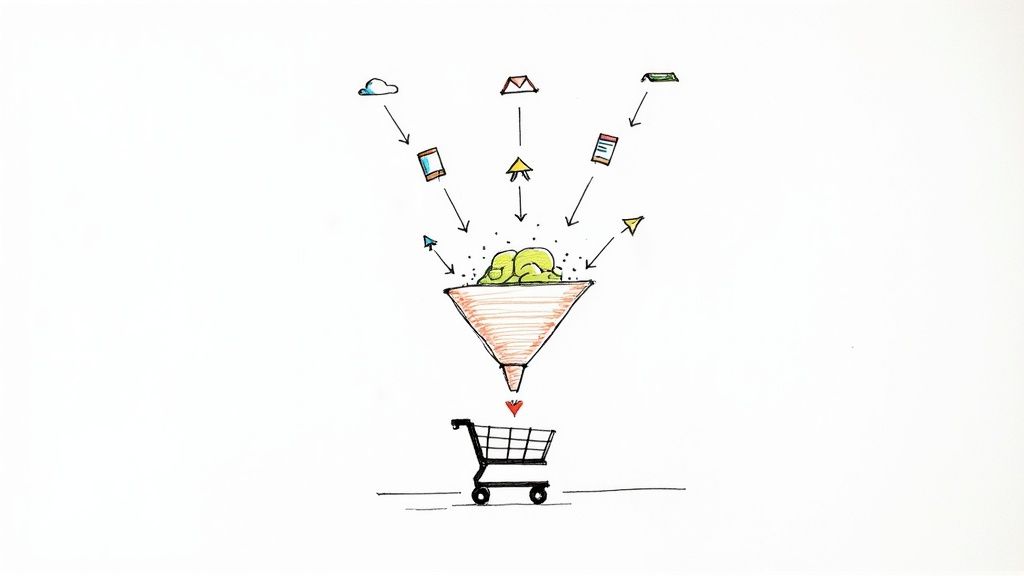
Getting a potential customer to click through to your website is a huge win, but it's only half the battle. The moment they land on your page, the clock starts ticking. This is where AI shifts its focus from grabbing attention to driving action, turning your storefront from a static catalog into a dynamic, responsive space that actively guides visitors toward the checkout.
Think of these on-site AI tools as your digital sales associates. They’re the expert stylists who know just what to recommend, the sharp assistants who can answer any question, and the keen observers who figure out what each customer wants—often before the customer even knows. Their goal is simple: make the shopping experience so smooth and personal that clicking "buy now" feels like the most natural next step.
AI Recommendation Engines: The Digital Stylist
Generic product suggestions are dead. Today’s AI recommendation engines are far more sophisticated, essentially acting as a personal shopper for every single visitor. By analyzing a user's real-time behavior—what they click on, what they add to their cart, and what they scroll past—the AI can surface hyper-relevant suggestions that truly resonate.
This goes way beyond the classic "customers also bought" carousel. The best AI tools can suggest complementary items to complete an outfit, the right accessories for a recently viewed gadget, or even compelling alternatives if a user seems hesitant. Not only does this make for a better, more helpful shopping experience, but it also does wonders for your Average Order Value (AOV).
For instance, if someone adds a pair of running shoes to their cart, a smart AI engine might instantly show a row of moisture-wicking socks, a popular running belt, and high-energy gels. These aren't random upsells; they're items that genuinely enhance the original purchase.
Intelligent Site Search That Understands Intent
A clunky, frustrating search bar is one of the fastest ways to lose a customer. People don't think in rigid keywords anymore; they search the way they talk. An intelligent, AI-powered site search gets this.
Instead of just matching text, these advanced search tools work to understand what the user is actually trying to find. A search for "something warm for a winter hike" won't just pull up products with "warm" in the title. It understands the context and shows insulated jackets, thermal base layers, and wool socks.
By figuring out the why behind a search, not just the what, AI-powered search cuts down on friction and connects shoppers with the right products faster. This one upgrade can have a massive impact on your conversion rates.
Dynamic Pricing and Real-Time Adjustments
Pricing is one of the most powerful levers you can pull in ecommerce, and AI brings a level of agility that was once unimaginable. Dynamic pricing tools crunch multiple data points in real time to land on the perfect price for a product at any given moment.
These factors can include:
- Competitor Pricing: The AI keeps an eye on what your competitors are charging and adjusts your prices to stay in the game.
- Customer Demand: Prices might inch up for hot-ticket items or dip to spark sales during slower periods.
- User Behavior: The tool could offer a small, personalized discount to someone who has viewed an item several times but hasn't committed.
This approach means you're always pricing competitively without leaving money on the table, maximizing both revenue and customer trust.
The Rise of Conversational AI Chatbots
Let's be clear: modern AI chatbots are light-years ahead of the clunky, robotic scripts of the past. Today’s conversational AI is a knowledgeable and genuinely helpful guide, available 24/7 to help customers at any point in their journey.
They can answer detailed product questions, check on an order status, or even help a customer complete their purchase right there in the chat window. This instant support is a game-changer, removing roadblocks that would otherwise lead straight to an abandoned cart. The data backs this up, with 84% of ecommerce businesses calling AI their top priority and seeing AI-powered chat lead to a fourfold increase in conversions. You can dig deeper into how AI is boosting profitability on Shopify's blog.
By weaving these on-site tools together, you create a smart, cohesive shopping experience. From the second a visitor lands on your site, AI is working to understand their needs, guide them to the perfect products, and give them the support they need to become a happy, loyal customer.
Streamlining Operations with AI Automation
A great customer experience doesn’t stop once the credit card is charged. The real work—the stuff that happens behind the scenes—is where you truly build or break brand loyalty. This is where AI shifts from its customer-facing roles and becomes the operational engine for your entire business, smoothing out the messy logistics of modern retail.
Think of operational AI as the expert stage crew for your online store. While your marketing and personalization AIs are the stars of the show, this crew makes sure every prop is in place and every transition is seamless. They handle the less glamorous but absolutely critical tasks that keep your business humming and have a direct impact on customer satisfaction and your bottom line.
Predictive Inventory Management
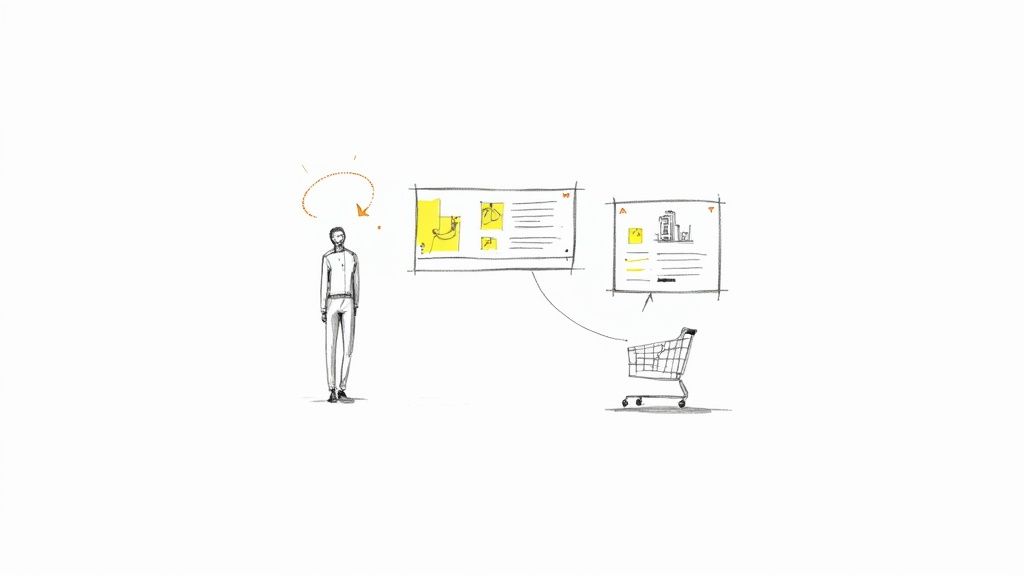
Few things kill customer trust faster than a "sold out" sign on a popular item. AI-powered inventory management helps you get ahead of the curve, shifting from reactive ordering to proactive forecasting. This means you can finally dodge both costly stockouts and the profit-killing problem of overstock.
These systems are like a seasoned stock manager who can practically see into the future. By digging into historical sales data, current market trends, and even outside factors like holidays or seasonal weather, these tools predict future demand with stunning accuracy. You can finally achieve that perfect inventory balance.
For instance, an AI might notice a 15% sales spike for a specific raincoat every time rain is in the forecast and automatically flag it for reorder. This way, you always have exactly what your customers want, right when they want it.
Sophisticated Fraud Detection
As your store grows, so does your exposure to fraudulent transactions. AI-based fraud detection is your digital bouncer, protecting your revenue and your customers without creating a frustrating checkout experience for legitimate buyers. It's a world away from outdated, rule-based systems.
AI algorithms sift through thousands of data points for every single transaction in real-time, catching suspicious patterns a human would never spot. This includes:
- Behavioral Analysis: Is this person clicking and typing like a normal shopper, or a bot?
- Location Consistency: Does the IP address, shipping location, and billing address actually make sense together?
- Purchase History: Is this transaction completely out of character for this customer's account?
This intelligent screening cuts down on chargebacks and fosters a secure shopping environment, which is a massive factor in building customer trust.
Key Insight: The best operational AI doesn't just automate what you're already doing; it anticipates problems before they happen. From predicting a stock shortage to flagging a fraudulent order, AI helps your business become proactive instead of reactive, saving you time, money, and a lot of headaches.
Transforming Customer Support
The post-purchase experience is your golden opportunity to create a customer for life. AI completely overhauls this process by handling routine questions instantly, freeing up your human agents to tackle the complex issues where they can really shine. It’s all about delivering faster, smarter answers.
AI can automate several critical support functions:
- Intelligent Ticket Routing: The system reads an incoming email or chat, understands the problem, and automatically sends the ticket to the right department—billing, returns, or technical support. No more manual sorting.
- Instant Answers: For common questions like "Where is my order?" or "How do I make a return?", an AI can provide an accurate response 24/7, without making the customer wait.
- Sentiment Analysis: These tools can scan customer feedback from surveys, reviews, and support tickets to spot recurring issues or widespread frustration. This gives you a clear signal on what parts of your operation need a tune-up.
By taking the mountain of repetitive queries off your team's plate, these systems empower them to deliver truly exceptional service where it matters most. This is how you turn potential problems into positive experiences that keep customers coming back.
Choosing and Implementing the Right AI Tools
Now that you've got a solid grasp of what AI can do, it's time to map out your plan. Picking the right tools can feel like trying to find a needle in a haystack, but with a clear process, it becomes much more manageable. The goal isn't to bolt on every shiny new AI toy at once; it's to strategically pick solutions that fix your most significant business headaches.
Think of it like a doctor diagnosing a patient—you wouldn't just hand out random prescriptions. You have to identify the symptoms first. In the same way, you can't pick the right AI tool without knowing your store’s biggest pain points. Is your cart abandonment rate through the roof? Are customer support ratings tanking? Are you struggling to get customers to come back for a second purchase?
Zero in on one or two key areas where you're feeling the most pain. This focused approach is the best way to ensure your first move into AI delivers a real, measurable win.
How to Evaluate AI Ecommerce Tools
Once you’ve identified the problem you’re trying to solve, you can start shopping for solutions. But not all AI tools are created equal. The perfect tool for one brand might be a total dud for another. Use these core criteria to cut through the marketing noise and find tools that are genuinely right for your store.
Seamless Integration: How easily does the tool play with your existing setup, like Shopify, BigCommerce, or Magento? A tool that demands a complicated, custom-coded integration will bleed you dry in both time and money. Look for plugins with proven, one-click connections.
Scalability: The tool you pick today needs to keep up with you tomorrow. Can it handle a 10x traffic spike on Black Friday without breaking a sweat? Make sure its performance—and its pricing model—can grow as you do.
Ease of Use: You and your team shouldn't need a Ph.D. in data science to use it. An intuitive dashboard and reports that actually make sense are non-negotiable. The most powerful features in the world are useless if they're too confusing to use.
Pricing and ROI: Get a crystal-clear understanding of the pricing. Is it a flat monthly fee, a pay-as-you-go model, or does it take a cut of the revenue it helps generate? Do a back-of-the-napkin calculation for your potential return on investment to see if the numbers add up.
Platform vs. Point Solution: Which Is Right for You?
One of the first big decisions you'll make is whether to go all-in on a comprehensive AI platform or to pick and choose specialized "point solutions" that do one thing exceptionally well. An all-in-one platform like EcomEfficiency gives you a whole suite of tools under one roof, while a point solution might be a standalone chatbot or a dedicated product recommendation engine.
Each path has its trade-offs. An all-in-one suite simplifies your tech stack and makes sure all your AI tools work together without any fuss. On the other hand, a best-of-breed specialized tool might offer more power and deeper features for that one specific job.
To help you decide, here’s a breakdown of how they stack up.
Choosing Your AI Strategy: Platform vs Point Solution
| Consideration | All-in-One Platform | Best-of-Breed Tool |
|---|---|---|
| Cost | Typically lower overall cost with predictable monthly billing. | Can become expensive as you add multiple specialized tools. |
| Integration | All tools are designed to work together seamlessly out of the box. | May require complex integrations between different vendors. |
| Functionality | Broad range of features covering the entire customer journey. | Deep, highly specialized features for a single business need. |
| Management | One vendor, one invoice, and one support contact to manage. | Multiple vendors, contracts, and support teams to juggle. |
For most small to medium-sized e-commerce businesses, an all-in-one platform usually offers the best mix of power, simplicity, and value. It gives you the freedom to experiment across different AI functions without having to manage a bunch of different subscriptions and vendors.
Launching Your First AI Pilot Project
Going from zero to one hundred with a new technology is a recipe for disaster. The smartest approach is to start with a small, controlled pilot project. This lets you test the waters, measure the actual impact, and learn some crucial lessons without risking your entire operation.
A successful pilot project is your proof of concept. It builds confidence within your team and provides the hard data needed to justify a larger investment in AI technology.
Here's how to run a pilot that sets you up for success:
Define a Clear Goal: What, exactly, are you trying to improve? Don’t be vague. Instead of "improve customer service," aim for something specific like, "reduce average support ticket response time by 25%."
Set Measurable KPIs: Figure out which key performance indicators (KPIs) will tell you if you're winning. This could be anything from conversion rate and average order value to customer satisfaction scores.
Prepare Your Team: Let your team in on the plan. Explain why you're bringing this new tool on board and give them the training they need to feel confident using it. Remember, AI is a tool to empower your people, not replace them.
By starting small and proving the value of the best AI tools for e-commerce, you build a solid foundation for a smarter, more efficient, and more profitable online store.
Looking Ahead at AI in Ecommerce
The AI tools we see in ecommerce right now are incredible, but they're really just the opening act. We're about to see a fundamental shift—moving beyond simply making current processes faster and smarter, toward creating entirely new ways to shop and run a business. This isn't just about automation anymore; it's about building truly intelligent, creative partnerships with AI.
Generative AI is at the forefront of this evolution, quickly turning from a cool new toy into an essential business asset. Picture this: instead of writing one standard product description, an AI whips up a dozen different versions, each perfectly tuned for a specific customer segment. It even creates unique marketing visuals to go with them. This kind of power frees up your creative teams from the daily grind, letting them focus on big-picture strategy and genuine innovation.
The Dawn of Hyper-Personalization
The next frontier for customer experience is genuine one-to-one personalization. We’re heading toward a world where AI designs a unique, evolving shopping journey for every single person who visits your site. Forget the static homepage. An AI will build a version just for you, based on your previous clicks, what it thinks you'll need next, and even external factors like the weather in your city.
And this goes way beyond just showing you a few different products. AI will personalize every single interaction:
- Customized Content: The blog posts, how-to guides, and videos you see will be hand-picked based on your interests and where you are in your buying journey.
- Dynamic Interfaces: The very layout of the website could change on the fly to match how you prefer to browse and shop.
- Proactive Engagement: AI will start anticipating what you need, offering a helpful tip or the right piece of info before you even think to ask for it.
Autonomous Agents and Immersive Shopping
On top of deep personalization, autonomous AI agents are poised to completely change the game for customer service and operations. We're not talking about the simple chatbots of the past. These are sophisticated systems that can handle complex jobs all on their own—from negotiating prices with suppliers to solving tricky customer problems without a human needing to step in.
This isn't some far-off fantasy; it's happening fast. By 2028, it’s predicted that around one-third of online retailers will be using advanced AI agents. That’s a massive leap from less than 1% in the early 2020s. This explosive growth is part of a bigger picture, with 97% of retail companies planning to pour more money into their AI budgets. You can dig into more of the numbers on the future of AI in ecommerce and investment trends.
The future isn't about AI or humans; it's about AI amplifying human capability. The most successful ecommerce brands will be those that learn how to integrate these advanced tools to create experiences that are both incredibly efficient and deeply human.
Finally, the boundary between online and in-store shopping is going to get even blurrier, with AI as the driving force. Think immersive virtual and augmented reality shopping. You won't just browse photos of a new couch; you'll use an AI-powered AR tool on your phone to see exactly how it looks and fits in your own living room.
Getting your business ready for what’s coming means staying curious, flexible, and ready to experiment. The best AI tools aren’t just about fixing today’s headaches—they’re about laying the groundwork for tomorrow’s breakthroughs.
Common Questions About AI in Ecommerce
Getting into AI can feel a bit overwhelming, and it's natural to have questions. Let's tackle some of the most common ones we hear from store owners just like you.
Isn't AI Super Expensive for a Small Shop?
That’s probably the biggest misconception out there. While you can certainly find enterprise-grade AI with a price tag to match, many of the best tools for ecommerce are surprisingly budget-friendly. We're talking plans that often start under $30 per month.
The real question isn't about cost, but about return. When an AI tool can handle your customer service queries or bump up your average order value, it often pays for itself in the first month. Think of it as hiring a hyper-efficient employee for a fraction of the cost.
Do I Need to Be a Coder to Use This Stuff?
Absolutely not. If you can find your way around a Shopify dashboard or launch a Facebook ad, you've got all the technical skills you need. Today’s AI tools are built for business owners, not developers.
They come with clean, intuitive interfaces and simple, no-code setups. You bring the business strategy, and the tool does all the complicated work in the background.
Is AI Going to Replace My Team?
This is a valid concern, but the goal of AI is to augment your team, not replace them. AI is fantastic at the boring, repetitive stuff—the tasks that drain your team's energy, like sorting through endless support tickets or crunching ad performance data.
By taking over the routine work, AI frees up your people to focus on what they do best: building real relationships with customers, thinking up creative marketing campaigns, and solving tricky problems. It’s about making your team more powerful, not smaller.
Essentially, AI handles the grunt work so your talented staff can focus on the high-impact activities that grow your brand and require a human touch.
Ready to slash your software costs and access all the best AI tools in one place? EcomEfficiency bundles 50+ premium platforms like Semrush, Midjourney, and ChatGPT into one simple subscription. Start saving up to 99% on your tool stack today!